On-Chain Transparency: Rebuilding Trust in Asset Management
On-chain settlement lets allocators verify how capital is deployed instead of taking a manager's word for it. What that record can prove, what it cannot, and how to publish it without inviting front-running.


When an allocator wires capital to a manager, they receive in return a promise and a reporting cadence. The promise is that the capital will be deployed as mandated; the cadence — a monthly factsheet, a quarterly statement, an annual audit — is how they check. Between those dates, they are trusting. Every fund fraud of the past two decades exploited that gap: the interval in which the record is whatever the manager says it is.
On-chain settlement closes the gap. When a portfolio transacts on a blockchain, the position is not a number on a statement to be reconciled later — it is a state on a shared ledger, visible the moment it changes and impossible to revise after the fact. This is a narrow claim, and it is worth stating precisely: on-chain transparency does not make a manager skilled or a strategy sound. It makes the record verifiable. That is a smaller thing than the industry's marketing suggests, and a more durable one.
The Trust Deficit Is Structural, Not Behavioural
Traditional asset management runs on periodic disclosure and third-party verification: the manager keeps the books, an administrator strikes the NAV, an auditor signs off once a year. The model is not naive. It is layered with precisely these checks because the underlying records are private and the allocator cannot see them directly.
But every layer is itself a trust assumption. The administrator reconciles against statements the manager provides. The auditor samples; it does not replay every trade. The allocator, at the end of the chain, is trusting a chain of people to have trusted the right things. When the record is private, fraud is not a failure of oversight so much as an exploitation of the interval between disclosures — the window in which positions, fee accruals, and trading activity exist only inside the manager's systems.
This is why transparency has moved from a hygiene factor to a selection criterion. Allocators accustomed to settling securities in seconds and reconciling treasury positions on demand increasingly ask why a fund's holdings should remain a monthly disclosure. The question is no longer whether a manager is honest. It is whether honesty has to be assumed at all.

What the Ledger Actually Replaces
A blockchain is a shared, append-only ledger whose entries are confirmed by the network rather than asserted by one party. Stripped of the surrounding rhetoric, it does one thing of consequence for asset management: it moves the system of record out of the manager's exclusive custody and into a place the allocator can read directly. The shift is from trust me, then verify later to verify now, no permission required.
That single property collapses four familiar reconciliation problems into one inspectable record.
Position visibility becomes continuous, not periodic. The ledger reflects the actual state of the portfolio at the moment it changes. There is no lag between the position a manager holds and the position an allocator can see, because they are reading the same entry. Mandate breaches surface in real time rather than at the next reporting date.
Transaction history becomes permanent. Each trade is a timestamped, confirmed entry that cannot be edited or backdated after settlement. The classic fraud of revising the record to fit a narrative — repainting a bad month, hiding a prohibited position — is not detected after the fact; it is foreclosed.
Fee accrual becomes mechanical. Management and performance fees can be encoded as contract logic that computes and draws against the same ledger everyone audits. Disputes shift from was this fee correct to is this formula correct — a question answerable once, in public, before a single dollar moves.
Performance becomes reconstructable from primary data. Because every cash flow and position change is recorded, an allocator can rebuild returns from the raw entries rather than accepting a manager-supplied figure. Attribution stops being a disclosure and becomes a computation anyone can rerun.
The common thread is that each of these replaces an act of faith with an act of inspection. Nothing here makes the strategy better. It makes the strategy honest about what it did.
The Tension: Transparency That Front-Runs Itself
Here the honest case has to confront its own edge. Full, real-time, public disclosure is not an unalloyed good. A live feed of a fund's positions is also a live feed for predatory traders. Publish that you are accumulating a large position, and the market front-runs the rest of your entry. Publish that you are unwinding under pressure, and others trade ahead of your exits. Treat fund holdings as material non-public information for a reason — making everything public the instant it happens does not abolish that risk, it inverts it, handing the manager's edge to whoever watches the chain most closely. Naive transparency degrades the very returns the allocator is trying to protect.
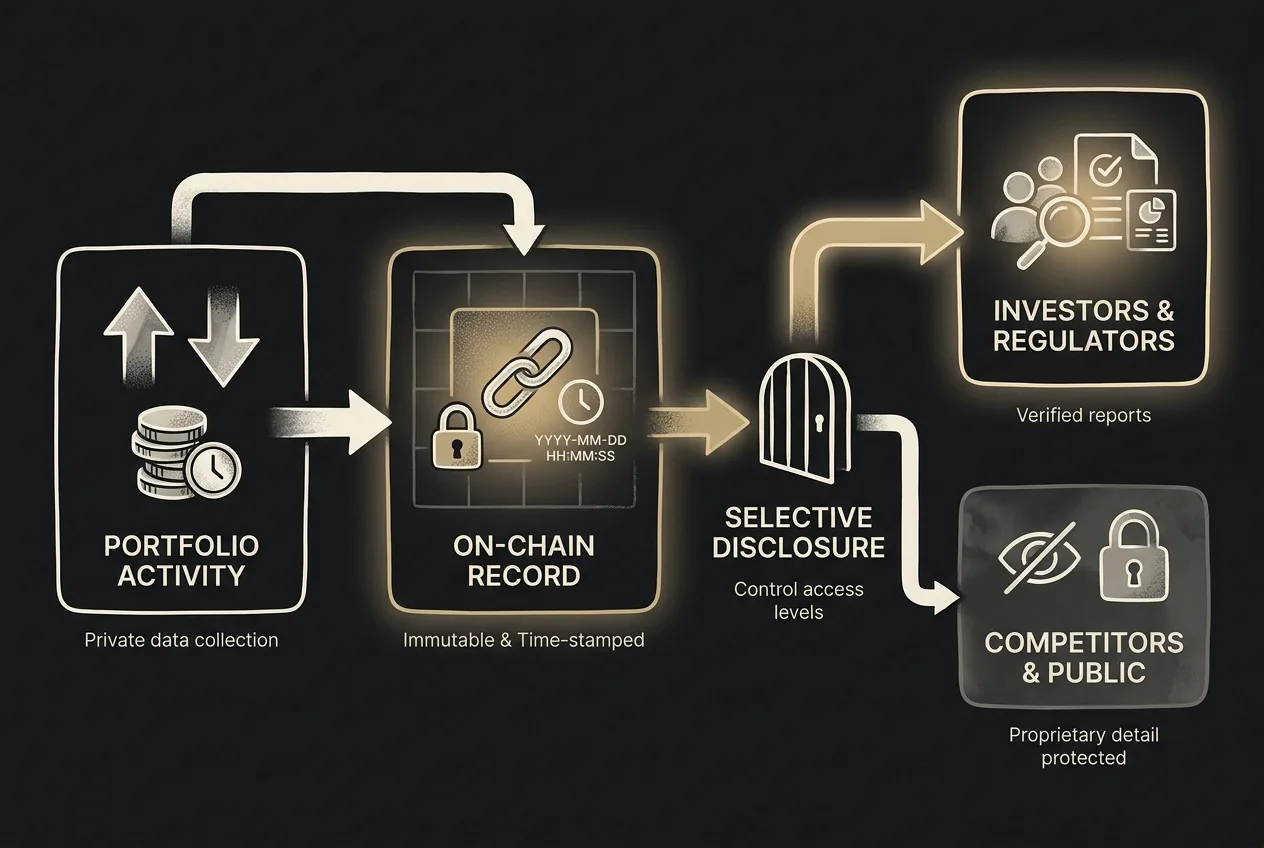
So the design problem is not how much to disclose but to whom, and when. The objective is verifiability for the people entitled to it, without broadcasting actionable intelligence to the people who would trade against the fund. Three patterns do most of the work, and each makes an explicit tradeoff.
Permissioned disclosure. Detailed positions settle on a network readable by investors and regulators but not the public. Allocators get continuous verification; competitors get nothing. The cost is that "verifiable" now depends on who controls read access — a weaker guarantee than an open chain, and one that must be governed deliberately rather than assumed.
Aggregate-and-prove. The fund publishes portfolio-level metrics — exposure, leverage, risk bands — on a public chain, while detailed holdings stay private. Cryptographic proofs attest that the public aggregates faithfully summarise the private positions. The allocator verifies the summary is honest without learning the line items; the tradeoff is that they are trusting the math, not reading the trades.
Delayed reveal. Position-level records are committed immediately but sealed, then opened after a lag long enough that the information is no longer tradeable. Permanence holds from the first moment — the record cannot be altered while sealed — so the eventual reveal proves what was true at execution time, not what is convenient to claim later. The allocator trades immediacy for an audit trail that cannot be retrofitted.
None of these is "more transparent" in the absolute. Each chooses a different point on the curve between what the allocator can verify and what the market can exploit. The work of an institutional platform is to make that choice explicitly, per strategy, and to encode it in the rails rather than leaving it to a disclosure policy that can quietly change.
Where the Rails Already Lead
The regulatory direction reinforces this. The European Union's Markets in Crypto-Assets Regulation (MiCA) and the SEC's developing framework for digital-asset securities both treat on-chain records as something supervisors can read rather than merely receive — moving the regulator, like the allocator, from periodic disclosure toward direct inspection. The operational pieces are following: custodians and prime brokers have built out digital-asset infrastructure, and administrators are learning to fold on-chain state into the NAV process instead of treating it as an exotic exception.
The harder shift is cultural, and it cuts against the industry's instincts. For decades, opacity was a privilege of scale — the better your track record, the less you had to explain. Continuous verification reverses the incentive. It rewards the manager whose record survives inspection and penalises the one who needs the interval to be private. That is uncomfortable for some incumbents and decisive for the allocators choosing between them.
Accountability as Architecture
The trust deficit in asset management is not a messaging problem. It is structural — a consequence of records that live inside the manager and surface only on a schedule the manager sets. On-chain settlement addresses it at the source, not by asking allocators to trust more but by giving them less to take on faith.
At Adaptic, we treat verifiability as an architectural property, not a reporting feature. Where on-chain settlement is appropriate, the system should be built so an allocator can reconstruct how capital was deployed from primary records rather than from a manager's account of them — and so the disclosure tradeoff, the choice of who can see what and when, is encoded in the rails rather than promised in a policy. Humans should govern those rails, with the machinery operating them and leaving a record neither side can quietly revise. That is the narrow, durable claim worth making: not that the strategy is right, but that the question of what it actually did is no longer a matter of trust.