The Tokenized Fund Revolution: Institutional Infrastructure for Digital Assets
How tokenized fund structures move compliance, NAV, and fee logic into the instrument itself — and why the audit trail, eligibility rules, and a named person's sign-off on irreversible acts belong in the rails, not in a spreadsheet beside them.


A fund's most important records are typically the ones held furthest from where the money moves. The investor register lives with a transfer agent. The NAV lives in the administrator's overnight batch. Eligibility lives in a document-management system that no transfer ever consults. Each record is authoritative, and each is reconstructed after the fact by a different party, on a different system, from a different copy of the truth. For an industry that moves trillions of dollars a year, the operational backbone is a reconciliation exercise stretched across days.
Tokenized fund structures change where those records sit. Compliance, pricing, distributions, and the investor lifecycle stop being descriptions of what the fund did and become the rules that govern what the fund can do. The eligibility check is not a file an officer reads; it is a precondition the transfer cannot bypass. The fee calculation is not a quarterly reconstruction; it is a function the contract executes and signs. The audit trail is not assembled from logs after a question is asked; it is the ledger the transaction already wrote to.
This is a narrower claim than the usual rhetoric around tokenization, and a more useful one. Most of what makes a fund operationally fragile is the gap between an action and the record of that action. Close the gap — put the rule, the proof, and the act on the same rails — and a large class of disputes, delays, and reconciliation failures stops being possible. The question for allocators and managers is not whether tokenized structures will mature, but whether their operating model is built to consume records that are generated as a byproduct of the transaction rather than reconstructed alongside it.
From Paper to Programmable: Where the Records Move
Traditional fund structures rely on a web of intermediaries, and the architecture is legible in who holds which record. Transfer agents maintain the investor register. Administrators calculate NAV and process subscriptions and redemptions. Custodians hold the underlying assets. Compliance officers verify eligibility against requirements that vary by jurisdiction, fund type, and investor classification. Each intermediary holds an authoritative copy of part of the truth, and the operational cost of the fund is largely the cost of keeping those copies agreed.
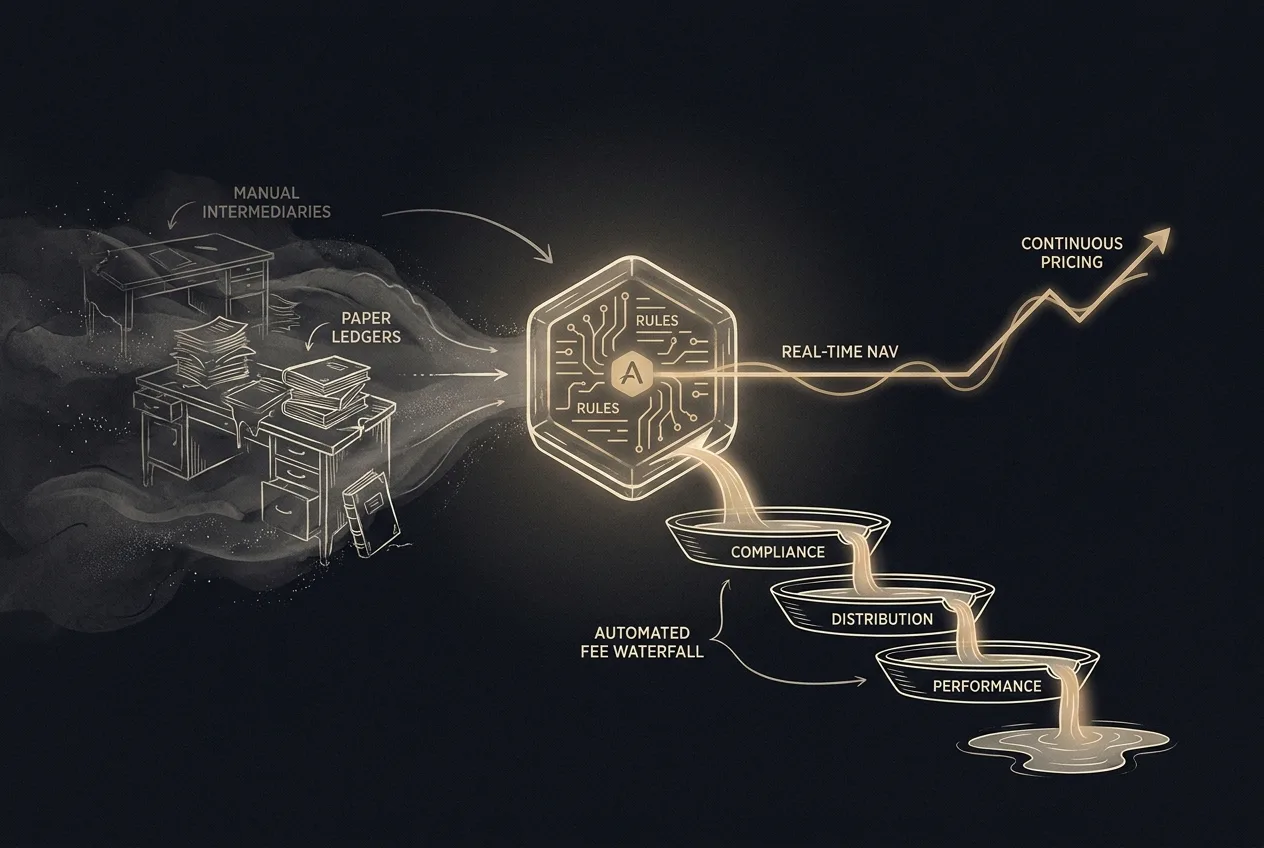
A tokenized fund moves the authoritative copy into a single programmable layer. The share register is the ledger; each token represents a proportional interest. The rules governing who can hold tokens, when transfers are permitted, and how distributions and fee deductions execute are encoded in the instrument itself rather than enforced beside it. The same system that records what happened is the system that decided whether it was allowed to.
Tokenization does not delete the intermediaries. It changes their job from processing each transaction to governing the policy the transactions run under — and from reconstructing the audit trail after a question is asked to verifying one the rails already produced.
That shift is the substance, and it has a precise boundary. Institutional operations require human judgment over irreversible acts: a NAV strike, a wire, a redemption release. They do not require a human in the path of every routine transfer. A well-designed tokenized fund automates the predictable and routes the consequential to a named human — points the rest of this article returns to, because the boundary between the two is where the design earns its keep.
Policy as Code: Eligibility Enforced in the Instrument
Investor eligibility is one of the most operationally burdensome parts of fund management, and the burden is structural rather than incidental. Eligibility criteria — accredited-investor status, qualified-purchaser thresholds, residency restrictions, sanctions screening, beneficial-ownership verification, tax documentation — are checked at onboarding and periodically thereafter, then filed in a document system that the trading and settlement infrastructure never reads. The rule and the act that the rule governs live on different systems. Nothing structurally prevents a transfer to an investor whose qualification lapsed last month; the only safeguard is that someone reviews the file before the next periodic cycle.
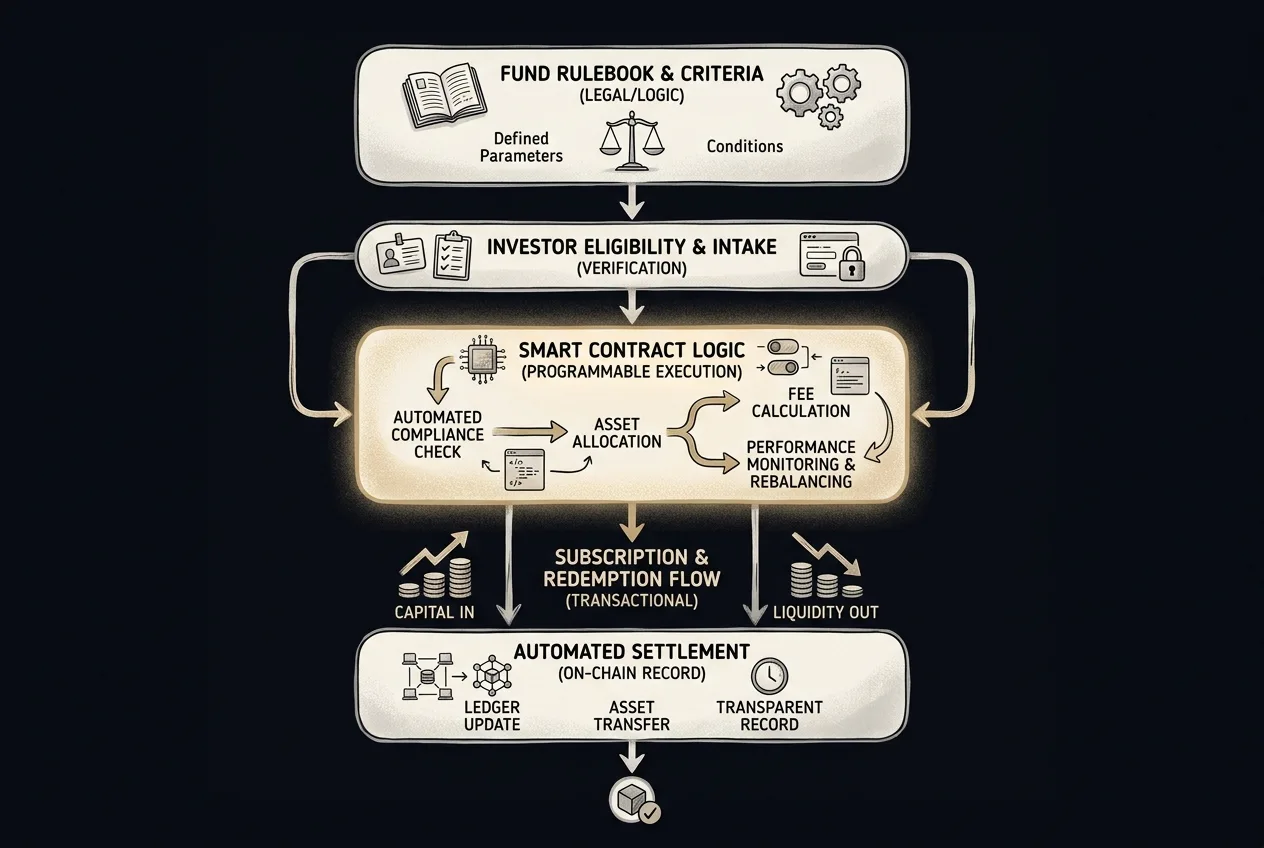
Tokenized funds close that gap by making eligibility a property of the instrument rather than a document beside it. The transfer restriction is part of the token's transfer function: before any token is issued, transferred, or redeemed, the contract evaluates whether both parties satisfy the fund's requirements, and a transfer that fails simply does not execute. The check draws on attestations issued by regulated identity providers — typically verifiable credentials bound to the investor's on-chain address — so the policy is enforced at the moment of action, against an ineligible counterparty, by the same code that would have moved the tokens. Policy-as-code is not a faster review. It is the removal of the window in which an unauthorized transfer was possible.
The Mechanics of Programmable Compliance
The architecture typically operates across three layers:
Identity and attestation layer. Regulated KYC/AML providers issue verifiable credentials confirming an investor's identity, accreditation status, jurisdiction, and tax classification. The credentials are cryptographically signed and verifiable on-chain without exposing the underlying personal data, which keeps the eligibility decision auditable while leaving the sensitive records off the ledger. Standards such as ERC-3643 and the T-REX protocol have established patterns for this approach that are seeing meaningful institutional adoption.
Transfer restriction layer. The contract maintains transfer rules that reference the attestation layer, and a transfer executes only if both parties hold valid, unexpired credentials satisfying every applicable requirement. Rules compose to handle multi-jurisdictional structures — a fund accepting qualified purchasers in the United States, professional investors in the EU, and accredited investors in Singapore, each under different documentation regimes — without that complexity migrating into a human checklist. The eligibility matrix lives in one place, versioned and inspectable, rather than in the working memory of a compliance team.
Ongoing monitoring layer. Credentials carry expiry dates and can be revoked. When an accreditation lapses or a sanctions list updates, the system restricts further transactions involving the affected tokens until the position is resolved, rather than waiting for the next periodic review to surface the change. The honest framing is that this narrows the detection window to the freshness of the underlying attestation feeds — it does not eliminate it, and a credential that is stale at the source is stale on-chain. The dependency moves from review cadence to data quality, which is a better dependency to have but not an absent one.

Real-Time NAV: Moving Beyond End-of-Day Pricing
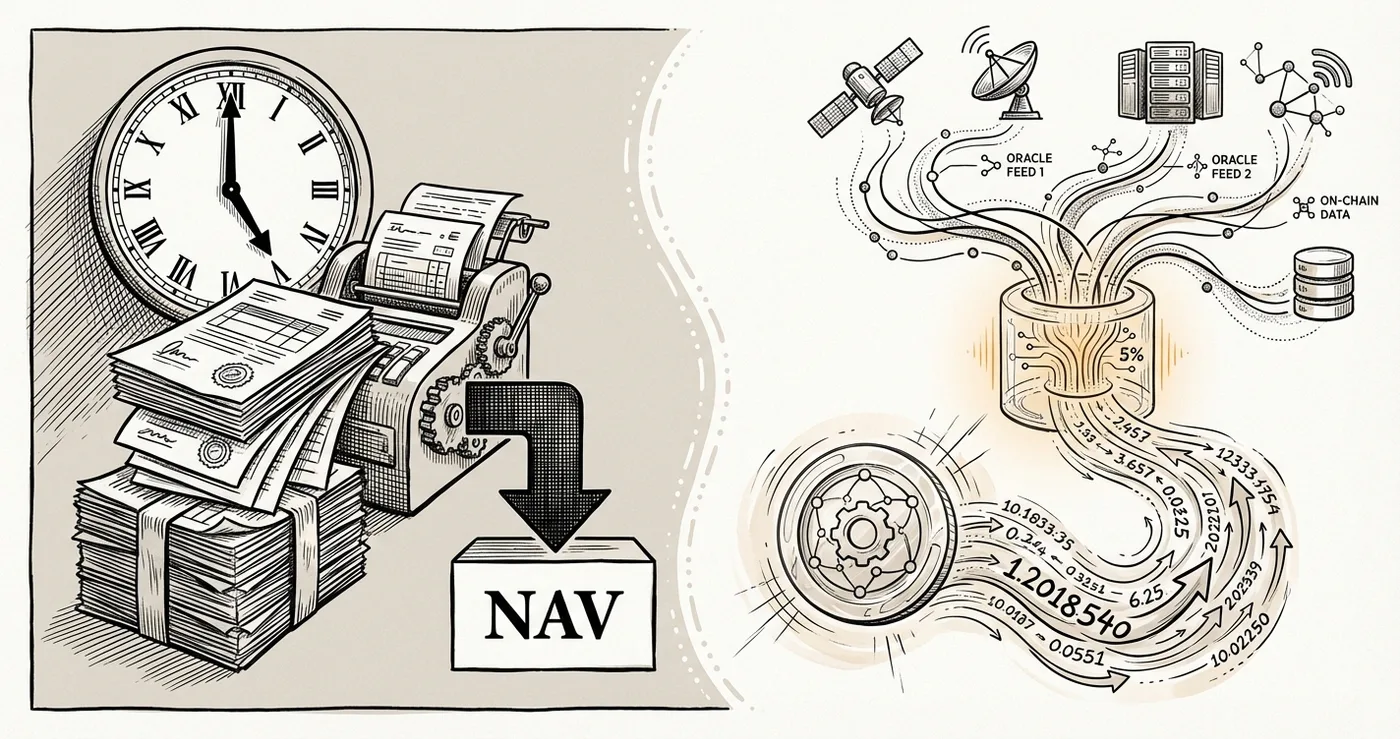
Net asset value calculation is the heartbeat of any fund. In traditional structures, NAV is typically computed once per day, after markets close, by the fund administrator. The process involves collecting closing prices for all portfolio holdings, applying valuation methodologies for illiquid positions, deducting accrued fees and expenses, and dividing the result by the number of outstanding shares. The final NAV is usually available several hours after the calculation begins, and in some cases not until the following morning.
This latency creates real problems. Investors submit subscription or redemption requests without knowing the price at which they will transact. Large redemptions can hand a timing advantage to investors who act before a NAV decline reaches published figures. And the opacity of the calculation itself — a number arriving without the inputs that produced it — has been a durable source of tension between managers and their investors.
Tokenized fund structures change what is computable continuously and what must remain deliberate. When portfolio holdings are represented on-chain or priced through reliable oracle networks, an indicative NAV can update as the underlying value moves, giving investors live visibility into their position. But "the NAV updates continuously" and "the NAV is struck" are different claims, and conflating them is where most real-time-NAV pitches overreach. The struck NAV — the one that prices a subscription or redemption and becomes a record the fund stands behind — is an irreversible economic act. It should remain a draft until a named human releases it. Continuous computation feeds the decision; it does not make the decision. The contract can stage the strike, attach the oracle inputs and the valuation policy that produced it, and hold it pending release, so that the human is approving a fully-formed, fully-evidenced figure rather than re-deriving one. What becomes faster is the assembly of the number and the audit trail behind it. What stays human is the act of standing behind it.
Practical Considerations for Real-Time NAV
The transition to real-time NAV is not without complexity. Several challenges must be addressed:
Oracle reliability. Continuous NAV is only as trustworthy as the price feeds beneath it, and the feed is now an attack surface as much as a convenience. For liquid, exchange-traded assets, oracle networks are credible and maturing. For private credit, real estate, or venture positions, continuous pricing is genuinely hard and often dishonest to attempt; the defensible pattern is hybrid — automated feeds for the liquid sleeve, periodic governed valuations for the illiquid one — with the NAV explicit about which inputs are live and which are carried. A real-time NAV that silently interpolates an illiquid mark is less trustworthy than an honest daily one.
Valuation methodology governance. Continuous pricing does not retire valuation policy; it raises the stakes on it. Stale prices, cross-time-zone assets, and the handoff between automated and manual inputs all need defined treatment, and each of those decisions should leave a record on the same rails as the NAV it shaped. This is the audit-in-the-rails principle applied to pricing: the figure and the policy that justifies it travel together, so a later question about why a mark was carried or overridden is answered by inspecting the record rather than reconstructing intent.
Subscription and redemption mechanics. A known price changes investor behaviour, and not only for the better. Subscribing or redeeming at or near a live NAV removes the blind-order problem but opens a front-running and arbitrage surface against the fund, particularly around oracle update boundaries. Mitigations — short pricing windows, anti-sandwiching controls, human-released strikes for size above a threshold — are design obligations, not afterthoughts, and a serious implementation states which it relies on.
The direction of travel is toward more transparency, but transparency is a property of governance, not of latency. Real-time NAV is an improvement when the speed is matched by an audit trail and a human gate on the irreversible strike; without those, it is faster opacity. The honest version is the one worth building.
Automated Fee Crystallisation and Waterfall Distributions
Fee structures in institutional funds are notoriously complex. Management fees, performance fees with high-water marks, hurdle rates, catch-up provisions, and multi-tier waterfall distributions create computational challenges that are typically handled by fund administrators using a combination of proprietary software and manual verification.
The opacity of these calculations has been a persistent source of friction, and the friction has a single root: the investor cannot see the computation, only its result. Discrepancies between calculated and expected fees can take weeks to resolve precisely because resolving them means two parties re-deriving the same number from two private spreadsheets. The batch nature of traditional crystallisation compounds this, deducting fees quarterly against a high-water mark whose history the investor must take on trust, so the timing of fee recognition drifts from the economic reality it is meant to reflect.
Encoding Fee Logic in Smart Contracts
Tokenized funds encode fee logic in the instrument. Management fees accrue continuously and are reflected in NAV as they accrue. Performance fees crystallise when their defined conditions are met — at a set frequency, on redemption, or at period end — against a high-water mark the contract itself maintains and timestamps, so the history that the investor previously had to trust is now the history the contract can show.
Waterfall distributions follow the same pattern. The priority of payments, the threshold that activates each tier, and the mechanics of distribution are defined once and executed deterministically; when distributable proceeds arrive, the contract runs the waterfall and writes a complete record of each calculation to the same ledger that moves the funds. The computation and its proof are the same artifact. Where the irreversible step is the cash leaving — a distribution wire, a redemption payout — that step stays a draft until a named human releases it, with the full waterfall calculation attached for review. Determinism makes the number checkable; the human gate keeps the payout accountable.
Encoding fee logic in the instrument is not primarily a cost saving. It collapses a category of disputes by replacing two private computations with one shared, inspectable one — the manager and the investor reason over the same execution record rather than over competing reconstructions of it.
This is the proof-not-promotion posture made concrete. The manager does not ask investors to trust that fees were computed correctly; the manager points to the logic and the execution history and lets them verify. The adversarial reflex that fee discussions tend to provoke gives way to a shared reference both parties can interrogate. The tradeoff is that the logic must be right before it ships — a bug in a fee contract is a bug in the fund's economics — which moves the diligence burden onto contract review and formal testing, where it belongs, rather than onto quarterly dispute resolution.

Cross-Border Regulatory Challenges
Tokenized funds inherit a regulatory framework written for a different transfer mechanism. Securities laws, fund regulations, and tax treaties assume that fund interests move through intermediary chains with clear jurisdictional boundaries and an identifiable party to hold accountable at each hop. The token's transfer model does not match that assumption, and most cross-border friction in tokenized funds traces back to the mismatch rather than to hostility from any single regulator.
The specific problem is that a token's mobility outruns the jurisdictional model around it. A fund token issued under Cayman Islands law can sit in a wallet controlled from Singapore, transfer to a counterparty in Switzerland, and redeem through a contract executing on a network with no fixed location — and policy-as-code in the instrument is precisely the tool that re-imposes the boundaries the token would otherwise dissolve. The transfer-restriction layer is where jurisdiction is re-asserted: the rule that this token may only be held by an eligible holder in a permitted jurisdiction is the on-chain stand-in for the intermediary that traditional law assumed. The open question is whether that on-chain enforcement is recognised as sufficient by each regulator whose investors the fund admits.
Emerging Regulatory Frameworks
Several jurisdictions have made meaningful progress in developing regulatory frameworks that accommodate tokenized fund structures:
DIFC Innovation Testing License. The Dubai International Financial Centre has established an innovation testing regime that allows fund managers to operate tokenized fund structures within a regulated sandbox. The programme provides a pathway from experimentation to full licensing, with graduated requirements that increase as the fund's assets under management grow. This approach has attracted significant interest from institutional fund managers seeking a jurisdiction that is both crypto-forward and financially sophisticated.
Luxembourg and Ireland. Both jurisdictions, which together domicile a significant proportion of global fund assets, have taken steps to accommodate tokenized fund interests within their existing regulatory frameworks. Luxembourg's blockchain laws and Ireland's regulatory guidance on distributed ledger technology provide a basis for tokenized fund operations within established fund structures.
Singapore MAS framework. The Monetary Authority of Singapore has been among the most proactive regulators in developing guidance for tokenized securities, including fund interests. The Variable Capital Company structure, combined with MAS's regulatory sandbox, provides a viable framework for institutional tokenized fund operations.
The challenge is harmonisation. A tokenized fund that operates across multiple jurisdictions must satisfy the requirements of each, and the lack of mutual recognition between regulatory frameworks creates compliance burdens that partially offset the efficiency gains of tokenization.
Custody and Settlement: The Irreversibility Problem
Custody is the most consequential part of tokenized fund operations because it is where the technology's defining property — irreversibility — is least forgiving. A mistaken wire in the traditional system can often be recalled; a transfer of bearer-like tokens to the wrong address, or a signing key compromised, generally cannot. Institutional investors and their regulators therefore require assurance not only that assets are held securely but that access is gated and recovery is possible when a key is lost or an operator errs.
The custody landscape has matured to meet much of this. Qualified custodians offer institutional-grade solutions with multi-party computation for key management, hardware security modules, geographically distributed signing authority, and insurance. These satisfy the custody requirements of most frameworks, with gaps remaining in some jurisdictions — and the residual risk is operational rather than cryptographic. The unglamorous discipline of who can authorise a movement, under what quorum, and through which named-human release is where custody actually succeeds or fails. This is the same gating principle that governs the NAV strike and the distribution wire, applied to the keys themselves: the irreversible act waits on an authorised human, and the authorisation is itself a record.
Settlement is where the gains are most immediate and most often overstated. Traditional subscriptions and redemptions run on T+1 to T+5 cycles; tokenized interests can settle atomically, with payment and token issuance bound into a single indivisible transaction, removing the principal risk that one leg settles and the other does not. That is a genuine reduction in settlement risk and capital tied up against it. The tradeoff to state plainly is that atomic settlement compresses the window in which an error can be caught. A T+2 cycle contains a reconciliation step; an atomic swap does not. The protection has to move upstream — into the pre-authorisation checks and the human gate that run before the irreversible transaction is signed — because there is no clean unwind afterward. Faster settlement is an argument for stronger pre-trade governance, not a substitute for it.
Interoperability and the Path to Standard Infrastructure
Most of the value in tokenized fund infrastructure is latent until the tokens can move. A fund interest confined to one wallet, one venue, and one custodian is a more expensive version of a traditional structure with fewer parties to call when something breaks. The advantages compound only when fund tokens can move across compatible platforms, serve as collateral, and sit inside portfolio systems alongside traditional holdings — and crucially, when they carry their eligibility and audit properties with them rather than shedding them at each boundary. A token whose transfer restrictions are honoured on its home platform but ignored once it moves has exported a compliance gap, not achieved interoperability.
Standards are forming around exactly this requirement. ERC-3643, the Token Taxonomy Framework, and several consortium efforts are converging on common vocabularies for issuance, transfer, corporate actions, and redemption — the lifecycle events where the eligibility and audit guarantees either survive a cross-platform hop or are lost at it. The substance of interoperability here is not that tokens move; it is that the policy embedded in the instrument moves with them.
The constraint is adoption, and it is real. A standard matters only where it is implemented, and the field is still fragmented across platforms, chains, and stacks. Convergence is happening through the practical need to transact across venues rather than through any top-down mandate, which makes it durable but slow. An allocator underwriting a tokenized fund today should treat cross-platform portability as a claim to verify, not a property to assume.
The Endpoint Is Not Autonomy — It Is Governed Automation
The advocate's endpoint is the fully autonomous fund: capital raising, deployment, risk management, rebalancing, fee crystallisation, compliance, and reporting all running through smart contracts with no human in the loop. It is a tidy vision, and it is the wrong target for institutional capital.
The reason is structural, not a matter of how mature the technology becomes. A fund holds fiduciary obligations, and a fiduciary duty is owed by a person, not delegated to a contract. The right endpoint is not the removal of the human but the precise placement of the human: automate everything predictable, route everything irreversible to a named, accountable human, and make both the automation and the release leave a record. A NAV strike, a redemption release, a distribution wire, a fee crystallisation that moves cash — each stays a draft until a named human releases it, and each release is itself logged. Everything between those gates can and should be programmatic. The art is in drawing the line, and the line is irreversibility.
Framed that way, the remaining dependencies are clear and finite: better oracles, hardened contracts, regulatory recognition of on-chain enforcement, and investor comfort with automation they can audit. Each component that moves from manual reconstruction to governed automation lowers cost and raises transparency — not because a human was removed, but because the record and the act were finally put on the same rails. The institutions building this now are setting the operational standard for how the next generation of funds is run, and the durable advantage will accrue to those who automate aggressively and gate the irreversible deliberately, rather than to those who automate everything and gate nothing.
An operating system for AI-managed capital should run the fund's on-chain and off-chain rails as one system rather than two integrations bolted together. The eligibility policy that governs an on-chain transfer should be the same policy that governs an off-chain subscription; the audit trail should span both; the human gate on a NAV strike or a wire should be the same gate whether the cash moves through a custodian or a contract. Programmable eligibility, governed NAV, deterministic fee logic, and cross-platform portability are not separate products in that model — they are properties of putting the rule, the proof, and the irreversible act on the same rails, with a named human in front of anything the fund cannot take back. The work is to make that posture available to eligible investors without asking them to choose between the speed of automation and the accountability their mandates require. The tokenized fund structures described here are not a break from how institutional capital is governed. They are a way to enforce that governance in the instrument rather than in the spreadsheet beside it.