Tokenization at Scale: What Institutional Digital-Asset Operations Require
Tokenization at scale is not a throughput problem. It is an operating-requirements problem: putting the audit trail in the rails, putting irreversible transfers and NAV behind a named person's sign-off, and checking eligibility against written rules inside the instrument — across on-chain and off-chain rails at once.


A pilot tokenizes one fund interest, moves it between two whitelisted wallets, and prints a clean demo. Scale tokenizes thousands of positions across jurisdictions, redeems them under deadline, marks NAV that investors trade against, and survives an audit two years later when nobody remembers the transaction. The difference is not transactions per second. It is operating requirements — the rules, records, and human authority that have to hold every time, not just in the demo.
Institutional capital already holds tokenized assets in meaningful size; that question is settled. The open one is whether the operating model around them is institutional, or merely a faster way to make the same irreversible mistakes. What follows is what scale actually requires, and why those requirements are properties of the system rather than items on a checklist.
The Requirement Is Operating Discipline, Not Throughput
Tokenization converts rights to an asset into a token on a distributed ledger. The conversion is the easy part. The hard part is that on-chain settlement is irreversible and bearer in nature: whoever controls the key controls the asset, and a confirmed transfer cannot be recalled by appeal to any authority. That single property turns every operational shortcut traditional finance quietly tolerates — a misdirected wire reversed by phone, a NAV correction filed the next morning, an eligibility check done after the fact — into a permanent loss.
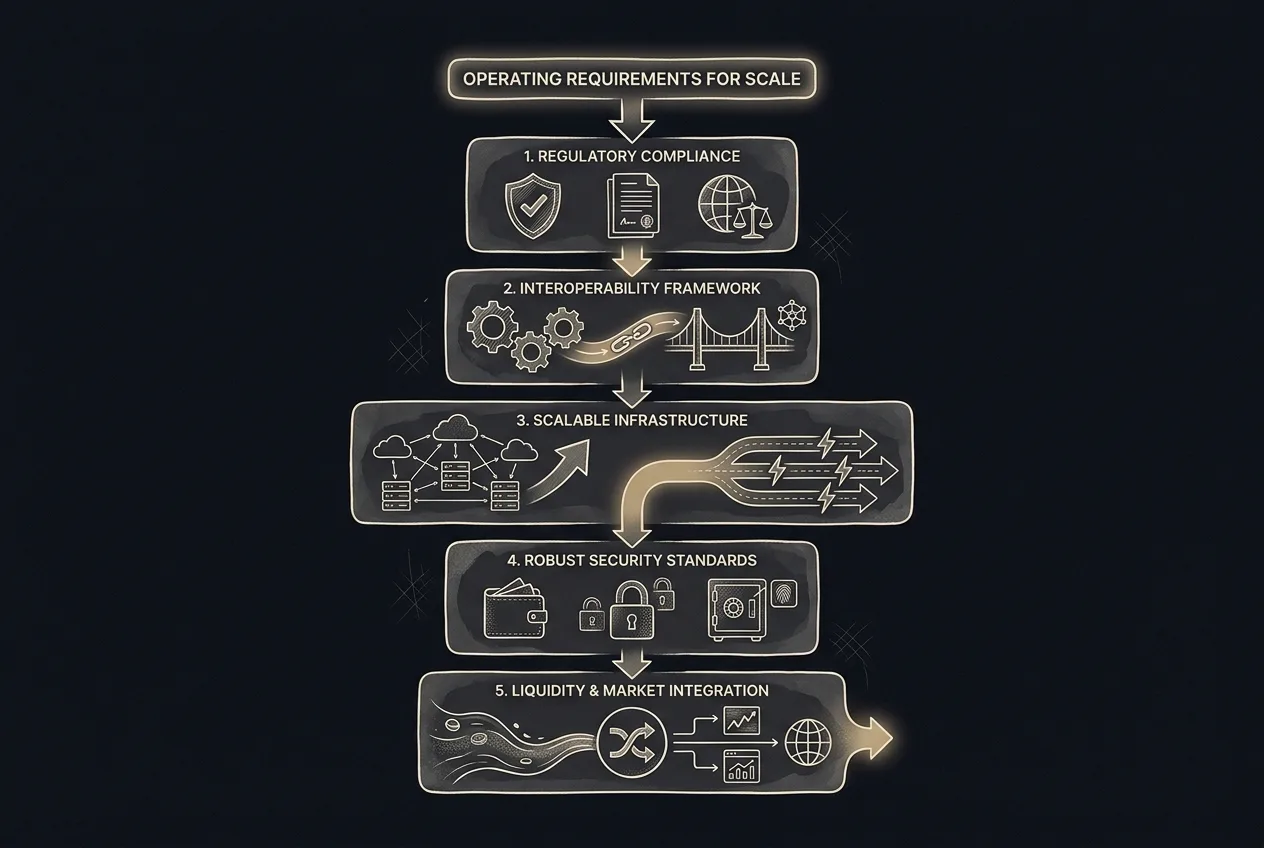
The institutional requirements at scale are therefore not exotic. They are the ordinary disciplines of fund operations, made non-negotiable because the rails no longer forgive. Three bind hardest.
Eligibility and compliance belong in the instrument, not beside it. A tokenized security issued in Singapore may have investors in Switzerland and an underlying asset in the United States, each jurisdiction imposing its own rules for investor verification, transfer restrictions, and beneficial-ownership reporting. The naive design enforces these in an off-chain team that reviews transfers after they request to settle. The scalable design encodes them as policy-as-code in the token's transfer logic, so an ineligible transfer cannot confirm in the first place. The check moves from a person who can be overwhelmed to a rule that holds at any volume.
Irreversible acts must be gated on a named human. Multi-signature schemes, hardware security modules, and distributed signing authority are necessary, but they are mechanics, not governance. The governance requirement is that every irreversible movement of capital — a redemption, a custody withdrawal, the publication of a NAV investors will price against — resolves to a specific, attributable human authorisation, recorded before the act rather than reconstructed after it. Automation can prepare and propose; a named party authorises what cannot be undone.
The audit trail belongs in the rails. Reconstructing who authorised what, against which policy, from logs scattered across a ledger, a custody console, and an administrator's spreadsheet is where institutional operations fail under examination. At scale the audit spine must be a first-class part of the system: every transfer, eligibility decision, and valuation emits an attributable, time-ordered record as a byproduct of the operation itself. Auditability designed in is cheap; auditability bolted on is a forensic project.
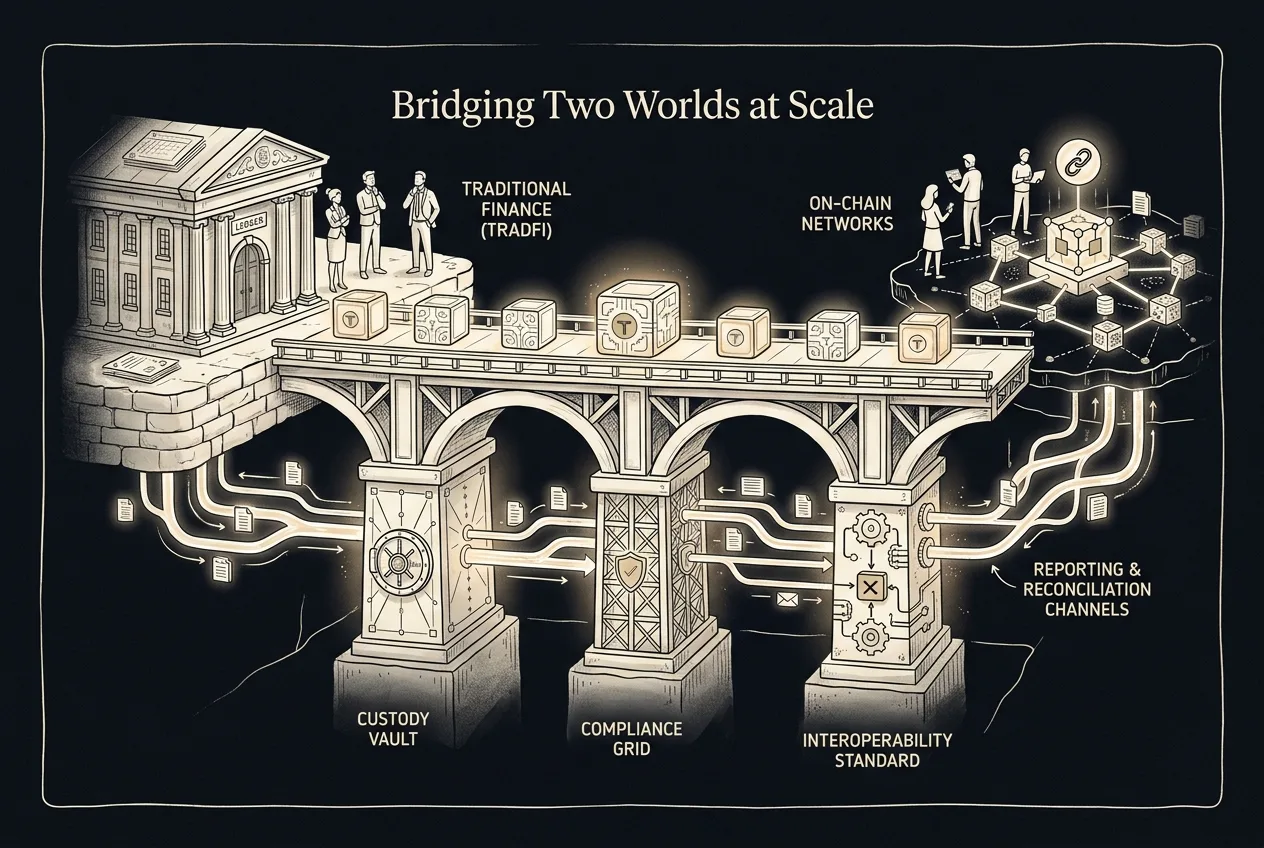
One Operating System Across On-Chain and Off-Chain Rails
No institution operates exclusively in tokenized assets. A real portfolio holds tokenized fund interests next to listed equities, bank cash, derivatives, and private positions — settling across ledgers, depositories, and wire networks that share no common clock or record. The binding scalability constraint is not how fast any one rail confirms, but whether a single operating model spans all of them, so that position, valuation, and authority stay consistent no matter which rail an asset lives on.
The failure mode is parallel systems. A tokenized book run on its own stack beside the traditional book means two registers of who owns what, two valuation processes, two audit trails, and a reconciliation function to paper over the seam between them. That seam is where errors hide and where the promised efficiency quietly leaks back out. Reconciliation is not a feature; it is the tax a firm pays for building two systems where it needed one.
The discipline that resolves this treats on-chain state as one more rail under a unified control layer, not a separate world. Valuation, eligibility, and the audit spine are defined once and applied to every position: the same NAV logic prices the tokenized interest and the listed equity, the same policy engine clears a token transfer and a wire, the same record captures both. Shared token standards matter — interoperable rails are worth more than proprietary ones — but they are an external dividend the industry earns slowly. The internal requirement, available to a firm today, is to stop running the on-chain book as an exception.
Scale Comes From Better Policy, Not More Headcount
The tell of an operation built for scale is what happens when volume rises. A program that meets each new requirement by adding reviewers, reconcilers, and exception-handlers has not scaled its operating model; it has scaled its payroll, and it pays linearly for every increment of growth. A program built on the disciplines above absorbs the same growth by tightening policy, because the policy — not a person — enforces the rule on each transaction.
This is also why the policy layer must be governed as the firm's most critical infrastructure rather than as code shipped once. Moving enforcement from a fallible team into on-chain logic is the point — but code at scale fails in ways a launch-day audit does not catch. Dependencies shift, edge cases surface only under volume, and an exploit in transfer logic is itself an irreversible movement of capital. The layer that decides who may move what needs continuous monitoring, a disclosed path for reporting vulnerabilities, and upgrade mechanisms gated by the same named-human authority as the transfers it governs — not a single anonymous key.
Proof, Not Promotion
The tokenization thesis is sound where the rails are clearly better: programmable instruments, atomic settlement, fractional ownership, and provenance traditional infrastructure cannot match. Near-term scale will concentrate where that advantage is unambiguous and the regulatory frame is settled — real estate, private credit, and fund interests — while public securities wait on market-structure questions code does not resolve.
What separates the firms that will operate at scale from those that will only demo at scale is whether they can prove their controls hold rather than assert it. The decisive evidence is pre-authorization: a record, written before each irreversible act, naming who authorised it and against which policy — not a reconstruction assembled after an incident to explain what went wrong. An operation that can answer "who could have moved this, under what rule, and where is the record" for any token in its book, on demand and across every rail it touches, has built for scale. One that produces that answer only by mobilising a team to comb through logs has not, whatever volume it processes today.
That is the discipline tokenization at scale requires: the audit trail in the rails, irreversible transfers and NAV gated on a named human, eligibility enforced as policy inside the instrument, and one operating model across on-chain and off-chain assets alike. Tokenizing an asset is no longer the hard part. The operating system to be trusted with it at scale is the work that remains — and the only part that compounds.