Institutional Digital Asset Custody: Architecture for a Trustless World
Multi-signature, MPC, and tiered storage are the mechanics of digital asset custody. The institutional substance is governance: written rules checked before every transfer, a named person signing each irreversible one, and an audit trail that makes accountability part of the architecture rather than a report.


When an institutional allocator commits capital to a digital asset strategy, the first question is rarely about alpha. It is about custody. Where are the assets held? Who controls the keys? Who can move them, under what authority, and what record survives the act? These are not hypothetical concerns. The history of digital assets is littered with billions of dollars lost to custodial failures: exchange collapses, commingled client funds, and single-point-of-failure key management that wiped out entire portfolios in a single confirmed block.
For traditional asset classes, custody is a comparatively solved problem. Securities are held in omnibus accounts at regulated depositories. Cash sits in segregated accounts at licensed banks. The legal and operational frameworks are mature, tested through decades of practice and crisis, and crucially reversible: a misdirected wire can be recalled, a trade can be busted, a custodian's records can be corrected by appeal to a central authority. Digital assets offer no such comfort. The bearer nature of cryptographic keys means that possession is ownership, and the irreversibility of an on-chain transfer means that an error, once confirmed, is permanent.
That permanence is the entire problem, and it reframes custody from a storage question into a governance one. The word "trustless" describes the settlement layer, not the operation that sits on top of it. A blockchain removes the need to trust an intermediary to honour a transfer; it does nothing to decide whether the transfer should have happened, who authorised it, or whether the destination was an error. Trustless settlement is not ungoverned custody. Someone, or something, still authorises every irreversible movement of capital, and the institutional question is whether that authority is explicit, attributable, and recorded, or implicit, diffuse, and lost the moment the block confirms. Custody, properly understood, is the architecture that answers that question. It is not a back-office function. It is the foundation on which every other aspect of institutional digital asset operations depends.
The Custody Imperative for Institutional Allocators
Institutional investors operate under fiduciary obligations that demand custodial arrangements meeting specific legal, regulatory, and operational standards. For registered investment advisors in the United States, the SEC's custody rule requires that client assets be held by a qualified custodian. For UCITS funds in Europe, custody requirements are defined by the AIFMD and UCITS directives. Similar frameworks exist across Asia-Pacific jurisdictions, each with their own definitions of what constitutes adequate custodial protection.
Digital assets challenge these frameworks in fundamental ways. Traditional custody relies on intermediaries who maintain records of ownership. The security of the arrangement depends on the intermediary's internal controls, insurance coverage, and regulatory oversight. Digital asset custody, by contrast, depends on the security of cryptographic keys. Whoever controls the private key controls the asset, regardless of what any ledger or intermediary might say.
This distinction has profound implications. A custodian holding equities can rely on the depository's records to resolve disputes. A custodian holding Bitcoin cannot appeal to any central authority if a private key is compromised or a transfer is sent to the wrong address. The transaction is final. The asset is gone. This finality creates both the promise and the peril of digital asset custody: the elimination of intermediary risk comes at the cost of absolute responsibility, not only for key security but for the authority and intent behind every signature the keys produce.
Multi-Signature Wallet Architectures
The most straightforward approach to eliminating single points of failure in digital asset custody is multi-signature technology. A multi-signature wallet requires multiple independent private keys to authorise a transaction, typically configured as an M-of-N scheme where M signatures out of N total keys are required.
A common institutional configuration is 3-of-5, where five keys are distributed across geographically separated facilities, and any three must sign to execute a transaction. This arrangement provides redundancy against key loss, since any two keys can be unavailable without affecting the wallet's operability, while simultaneously requiring collusion among multiple key holders to move assets.
Strengths and Limitations
Multi-signature wallets offer conceptual simplicity and battle-tested security for assets on blockchains that natively support them, most notably Bitcoin. The signing logic is enforced by the blockchain protocol itself, meaning that the security guarantees are independent of any custodian's proprietary software.
However, multi-signature approaches carry significant limitations in an institutional context. The on-chain footprint of multi-signature transactions is larger and more expensive than single-signature transactions. Key rotation, the process of replacing compromised or retired keys, requires creating new wallets and migrating assets, an operationally burdensome process at scale. And critically, multi-signature implementations vary across blockchains. A multi-signature scheme that works natively on Bitcoin must be implemented differently on Ethereum, and may not be available at all on certain newer chains.
For institutions managing portfolios across dozens of blockchain networks, the inconsistency of multi-signature implementations creates operational complexity that scales poorly.

MPC: The Institutional Standard
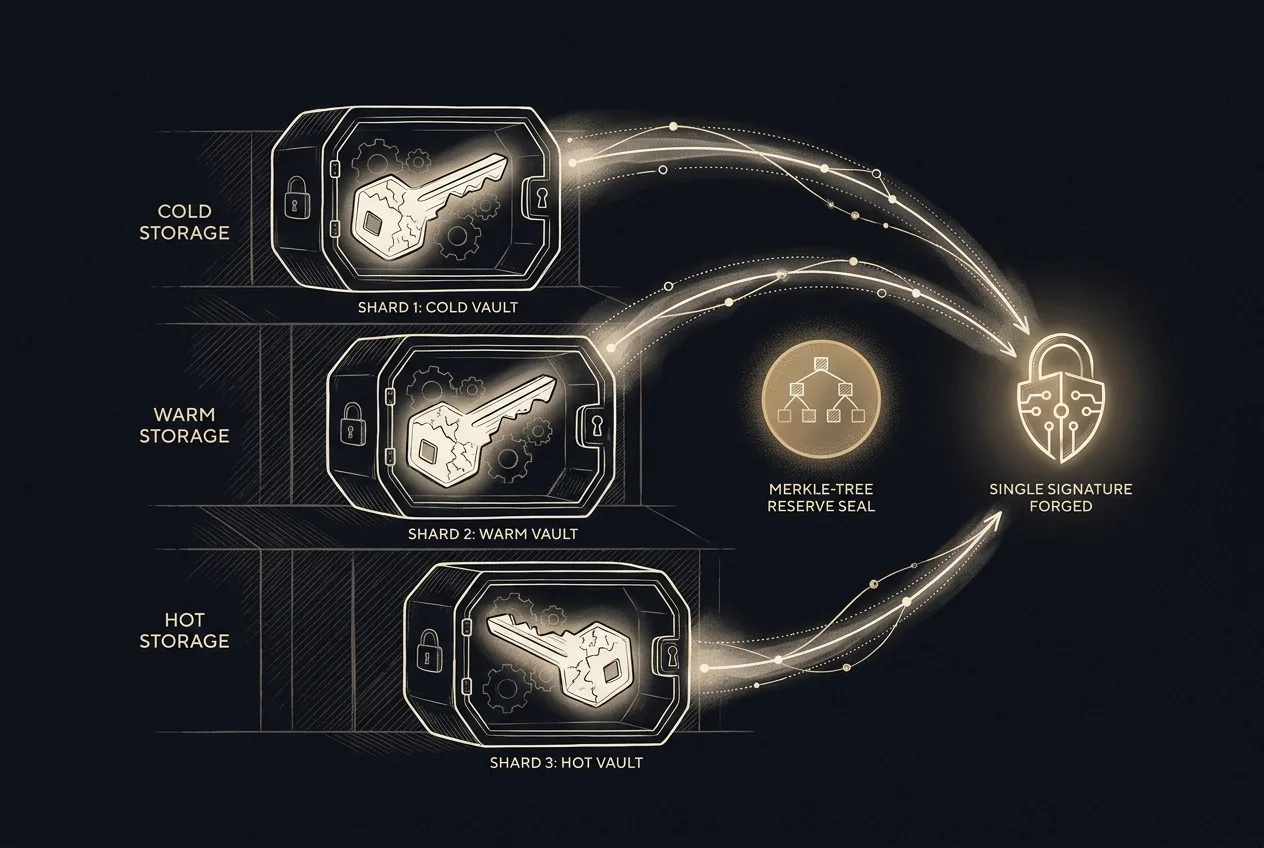
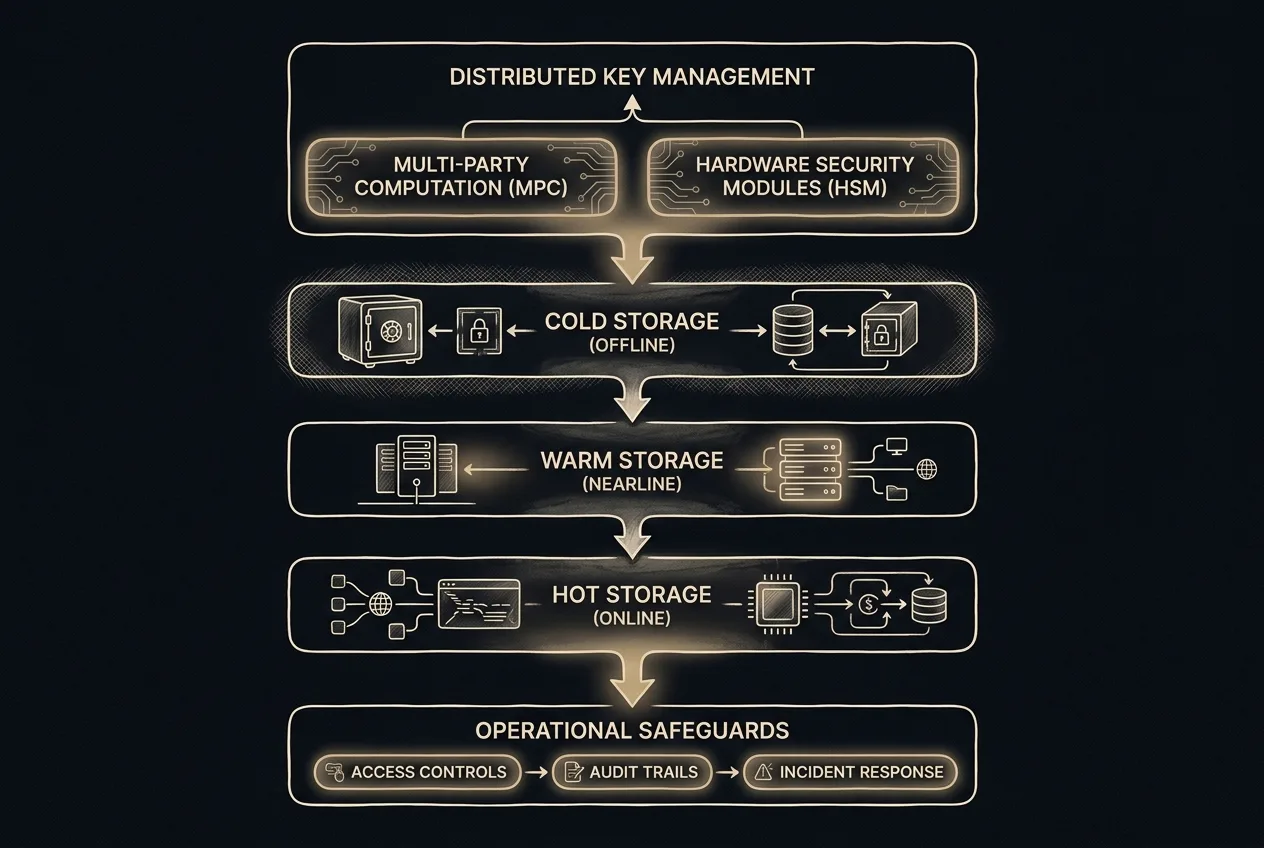
Multi-party computation has emerged as the dominant key management technology for institutional digital asset custody, and for good reason. MPC distributes the cryptographic signing process across multiple independent parties without ever assembling the complete private key in a single location. Each party holds a key share, and the signing protocol produces a valid signature through a collaborative computation that never exposes any individual share.
The critical advantage of MPC over multi-signature is that the resulting transaction is indistinguishable from a standard single-signature transaction on the blockchain. This means MPC works uniformly across every blockchain network, eliminates the on-chain cost premium of multi-signature transactions, and avoids revealing the custodian's security architecture to external observers.
How MPC Custody Works in Practice
A typical institutional MPC custody architecture distributes key shares across three or more independent environments. These environments are typically operated by different entities, housed in separate data centres, and governed by distinct access control policies. The threshold for signing is configured such that a subset of the environments must participate to produce a valid signature, while no single environment or entity can sign unilaterally.
When a transaction is initiated, the signing request is propagated to the participating environments. Each environment independently validates the transaction against its own policy engine, checking parameters such as destination addresses, transaction amounts, velocity limits, and time-of-day restrictions. Only if the transaction passes all policy checks in the required number of environments does the collaborative signing protocol execute.
The policy engine is where the real institutional control lives, and where the distinction between a custody product and a custody architecture becomes clear. A signing scheme that simply requires three of five environments to agree is a mechanism for distributing risk, not for governing intent. What an allocator's fiduciary obligation demands is that the rules themselves be explicit, versioned, and enforced by construction rather than by the discipline of whoever is on the signing rota that day. Encoding custody policy as code — destination allowlists, per-counterparty limits, escalation thresholds, the precise act-types that may execute automatically versus those that may not — turns the policy engine from a configuration screen into the governance surface of the entire custody operation. The cryptography decides whether a signature is valid; the policy decides whether it should ever have been requested.
This is also where the line between machine operation and human authority must be drawn deliberately. A read of an oracle, a balance check, a market-making quote, the routine sweep of dust between tiers — these are reversible or inconsequential, and a well-specified policy engine can let them run continuously without a person in the loop. A withdrawal to an external address, a wire, a transfer to a new counterparty is none of those things. It is irreversible the instant it confirms, and it is precisely the act that should never execute on automation alone. The correct architecture treats such a transfer as a draft: assembled, validated, and policy-checked by the machine, but held — unsigned and unsent — until a named, authorised human releases it. Machines operate the custody layer; humans govern the irreversible movements. Custody, in this frame, is the named-human gate on every transfer that cannot be undone, backed by the cryptographic guarantee that no single environment could have signed without it.
Key rotation in MPC architectures is significantly simpler than in multi-signature schemes. New key shares can be generated and distributed without changing the underlying public key or wallet address. This means that key shares can be rotated on a regular schedule, or immediately in response to a suspected compromise, without any on-chain transaction or asset migration.
The MPC Vendor Landscape
The institutional MPC custody market has consolidated around a handful of providers whose technology underpins a significant proportion of institutional digital asset holdings. Fireblocks, which processes a substantial share of institutional digital asset transactions, provides MPC-based custody integrated with policy engines and connectivity to exchanges and DeFi protocols. Copper, Qredo, and Sepior offer competing MPC implementations with varying approaches to threshold schemes, hardware integration, and governance models.
The differentiation among MPC providers increasingly lies not in the cryptographic primitives, which are well understood, but in the policy layer, operational tooling, and integration capabilities that surround them. Institutional custodians evaluate providers based on the granularity of their policy engines, the flexibility of their approval workflows, and the breadth of their blockchain and protocol support.
Tiered Storage: Hot, Warm, and Cold
No single custody configuration is optimal for all operational needs. Assets required for immediate trading must be accessible with minimal latency. Assets held as long-term reserves should be stored with maximum security, even at the cost of accessibility. Institutional custody architectures therefore employ tiered storage strategies that balance security and operational efficiency.
Cold storage represents the highest security tier. Private keys or key shares are held in air-gapped environments, meaning they have no network connectivity whatsoever. Transactions from cold storage require physical access to signing devices, manual approval workflows, and often multi-person ceremonies where multiple authorised individuals must be physically present. Cold storage is appropriate for reserve assets that are not expected to be moved frequently. The trade-off is latency: executing a transaction from cold storage can take hours or even days.
Warm storage occupies a middle ground. Key shares are held in secure, network-connected environments with automated policy enforcement. Transactions can be executed programmatically, subject to predefined limits and approval workflows. Warm storage is suitable for assets that support active trading strategies but do not require sub-second execution. Most institutional custody providers implement warm storage as their default tier, with policy engines that enforce transaction limits, whitelist destination addresses, and require multi-party approval above certain thresholds.
Hot storage prioritises speed above all else. Key material is held in memory on network-connected servers, enabling automated, low-latency transaction signing. Hot storage is necessary for strategies that require rapid execution, such as market making, arbitrage, or DeFi yield farming. The security trade-off is significant: hot wallets are the most vulnerable to network-based attacks and software exploits. Institutional best practice limits hot wallet exposure to the minimum capital required for immediate operational needs, typically a small single-digit percentage of total assets under management.
Dynamic Rebalancing Across Tiers
Sophisticated custody operations implement automated rebalancing between storage tiers. When hot wallet balances fall below operational thresholds, warm storage automatically initiates a replenishment transfer. When hot wallet balances exceed limits, excess funds are swept to higher-security tiers. This rebalancing operates continuously, governed by policy engines that adjust thresholds based on trading volumes, market conditions, and risk parameters.
The operational challenge is ensuring that rebalancing transactions are themselves secure. A compromised rebalancing process could drain warm or cold storage into a hot wallet controlled by an attacker. Institutional implementations address this by requiring that all inter-tier transfers pass through the same policy enforcement and multi-party approval mechanisms as external transactions.

Insurance and Regulatory Frameworks
Insurance coverage for digital asset custody has matured significantly but remains incomplete relative to traditional asset classes. Lloyd's of London, Marsh, and Aon offer custodial insurance policies covering theft, including internal collusion, physical destruction of key material, and certain categories of operational error. Coverage limits have expanded as the market has grown, with some policies now covering hundreds of millions of dollars per incident.
However, institutional allocators should understand the limitations of available coverage. Most policies exclude losses resulting from smart contract exploits, protocol-level vulnerabilities, or regulatory seizure. Coverage is typically limited to assets in cold or warm storage, with reduced or no coverage for hot wallet balances. And the claims process for digital asset losses is still evolving, with limited precedent for how insurers will respond to novel loss scenarios.
Regulatory frameworks for digital asset custody are converging toward common principles, even as implementation details vary by jurisdiction. The core requirements emerging across major financial centres include segregation of client assets from the custodian's own holdings, regular proof-of-reserves attestations, minimum capital requirements, and independent audits of custodial operations.
The SEC's proposed custody rule amendments, the European Union's MiCA framework, and similar initiatives in Singapore, Hong Kong, and the UAE all contemplate specific requirements for digital asset custodians. While harmonisation remains aspirational, the direction of travel is toward a regulatory environment where digital asset custodians operate under obligations comparable to those governing traditional securities custodians.
Segregation of Assets and Proof of Reserves
The collapse of FTX in 2022 demonstrated the catastrophic consequences of commingling customer assets with proprietary holdings. For institutional custody, asset segregation is not merely a best practice. It is a non-negotiable requirement that must be enforced at both the legal and technical levels.
Legal segregation requires that client assets be held in accounts or wallets that are clearly identified as client property, legally ring-fenced from the custodian's estate in the event of insolvency. Technical segregation requires that client assets be held in separate blockchain addresses or accounts, with access controls that prevent the custodian from unilaterally moving client assets for proprietary purposes.
Proof of reserves has emerged as a complementary assurance mechanism. By publishing cryptographic attestations that link on-chain balances to reported client holdings, custodians can provide continuous, independently verifiable evidence that they hold assets sufficient to cover their obligations. Merkle tree-based proof-of-reserves schemes allow individual clients to verify that their specific balance is included in the custodian's attestation without revealing the balances of other clients.
The limitations of proof of reserves should be understood clearly. A proof-of-reserves attestation demonstrates that the custodian holds certain assets at a specific point in time. It does not demonstrate that those assets are unencumbered, meaning free from liens, pledges, or other claims. It does not demonstrate that the custodian's liabilities do not exceed its assets. And it can be gamed through temporary borrowing of assets to inflate balances during attestation windows. Institutional-grade proof of reserves must therefore be combined with proof of liabilities and conducted on an unpredictable schedule to be meaningful.
Proof of reserves answers "what do you hold" at a moment in time. The harder and more consequential question is "how did this balance come to be" — and that is answered not by a periodic snapshot but by a continuous, append-only record of every action that touched the assets. The strongest custody operations treat the audit trail not as a compliance export generated after the fact, but as a structural property of the rails: every transfer, every policy evaluation, every approval and rejection logged at the point of decision, attributable to the specific human or machine that acted, and tied back to the policy clause that authorised it. Built this way, the record is replayable — a regulator, an auditor, or an internal investigator can reconstruct exactly why a given transfer executed, who released it, and which rule permitted it, rather than reasoning from inference and incomplete logs. On-chain settlement provides a permanent record of what moved; institutional custody must supply an equally durable record of why, by whom, and under what authority. Accountability is not a report you run. It is an architecture you build.
Cross-Chain Custody Challenges
The proliferation of blockchain networks creates custody challenges that have no analogue in traditional finance. An institutional portfolio may hold assets across Ethereum, Bitcoin, Solana, Avalanche, Cosmos-based chains, and numerous layer-2 networks, each with distinct signing schemes, address formats, and transaction models.
Managing custody across this fragmented landscape requires either supporting native key management for each chain, which is operationally expensive and introduces chain-specific risks, or adopting abstraction layers that provide unified custody interfaces across multiple chains. MPC-based custodians generally follow the latter approach, using their protocol-agnostic signing capabilities to support new chains without fundamental architectural changes.
Bridge security adds another dimension of complexity. Moving assets between chains typically involves either native bridge protocols or third-party bridge services, both of which have proven to be significant attack vectors. Institutional custody policies must define which bridges are approved, what exposure limits apply to bridged assets, and how the additional risks of cross-chain operations are monitored and managed.
Integration with Traditional Custodians
The convergence of digital asset custody with traditional financial infrastructure is accelerating. BNY Mellon, the world's largest custodian by assets under custody, launched digital asset custody services in 2022 and has continued to expand its capabilities. State Street, Northern Trust, and other major custodians have either launched or announced digital asset custody offerings.
For institutional allocators, the involvement of traditional custodians provides several advantages. These institutions operate under established regulatory frameworks, maintain substantial capital reserves, carry extensive insurance coverage, and have decades of experience managing operational risk in custodial operations. Their entry into digital asset custody raises the floor for operational standards across the industry.
The integration model typically involves traditional custodians partnering with technology providers who supply the cryptographic infrastructure while the custodian provides the regulatory wrapper, operational processes, and client relationships. This division of responsibilities leverages the comparative advantages of each party: technology firms contribute cryptographic expertise and blockchain connectivity, while traditional custodians contribute regulatory standing, operational discipline, and institutional client trust.
Operational Security: Key Management, Access Controls, and Disaster Recovery
Beyond the cryptographic foundations, institutional custody requires comprehensive operational security practices that address the human and procedural dimensions of key management.
Access controls must follow the principle of least privilege, ensuring that no individual has more access than their role requires. Signing authority should be distributed across multiple individuals and roles, with clear escalation procedures for transactions that exceed routine parameters. Background checks, ongoing monitoring, and regular access reviews are standard practice at institutional custodians.
Key ceremony procedures govern the generation, distribution, and rotation of cryptographic key material. These ceremonies are conducted in physically secured environments with multiple witnesses, sealed packaging for key material that shows any attempt to open it, and detailed documentation of every step. The formality of these procedures may seem excessive to those accustomed to software-centric security models, but they reflect the irreversible consequences of key compromise in digital asset custody.
Disaster recovery planning must account for scenarios including data centre destruction, regional catastrophes, key personnel unavailability, and coordinated attacks on multiple facilities. Recovery plans are tested through regular drills that simulate various failure modes and measure the time required to restore full operational capability. Geographic distribution of key shares and backup material ensures that no single event can render the custody infrastructure inoperable.
Incident response protocols define how suspected compromises are detected, investigated, and remediated. The speed of blockchain transactions means that the window between detecting a compromise and preventing asset loss can be extremely narrow. Automated monitoring systems that detect anomalous transaction patterns and trigger immediate freezes on signing operations are essential components of institutional custody infrastructure.
The Future: Programmable Custody with Smart Contracts
The next evolution of institutional custody moves beyond securing static holdings toward programmable custody, where custodial policies are encoded in smart contracts and enforced on-chain. In this model, the custodian's role shifts from executing transactions on behalf of clients to maintaining the infrastructure that enables clients to define and enforce their own custodial policies.
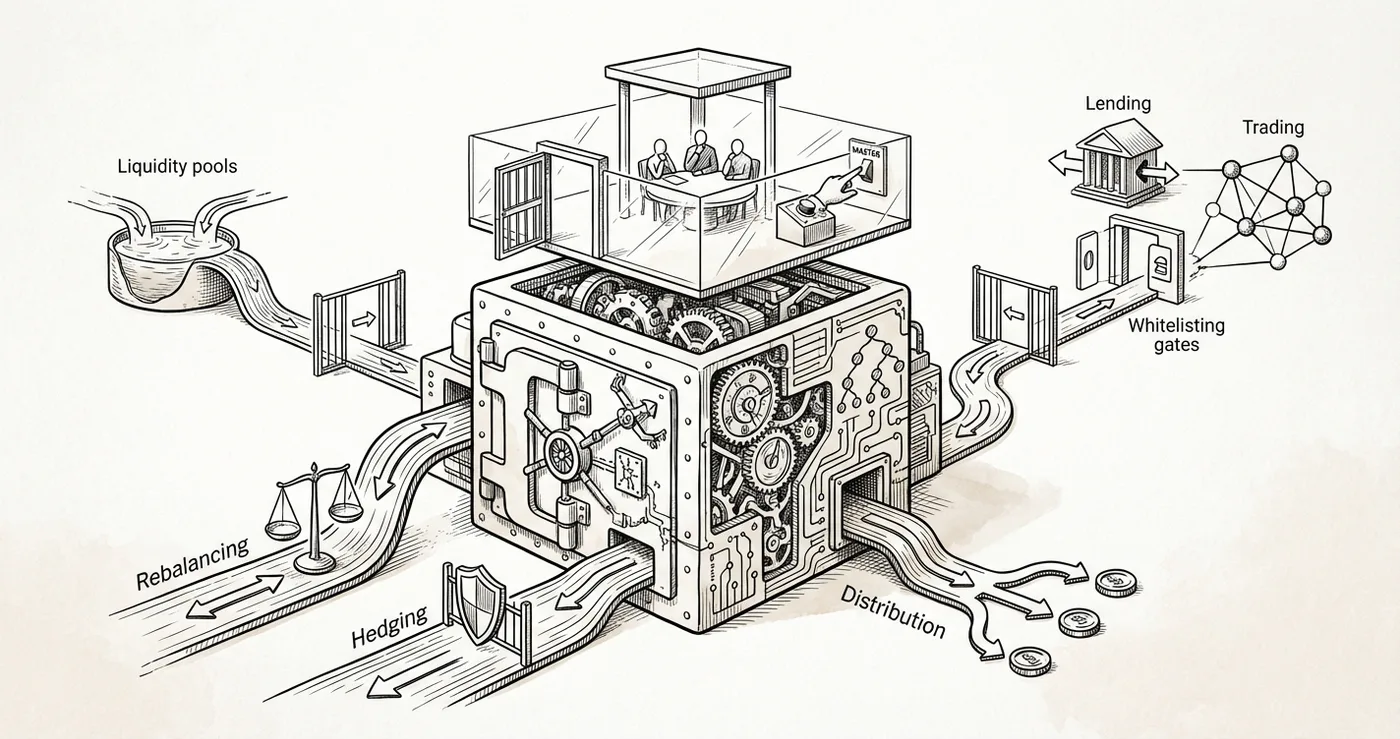
Programmable custody enables scenarios that are impractical with traditional approaches. A fund manager could define a custodial policy that automatically rebalances between storage tiers based on market conditions, executes predefined hedging strategies when portfolio risk exceeds thresholds, and distributes returns to investors according to waterfall logic, all without requiring manual intervention from the custodian.
The discipline that keeps this safe is the same act-type distinction that governs any custody architecture, now expressed in code that settles on-chain. Encoding policy in a smart contract does not dissolve the line between what may run autonomously and what must remain human-gated; it makes that line auditable. Reversible and bounded operations — rebalancing within a tier, executing a hedge inside pre-authorised limits — are exactly what programmable policy is suited to automate. The release of capital to an external party is not, and a well-designed on-chain policy encodes that asymmetry explicitly rather than letting the convenience of automation erode it. Programmability should widen the set of operations a machine can execute under explicit policy; it should never quietly move irreversible transfers from the human-governed column into the automated one.
The integration of custody with decentralised finance protocols represents another frontier. Institutional participants increasingly seek to deploy custodied assets into DeFi yield strategies, lending protocols, and liquidity pools. Programmable custody can enforce risk limits and protocol whitelists at the custodial level, ensuring that assets are deployed only into approved protocols and within approved parameters.
These capabilities are not yet mature. Smart contract risk, oracle dependencies, and the evolving regulatory treatment of on-chain custody arrangements all require further development, and any honest account of the field has to hold the promise and the unsolved problems in the same hand. But the trajectory is clear: custody is evolving from a static safekeeping function into a dynamic, programmable layer that actively participates in portfolio management and risk control — which makes the governance discipline around it more important, not less.
For a new generation of digital asset platforms, custody cannot be an afterthought bolted on once strategies are live, nor a point tool stitched alongside execution, risk, and reporting systems that each maintain their own partial view of what moved and why. It belongs to the same operational fabric as everything else the platform does. When custody, execution, policy, and the audit record share one substrate, the named-human gate on an irreversible transfer is not a separate approval queue but a single act-type in a consistent governance model, and the record of who authorised what is continuous rather than reassembled across systems after an incident.
That integration is what lets an institution scale through better policy rather than more headcount. The throughput of a custody operation should be a function of how precisely its rules are written, not how many reviewers stand between a draft transfer and the chain. Encode the policy well, gate the irreversible acts to named humans, and make the audit spine structural, and the same small team can govern far more capital without loosening control — because the control lives in the architecture, not in anyone's vigilance.
The principles are easy to assert and hard to live by, which is why the only credible demonstration is operating this way in practice, under the same gates and the same record an allocator would be asked to trust. "Trustless" was never an invitation to dispense with governance. It is a settlement guarantee that raises the stakes on everything governance is supposed to do, and the platforms that treat custody as accountability made architectural — rather than safekeeping with a dashboard — will be the ones institutional allocators can hand irreversible authority to. For an allocator, the security of their assets is not one feature among many. It is the prerequisite for everything else.