Building Resilient Trading Systems: Lessons from High-Availability Engineering
Why resilience in a trading system is a property of the integrated whole, not a feature added to it: redundancy, circuit breakers, graceful degradation, chaos engineering, and the replayable record that makes failures survivable.


On August 1, 2012, Knight Capital Group deployed a software update to its market-making system. Within forty-five minutes of the market open, the system had executed millions of erroneous trades, accumulating a loss of approximately four hundred and forty million dollars. The firm, which had been one of the largest market makers on the New York Stock Exchange, was effectively bankrupt by lunchtime. It was acquired by Getco in a fire sale four months later.
On August 22, 2013, the Nasdaq Stock Market halted trading for over three hours due to a failure in its Securities Information Processor, the system that consolidates and distributes quote and trade data. The outage affected all Nasdaq-listed securities, including Apple, the most actively traded stock in the world at the time. The root cause was a software bug triggered by an unusual sequence of connection and disconnection events from a participant's system.
These are not historical curiosities. They are case studies in what happens when trading systems fail to meet the resilience standards that institutional markets demand. Every firm that operates a trading platform, whether a market maker, an exchange, a systematic fund, or a broker-dealer, must grapple with the same fundamental question: how do you build systems that continue to operate correctly when components fail, inputs are corrupted, load exceeds capacity, or the unexpected becomes actual?
The discipline of high-availability engineering, developed over decades in fields ranging from telecommunications to aerospace to internet-scale distributed systems, provides a rigorous framework for answering this question. Applying that framework to trading systems requires adapting its principles to the unique constraints of financial markets: strict correctness requirements, regulatory mandates, real-time latency demands, and the catastrophic cost of certain failure modes.
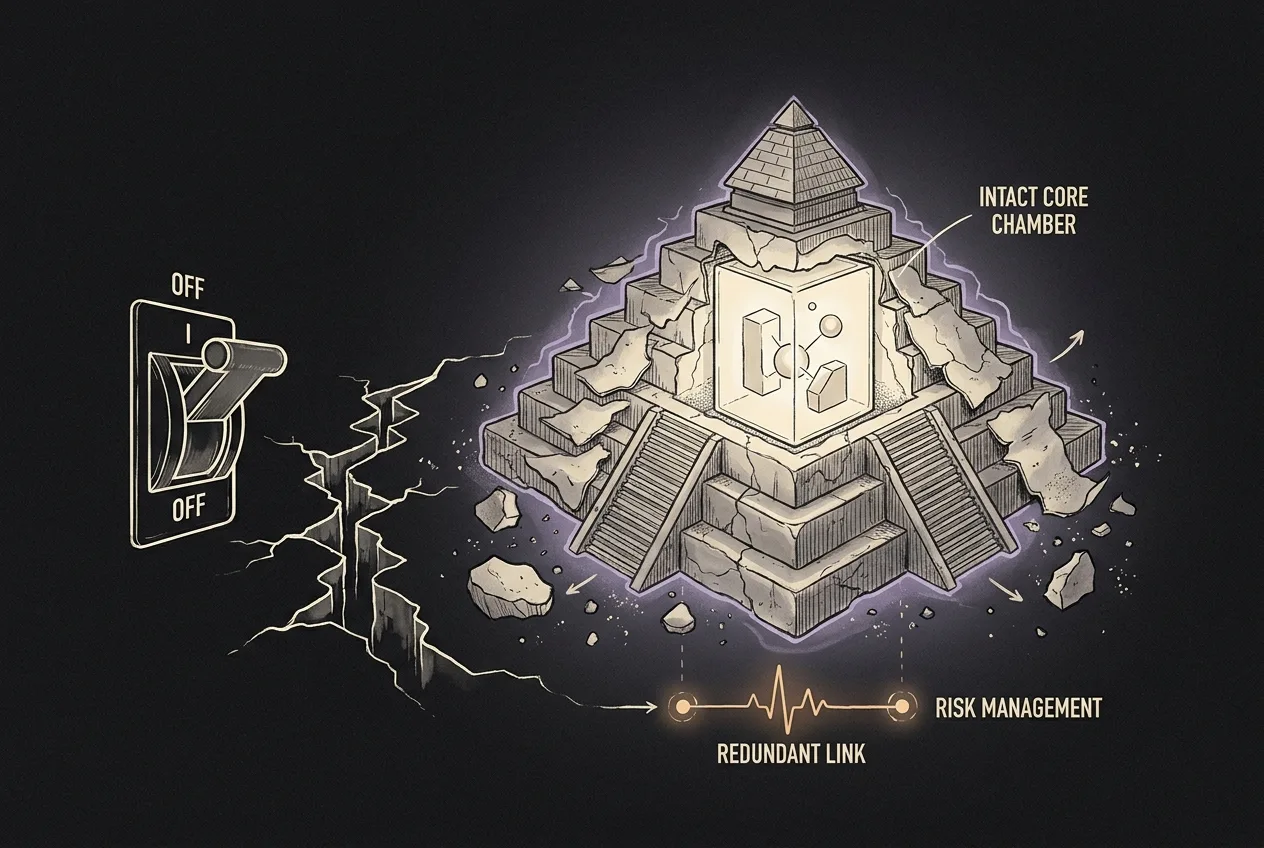
It also requires a more uncomfortable admission than most resilience checklists allow. Resilience is not a feature you bolt onto a system; it is a property of how the system is composed. A firm running a stack of point tools — one vendor for order management, another for risk, a third for market data, each with its own state and its own idea of what just happened — inherits the seams between them as failure modes. When those tools disagree under stress, no individual component is wrong, yet the system as a whole is. The alternative is to treat resilience as an architectural commitment: one data model, one record of every action, one place where the system's view of reality is reconciled. The mechanisms that follow are how that commitment is honoured.
Defining Five-Nines: What Availability Actually Means
The term "five nines" refers to 99.999% availability, which translates to approximately five minutes and fifteen seconds of unplanned downtime per year. For a trading system that operates during market hours, roughly six and a half hours per day for US equity markets, five-nines availability means less than two seconds of unplanned downtime per trading day averaged over a year.
This target is aggressive but not arbitrary. Institutional clients, regulators, and counterparties expect trading systems to be available whenever markets are open. An outage during a market-moving event, an unexpected Fed announcement, a flash crash, a geopolitical shock, is precisely the moment when the system's availability is most critical and most stressed. Systems designed for high availability under normal conditions but that degrade under stress are not truly highly available; they merely appear so until the conditions that test them arrive.
Achieving five-nines availability requires a systematic approach across multiple dimensions: eliminating single points of failure, implementing automated failover, designing for graceful degradation, testing failure scenarios continuously, and building organizational processes that respond to incidents with speed and discipline.
Active-Active and Active-Passive Architectures
The foundation of high availability is redundancy, and the architectural choice that shapes every other decision is whether to deploy in an active-passive or active-active configuration.
In an active-passive configuration, the primary system handles all production traffic while one or more standby systems replicate state from the primary and remain ready to assume operations if the primary fails. Failover can be automatic, triggered by health check failures or heartbeat timeouts, or manual, initiated by an operator. The standby system must be sufficiently synchronized with the primary that it can resume operations without data loss or inconsistency.
The primary advantage of active-passive is simplicity. Only one system processes transactions at any time, eliminating the complex consistency challenges of concurrent processing. The primary disadvantage is failover latency. Even automated failover requires detecting the failure, confirming it is genuine rather than a transient network issue, activating the standby, and redirecting traffic. This process typically takes seconds to minutes, during which the system is unavailable.
Active-active configurations run multiple instances simultaneously, each processing a portion of the production workload. If one instance fails, the remaining instances absorb its traffic without interruption. The failover is essentially instantaneous, because there is no standby to activate; the surviving instances are already running.
The advantages of active-active are compelling: near-zero failover time, better resource utilization since standby capacity is not idle, and the ability to perform maintenance on individual instances without downtime. The disadvantages are substantial: every instance must have a consistent view of shared state, requiring distributed consensus protocols or careful partitioning to avoid conflicts. For trading systems where order state must be exactly correct, the consistency requirements of active-active deployments add significant complexity.
Most institutional trading platforms use a hybrid approach. The stateless components of the system, such as market data distribution, analytics computation, and API serving, run in active-active configurations behind load balancers. The stateful components, such as the order management system and position management system, run in active-passive configurations with synchronous state replication to minimize data loss during failover.
Circuit Breakers: Containing Failures Before They Cascade
The Knight Capital disaster illustrates a failure mode that redundancy alone cannot prevent: a system that is fully operational but producing incorrect results. The servers were running, the network was connected, the exchange was accepting orders. The problem was that the software was doing the wrong thing, and doing it at enormous speed.
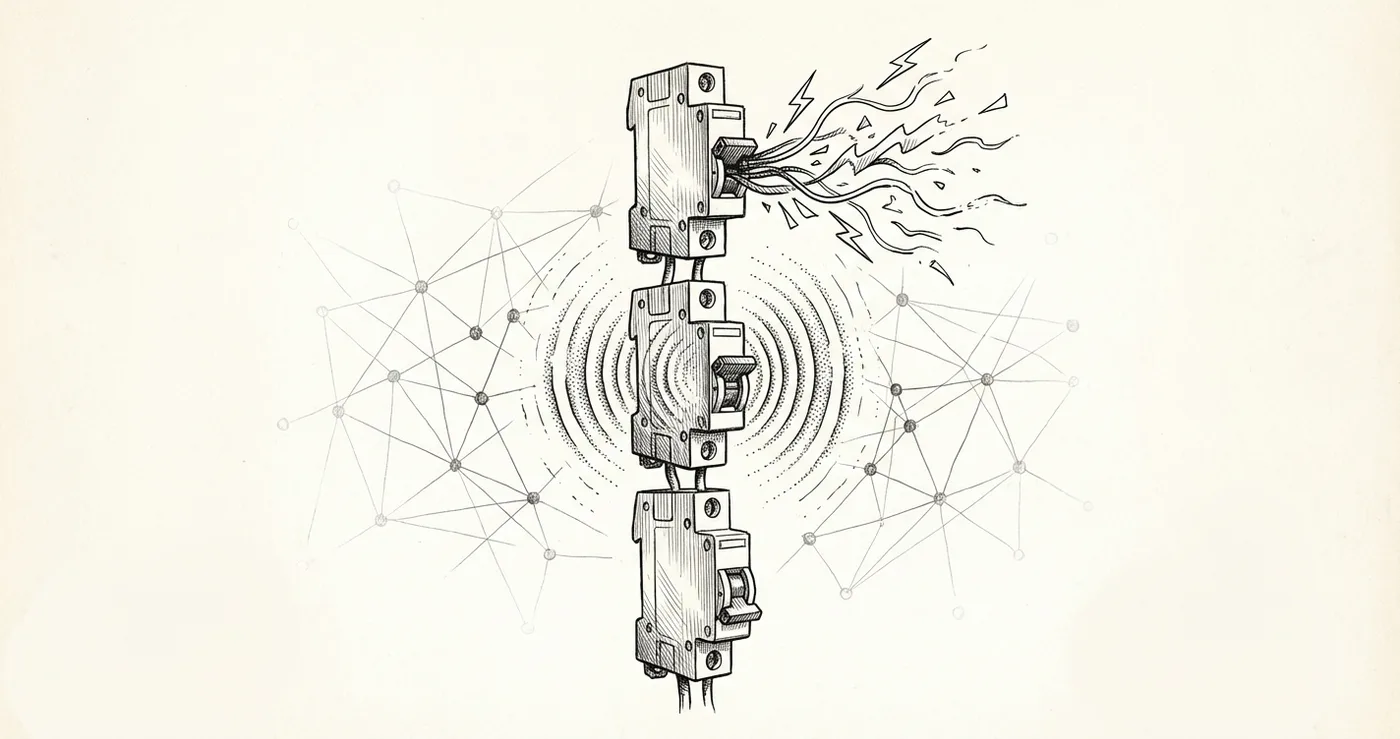
Circuit breakers are a defensive pattern borrowed from electrical engineering and popularized in software by Michael Nygard's work on release stability patterns. A circuit breaker monitors a specific operation or subsystem and, when it detects anomalous behavior, automatically halts or restricts the operation before it can cause further damage.
In trading systems, circuit breakers operate at multiple levels. Position-level circuit breakers halt trading in a specific instrument when the position exceeds a predefined threshold or when the rate of accumulation suggests a runaway algorithm. Strategy-level circuit breakers pause an entire trading strategy when its behavior deviates from expected parameters, such as order submission rates, fill rates, or profit-and-loss trajectory. Portfolio-level circuit breakers can halt all trading activity when aggregate metrics, such as total loss, gross exposure, or net exposure, breach predefined limits.
The design of effective circuit breakers requires balancing sensitivity against false positives. A circuit breaker that trips too easily will interrupt legitimate trading activity, potentially causing losses from unmanaged positions or missed opportunities. A circuit breaker that trips too late may not prevent material damage. The calibration process involves analyzing historical trading data to establish baseline behavior, defining thresholds that capture genuine anomalies while tolerating normal variation, and backtesting the circuit breaker against historical incidents to verify that it would have detected the problem in time.
Automated kill switches represent the most aggressive form of circuit breaker: a mechanism that can immediately cancel all open orders and halt all new order submission. Every institutional trading platform should have a kill switch that can be activated both automatically, by the risk system, and manually, by authorized personnel. The kill switch must be tested regularly, because a kill switch that fails when needed is worse than no kill switch at all, as it creates false confidence in a safety mechanism that does not work.
The kill switch is also where a useful design principle becomes concrete: machines operate, but humans govern. Most of the system runs autonomously, because no human can react to a runaway algorithm in the seconds that matter. But a small class of acts is irreversible or systemic enough that they should be gated to a named, accountable human rather than left entirely to automation — flattening the book, overriding a tripped breaker to resume trading, promoting a new deployment to full traffic. The cleanest way to express this is policy-as-code: the conditions under which the machine acts on its own, and the conditions under which it must stop and ask, are written down, version-controlled, and enforced uniformly rather than carried in an operator's head. Resilience and governance are the same discipline viewed from two angles, because the moments when a system is most likely to do catastrophic damage are precisely the moments when it is failing.
Chaos Engineering in Trading Systems
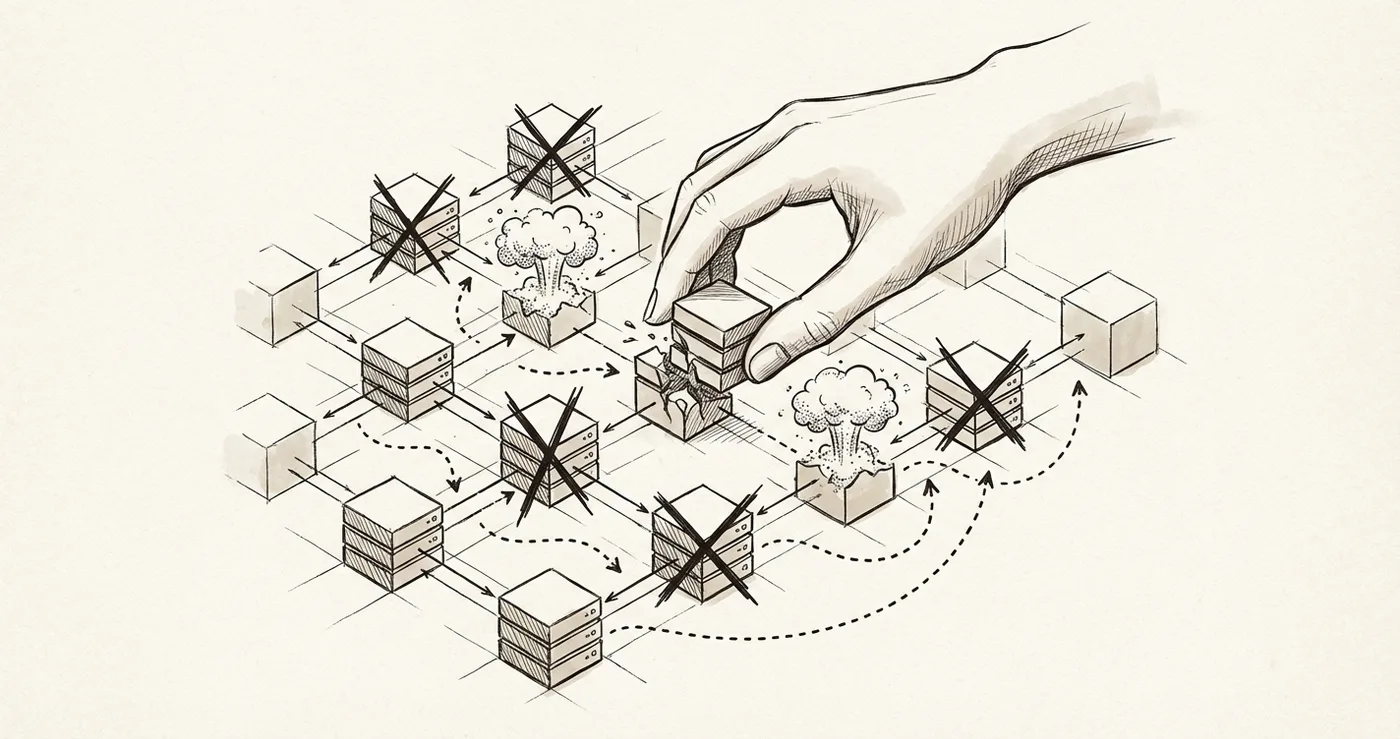
Chaos engineering is the discipline of deliberately injecting failures into production or production-like environments to test the system's resilience. The practice was pioneered by Netflix, whose Chaos Monkey tool randomly terminates virtual machine instances in production to verify that the system can tolerate individual server failures without service disruption.
Applying chaos engineering to trading systems requires adaptation to the unique constraints of financial markets. Injecting failures into a live trading system during market hours carries obvious risks. Most firms practice chaos engineering in production-like staging environments that mirror the architecture, data flows, and load characteristics of production without the risk of actual financial impact.
The categories of failure that should be tested are extensive. Infrastructure failures include server crashes, network partitions, disk failures, and cloud provider outages. Data failures include stale market data feeds, corrupted price ticks, missing reference data, and delayed execution reports. Dependency failures include unavailability of downstream services such as risk computation, compliance checking, and order routing. Capacity failures include sudden spikes in market data volume, order submission rates, and concurrent user connections.
Each chaos experiment follows a structured protocol: define a hypothesis about expected system behavior during the failure, inject the failure in a controlled manner, observe the system's actual behavior, and compare it against the hypothesis. Discrepancies between expected and actual behavior reveal resilience gaps that must be addressed.
For trading systems, the most valuable chaos experiments test the interactions between failures and market conditions. What happens when the primary market data feed fails during a period of high volatility? Does the system failover to the secondary feed correctly, and does the failover introduce a gap in price history that corrupts signal calculations? What happens when the risk computation service becomes slow, and pre-trade risk checks begin timing out? Does the order management system queue orders, reject them, or bypass the risk check entirely? These compound failure scenarios are where the most dangerous vulnerabilities hide.
Market Data Failover
Market data is the sensory input of a trading system. Without accurate, timely market data, the system cannot generate signals, price risk, or execute orders effectively. Market data failover, the ability to maintain continuous data feeds when primary sources fail, is among the most critical resilience capabilities for any trading platform.
The standard approach to market data resilience uses multiple independent data sources in a primary-secondary configuration. The primary feed, typically a direct exchange feed or a low-latency consolidated feed from a provider such as the SIP, CTA, or a commercial aggregator, is the default source. One or more secondary feeds from independent providers serve as backups. A market data arbitration layer monitors all feeds simultaneously, detecting staleness, gaps, or anomalies in the primary feed and switching to the secondary when necessary.
The arbitration logic must handle subtleties that naive failover misses. A primary feed that is technically connected but delivering stale data, a condition known as a "stale feed," must be detected and treated as a failure. A secondary feed that delivers slightly different prices due to timing differences in aggregation must be reconciled with the primary to avoid discontinuities in signal calculations. A failover that occurs mid-calculation must be handled gracefully, either by restarting the calculation with data from the new feed or by flagging the result as potentially affected by the data transition.
Geographic diversity in data sourcing provides resilience against localized failures. A firm receiving market data through a primary path routed through its New York data center and a secondary path routed through a Chicago facility is protected against a network failure affecting either location individually. Cross-provider diversity protects against failures specific to a single data vendor.
Disaster Recovery: Lessons from Knight Capital and Nasdaq
The Knight Capital incident and the Nasdaq flash freeze offer complementary lessons about trading system resilience. Knight Capital's failure was a software deployment error: old code was inadvertently activated on a production server, causing the system to execute a dormant trading strategy at massive scale. The lesson is that deployment processes are as critical as the deployed software. Automated deployment validation, canary releases that activate new code on a small subset of traffic before full rollout, and automated rollback mechanisms that can revert a deployment in seconds are essential safeguards.
Knight Capital also lacked adequate real-time monitoring of its aggregate trading behavior. The erroneous strategy was generating massive losses for forty-five minutes before the firm was able to diagnose and halt the problem. A comprehensive monitoring system with automated circuit breakers could have detected the anomalous order flow within seconds and halted trading automatically, limiting the loss to a fraction of the eventual total.
Detecting the failure is only half the problem; reconstructing it afterward is the other half, and it is where most firms discover their instrumentation was thinner than they believed. The forty-five minutes that mattered to Knight Capital were knowable only in retrospect, by piecing together logs across systems that were never designed to be read as a single narrative. A system in which every action — every order, every risk check, every parameter change, every failover — is written to one append-only record, in causal order, turns post-incident reconstruction from forensic archaeology into a query. This audit spine is not a compliance afterthought. It is the most valuable instrument a firm has during an incident, because it lets responders answer the only question that counts under pressure: what did the system actually do, and in what order. A record that can be replayed is a record that can be trusted, and trust is what is scarcest at three minutes into an outage.
The Nasdaq outage illustrates the risk of complex system interactions. The failure was triggered by a sequence of events that the system's designers had not anticipated: a specific pattern of connection and disconnection from a market participant's system exposed a bug in the SIP's handling of data integrity. The lesson is that testing individual components in isolation is insufficient. End-to-end testing that exercises the full chain of interactions, including unusual sequences and edge cases, is necessary to uncover vulnerabilities that emerge from component interactions.
Both incidents underscore the importance of rehearsed incident response procedures. When a critical failure occurs during market hours, the response team must act within minutes, not hours. This requires pre-defined runbooks that specify the diagnostic steps, escalation paths, and remediation actions for each category of failure. It requires regular drills that simulate realistic incident scenarios and measure the team's response time and accuracy. And it requires a blameless post-incident review process that extracts lessons from every failure and feeds them back into the system's design and the team's procedures.
Graceful Degradation Under Load
A resilient trading system does not simply choose between fully operational and fully offline. It is designed to degrade gracefully under adverse conditions, shedding non-essential functionality to preserve the core capabilities that matter most.
The graceful degradation hierarchy for a trading system might proceed as follows. Under normal conditions, all systems operate at full capability. Under moderate stress, non-critical features such as historical analytics, reporting, and user interface refinements are deprioritized in favor of core trading, risk management, and position tracking. Under severe stress, the system reduces the frequency of computationally expensive operations such as full portfolio optimization and Monte Carlo risk simulation, relying on faster approximate methods. Under extreme stress, the system enters a protective mode that focuses exclusively on managing existing positions and risk, halting new trade initiation until conditions normalize.
Each degradation level must be carefully designed to preserve the system's most critical functions while shedding the least critical. The transitions between levels should be automated, triggered by measurable indicators such as system load, latency percentiles, error rates, or market volatility. Manual override must also be available, because automated systems cannot anticipate every scenario that might warrant a change in operating mode.
Load shedding is a related technique that protects the system from being overwhelmed by excessive demand. When incoming request rates exceed the system's capacity, a load shedder selectively rejects lower-priority requests to ensure that higher-priority requests are processed successfully. In a trading system, order submissions and risk checks are high priority; analytics queries and report generation are lower priority. A well-designed load shedder ensures that the system remains responsive for critical operations even when total demand exceeds capacity.
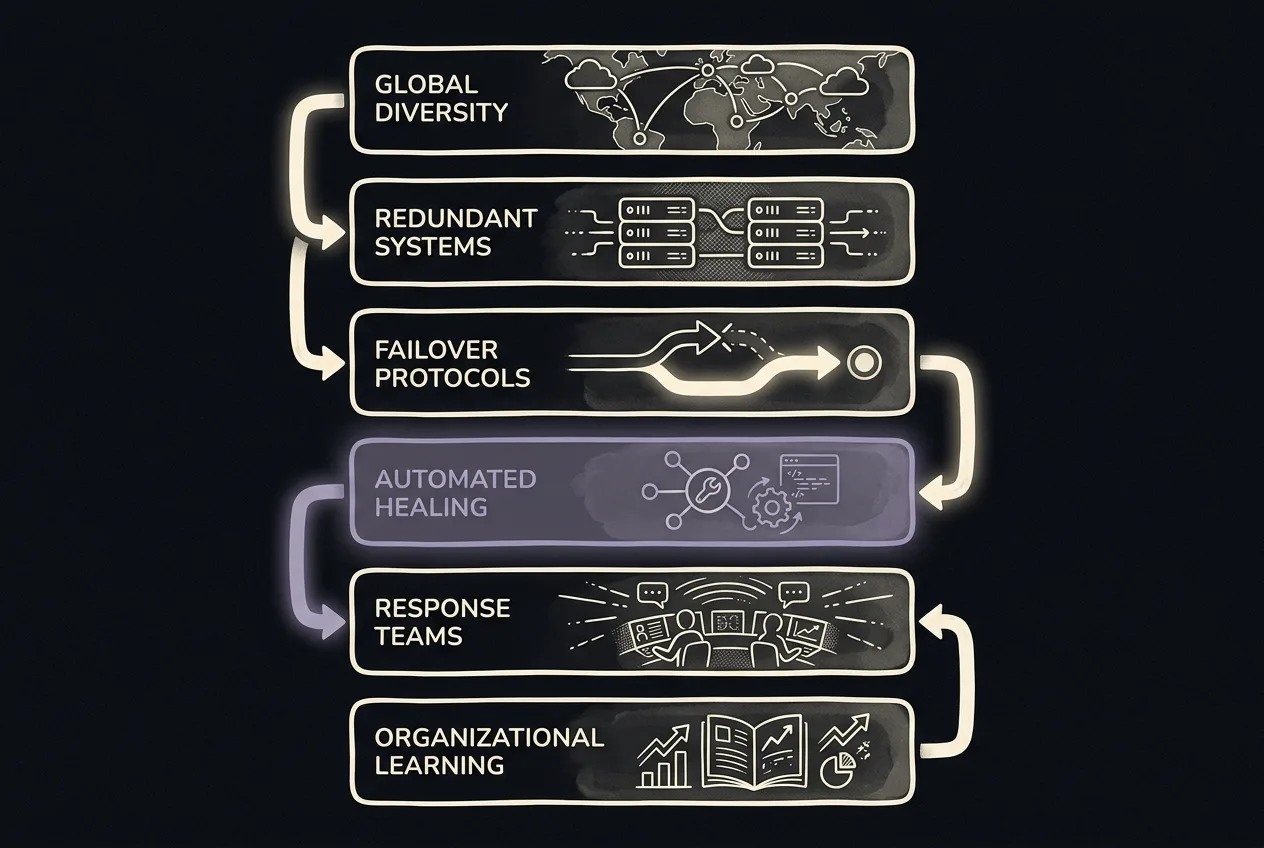
Resilience Scales With Policy, Not Headcount
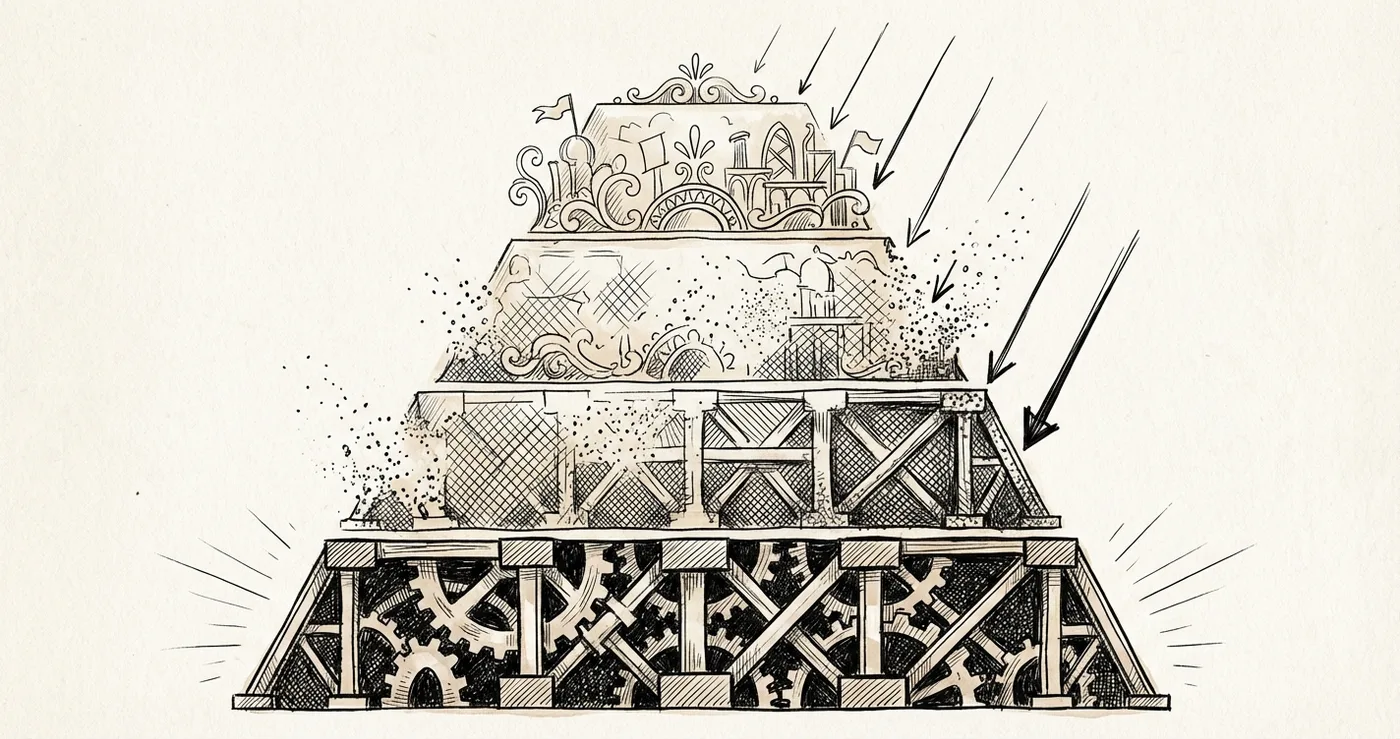
Technical measures alone are insufficient. Resilience is an organizational characteristic as much as a technical one, but the version of that claim worth defending is narrower than the usual appeal to culture. What separates the firms that survive a crisis from the ones that do not is rarely the size of their on-call rotation. It is how much of their operational judgment has been encoded into the system itself, where it executes consistently, rather than left to be improvised by whoever happens to be awake.
This is the practical case for treating policy as code. A runbook in a wiki is a hope; a degradation hierarchy, a set of circuit-breaker thresholds, and an escalation rule expressed as version-controlled policy are enforced behaviour. The most resilient organizations conduct regular game day exercises that simulate realistic failure scenarios, including compound failures across multiple components, and they fold what they learn back into that policy rather than into tribal memory. They maintain runbooks, but they treat the runbook as a specification to be automated, not a substitute for automation. And they sustain a blameless review process, less out of sentiment than out of incentive design: a team that fears blame hides problems, and hidden problems are how a contained failure becomes a catastrophic one. The compounding advantage is that improvements made this way scale. A firm that responds to each incident by adding another person to watch a dashboard has bought linear protection at linear cost; a firm that responds by sharpening a policy has made every future instance of that failure mode cheaper to survive.
The cost of building resilient trading systems is substantial. Redundant infrastructure, chaos engineering programs, comprehensive monitoring, regular disaster recovery testing, and the engineering talent to design and maintain these systems represent a significant ongoing investment. But the cost of inadequate resilience is far greater. Knight Capital's four hundred and forty million dollar loss was accumulated in less than an hour. The reputational damage from a major outage can impair a firm's ability to attract clients and capital for years. And the regulatory consequences of operational failures are becoming increasingly severe as regulators raise their expectations for operational resilience.
For institutional trading platforms, resilience is not a feature to be added after the system is built. It is a design principle that must inform every architectural decision from the beginning, and it is one of the few claims a platform cannot make on a slide. The only credible evidence is a system that has been running continuously, through real market stress, on capital that the firm's own outcomes depend on. The systems that survive and thrive through market crises are those built by teams that took the time to ask, before the crisis arrived, what will happen when things go wrong — and then built systems whose answers had already been tested.