Low-Latency Trade Orchestration: Engineering Speed Without Sacrificing Control
Why the speed-versus-control tradeoff in institutional execution is a design choice, not a physical law — and how enforcing policy on the hot path resolves it.


In institutional trading, speed and control are usually framed as opposing forces. Faster execution demands fewer checks. Comprehensive risk management introduces latency. Regulatory compliance requires audit trails that slow the critical path. The framing feels intuitive, and it is wrong. It treats control as something bolted onto the execution path after the fact — a tax on speed — when the resolution is to compile control into the path so that an order is fast precisely because it has already been checked.
This is not a semantic distinction. A risk limit expressed as policy-as-code, evaluated deterministically on the hot path before an order leaves the gateway, costs a known and bounded number of microseconds and never lets an out-of-policy order reach the wire. A risk limit enforced by a downstream system, a human reviewer, or a post-trade report is slower, weaker, and arrives too late to prevent the loss it was meant to stop. The firms that have internalised this build one integrated execution system where speed and control share the same code path; the firms that have not assemble a stack of point tools and pay for the seams in both latency and risk. The remainder of this article traces where that principle lives in the stack — routing, pre-trade risk, execution algorithms, measurement, compliance, and infrastructure — and what it takes to make speed and control complementary rather than competing.
The Latency-Control Tradeoff in Institutional Trading
The tension between latency and control is real, but it is a design problem, not a physical constraint. Every microsecond of processing time on the critical path, from signal generation to order submission, represents potential slippage against a moving market. For strategies that depend on capturing short-lived price dislocations, even modest latency can erode alpha significantly. But removing all checks from the critical path creates unacceptable operational risk: a single erroneous order, unconstrained by position limits or notional checks, can cause losses that dwarf years of accumulated alpha.
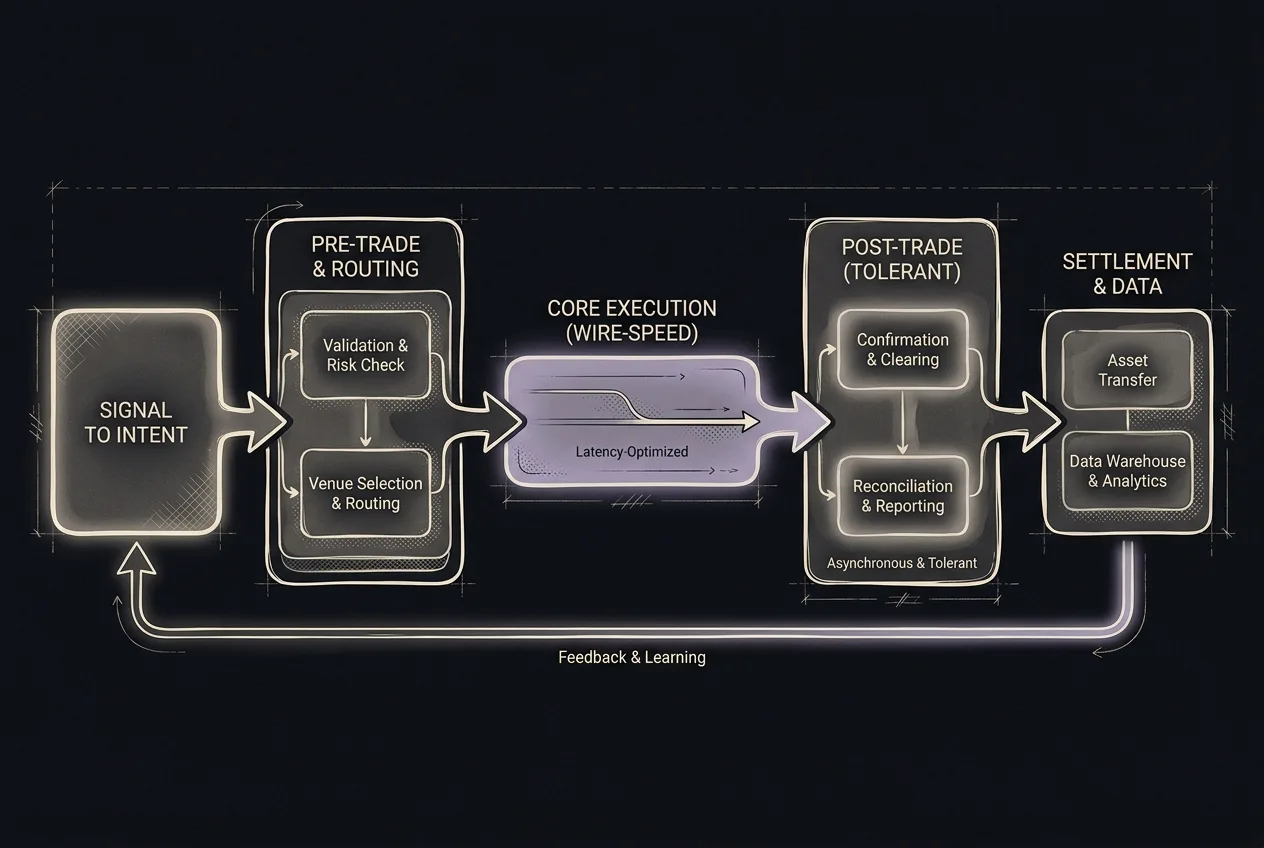
The resolution lies in classifying every check by the act it governs and allocating the latency budget accordingly. A check that gates whether an order should reach the market at all — a position limit, a notional cap, a policy constraint — must run at wire speed, because its job is to prevent an irreversible act before it happens. A check that documents what already happened — post-trade compliance reporting, transaction cost attribution — can tolerate seconds or minutes, because nothing it does changes the outcome. The two belong on different paths. Conflating them is what produces the false tradeoff: when reporting logic sits on the order path, control genuinely does cost speed, and when prevention logic is deferred to a report, speed genuinely does cost control. Separate them cleanly and neither penalty exists.
Institutional clients demand both sides of this. A pension fund allocator needs assurance that automated systems cannot exceed concentration limits or violate investment policy constraints — that the constraints are enforced by construction, not by trust. A quantitative hedge fund needs assurance that the same systems add no avoidable latency to time-sensitive strategies. These are not competing requests once control is expressed as code on the hot path: the same mechanism that makes a limit unbreachable is the one that makes it cheap to evaluate. Meeting both at once is the defining engineering challenge of modern execution infrastructure, and the rest of this article is about how each layer earns it.
Multi-Broker Smart Order Routing Architecture
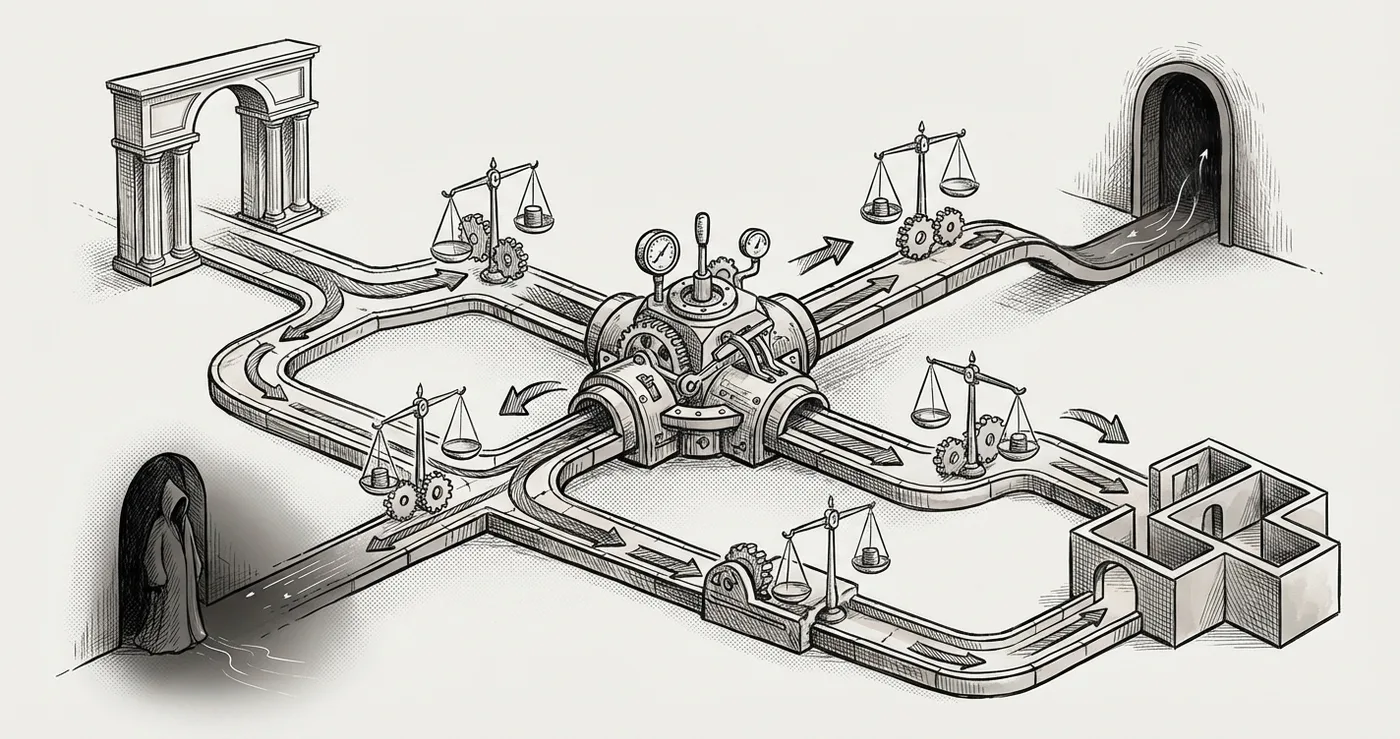
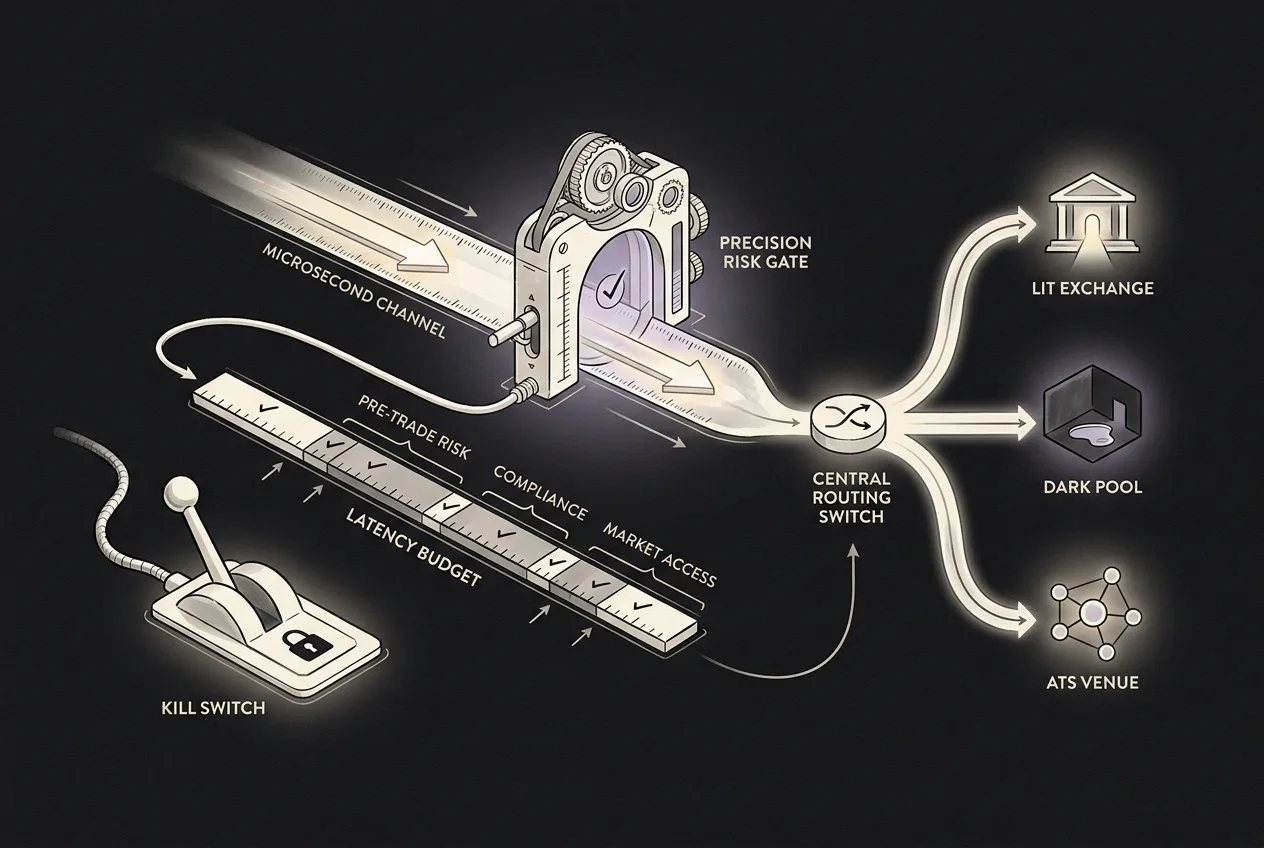
Smart order routing (SOR) is the first place the integrated-system argument earns its keep. The router decides where and how to execute an order across multiple venues and brokers, and every one of those decisions is simultaneously an execution-quality choice, a market-impact choice, and a regulatory one. Treating those as separate systems — a routing engine here, a compliance check there — reintroduces exactly the seams the architecture is meant to eliminate. A well-built SOR makes the regulatory constraint part of the routing computation rather than a gate it must clear afterward.
Venue Selection and Liquidity Analysis
A sophisticated SOR engine maintains a real-time model of available liquidity across lit exchanges, dark pools, and alternative trading systems. For each incoming order, the router evaluates venue characteristics including displayed depth, historical fill rates, average queue times, fee schedules, and the probability of information leakage. The venue selection algorithm must balance immediate execution probability against the risk of adverse selection, particularly in dark pools where the counterparty's information advantage is uncertain.
The routing decision is further complicated by regulatory requirements. Regulation NMS in the United States mandates that orders be executed at the National Best Bid and Offer (NBBO) or better, requiring the router to incorporate protected quote data into every decision. MiFID II in Europe imposes best execution obligations that extend beyond price to include cost, speed, likelihood of execution, and settlement considerations.
Multi-Broker Connectivity
Institutional execution platforms typically maintain direct connectivity to multiple prime brokers and execution brokers, each offering different strengths. One broker may provide superior access to dark pool liquidity. Another may offer lower commission rates for large-cap equities. A third may specialize in international markets or specific asset classes. The SOR engine must route orders to the optimal broker for each specific trade, considering not just execution quality but also counterparty risk, credit utilization, and settlement efficiency.
Managing multiple broker connections introduces complexity in order state management. An order that is partially filled at one venue may need to be re-routed to another, requiring atomic state transitions and careful handling of race conditions. The orchestration layer must maintain a consistent view of each order's lifecycle across all venues and brokers, even when network latency varies between connections.
Adaptive Routing
Static routing rules are insufficient for modern markets. Liquidity conditions change throughout the trading day, varying with scheduled events such as market opens, economic releases, and index rebalances. An adaptive SOR continuously updates its venue models based on recent fill data, adjusting routing probabilities in real time. Reinforcement learning approaches have shown promise here, with agents that learn routing policies by interacting with the live market environment and optimizing for realized execution quality. A learned policy does not loosen the control argument, it sharpens it: the venue model may adapt freely, but it adapts inside a fixed envelope of hard constraints — the same pre-trade limits and best execution obligations apply whether the routing decision came from a static rule or a trained agent. The machine is free to optimise; it is not free to leave the envelope the policy defines.
Pre-Trade Risk Checks at Wire Speed

Pre-trade risk validation is where "speed without sacrificing control" stops being a slogan and becomes an implementation. It is the control layer between signal generation and order submission, and it must enforce hard limits on position size, notional exposure, concentration, and leverage without adding meaningful latency to the execution path. The institutional version of this is policy-as-code: risk policy authored once in a reviewable, version-controlled form, then compiled into the validation logic that every order traverses. Authoring and enforcement are deliberately separated — humans govern the policy, machines operate it on every order — so the constraint a risk officer approves on Monday is provably the same constraint the gateway enforces on Tuesday's ten-thousandth order. This is not optional for institutional platforms: exchange rules, broker requirements, and internal risk policies all mandate pre-trade checks, and failure to enforce them can result in regulatory sanctions, margin calls, or catastrophic losses.
Hardware-Accelerated Risk Engines
The highest-performance risk engines use field-programmable gate arrays (FPGAs) or custom application-specific integrated circuits (ASICs) to evaluate risk rules in hardware. An FPGA-based risk engine can evaluate a complete set of pre-trade checks, including position limits, notional caps, order rate limits, and fat-finger checks, in under one microsecond. This is fast enough to be effectively transparent to the execution path, adding negligible latency while providing comprehensive protection.
For platforms where FPGA development is impractical, software-based risk engines can achieve sub-hundred-microsecond latency using techniques such as lock-free data structures, memory-mapped position state, and pre-computed risk budgets. The key is to avoid any operation that requires disk I/O, network round-trips, or lock contention on the critical path.
Hierarchical Risk Limits
Institutional risk management operates at multiple levels: individual order limits, strategy-level exposure caps, portfolio-level concentration constraints, and firm-wide aggregate limits. A well-designed risk engine evaluates these hierarchically, with fast-path checks for the most common cases and slower, more comprehensive evaluation only when fast-path limits are approached.
For example, if a strategy's current position is well below its notional limit, a simple comparison against a pre-computed threshold is sufficient. Only when the position approaches the limit does the engine need to perform a full evaluation that accounts for pending orders, unrealized P&L, and correlated exposures. This hierarchical approach ensures that the vast majority of orders pass through risk checks in the minimum possible time.
Kill Switches and Circuit Breakers
Beyond per-order risk checks, the execution platform must implement system-level safety mechanisms. The kill switch is the clearest expression of the governance boundary: the act of halting all trading is irreversible in its consequences and reserved to a named, authorised human, even when the conditions that warrant it are detected by machine. Circuit breakers occupy the layer below — they detect abnormal patterns such as excessive order rates, rapid P&L drawdowns, or unusual fill sequences, and either throttle activity automatically or escalate to that human for the halt decision. Machines surface the anomaly and can dampen it; a person owns the act of stopping the firm.
These mechanisms must be independent of the primary execution path. A kill switch that relies on the same infrastructure it is designed to protect is useless in the failure scenario that calls for it. Best practice is to implement kill switches as separate, minimal-dependency systems that can override the execution engine at the network level, so that the one control nobody can afford to lose is the one least coupled to what it overrides.
Algorithmic Execution Strategies

Once an order passes pre-trade risk checks, the execution algorithm determines how to work it into the market. The choice of algorithm depends on the order's urgency, size relative to available liquidity, information sensitivity, and the client's specific objectives.
VWAP (Volume-Weighted Average Price)
VWAP algorithms aim to execute an order in proportion to the market's natural volume profile, minimizing market impact by spreading execution across the trading day. The algorithm uses historical volume curves, updated with intraday observations, to schedule child orders. VWAP is appropriate for large orders where minimizing market impact is more important than execution speed, and where the portfolio manager is benchmarked against the day's average price.
Implementation nuances matter. A naive VWAP algorithm that slavishly follows the historical volume curve will underperform when intraday volume deviates from historical patterns, as it often does around news events or index rebalances. Adaptive VWAP implementations adjust their participation rate in real time based on observed volume, maintaining the target participation rate rather than a fixed share schedule.
TWAP (Time-Weighted Average Price)
TWAP algorithms distribute execution evenly across a specified time interval. While simpler than VWAP, TWAP is appropriate when the volume profile is uncertain or when the goal is to minimize timing risk rather than volume-weighted impact. TWAP is also used for less liquid securities where historical volume profiles are unreliable predictors of future trading patterns.
Implementation Shortfall
Implementation shortfall algorithms, also known as arrival price algorithms, seek to minimize the total cost of execution relative to the price at the time the trading decision was made. Unlike VWAP and TWAP, which are passive benchmarks, implementation shortfall algorithms actively balance the tradeoff between market impact (from trading too aggressively) and timing risk (from trading too slowly as the price moves away).
These algorithms are the most sophisticated in the execution toolkit. They typically use a model of market impact that estimates the price move caused by the algorithm's own trading, combined with a volatility model that estimates the risk of adverse price movement during execution. The optimal trading trajectory minimizes the expected sum of these two costs, adjusting dynamically as market conditions evolve.
For institutional portfolios where the investment decision has immediate alpha content, implementation shortfall is the preferred execution strategy. It directly aligns the execution algorithm's objective with the portfolio manager's goal of capturing as much of the signal's value as possible.
Dark Pool and Conditional Strategies
For orders where information leakage is a primary concern, execution algorithms may prioritize dark pool liquidity. These strategies use conditional orders that rest in multiple dark pools simultaneously, executing against natural contra-side flow without revealing the order's full size to the market. Invitations to trade, conditional indications of interest, and periodic auctions provide mechanisms for institutional participants to interact without pre-trade transparency.
The risk of dark pool execution is adverse selection: the counterparty in a dark pool trade may be better informed, resulting in fills that are systematically on the wrong side. Sophisticated algorithms monitor fill quality in each dark pool and adjust routing accordingly, avoiding venues where adverse selection rates exceed acceptable thresholds.
Slippage Measurement and Best Execution Monitoring
Execution quality cannot be managed without rigorous measurement. Slippage, the difference between the intended execution price and the achieved execution price, is the primary metric, but it must be decomposed into meaningful components to be actionable.
Slippage Decomposition
Total slippage can be broken into market impact (the price move caused by the order itself), timing cost (the price move between the trading decision and the start of execution), spread cost (the bid-ask spread paid on each fill), and opportunity cost (the alpha lost on any portion of the order that was not executed). Each component has different drivers and requires different mitigation strategies.
Market impact is a function of order size relative to available liquidity, execution speed, and the information content of the trade. Permanent impact, which does not revert, represents the market's rational response to the information revealed by the trade. Temporary impact, which reverts after execution completes, represents the liquidity premium demanded by market makers for absorbing the order. Understanding this decomposition is essential for evaluating and improving execution algorithm performance.
Transaction Cost Analysis (TCA)
Transaction cost analysis (TCA) provides a systematic framework for evaluating execution quality across multiple dimensions. A comprehensive TCA system compares achieved execution prices against multiple benchmarks: arrival price, VWAP, TWAP, close price, and implementation shortfall. It segments results by order characteristics such as size, urgency, asset class, market conditions, and execution venue, identifying patterns that inform future execution decisions.
For institutional investors subject to best execution obligations under MiFID II or similar regulations, TCA is not merely a performance tool but a compliance requirement. The execution platform must produce detailed TCA reports that demonstrate systematic efforts to achieve the best possible outcome for clients, considering price, cost, speed, and likelihood of execution.
Real-Time Execution Monitoring
Post-trade TCA, while valuable, is retrospective. Real-time execution monitoring provides immediate visibility into in-flight orders, enabling traders and risk officers to intervene when execution quality deteriorates. Dashboards displaying live slippage estimates, participation rates, and venue fill rates allow human oversight of algorithmic execution without requiring manual intervention in normal conditions.
Anomaly detection systems complement human monitoring by flagging unusual patterns automatically. A sudden increase in adverse selection in a specific dark pool, an unexpectedly large market impact for a given order size, or a divergence between actual and expected fill rates all warrant immediate investigation.
Post-Trade Compliance and Regulatory Reporting
The regulatory obligations of institutional trading extend well beyond pre-trade risk checks. Post-trade compliance encompasses trade reporting, position reporting, best execution documentation, and market abuse surveillance — all of which rest on a single foundation: an audit spine that records every order, fill, amendment, cancellation, and risk decision as an ordered, append-only event log. The discipline that makes this tractable is that the same spine serves the microsecond path and the regulator. A decision made in under a microsecond on co-located hardware is still emitted as an event, with a timestamp precise enough to reconstruct the exact sequence later. Speed does not exempt an action from the record; the record is what lets the firm prove, after the fact, that a fast decision was also a correct and authorised one. An execution path that cannot be replayed is not faster — it is merely unaccountable.
Regulatory Reporting
Depending on jurisdiction, institutional participants may be required to report trades to a consolidated tape (in the US), an approved reporting mechanism (in the EU), or a trade repository (for derivatives). Reports must be filed within specified timeframes, often within minutes of execution, and must contain prescribed data fields including price, volume, venue, timestamp, and counterparty identifiers.
Market Abuse Surveillance
Regulations such as the Market Abuse Regulation (MAR) in Europe require institutional firms to maintain surveillance systems capable of detecting potential market manipulation, insider trading, and other abusive behaviors. For algorithmic trading firms, this includes monitoring for patterns such as spoofing (submitting orders with intent to cancel), layering (placing multiple orders at different price levels to create a false impression of demand), and wash trading (trading with oneself to inflate volume).
Surveillance of this kind is only as good as the data beneath it, which is why the audit spine is built once and reused rather than reconstructed per obligation. Because every order message, market data snapshot, and risk decision is already preserved as a nanosecond-timestamped event in an append-only log, surveillance becomes a query over the same record that satisfies trade reporting and best execution review — not a parallel logging system bolted on to answer regulators. One spine, many obligations.
Co-Location vs. Cloud: Modern Execution Infrastructure
The choice between co-located infrastructure (physical servers housed in exchange data centers) and cloud-based execution is one of the most consequential architectural decisions for an institutional trading platform.
The Case for Co-Location
Co-location minimizes network latency to the matching engine, which is the primary determinant of execution speed for latency-sensitive strategies. Physical proximity to the exchange reduces round-trip times from milliseconds to microseconds, and eliminates the variability introduced by wide-area networks. For market-making strategies and statistical arbitrage approaches where speed is the primary competitive dimension, co-location remains essential.
Co-located infrastructure also provides deterministic performance characteristics. Dedicated hardware, purpose-built network stacks, and kernel-bypass techniques eliminate the jitter and tail latency that plague shared infrastructure. For strategies where worst-case latency matters as much as average latency, this predictability is invaluable.
The Case for Cloud
Cloud infrastructure offers advantages in scalability, operational simplicity, and cost efficiency that are compelling for many institutional use cases. Portfolio rebalancing, end-of-day order generation, and strategies with holding periods measured in days or weeks do not require microsecond-level latency. For these workloads, cloud execution provides elastic compute capacity, managed infrastructure, and geographic flexibility at a fraction of the cost of dedicated co-located hardware.
The cloud also enables capabilities that are difficult to replicate in a co-location environment. Machine learning model training and inference, large-scale data processing, and LLM-based signal generation all benefit from the cloud's ability to provision GPU clusters on demand. The hybrid signal factory described in modern alpha generation architectures is fundamentally a cloud-native workload.
The Hybrid Approach
The most sophisticated institutional platforms adopt a hybrid infrastructure strategy. Latency-critical components, specifically the order gateway, matching engine interface, and pre-trade risk engine, run on co-located hardware with deterministic, microsecond-level performance. Signal generation, portfolio optimization, post-trade analytics, and compliance reporting run in the cloud, leveraging elastic compute and managed services.
The communication layer between co-located and cloud components must be carefully designed to avoid introducing latency on the critical path. Asynchronous messaging, with the co-located components operating autonomously based on pre-computed parameters pushed from the cloud, is the standard pattern. The co-located execution engine receives updated signals, risk limits, and algorithm parameters from the cloud but does not depend on cloud connectivity for real-time order processing.
Building Institutional Confidence in Automated Execution
Technology alone does not create institutional confidence. Portfolio managers, risk officers, compliance teams, and allocators all require assurance that automated execution systems operate within defined parameters and can be overridden when necessary. That assurance has to be earned by proof rather than asserted by promotion: an allocator does not want to be told the system is safe, they want to inspect the policy it enforces and replay the decisions it made. Building this confidence requires transparency, governance, and demonstrated reliability — each of which is a property of the architecture, not a claim about it.
Transparency and Explainability
Every execution decision must be traceable. When a portfolio manager asks why a specific order was routed to a particular venue, or why an algorithm chose a specific participation rate, the system must provide a clear, auditable explanation. This explainability extends to risk decisions: if a pre-trade risk check rejects an order, the reason must be immediately apparent and actionable.
Real-time dashboards, detailed execution reports, and comprehensive TCA analysis all contribute to transparency. But the most effective confidence-building mechanism is a complete audit trail that allows any decision to be reconstructed after the fact, demonstrating that the system operated exactly as designed.
Governance and Human Oversight
Automated execution systems must operate within a governance framework that defines clear roles, responsibilities, and escalation procedures. Risk limits must be approved by authorized personnel and documented in version-controlled configuration. Changes to execution algorithms, risk parameters, or routing logic must go through a controlled release process with testing, approval, and rollback capability.
This is the operating principle, not a compromise: humans govern, machines operate. People set policy, approve limits, and own the irreversible acts — halting the firm, overriding a constraint, authorising a change to the rules. Machines execute within those rules at a speed and volume no human could match, on every order, without fatigue or discretion drift. Human oversight is therefore not about second-guessing every automated decision; the volume makes that impossible and the determinism makes it unnecessary. It is about holding the authoring layer, retaining the ability to intervene when conditions warrant it, and having the visibility to know when intervention is needed. The payoff is that the firm scales on better policy rather than more headcount — a tighter, better-reasoned set of rules governs ten times the order flow without ten times the staff, because the constraint, once authored, enforces itself.
Reliability and Resilience
Institutional confidence ultimately rests on demonstrated reliability. The execution platform must handle hardware failures, network outages, exchange disruptions, and data feed anomalies without loss of orders, inconsistent state, or uncontrolled risk exposure. This requires redundant architecture at every layer, automated failover procedures, and comprehensive disaster recovery testing.
A platform's resilience under stress is among the most compelling evidence of its reliability. Rigorous post-incident review, with documented root causes and remediation actions, reflects a culture of operational excellence that institutional allocators value as highly as raw performance metrics.
Conclusion
Low-latency trade orchestration is not about raw speed at the expense of everything else. It is about engineering a system in which control is the reason for the speed, not a drag on it — where the pre-trade check runs in microseconds because the policy is compiled into the path, where every fast decision is replayable from the same audit spine that answers the regulator, and where the irreversible acts are reserved to the humans who govern while the machines operate everything else. The firms that treat speed and control as complementary properties of one integrated system, rather than competing features negotiated across a stack of point tools, are the ones that earn durable institutional trust.
This is the principle Adaptic builds on: every order checked against its account's trading policy before it reaches the broker, a record that holds for each decision as much as for the daily report, and a clear line between what machines operate and what humans govern. Speed without control is reckless. Control without speed is uncompetitive. Built correctly, they are not a tradeoff to balance but a single property to engineer — and the proof is in the record, available for inspection rather than offered on assurance.