Capital, intelligentlygoverned.
Connect research, risk, execution and oversight in one system.
You set the mandate. AI runs the firm.
Institutional discipline. Without the institutional headcount.
A small team cannot check every order, watch every limit and record every decision by hand. Adaptic does it in software, every time, and brings people only what needs their judgment.
- Limits that hold.Every order is checked against the account’s trading policy before it reaches the broker. A policy that cannot be read counts as trading switched off.
- Protection that does not wait.Daily-loss and drawdown halts, trailing stops, volatility exits and the end-of-day flatten act on their own. Nobody has to be awake for risk to come down.
- A record you can examine.Each trade carries the model’s thesis and the price that would prove it wrong. Each decision a person takes carries a written reason and, where required, a second signature.
Don’t add AI to the firm. Rebuild the firm around it.
Most firms bolt a model onto tools that were built for people. Adaptic starts from the other end. The trading call, the limits, the checks and the record live in one system, and people sit where judgment is needed.
- Limits, set once.People write the limits. The engine works inside them every day.
- Checks, not reminders.A limit is a number the engine tests before every order.
- A record, not a recollection.Decisions are written down as they happen, with who and why.
- Judgment where it matters.The system raises the exceptions. People decide them.
Author the mandate. Watch it run. Intervene with judgment.
Your people set the intent and the limits, watch the accounts, and decide what the system raises.
- Single-name concentration
- ≤ 7.0%
- Sector concentration
- ≤ 25.0%
- Gross exposure
- ≤ 150%
- Open positions
- ≤ 20
Entry halt · off · trading active- Risk state · normalEntry refused · single-name 7.3% vs 7.0% limit
- Concentration escalation on one name.
Raised with the evidence: the state, the expected impact, the downside, and what happens if nobody acts.
- Portfolio manager · written reason✓ approved
- Risk officer · second signature○ awaiting
Each signature is recorded to the decision ledger.
Models are probabilistic. The permission is not.
A language model makes each buy, sell or pass call and must state the price that would prove it wrong. Everything after that is fixed rules: sizing, the checks, and the decision to send. If the model is unavailable, the trade is skipped. We call the checks the kernel.
- Screening
- Trading call
- Sizing
- Kernel
- Broker
- Record
Five places an order is checked
Every refusal is stored with the stage that refused it and what it measured.
Each account moves through recorded risk states, normal, warn, throttle, paused, flatten and halt, and every transition is written down with its reason.
Humans govern. Machines operate.
The engine, on its own
- Screening, the trading call, sizing and the checks
- Exits, trailing stops and the end-of-day flatten
- Halts on daily loss, drawdown, data quality and market dislocation
- Broker reconciliation every five minutes in market hours
People, on the record
- Set each account’s trading policy and limits
- Stop new entries on an account with one switch; exits keep running
- Write the mandate and approve it with a second person
- Decide what the system raises, with a written reason and a second signature where required
Adaptic’s operators change engine settings only through a governed change that records the approver and the reason. Orders do not wait for a person.
Every trade explains itself.
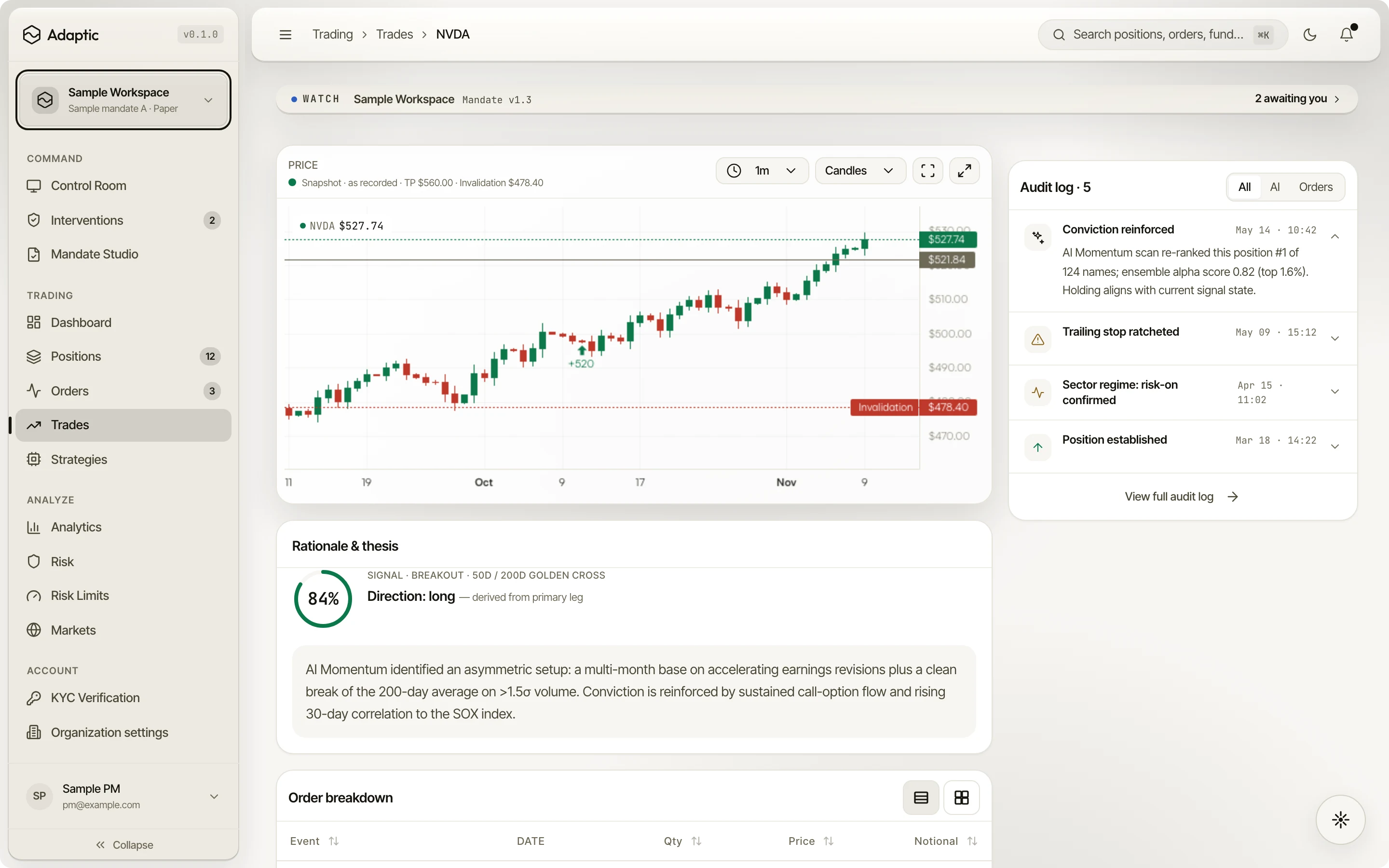
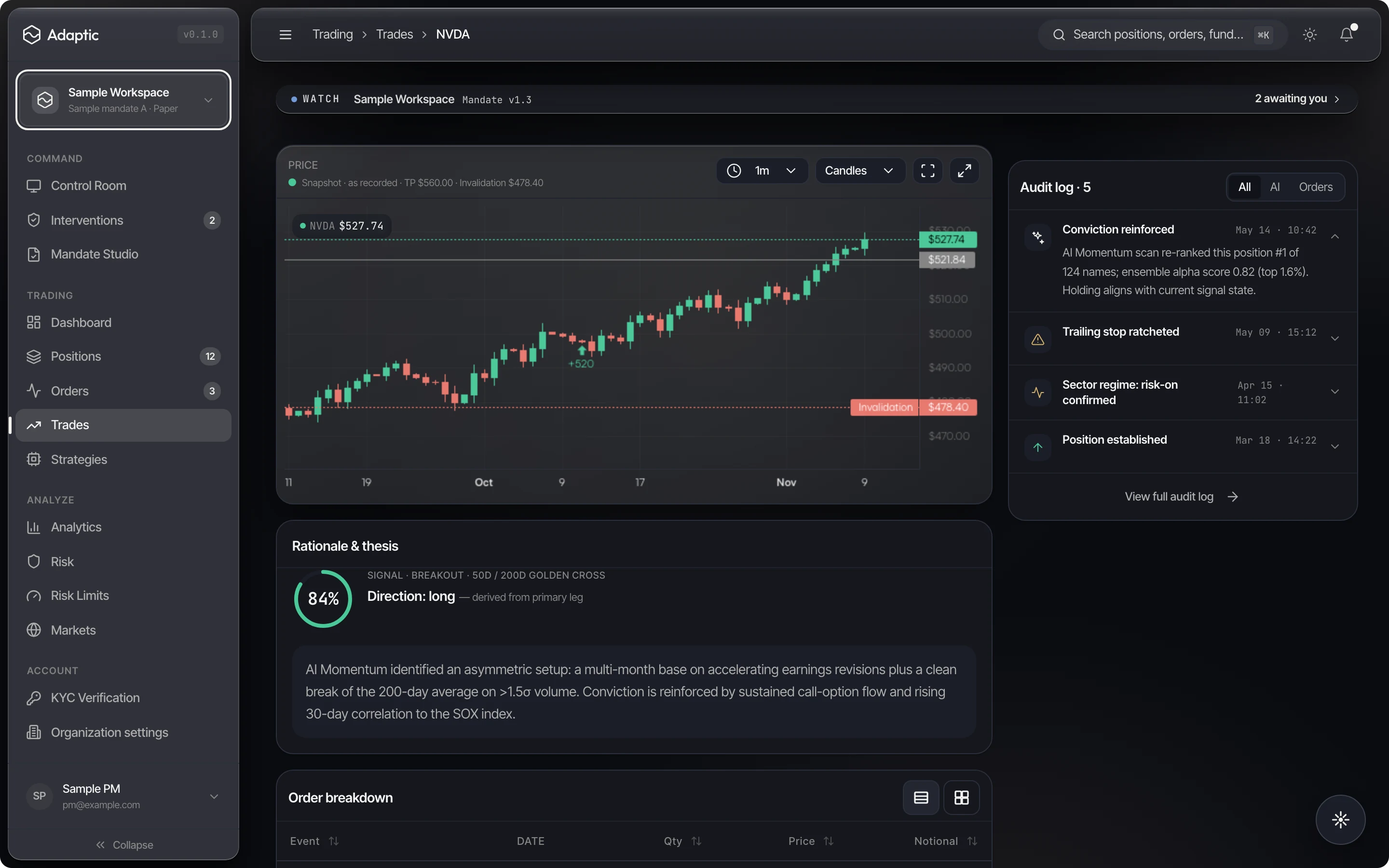
Open any trade in the Adaptic OS and read why it exists: the signal behind it, the thesis, the invalidation and target levels, the legs, how far it moved for and against you, and its audit trail.
Ask about your book.
Ada, the OS’s AI assistant, answers questions about your book in plain language from live data through read-only tools. It cannot place or cancel orders.
Written as it happens.
Illustrative sample data| When | Actor | Act | Control |
|---|---|---|---|
| 10:42:18 | Adaptic engine | Entry refused | single-name concentration 7.3% vs 7.0% limit |
| 11:05:02 | Adaptic engine | Position opened | invalidation 182.40 stated |
| 13:20:47 | Adaptic engine | Trailing stop moved | position stop |
| 14:02:11 | Portfolio manager (sample) | Intervention approved | rationale recorded, 1 of 2 |
| 14:09:36 | Risk officer (sample) | Intervention co-signed | 2 of 2 |
Decisions are recorded as new entries, with who and why.
Built for the people accountable for capital.
Set the limits once. The engine trades inside them, every order is checked before it reaches the broker, and the family’s advisers can read every decision.
What changes
- Limits per account that the engine enforces
- One switch that stops new entries
- Decisions with a written reason and a second signature
Where we are building. Jurisdiction by jurisdiction.
Adaptic is based in the DIFC and is preparing to operate in ADGM, the United Kingdom, Singapore and the European Union. Each component and each jurisdiction shows its current state below.
- 2
separate grants, in two systems, before any account can send orders to a broker
- 2
people to approve a mandate; the author cannot approve their own
- 5 min
between broker reconciliations in market hours; a mismatch halts new entries
Status
- Trading engine · US equities and two-leg options spreads, through the broker Running
- Pre-trade checks, account scope and entry halt Running
- Automatic protections · halts, trailing stops, end-of-day flatten Running
- Decision records · risk verdicts, trade audit, governance decisions Running
- Adaptic OS · Control Room, Interventions, Mandate Studio, book, risk, stress tests Running
- Ada, the OS’s AI assistant · read-only Running
- Order entry from the OS Switched off
- Approved mandate driving the enforced limits Roadmap
- Observatory screen for clients · trade lineage is recorded today Roadmap
- NAV strike and fee accrual · preview today In build
Jurisdictions
- DIFCNOW · LICENSING PENDING
- ADGMIN PROGRESS
- United KingdomIN PROGRESS
- SingaporeIN PROGRESS
- European UnionIN PROGRESS
A six-week shadow pilot. No capital at risk.
Your team works in its own Adaptic OS workspace on a broker paper account: your limits, your mandate, your approvers. Live market data, simulated execution.
- Weeks 1 to 2Set up.
Invite your team, connect a paper account, set the trading policy, write and approve the mandate.
- Weeks 3 to 4Watch it run.
The engine trades the paper account inside your limits. Your people watch, and decide what it raises.
- Weeks 5 to 6Review the record.
Read the trades, the decisions and the refusals. Proceed, revise or decline.
Start with a conversation.
Tell us who you are and what you are evaluating. A person reads every request.
Sample data on this page is illustrative. Nothing here is an offer.