Tokenized Fund Infrastructure: A Technical Framework for Digital Asset Management
A named reference architecture for institutional tokenized-fund infrastructure — token standard, transfer-restriction layer, registrar, NAV oracle, custody, and settlement — built layer by layer, with the failure modes, tradeoffs, and accountability controls that determine whether it survives contact with a regulated balance sheet.


Executive Summary
The institutional fund management industry is entering a period of structural transition. Tokenized fund vehicles --- funds whose shares are represented as digital tokens on distributed ledgers, with operational logic encoded in smart contracts --- are moving from proof-of-concept to production deployment. As of early 2026, over $12 billion in tokenized fund assets are managed across regulated structures in the United States, European Union, Singapore, and the UAE, with issuance accelerating as regulatory frameworks mature.
The problem this paper addresses is specific. Tokenization is frequently sold as a settlement-speed upgrade — replace T+2 with T+0 and the rest follows. It does not. A tokenized fund inherits the full obligation set of a regulated vehicle: eligibility enforcement, transfer restriction, an authoritative share register, defensible net asset value, segregated custody, and an audit trail a regulator can reconstruct. Move those obligations onto a ledger without re-architecting how they are enforced and recorded, and the result is the same operational fragility as before, now with irreversible transactions and a smaller margin for error. The hard problem is not making a fund move faster. It is making a fund whose state is correct, whose actions are accountable, and whose record is reconstructable, on rails where a mistake cannot be unwound.
This white paper provides a named reference architecture for institutional-grade tokenized-fund infrastructure, built layer by layer: the token standard and its transfer-restriction layer, the share registrar, the NAV oracle, custody and key management, the settlement engine, and the compliance system that binds them. For each layer it specifies the mechanism, the failure modes, and the tradeoffs — smart-contract, custody, regulatory, and liquidity risk — that determine whether the layer survives contact with a regulated balance sheet.
The intended audience is chief investment officers, heads of technology, and operational leadership at hedge funds, family offices, and asset managers evaluating tokenized fund structures for eligible and professional investors. The paper assumes familiarity with institutional fund operations and basic distributed ledger concepts. It does not assume deep smart contract engineering knowledge.
Tokenization is not an incremental efficiency gain layered onto existing fund infrastructure. It is a re-architecture of the fund itself --- from a collection of bilateral agreements and reconciled spreadsheets into a single programmable instrument whose eligibility, pricing, settlement, and audit trail are enforced in the rails rather than asserted after the fact.
Two principles run through every layer that follows. First, one record: the fund should keep one authoritative account of its own state — positions, holders, NAV, cash — spanning on- and off-chain rails, rather than reconciling competing ledgers held by six different service providers after the fact. Second, accountability as architecture: the controls that make a fund auditable and irreversible-act-safe — a clause-linked audit spine in the rails, policy-as-code enforced in the instrument, and named-human gating of irreversible operations — are not bolted on around the infrastructure. They are the infrastructure. The remainder of this paper describes what that looks like, and is honest about which parts are mature, which are maturing, and which remain unproven at institutional scale.
The Case for Tokenized Fund Vehicles
Structural Limitations of Traditional Fund Operations
Traditional fund structures operate on infrastructure designed for an era of paper-based record-keeping. Despite decades of digitization, the core operational model has changed remarkably little. Subscription and redemption requests are processed through transfer agents who maintain the fund's share register. Net asset value is calculated by fund administrators, typically published once daily with a lag of several hours after market close. Settlement of subscription and redemption flows occurs on T+1 to T+5 cycles depending on the fund type and jurisdiction. Compliance verification is performed at discrete checkpoints rather than continuously.
The deeper problem is not the latency of any single step. It is that no participant holds the authoritative record. A typical institutional fund maintains relationships with six to ten service providers --- transfer agent, fund administrator, custodian, legal counsel, compliance officer, auditor, prime broker, distributor --- each keeping its own ledger in its own format on its own cycle. The fund's true state — who owns what, what it is worth, what cash is committed — exists nowhere in one place. It is approximated by periodic reconciliation, and the gaps between reconciliation cycles are where breaks, errors, and disputes live. The resulting operational burden is substantial: industry estimates place the total cost of fund administration and operations between 15 and 40 basis points of assets under management annually, depending on fund complexity. That cost is the price of reconciling ledgers that should never have diverged.
The Tokenization Value Proposition
Tokenized fund structures address these limitations by collapsing the divergent ledgers into one programmable record and encoding fund operations directly against it. The value proposition is not theoretical, but each dimension carries a precondition — stated here, developed in the layers that follow.
Settlement compression. Tokenized fund shares settle atomically on-chain, reducing settlement cycles from days to seconds and eliminating the failed-trade reconciliation that consumes the back office. This eliminates principal settlement risk and frees capital otherwise locked during settlement windows — but only to the speed of the slowest off-chain leg. A redemption is no faster than the funding of the stablecoin that pays it, and atomicity protects only the legs that actually execute on-chain.
Continuous compliance. Investor eligibility, transfer restrictions, and jurisdictional requirements are enforced programmatically at the token level. Every transfer is validated against the fund's compliance ruleset before execution, closing the gap between compliance policy and enforcement — provided the ruleset encoded in the instrument is a faithful and current translation of the fund's legal obligations. Policy-as-code is only as correct as the policy it encodes.
Operational transparency. Fund operations --- subscriptions, redemptions, NAV strikes, fee crystallization, distributions --- execute against one on-chain record with a full audit trail. Investors, regulators, and auditors can independently verify fund state without relying on periodic reports from the administrator. Transparency is a property of the rails, not a report generated on top of them.
Fractional access. Token divisibility enables fractional share ownership, lowering minimum investment thresholds while maintaining the fund's institutional governance structure. A fund with a $1 million minimum can issue tokens representing $10,000 fractional interests without altering its legal structure or regulatory classification — subject to the eligibility constraints the transfer-restriction layer continues to enforce on every holder, fractional or not.
The Reference Architecture
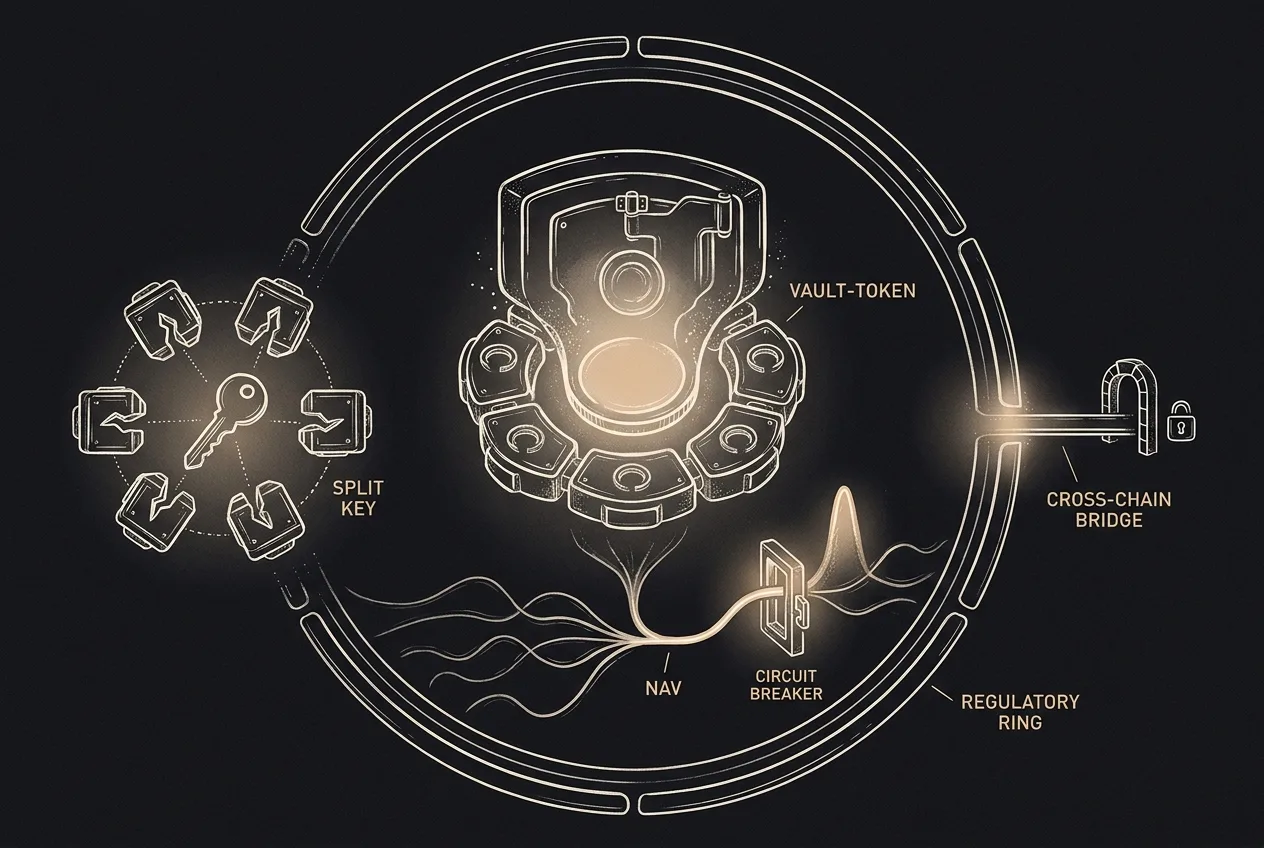
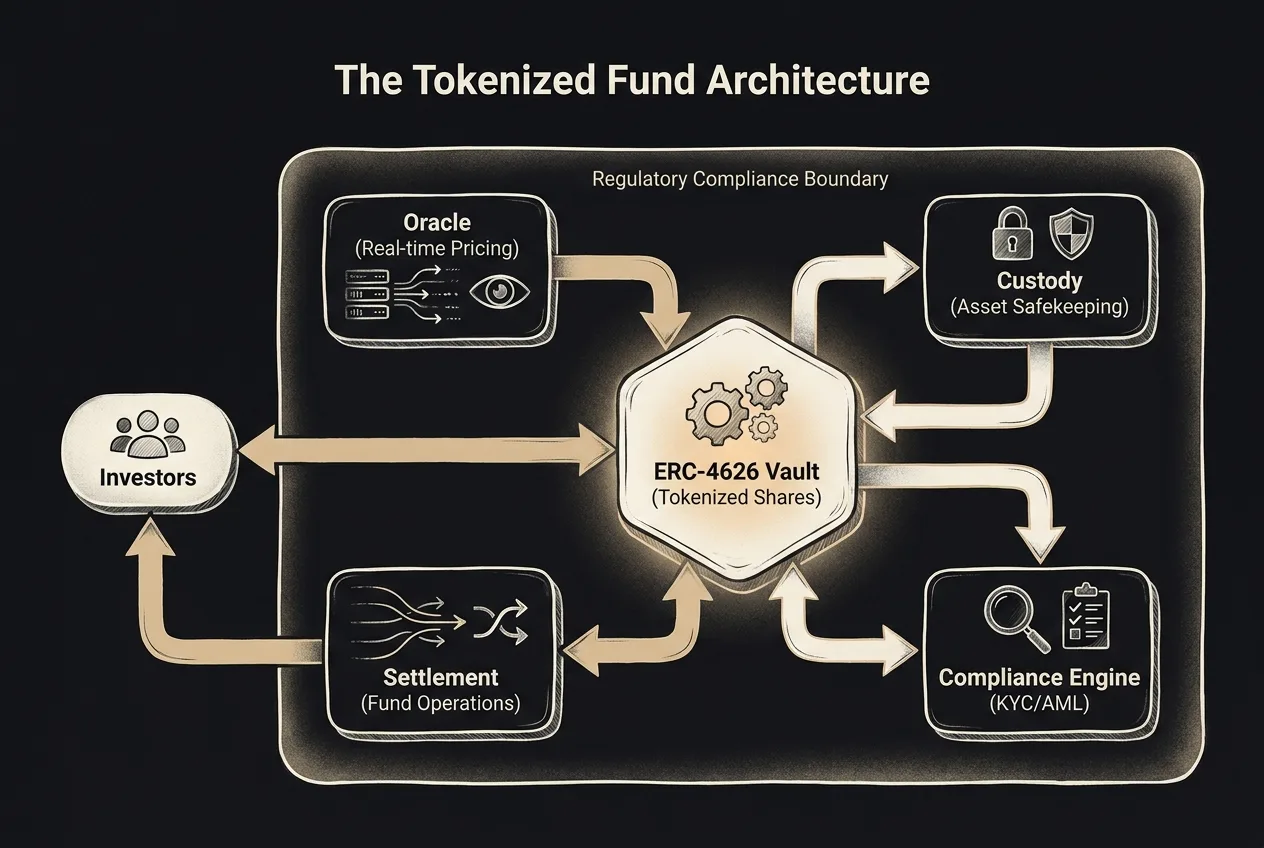
The infrastructure described in this paper is built from six layers, each with a single responsibility, composed so that the failure of one is contained rather than propagated:
- The vault and token contract — the instrument itself, holding the fund's assets and issuing the shares.
- The transfer-restriction layer — eligibility and compliance enforced in the token, on every transfer, before it executes.
- The share registrar — the authoritative on-chain record of who holds what, and the single source of truth the rest of the system reconciles against rather than around.
- The NAV oracle — the disciplined pipeline that brings off-chain valuation on-chain and gates its use when the data cannot be trusted.
- The settlement engine — the atomic exchange of shares for payment, bounded honestly by its off-chain legs.
- Custody and key management — control of the cryptographic keys that move the assets, and the named-human governance around their use.
A seventh concern, policy-as-code compliance, is not a layer but the connective tissue: the encoded ruleset that binds the others into one accountable instrument, developed alongside the transfer-restriction layer and revisited under regulatory risk. The layers are taken in turn through the remainder of the paper, with the regulatory landscape they must satisfy treated between settlement and custody.
Two structural properties cut across all of them and are introduced first, because every layer depends on them: the audit spine — the on-chain, append-only record of every state transition, each entry linked to the rule or instruction that authorized it, replayable by any party from genesis — and named-human gating — the requirement that no irreversible act executes autonomously. A NAV strike, a treasury wire, a redemption batch, a contract upgrade: each is prepared and validated by the system but remains a draft until a specific, authenticated, on-record human releases it. The audit spine makes the fund reconstructable. Named-human gating makes it accountable. The remaining layers are where the assets and the obligations actually live.
The Vault and Token Contract
ERC-4626 Tokenized Vaults
The ERC-4626 standard, ratified in 2022, provides a standardized interface for tokenized vault contracts --- smart contracts that accept deposits of an underlying asset and issue shares representing a proportional claim on the vault's holdings. The standard defines a consistent API for deposit, withdrawal, share pricing, and yield accounting, enabling composability across decentralized finance infrastructure.
For institutional fund vehicles, ERC-4626 provides the foundational abstraction but requires substantial extension. A production-grade tokenized fund vault must layer additional functionality on top of the base standard.
Share pricing logic. The base ERC-4626 standard computes share price as totalAssets / totalSupply. For a fund holding multiple asset classes, totalAssets must be derived from an oracle system that aggregates pricing data across traditional and digital asset markets. The vault contract must support configurable pricing methodologies --- mark-to-market, mark-to-model, or hybrid approaches --- depending on the liquidity characteristics of the underlying portfolio.
Subscription and redemption windows. Unlike permissionless DeFi vaults that accept deposits continuously, institutional funds typically operate with defined subscription and redemption windows --- daily, weekly, monthly, or quarterly. The vault contract must enforce these windows, queue requests received outside windows for the next processing cycle, and implement gate mechanisms that cap redemptions at a configurable percentage of fund NAV per period.
Fee crystallization. Management fees, performance fees, and hurdle rates must be computed and deducted on-chain according to the fund's fee schedule. Performance fee calculation requires tracking high-water marks per investor, computing returns net of management fees, and applying tiered fee structures. These computations must be gas-efficient and numerically precise, typically implemented using fixed-point arithmetic libraries to avoid floating-point rounding errors. Crystallization permanently transfers value from investors to the manager and is not reversible on-chain; it is therefore a gated act. The contract computes the crystallization and holds it as a pending entry, and a named administrator releases it only after the NAV it is struck against has itself been released. The audit spine records the computed amount, the high-water marks applied, the NAV reference, and the releasing party — so the fee can be reconstructed and defended years later from the chain alone.
Access Control and Role-Based Permissions
Institutional fund operations require granular role-based access control that extends well beyond simple owner-operator models. A production vault contract implements a role hierarchy with distinct privilege sets.
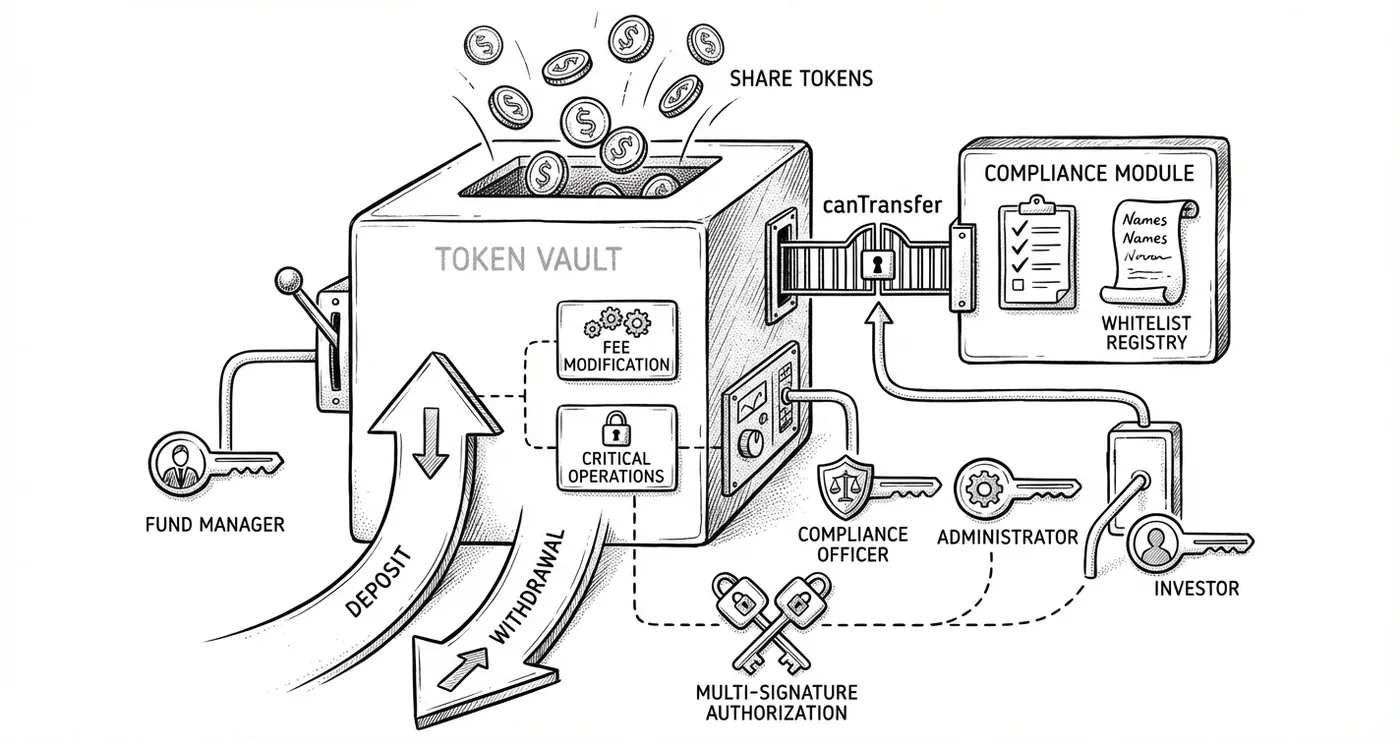
Fund manager. Authorized to execute investment decisions, adjust portfolio allocations, and modify operational parameters within bounds defined by the fund's governing documents. Cannot modify compliance rules or investor eligibility criteria.
Compliance officer. Authorized to update investor whitelists, modify transfer restrictions, and adjust jurisdictional compliance parameters. Cannot execute investment decisions or modify fee structures.
Administrator. Authorized to trigger NAV calculations, process subscription and redemption queues, and execute fee crystallization. Cannot modify portfolio allocations or compliance rules.
Investor. Authorized to submit subscription and redemption requests, view fund performance data, and transfer shares to other whitelisted addresses subject to compliance constraints.
This role separation is typically implemented using OpenZeppelin's AccessControl contract with custom role definitions. Roles are necessary but not sufficient: a role grants the capability to act, but the irreversible acts within a role — a fee-structure change, a NAV release, a treasury movement, a contract upgrade — must additionally be gated. The pattern that enforces this is a draft-and-release flow backed by multi-signature authorization. The privileged action does not execute when invoked; it is recorded as a pending proposal, and execution requires a threshold of independent signatures, at least one of which is a named human outside the operational role that proposed it — for example, a designated governance address controlled by the fund's board or advisory committee. The act is attributable to specific people, separable from routine operations, and reversible up to the moment of release. Every proposal, signature, and release lands on the audit spine, so authorization is reconstructable and not merely asserted.
The Transfer-Restriction Layer
The second layer is what makes a fund token a regulated instrument rather than a bearer asset. It enforces, in the token itself, on every transfer, who is permitted to hold the share — the on-chain expression of policy-as-code.
Compliance enforcement operates through a modular architecture. The core vault contract delegates transfer validation to an external compliance contract that implements a standardized interface. This separation of concerns allows compliance rules to be updated, under the gated upgrade flow above, without redeploying the vault that holds the assets.
The compliance module maintains several data structures: an investor whitelist mapping addresses to verified credential attestations, a jurisdictional restriction matrix defining which investor categories can hold tokens in which jurisdictions, and a transfer limit table enforcing maximum position sizes and concentration limits. Each entry is itself an authorized state change recorded on the audit spine — a whitelist addition is traceable to the compliance officer who made it and the attestation that justified it.
The design principle is defense in depth: compliance is not a single checkpoint but a series of independent validations, any one of which can halt an impermissible transaction.
When a token transfer is initiated, the vault contract calls the compliance module's canTransfer function, passing the sender, recipient, and amount. The compliance module evaluates the transfer against all active rules and returns a boolean result along with an error code if the transfer is rejected. This pattern, formalized in standards like ERC-1404 and ERC-3643, provides a consistent framework for regulated token transfers, and ERC-3643 additionally binds transfers to on-chain identity through an associated identity-registry contract.
The discipline this layer demands is translation fidelity. Eligibility, lock-ups, and jurisdictional restrictions are legal constructs; the contract enforces only their encoded form. A rule that is misencoded, or that lapses behind a changed obligation, fails silently — the chain keeps permitting transfers that the offering documents prohibit. The control is to treat the encoded ruleset as a governed artifact: every rule change is a gated, attributed, audit-logged act tied to the legal basis for it, and the encoded policy is reconciled against the fund's actual obligations on a defined cadence rather than assumed correct because it once was.
The Share Registrar
The transfer-restriction layer decides whether a transfer may happen; the registrar is the authoritative record of what is held once it has. In a traditional fund this is the transfer agent's book — the legal source of truth for ownership, distinct from any administrator's or custodian's copy. Tokenizing the fund does not remove the need for that record; it relocates it into the token contract's holder state and makes it the one record the rest of the system reconciles against rather than around.
For this to hold, the on-chain register must be the system of record by design, not a mirror of an off-chain book that can drift. The token contract's balances, the holder set the compliance module gates against, and the share count the NAV oracle divides into must be the same numbers, read from the same place. Where a legal register must exist off-chain for statutory reasons, the architecture designates one side as authoritative and the other as a derived projection, with a defined reconciliation that surfaces any divergence as an alert rather than absorbing it silently — because two registers that are each "sometimes right" reproduce exactly the reconciliation gap tokenization was meant to close. Corporate actions that change the register — splits, share-class conversions, forced redemptions under a regulator's order — are irreversible and therefore gated and recorded on the audit spine, so the holder record at any past block is reconstructable and defensible.
NAV Oracle Systems

The Oracle Problem in Institutional Context
Net asset value computation is the central pricing function of any fund vehicle. In traditional structures, NAV is calculated by the fund administrator using pricing data sourced from market data vendors, applied to the fund's portfolio holdings, and adjusted for accrued fees, pending transactions, and fair value estimates for illiquid positions. The result is typically published once daily, hours after market close.
Tokenized fund vehicles require on-chain NAV data to price subscriptions and redemptions executed through the vault contract. This creates a dependency on oracle systems --- mechanisms for delivering off-chain data to on-chain smart contracts. The reliability, accuracy, and manipulation resistance of the oracle system directly determines the integrity of the fund's pricing.
A NAV strike is an irreversible act. Once it is the price the contract uses, subscriptions and redemptions execute against it and value moves between entering, exiting, and remaining investors at that number. A wrong strike is a wealth transfer that is expensive and sometimes impossible to claw back on-chain. The oracle is therefore not only a data pipeline but a gate: the system computes a candidate NAV from aggregated inputs, but the strike that the vault prices against is released by a named administrator who has reviewed the candidate and its provenance, against the same separation of duties applied to every other irreversible operation. The audit spine records the inputs, the methodology version, the candidate, the releasing party, and the timestamp, so any historical strike is reconstructable and defensible against an investor or regulator challenge.
Multi-Source Price Aggregation
Production-grade NAV oracle systems aggregate pricing data from multiple independent sources to mitigate the risk of any single data feed being inaccurate, stale, or manipulated. A robust aggregation strategy combines several approaches.
Primary market feeds. Direct price feeds from regulated exchanges and market data vendors (Bloomberg, Refinitiv, ICE) provide the canonical pricing source for liquid instruments. These feeds are delivered to the oracle contract through a network of independent node operators who attest to the data's accuracy.
Time-weighted average price mechanisms. For digital assets traded on decentralized exchanges, TWAP oracles compute the average price over a configurable window --- typically 15 to 60 minutes --- to smooth out short-term volatility and reduce susceptibility to flash loan manipulation. The TWAP is computed using cumulative price accumulators that are updated with each block, making retroactive manipulation computationally infeasible for sufficiently long windows.
Deviation circuit breakers. The oracle contract monitors price updates for anomalous deviations. If a reported price deviates from the current on-chain price by more than a configurable threshold --- typically 5% to 10% depending on asset volatility --- the update is quarantined and escalated for manual review. This prevents erroneous or manipulated price feeds from corrupting the fund's NAV.
Staleness and Liveness Guarantees
Oracle data has a time dimension that must be managed explicitly. A price feed that was accurate an hour ago may be materially stale if the underlying market has moved significantly. The oracle contract enforces liveness constraints by rejecting price data older than a configurable maximum age. If no fresh price data is available for a given asset, the vault contract enters a degraded mode where subscriptions and redemptions are queued rather than executed, preventing transactions at stale prices. This is the same principle as named-human gating expressed in time: when the system cannot establish that the price is trustworthy, the default is to do nothing irreversible and hold the action as a queued draft until the condition clears or a human intervenes — never to transact on the assumption that stale is close enough.
For funds holding assets across multiple time zones and market sessions, the oracle system must account for the asynchronous nature of global markets. A fund holding both US equities and Asian fixed income will have fresh prices for some positions while others are priced at the previous session's close. The NAV computation must handle this explicitly, applying fair value adjustments for positions priced at stale levels.
The Settlement Engine
T+0 Atomic Settlement
The most immediately measurable advantage of tokenized fund infrastructure is settlement compression. Traditional fund settlement involves a sequence of bilateral message exchanges between the investor, transfer agent, fund administrator, and custodian, each introducing processing delay and reconciliation overhead. The total settlement cycle for a typical hedge fund redemption ranges from T+1 for daily-liquidity vehicles to T+90 or longer for illiquid alternatives.
On-chain settlement is atomic: the exchange of fund tokens for payment tokens occurs in a single transaction that either completes entirely or reverts entirely. There is no partial settlement, no failed-trade reconciliation, and no principal risk during the settlement window because there is no settlement window. The investor's redemption proceeds and the fund's share cancellation execute simultaneously.
This atomicity is implemented through a settlement contract that coordinates the token transfer. When an investor submits a redemption request, the vault contract calculates the redemption amount based on the released NAV strike, locks the investor's fund tokens, and initiates a transfer of payment tokens (typically a regulated stablecoin such as USDC or USDT) from the fund's treasury to the investor's address. Both legs execute within the same atomic operation.
The honest boundary of this guarantee matters. Atomicity holds across the legs that are on-chain. It says nothing about the legs that are not: the fund's underlying portfolio may settle on traditional rails on T+1 or T+2, and the stablecoin paid to the investor must be funded and is itself a claim on an off-chain issuer. T+0 finality describes the share-for-stablecoin swap, not the round trip from underlying liquidation to investor cash. For a fund holding only on-chain assets the chain is short; for a fund holding traditional securities, on-chain atomicity is one fast link in a chain whose slowest off-chain link still sets the true cycle time. Naming this boundary is what separates an institutional treatment from a marketing one — and the gate before treasury disbursement is the same named-human release applied to every other movement of fund cash.
Gate Mechanisms and Liquidity Management
Atomic settlement does not eliminate the need for liquidity management. A fund holding illiquid underlying positions cannot honor unlimited redemptions regardless of how efficiently the settlement mechanism operates. Tokenized fund vaults implement gate mechanisms that enforce per-period redemption limits, typically expressed as a percentage of fund NAV.
When aggregate redemption requests for a given period exceed the gate threshold, the vault contract processes requests on a pro-rata basis, fulfilling each request proportionally and queueing the remainder for the next redemption window. This logic, which in traditional structures requires manual calculation and investor communication, executes deterministically on-chain with full transparency into queue position and expected processing timeline, and each gating decision is recorded on the audit spine.
The tradeoff this layer encodes is the liquidity-mismatch problem that no settlement speed can dissolve: a fund offering more redemption liquidity than its underlying portfolio can supply is structurally fragile, and faster rails make a run faster, not safer. The gate makes the fund's liquidity terms explicit and enforces them impartially across all holders. What it cannot do is conjure liquidity the portfolio does not have. The gate parameters themselves are governance-controlled, and changing them — particularly tightening them under stress, the moment investors are most sensitive — is an irreversible, consequential act that is gated and recorded, not adjusted quietly.
Regulatory Framework
A Multi-Jurisdictional Landscape
Tokenized fund vehicles operate at the intersection of securities regulation, digital asset regulation, and fund management regulation. The regulatory landscape varies significantly by jurisdiction, and institutional fund sponsors must navigate a complex matrix of requirements that are evolving rapidly.
DIFC Digital Asset Regime
The Dubai International Financial Centre has established one of the most comprehensive regulatory frameworks for tokenized fund structures. The DFSA's Digital Asset Regime, effective since 2024, provides a clear classification framework for investment tokens and establishes specific requirements for tokenized fund vehicles, including custody standards, disclosure obligations, and technology governance requirements. The regime distinguishes between security tokens (which fall under existing securities regulation) and other digital assets, providing regulatory clarity that has attracted significant institutional issuance.
MAS Framework (Singapore)
The Monetary Authority of Singapore has adopted a technology-neutral approach to tokenized fund regulation. Tokenized fund shares are classified as capital markets products under the Securities and Futures Act, subjecting them to existing prospectus, licensing, and conduct-of-business requirements. MAS has supplemented this framework with specific guidance on digital token offerings and has established Project Guardian, a collaborative initiative with industry participants to develop institutional-grade tokenized asset infrastructure. The framework emphasizes interoperability standards and investor protection while maintaining flexibility for innovation.
SEC Guidance (United States)
The U.S. regulatory environment for tokenized funds remains the most complex among major financial centers. The SEC has maintained that most tokenized fund interests constitute securities under the Howey test and are subject to full registration requirements under the Securities Act of 1933 and the Investment Company Act of 1940. Fund sponsors must navigate exemptions --- typically Regulation D for private placements or Regulation S for offshore offerings --- and comply with ongoing reporting and anti-fraud obligations. The SEC's emphasis on substance-over-form analysis means that the tokenized nature of fund shares does not alter the underlying regulatory classification.
CSSF Approach (Luxembourg)
Luxembourg's Commission de Surveillance du Secteur Financier has taken a pragmatic approach to tokenized fund vehicles. The CSSF permits tokenized shares within existing fund structures (UCITS and AIFs) provided the fund's depositary can demonstrate adequate custody capabilities for digital assets and the fund's prospectus adequately discloses the risks associated with tokenized share classes. This approach allows fund sponsors to add tokenized share classes to existing fund vehicles without establishing entirely new structures, significantly reducing time-to-market and regulatory complexity.
Custody and Key Management

The Custody Imperative
Custody of the cryptographic keys that control tokenized fund assets is the single most critical operational consideration in tokenized fund infrastructure. Unlike traditional fund assets, where custody involves maintaining records at a central securities depository, digital asset custody requires securing private keys --- cryptographic secrets that provide irrevocable control over on-chain assets. Loss or compromise of these keys results in permanent, unrecoverable loss of assets.
Multi-Party Computation Wallets
Multi-party computation (MPC) has emerged as the institutional standard for digital asset key management. MPC distributes the private key across multiple independent parties, such that no single party ever possesses or can reconstruct the complete key. Transaction signing requires a threshold number of parties to contribute their key shares to a distributed signing protocol, producing a valid signature without any party revealing their share to any other party.
For institutional fund custody, MPC offers several advantages over traditional multi-signature schemes. MPC operates at the cryptographic layer rather than the smart contract layer, making it blockchain-agnostic. It does not require on-chain multi-signature contracts, avoiding the gas costs and complexity associated with on-chain signature verification. And it provides key refresh capabilities --- the ability to generate new key shares without changing the underlying public key or on-chain address --- enabling periodic rotation of custodial access without asset movement.
Hardware Security Module Integration
Production-grade custody infrastructure deploys key shares within hardware security modules --- tamper-resistant computing devices that perform cryptographic operations without exposing key material to the host system. HSMs provide physical security guarantees: attempts to extract key material trigger zeroization (automatic key destruction), and the devices keep their own audit logs of all operations, in which any alteration is detectable.
The integration architecture typically pairs MPC with HSM deployment. Each MPC participant stores their key share within a dedicated HSM, and the distributed signing protocol executes across HSMs connected through authenticated, encrypted channels. This architecture ensures that key material is never exposed in software, even during the signing process.
Operational Controls
Institutional key management extends beyond the cryptographic infrastructure to encompass operational governance. A comprehensive key management framework defines policies for key generation ceremonies (performed in physically secured environments with multiple witnesses), key share distribution (each share held by a different authorized individual or entity), backup and recovery procedures (encrypted backups stored in geographically distributed secure facilities), and succession planning (documented procedures for transferring custodial access in the event of personnel changes).
Custody is where named-human gating is least negotiable, because a signature here moves assets irreversibly with no contract-level draft state to fall back on. A transaction-signing policy enforced at the custody layer — co-signing thresholds, address allowlists, per-transaction and per-period value limits, time-locks on first-time destinations — is the mechanism that makes a treasury movement a gated act rather than a single point of unilateral control. The aim is that no individual can move fund assets alone, every signed transaction is attributable to the specific people who authorized it, and the authorization record sits on the audit spine alongside the on-chain effect it produced. Key-management governance and contract-level governance are the same accountability discipline applied at two layers; they must agree, so that an act the contract treats as gated is not quietly un-gated by the way its signature is produced.
Interoperability and Cross-Chain Considerations
The Fragmented Landscape
The institutional blockchain ecosystem is fragmented across multiple networks. Ethereum remains the dominant platform for tokenized fund issuance, but purpose-built institutional networks --- Canton, Provenance, Polygon, Avalanche subnets --- are gaining traction for specific use cases. Each network offers different tradeoffs in transaction throughput, finality guarantees, privacy capabilities, and regulatory acceptance.
For institutional fund infrastructure, this fragmentation creates a practical challenge, and it is in direct tension with the one-record principle. Fund tokens issued on one network may need to interact with investors, payment systems, and secondary markets on others, and the moment the same share can exist on two chains, the question of where the authoritative holder record lives becomes acute. Interoperability is not a feature that can be retrofitted. It must be designed into the fund's architecture from inception, with one chain designated as the registrar of record and any representation elsewhere treated as a derived, reconcilable projection — never as a second independent ledger of ownership.
Standards-Based Token Design
The foundation of cross-chain interoperability is adherence to token standards that are recognized across networks. ERC-4626 vaults on Ethereum-compatible chains provide a consistent interface for vault operations. The ERC-3643 standard for regulated tokens (incorporating identity verification and transfer restrictions) provides a framework for compliance-aware interoperability. Fund tokens designed to these standards can be represented on other networks while preserving their compliance properties, provided the target network supports equivalent compliance verification — a fund token that loses its transfer restrictions when it crosses a bridge has become an unregulated bearer asset, which is a compliance failure, not an interoperability feature.
Cross-Chain Messaging and the Bridge Tradeoff
Beyond token movement, institutional fund operations require cross-chain message passing for NAV publication, compliance attestation synchronization, and corporate action notifications. Protocols like Chainlink CCIP and LayerZero provide general-purpose message passing, but institutional adoption requires guarantees around message ordering, delivery confirmation, and dispute resolution that these protocols are still maturing.
The unavoidable tension is that the bridges and messaging layers enabling cross-chain operation are themselves the most concentrated point of risk in the entire architecture. Bridges --- the mechanisms that move tokens and messages between networks --- have been the source of the industry's largest losses, with historical exploits exceeding $2 billion. The prudent posture, and the one consistent with the rest of this architecture, is to minimize bridge dependency rather than design around it: keep core fund operations — the register, the NAV, the gate — on a single chain of record; treat any cross-chain representation as a projection that can be frozen without halting the fund; cap the value transiting any single bridge in a period; and select bridges on the basis of their security model (cryptographic proof over trusted validator set), track record, and insurance, evaluated as one would evaluate a counterparty rather than a utility. A multi-chain fund is harder to keep honest than a single-chain one; the decision to become one should be made deliberately and priced for the risk it adds.
Risk Vectors
Smart Contract Risk
Smart contract risk is the most frequently cited concern in institutional evaluations of tokenized fund infrastructure. Smart contracts are deterministic programs: they execute exactly as written, including any defects in their logic. A bug in a fund vault's share pricing logic, fee calculation, or redemption processing could result in material financial loss, and on-chain transactions are generally irreversible.
Mitigation requires a layered approach: formal verification of critical contract logic using mathematical proof systems, multiple independent security audits by specialized firms, extensive testing across adversarial scenarios, staged deployment with conservative position limits during initial operation, and time-locked upgrade mechanisms that allow the fund's governance structure to correct defects before they can be exploited at scale.
Oracle Manipulation
Oracle manipulation represents a systemic risk for any on-chain fund vehicle that relies on external price data. An attacker who can influence the NAV oracle can extract value from the fund by subscribing at artificially low NAV or redeeming at artificially high NAV. Historical oracle manipulation attacks in decentralized finance have exploited thin liquidity, flash loan-enabled price distortion, and compromised data feed operators.
Institutional-grade oracle systems mitigate these risks through multi-source aggregation (requiring consensus across independent price feeds), TWAP smoothing (filtering short-term price distortions), deviation thresholds (rejecting anomalous price updates), and economic incentive alignment (requiring oracle operators to post collateral that is slashed for inaccurate reporting).
Bridge Exploits
Cross-chain bridge exploits represent the highest-severity risk vector in multi-chain fund infrastructure. Bridge attacks typically exploit vulnerabilities in the bridge's validator set (compromising a sufficient number of validators to forge cross-chain messages), its smart contract logic (exploiting reentrancy, integer overflow, or access control defects), or its cryptographic assumptions (breaking the security of the bridge's signature scheme or proof verification).
The mitigations are the single-chain-of-record posture and bridge-as-counterparty discipline developed in the interoperability section: keep core operations on one chain, cap per-bridge exposure, and maintain the ability to freeze any cross-chain representation without halting the fund.
Custody and Operational Risk
The risks above are exploits against code; custody risk is the irreversible consequence of a single mishandled key. Loss of a key share renders assets unrecoverable; compromise of a threshold of shares renders them stealable; and a poorly governed signing process can move assets without the authorization the fund believes it requires. This risk is not mitigated by cryptography alone but by the named-human gating, separation of duties, and signing-policy controls developed in the custody section — the assurance that no single party can move fund assets and that every movement is attributable and reconstructable from the audit spine. Custody is the layer where the gap between a well-designed control and an actually-enforced one is most expensive, and where operational drift — a relaxed threshold, an un-rotated share, an allowlist exception that became permanent — is the realistic failure mode rather than a cryptographic break.
Regulatory and Legal Risk
The regulatory landscape for tokenized fund vehicles is evolving rapidly, and regulatory risk cannot be mitigated through technology alone. Fund sponsors must maintain ongoing engagement with regulators in each jurisdiction where the fund operates, monitor legislative and regulatory developments that could affect the fund's structure or operations, and build flexibility into the fund's compliance architecture to accommodate regulatory changes without requiring complete redeployment. This is the practical payoff of policy-as-code in a modular compliance layer: when an obligation changes, the response is a governed, audited update to the encoded ruleset rather than a migration of the assets. The residual risk is the translation risk named earlier — a regulatory change correctly understood by counsel but incorrectly or belatedly encoded — which is an organizational discipline, not a contract feature.
The most resilient tokenized fund architectures are designed for regulatory adaptability --- modular compliance systems whose encoded rules are a governed, audited translation of current legal obligation, updatable without disrupting the fund's core operational logic.
Conclusion: The Architectural Principle
The six layers of this reference architecture — vault, transfer-restriction layer, registrar, NAV oracle, custody, and settlement engine — are individually implementable with tools and standards that exist today and operate in production across regulated jurisdictions. The building blocks are not the hard part. The honest assessment is that some are mature (the token standards, MPC custody, multi-source oracles), some are maturing (cross-chain messaging with institutional delivery guarantees), and some remain genuinely unproven at institutional scale (the operational discipline of running a fund whose every irreversible act is correctly gated, and whose encoded policy never drifts from its legal obligation). This paper has tried to name which is which rather than present the whole as finished.
What unifies the layers is not the ledger. It is a single architectural principle: the controls that make a fund trustworthy belong in the rails, not around them. A tokenized fund is well-built to the degree that its eligibility is enforced in the instrument rather than asserted by a checkpoint; its record is one authoritative account rather than a reconciliation of competing books; its irreversible acts — a NAV strike, a wire, a redemption batch, an upgrade — stay drafts until a named human releases them rather than executing autonomously; and its entire history is replayable from an on-chain audit spine where every state transition is linked to the rule or instruction that authorized it. Accountability, on this view, is not a policy layered over the system. It is a structural property of the system.
This is the same principle Adaptic applies to AI-managed capital generally: the leverage comes from better policy enforced in the rails, not from more headcount reconciling the gaps that weak rails leave behind. Tokenization is one expression of it — the case where the rails happen to be a distributed ledger and the irreversibility is literal. The discipline transfers because the principle does.
For institutional fund managers, the practical path follows from the principle. Begin with a defined scope — a single vehicle, a single jurisdiction, a single chain of record, a limited eligible-investor base — and prove the controls before widening any of them. Demand pre-authorization evidence rather than assurances: that the gates actually hold, that the encoded policy matches the offering documents, that a regulator could reconstruct any past state from the chain alone. Build operational competence on a small surface where a mistake is survivable, then extend the same architecture to additional vehicles. The technology is modular by design; the accountability discipline is what must be proven, and it is proven by demonstration, not by claim.