The Modern Family Office Technology Stack: From Spreadsheets to Institutional Infrastructure
Why family offices are replacing six custodian statements and a dozen spreadsheets with a single governed record across every manager and asset class.


Ask a family office principal what the family is worth and the honest answer is often a date: as of last quarter, give or take a private mark and a currency rate. The number lives nowhere as a single authoritative figure. It is assembled, days after the fact, from a brokerage portal, two fund administrators, a property manager's email, and a spreadsheet that one analyst understands. Family offices collectively manage more than $6 trillion in global assets, yet a striking number cannot produce, on demand, an accurate consolidated view of the wealth they steward.
This is not a tooling problem to be solved with a better spreadsheet. As family offices move into alternatives, direct deals, and multi-generational wealth spread across jurisdictions, the operational demands have outgrown the entire reconciliation-by-hand model. The institutional answer is not more tools but fewer: one governed record of the family's holdings, one data model spanning every manager and asset class, and one audit trail that explains how every number was produced. This essay traces that path from spreadsheets to institutional infrastructure, and is candid about where the transition is genuinely hard.
The Family Office Technology Gap
The technology deficit in family offices is not a matter of negligence. It is a product of history. Most family offices evolved from the personal financial management of a single wealth creator, gradually expanding in scope and complexity as assets grew and family branches multiplied. Technology decisions were made incrementally, often by individuals without dedicated technology expertise, resulting in a patchwork of disconnected tools and manual processes.
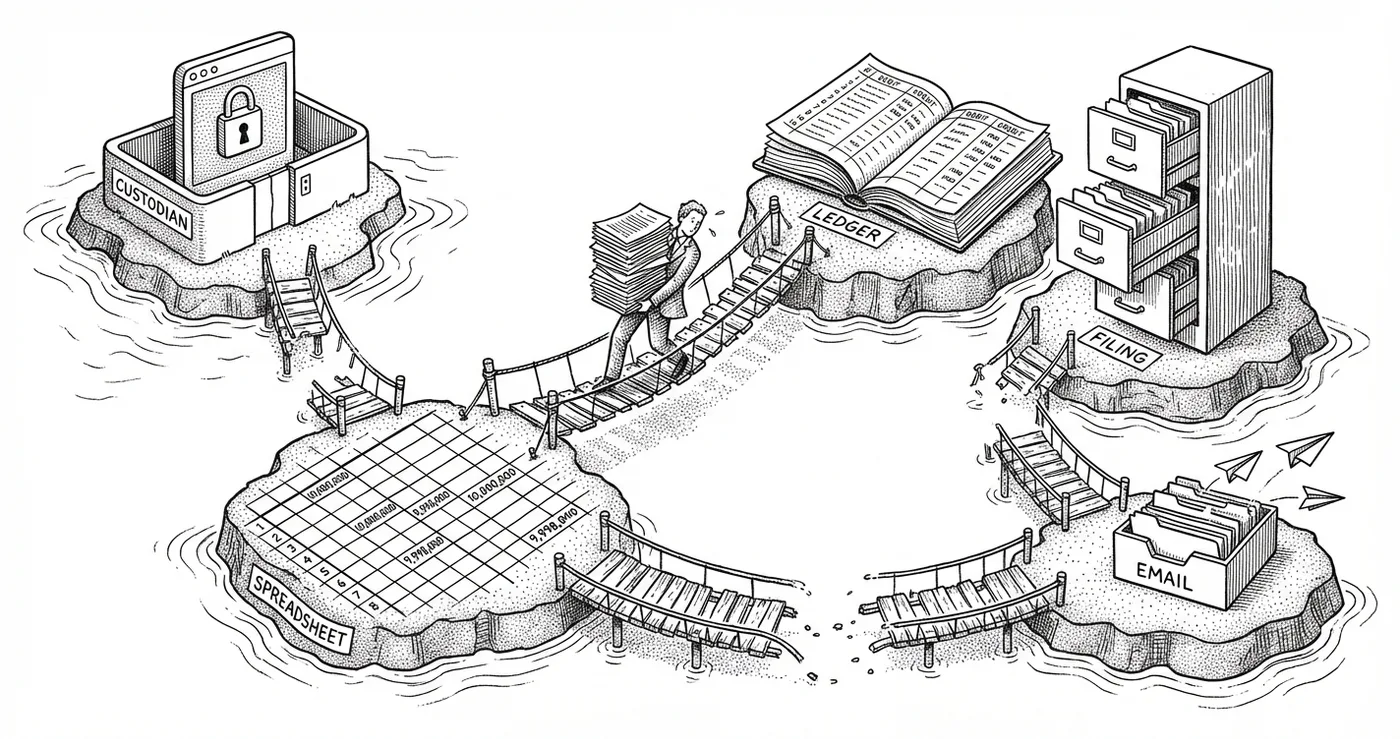
A typical family office technology environment might include a custodian portal for viewing holdings, a separate accounting system for bookkeeping, spreadsheets for performance tracking, email for document sharing, and a filing cabinet, physical or digital, for tax records. Each component functions adequately in isolation. Together they create an operational environment defined by data silos, manual reconciliation, and acute key-person risk: the family's true financial picture exists only as the merged output of several systems, and often only inside one analyst's working knowledge of how to merge them.
The consequences compound. When portfolio data lives in multiple disconnected systems, generating a consolidated view of family wealth costs hours of manual effort and is stale before it is finished. When performance attribution depends on spreadsheet formulas, error risk grows with every new asset class or account. When risk monitoring relies on periodic manual analysis, the family is effectively flying blind between reviews. None of these failures is visible in good markets; each surfaces precisely when conditions turn and the cost of not knowing is highest.
The deeper problem is structural. Fragmentation is not a list of inconveniences to be patched one by one; it is the absence of a single source of truth. Every downstream capability a family office wants, accurate reporting, defensible attribution, real-time risk, tax-aware execution, depends on that foundation existing first. For single-family offices managing $500 million or more it is a material operational risk; for multi-family offices serving several principals it is the constraint that caps how many relationships the office can serve without proportionally adding headcount.
From Spreadsheets to Consolidated Portfolio Views
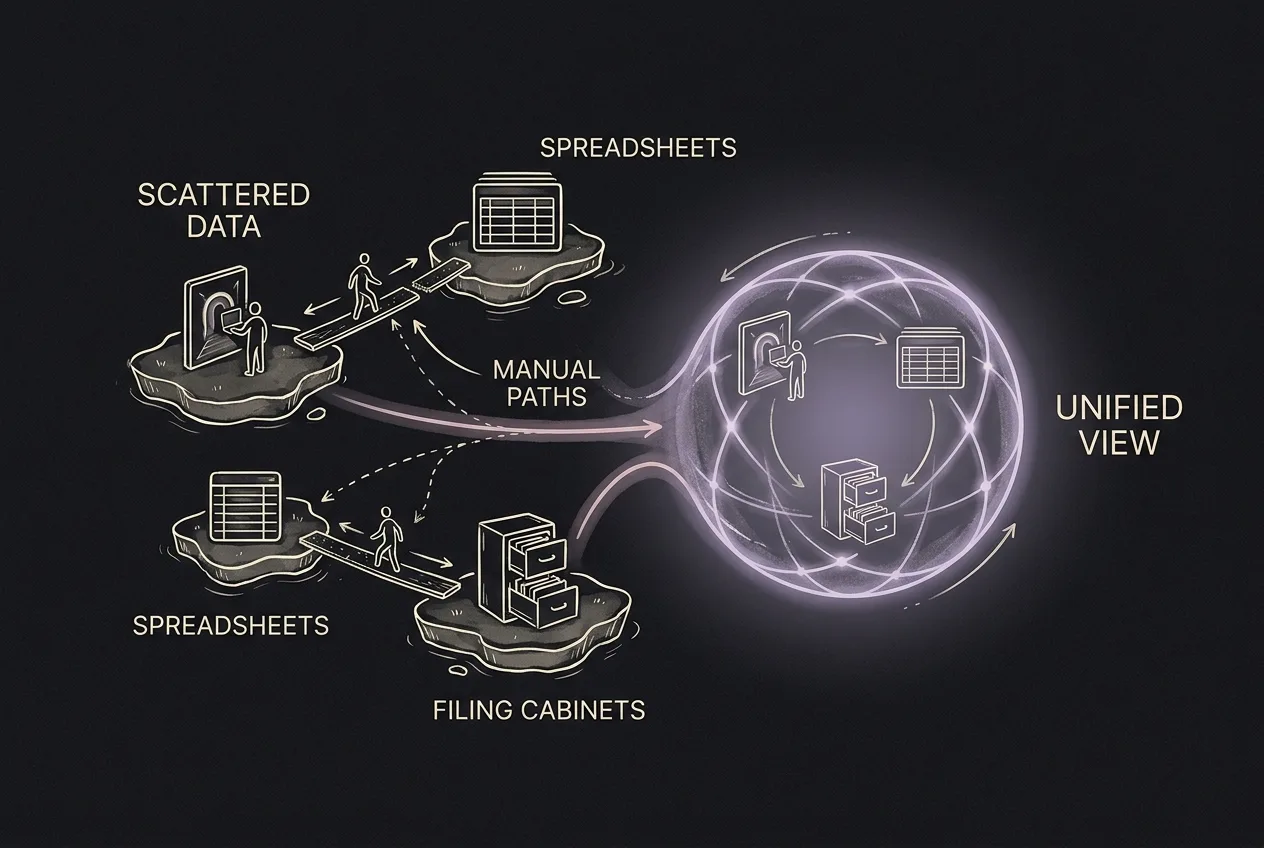
The most immediate pain point is the absence of a single, accurate, current view of total family wealth. It sounds like a basic requirement. It is surprisingly hard to satisfy when assets are spread across multiple custodians, asset classes, and legal entities, because the obstacle is not display but representation: there is no shared structure into which all of it fits.
A typical ultra-high-net-worth family might hold public equities at one brokerage, fixed income at another, private equity commitments through several fund administrators, real estate through various holding companies, and digital assets on one or more exchanges. Each position reports in its own format, on its own schedule. Staff manually aggregate it to produce anything resembling a consolidated view, and each manual step is a place where the truth can quietly diverge: figures transcribed between systems, timing mismatches between statements, currency conversions struck at inconsistent rates. By the time the report is assembled, the data underneath it has moved.
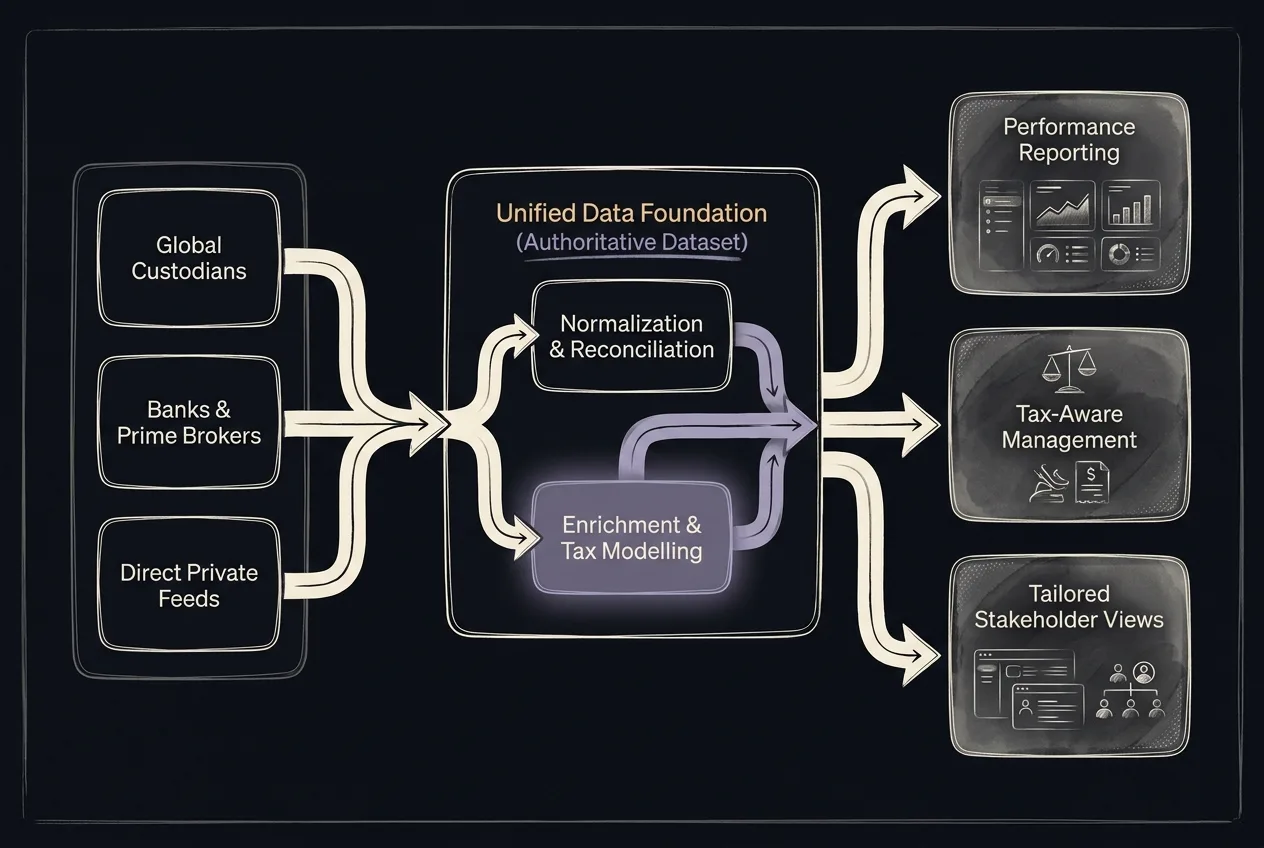
The institutional fix is not a better aggregation routine bolted onto the same fragmentation. It is one data model: a single normalized representation of a position, a transaction, an entity, and a valuation, into which every custodian and administrator feed is mapped on arrival. Direct connections pull position and transaction data automatically; the platform reconciles it against the model and maintains one consolidated record that updates continuously. The family office stops manufacturing the consolidated view each quarter and starts querying a record that is already consolidated, and gains the ability to analyze the portfolio as one book rather than a stack of disconnected statements.
Multi-Custodian Aggregation Challenges
Aggregating data across multiple custodians is more complex than it might appear. Each custodian has its own data formats, reporting schedules, and classification schemes. Security identifiers may differ between systems. Corporate actions may be reflected at different times. Cash balances may or may not include pending settlements.
These discrepancies create reconciliation challenges that consume significant staff time and introduce operational risk. A position that appears in one custodian's report but not another's may reflect a legitimate transfer in progress, a corporate action not yet processed, or a genuine error. Distinguishing between these possibilities requires domain expertise and access to multiple systems simultaneously.
The institutional response inverts the workflow. Instead of staff comparing reports line by line, a reconciliation engine compares each feed against the consolidated record, flags discrepancies, classifies them by likely cause, and surfaces only genuine exceptions for human review. The break does not disappear; it is routed to the one person who should decide it, with the evidence attached. Staff time shifts from reconstructing the truth to adjudicating the handful of cases the machine cannot resolve on its own, which is exactly the division of labour a family office should want: machines operate the reconciliation, humans govern the judgment calls.
For families with trusts, partnerships, and holding companies, consolidation is only the first requirement. The same data model has to encode the legal-entity hierarchy, attribute each asset to its beneficial owners, and support look-through that reveals the family's true economic exposure regardless of how a position is legally wrapped. A 30 percent stake in an operating company held three layers deep through an LLC and two trusts is a concentration the family must see as concentration, not as three unrelated line items. Without entity structure in the model, look-through is impossible; with it, the same record answers both legal-ownership and economic-exposure questions without a second reconciliation.
Real-Time Performance Attribution Across Asset Classes
Performance measurement is where the technology gap becomes most consequential. Family offices that rely on manual processes typically produce performance reports quarterly, often with a significant lag. These reports may cover public market holdings adequately but struggle to incorporate alternatives, real estate, and direct investments in a meaningful way.
The challenge is particularly acute for performance attribution, the analysis of what drove portfolio returns. Was outperformance due to asset allocation decisions, manager selection, or simply market beta? Did the private equity allocation contribute or detract from overall returns on a risk-adjusted basis? How did currency exposure affect the portfolio? These questions require sophisticated analytical capability applied to comprehensive, accurate data.
Credible attribution depends on the foundation laid earlier. An attribution engine can decompose returns across asset classes, geographies, currencies, and vehicles only because it sits on a complete, consolidated transaction history and applies one consistent valuation methodology across the whole book. Attribution computed over fragmented data is not analysis; it is the propagation of reconciliation errors into a decimal-precise figure that looks authoritative and is not. The same record that consolidates the portfolio is what makes the decomposition trustworthy.
Illiquid assets impose a genuine constraint that no platform removes. Private equity and venture positions are valued from recent transactions, comparable analysis, or fund-manager marks; real estate depends on periodic appraisals; all of these are estimates that update infrequently and embed their own assumptions. The honest objective is not false precision but disciplined consistency: apply a documented methodology, record which valuation source and date produced each mark, and let attribution distinguish realized results from unrealized marks rather than blending them into a single return that overstates what is actually known. A platform earns trust here by making the provenance of every valuation explicit, not by hiding the uncertainty behind a tidy number.
Risk Management for Concentrated Portfolios
Family office portfolios are frequently characterized by significant concentration, whether in a founding company's stock, a particular sector, a single geographic market, or illiquid assets that cannot be readily diversified. This concentration creates risk profiles fundamentally different from those of diversified institutional portfolios, requiring risk management approaches tailored to the family's specific circumstances.
Traditional risk metrics like Value-at-Risk and standard deviation, while useful, often fail to capture the full risk picture for concentrated portfolios. A family with 40% of its wealth in a single public company faces a qualitatively different risk than a diversified endowment with the same total assets. The family office needs tools that can model concentration risk, simulate liquidity events, analyze hedging strategies, and stress-test the portfolio against scenarios specific to the family's unique exposures.
Scenario engines, Monte Carlo simulation, and liquidity modeling exist to answer the questions a principal actually asks: what happens to total wealth if the founding company's stock falls 50 percent; how long the family can sustain current spending if public markets decline 30 percent and private assets turn hard to exit; what hedge is optimal given the family's tax position and concentrated holdings. These answers are only as good as the consolidated record beneath them. Run the same model on a portfolio that omits the look-through exposure buried in a holding company, and it will confidently understate the very concentration it was built to measure. Risk analytics do not substitute for a single source of truth; they presuppose one.
For multi-generational family offices, risk management extends beyond portfolio analytics to encompass estate planning scenarios, philanthropic commitments, and lifestyle spending projections. The technology platform must integrate investment risk analysis with broader wealth planning to provide a complete picture of the family's financial resilience.
Tax-Aware Investment Management at Scale
Tax management is arguably the single largest source of value a family office can provide, yet it is also one of the areas most poorly served by existing technology. The interaction between investment decisions and tax consequences is extraordinarily complex, particularly for families with holdings across multiple jurisdictions, entity types, and tax lots.
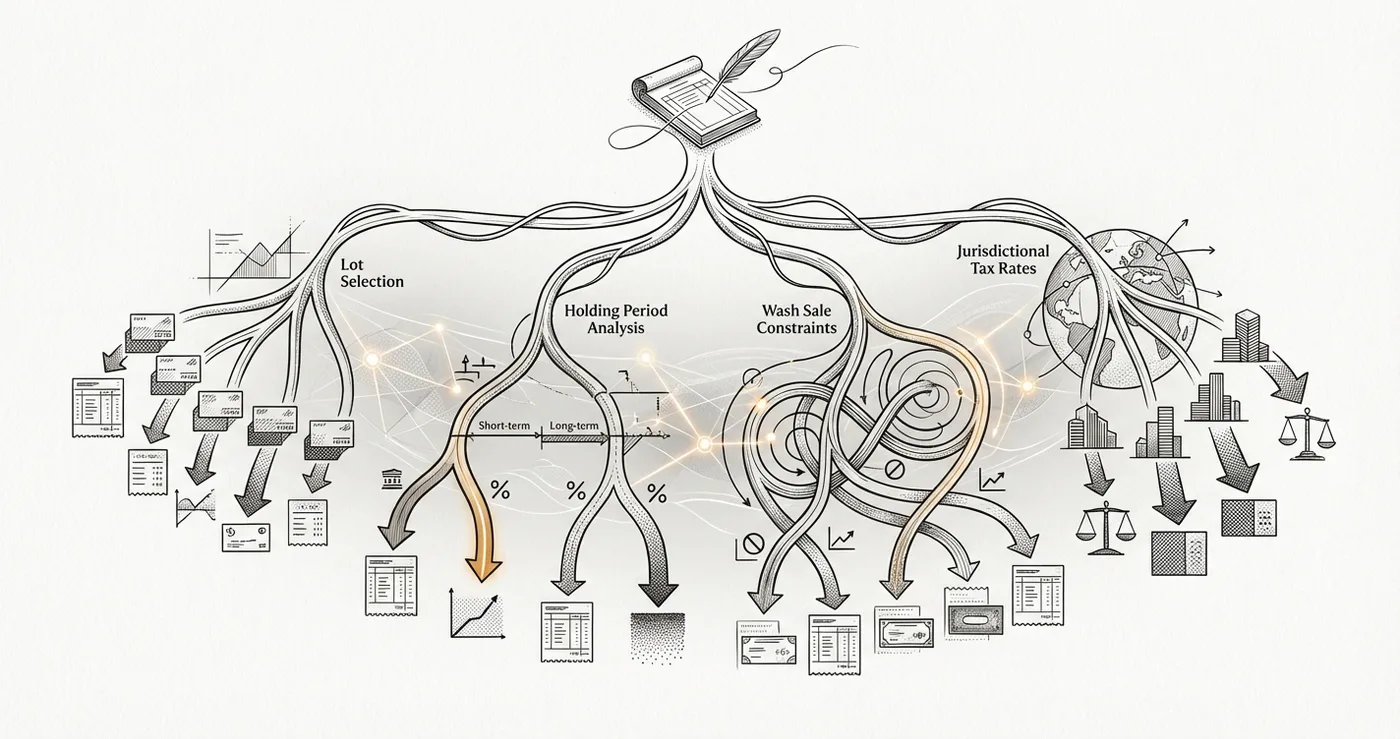
Consider the decisions involved in a simple portfolio rebalancing exercise for a taxable family office. Each sale generates a tax event. The choice of which tax lots to sell can dramatically affect the tax bill. Short-term versus long-term holding periods determine applicable rates. Wash sale rules constrain the timing of repurchases. State tax obligations vary based on entity domicile. And all of these factors must be weighed against the investment merits of the proposed trades.
When these decisions are made manually, the inevitable result is suboptimal outcomes. Either tax considerations are ignored in pursuit of investment objectives, or investment opportunities are foregone due to tax concerns that could have been managed more effectively. The family loses value in either case.
The institutional pattern is to move the tax analysis before the trade rather than after it. Tax-aware execution integrates the calculation into the pre-trade workflow: before an order is sent, the system computes its after-tax impact, selects the lots that minimize the bill, flags wash-sale violations, and proposes alternative implementations that reach the same investment objective at lower tax cost. This is the same discipline an institution applies when it pre-authorizes a trade against policy: the check happens while it can still change the decision, not in a post-mortem after the cost is locked in. The cumulative value of running every trade through that gate is real, though it is contingent on the family's tax position, turnover, and holding periods rather than a fixed return to be promised in advance.
Reporting for Multiple Stakeholders
Family offices serve an unusually diverse set of stakeholders, each with distinct information needs and levels of financial sophistication. The family patriarch may want a high-level wealth summary with year-over-year trends. The next-generation family member serving on the investment committee needs detailed performance attribution and risk analysis. The family's external tax advisor requires transaction-level data in specific formats. The trust's board of directors needs fiduciary-quality reporting with appropriate disclosures.
Meeting these varied needs with manual processes is extraordinarily labor-intensive. Staff spend weeks each quarter preparing different versions of essentially the same underlying data, reformatted and contextualized for each audience. The process is not only inefficient but also error-prone, as manual reformatting creates opportunities for inconsistencies between reports.
The single governed record is what resolves this. Configurable templates, role-based access, and automated distribution sit on top of it, but the load-bearing property is that one authoritative data set feeds every report. The patriarch's summary, the investment committee's attribution, and the tax advisor's transaction file are now different views of the same numbers rather than independently maintained documents that drift apart between quarters. When two stakeholders ask the same question, they get the same answer because the answer is computed once. Each receives the detail appropriate to their role, on their schedule, without staff re-keying anything.
Because every figure traces back to a recorded transaction and a dated valuation, the platform also supplies the audit trail that fiduciary reporting demands: not just the number, but the lineage of how it was produced and who could see it. Interactive dashboards then let stakeholders drill from a summary into the underlying detail themselves, which reduces the reporting burden on staff and, more importantly, lets the family interrogate its own data rather than wait for a formatted PDF.

The Case for Institutional Infrastructure at Family Office Scale
The objection most commonly raised against institutional-grade technology in family offices is one of proportionality. Why would an office managing $1 billion need the same infrastructure as a pension fund managing $50 billion? The investment is difficult to justify if one views technology purely as an operational cost.
The framing measures the wrong thing. Infrastructure is justified by the complexity of the problem it governs, not the size of the balance sheet it sits on, and complexity does not scale linearly with assets. A family office managing $1 billion faces the same analytical demands as a far larger institution: multi-asset attribution, real-time risk, tax-optimal execution, defensible records. A diversified book of public equities, private funds, real estate, and digital assets across several entities is a hard problem at $1 billion and a hard problem at $50 billion; the second office simply has more people to throw at it.
That is the real argument, and it is an argument about how a family office scales. Manual processes scale by headcount: every new manager, asset class, or family branch adds reconciliation work, and the only lever is to hire. A governed record scales by policy. Onboarding a new custodian means mapping one more feed into the existing data model, after which every downstream capability, consolidation, attribution, risk, reporting, extends to it automatically. The office grows the assets it oversees and the relationships it serves without growing the back office in lockstep. The cost equation reinforces this: cloud and software-as-a-service have removed the upfront infrastructure outlay that once made institutional tooling the preserve of the largest institutions, while the status quo keeps charging in staff time, error rates, and missed tax and risk decisions, costs that are real but rarely appear on any invoice.
The most compelling argument for institutional infrastructure, however, is risk mitigation. Family offices manage wealth that supports multiple generations, philanthropic commitments, and family enterprises. The consequences of operational failures, whether a reconciliation error that goes undetected, a risk exposure that is not properly monitored, or a tax obligation that is not optimally managed, can be measured in millions of dollars. Against these potential losses, the cost of robust technology infrastructure is modest.
Integration Requirements: Banks, Custodians, and Administrators
No technology platform operates in isolation. The value of a family office technology stack depends critically on its ability to integrate with the broader ecosystem of financial service providers that the family relies upon. This includes custodian banks, prime brokers, fund administrators, tax advisors, estate attorneys, and increasingly, digital asset platforms.
Integration requirements span multiple dimensions. Data integration ensures that position, transaction, and valuation information flows automatically between systems without manual intervention. Workflow integration enables processes like trade execution, cash management, and corporate action processing to span multiple systems seamlessly. Reporting integration allows the platform to incorporate data from external sources into unified family reports.
Integration quality, not feature count, determines the practical value of the investment. A platform with impressive analytics but poor custodian connectivity still requires manual data entry at the boundary, and a single re-keyed feed reintroduces exactly the divergence the consolidated record was meant to eliminate. The data model is only as authoritative as the least-connected source flowing into it. Family offices evaluating platforms should weigh integration breadth and depth at least as heavily as the analytics they will eventually run on the result.
Open architecture and API-first design matter for the same reason the model matters: the family's needs will change. New custodial relationships, additional asset classes, and shifting regulatory requirements each have to be absorbed by mapping a new source into the existing structure, not by rebuilding the structure. Platforms built on rigid, proprietary architectures become the next generation's fragmentation, the migration the office cannot afford to start.
Conclusion
Everything in this essay reduces to a single move: replace the merged output of several systems with one governed record, and let consolidation, attribution, risk, tax, and reporting all derive from it. Each downstream capability a family office wants turns out to depend on that foundation existing first, which is why a better spreadsheet never closes the gap and why the transition is worth doing properly rather than incrementally patching around the fragmentation.
The path need not be disruptive. The record can be built one feed at a time, starting with the sources that cause the most pain, and the office gains accuracy at each step rather than waiting for a finished migration. What matters is starting from an honest inventory of where the truth currently lives, a clear-eyed view of the operational risk that fragmentation carries into the next downturn, and a commitment to infrastructure that serves the family across generations rather than until the next analyst leaves.
Adaptic builds toward that single governed record: one data model spanning every manager and asset class, performance and risk analytics computed on a consolidated book rather than a stitched-together one, an audit trail behind every figure, and the operational workflows that consume staff time moved into the system. We would rather demonstrate that on a family's own holdings than describe it in the abstract. The objective is a family office that operates with the discipline of the most sophisticated institutions while remaining small enough to answer to the people whose wealth it stewards.