The 24/7 Market: Managing Crypto Exposure in Institutional Portfolios
A market that never closes cannot be governed by a desk that does. How institutional allocators replace overnight staffing with written limits that software checks, automatic protections, and named people deciding what the system escalates, for always-on crypto exposure.


Traditional financial markets operate on a schedule that institutional investors have optimised around for decades. Equities trade during defined sessions. Fixed income markets have established hours. Even foreign exchange, the closest analogue to a continuous market, has predictable liquidity patterns tied to the overlap of major financial centres. Staffing models, risk limits, compliance processes, and technology infrastructure are all calibrated to this rhythm of activity and rest.
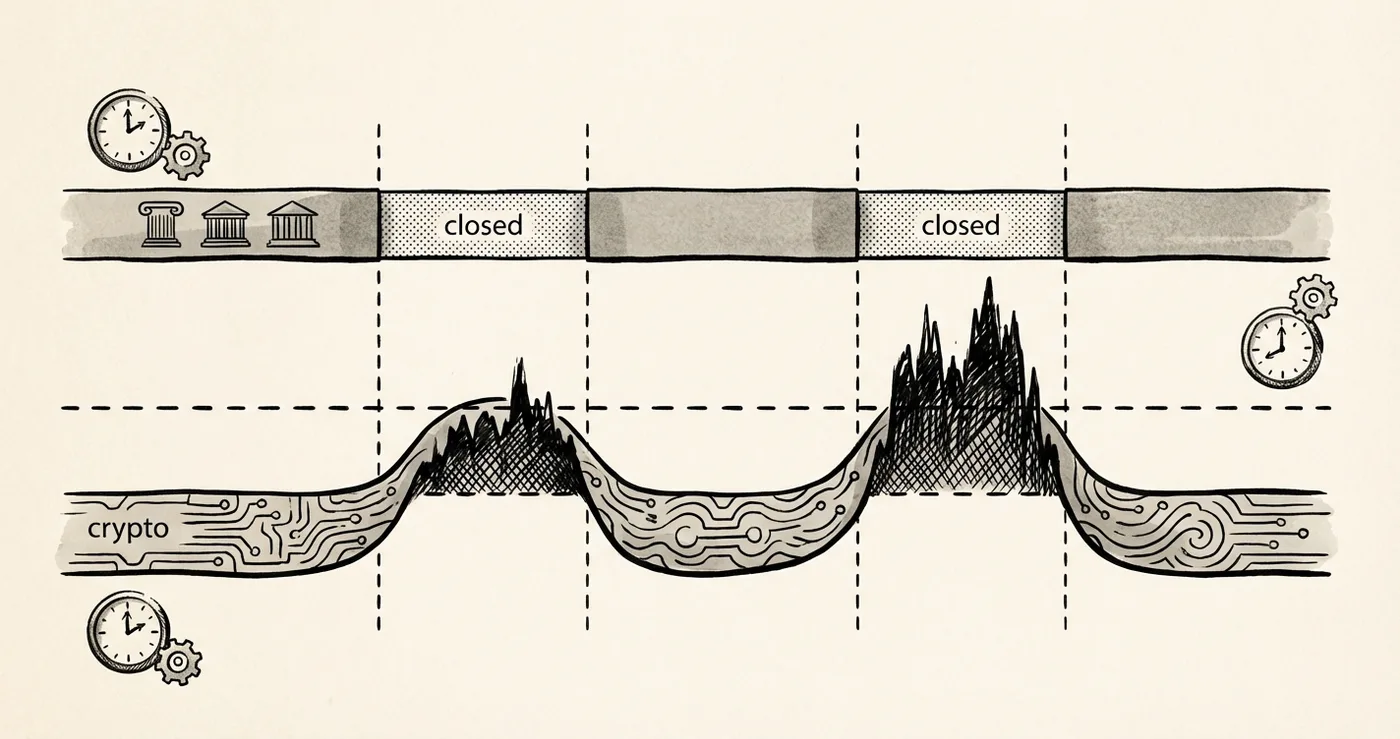
Cryptocurrency markets observe no such rhythm. Bitcoin trades at 3 AM on Christmas morning with the same finality as at 10 AM on a Tuesday in Manhattan. A governance vote on a DeFi protocol can restructure a billion-dollar liquidity pool on a Sunday afternoon. A stablecoin depeg can cascade through interconnected protocols at any hour of any day. For the eligible institutional and professional investors for whom digital assets are a permitted allocation, the always-on nature of crypto markets is not a minor operational detail. It is a fundamental challenge that touches every aspect of portfolio management, from risk oversight to staffing to technology architecture — and it sits on top of risks that have no clean traditional analogue: custody that can be irreversibly lost, liquidity that can vanish at a single venue, and a regulatory classification that remains unsettled in most jurisdictions. None of what follows assumes those risks away; the operational discipline it describes exists precisely because they are real.
The institutions that treat 24/7 market access as merely an extension of existing operations will eventually discover, probably during a weekend liquidation event, that the difference between a market that closes and one that never does is not one of degree but of kind. The closing bell was never just a convenience. It was the mechanism that aligned the cadence of human oversight with the cadence of risk. Remove it, and oversight has to be rebuilt on a different foundation — one that does not depend on a person being awake. This article argues that the foundation is governance encoded as policy: limits, exposure rules, and escalation paths that execute continuously, with human judgment reserved for the decisions that must not be automated.
The Structural Challenge of Always-On Markets
The assumption of market closure is deeply embedded in institutional operations. End-of-day processes, daily NAV calculations, overnight risk reports, morning meetings to review positions, all of these rituals depend on the existence of a natural pause in market activity. That pause provides time for reconciliation, review, and human judgment to catch errors before they compound.
Crypto markets eliminate this pause. The implications cascade through the entire operational stack.
Risk management in traditional markets can tolerate batch processing because material changes to portfolio risk are unlikely to occur between market close and the next morning's review. In crypto, a 20% drawdown can occur in the four hours between a risk officer leaving the office and checking their phone before bed. Batch risk processes that were adequate for equity portfolios become dangerously inadequate for portfolios with meaningful crypto exposure.
Compliance monitoring faces similar challenges. Transaction monitoring systems designed for market-hours activity miss weekend trading that may breach position limits or regulatory thresholds. Sanctions screening that runs on a daily cycle cannot catch interactions with addresses that are designated between screening runs. The regulatory expectation of continuous compliance does not relax because the compliance team is off duty.
Operational staffing is where the problem becomes structurally insoluble by headcount alone. There are 168 hours in a week. A desk staffed to institutional standards during market hours covers perhaps 50 of them; covering the rest at the same standard means three or four rotating shifts of analysts, risk officers, and approvers, each making consequential decisions at 3 AM on thin sleep. That model does not scale, and the decisions it produces at the margins are not the ones the firm would make in daylight. The answer is not to staff the gap but to close it: encode the standard the desk would apply into policy that executes regardless of the hour, and reserve human attention for the narrow set of decisions that genuinely require it. You scale 24/7 coverage from better policy, not from more bodies on a night shift.

Governance That Does Not Sleep
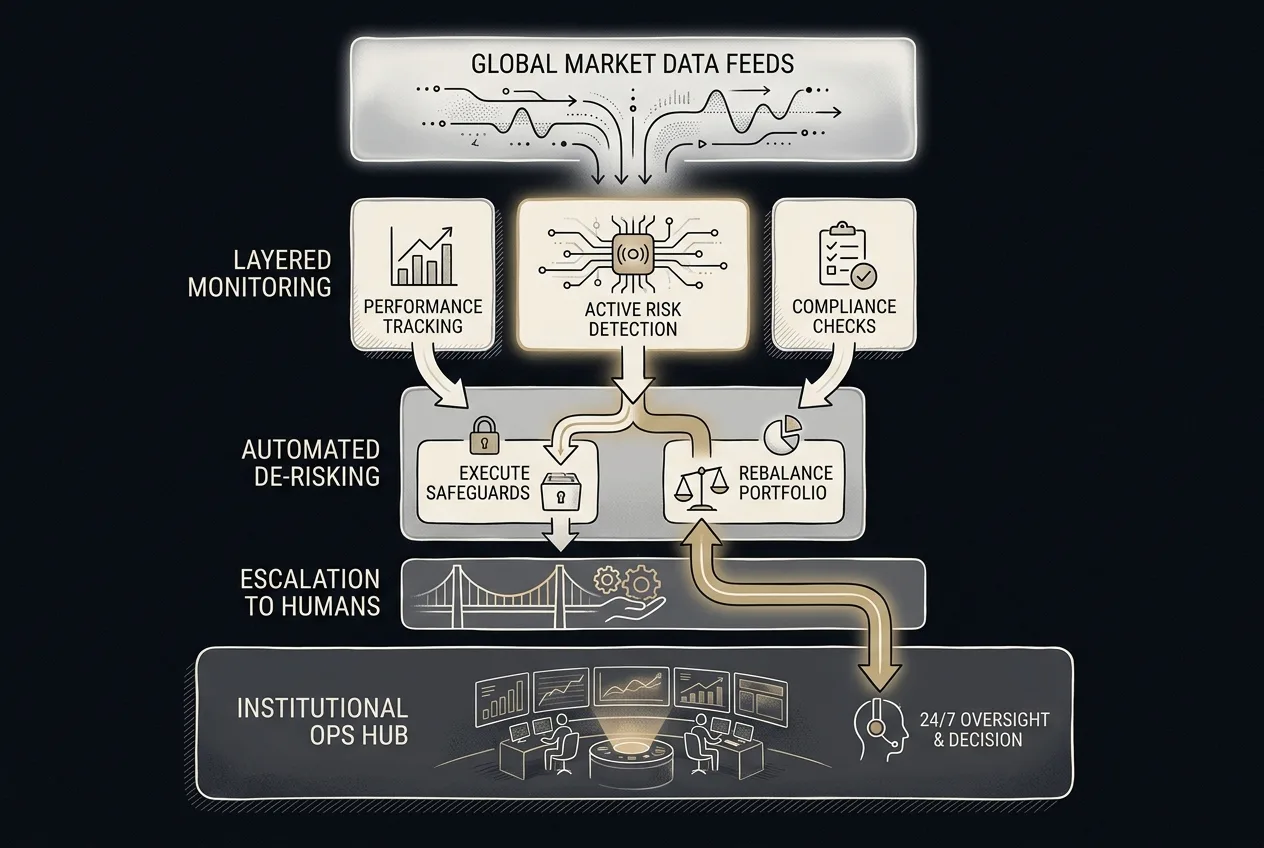
If the closing bell can no longer synchronise oversight with risk, something else must. The durable answer is to express the firm's risk appetite as policy-as-code: exposure limits, concentration caps, venue restrictions, and de-risking rules written as machine-enforceable constraints rather than as desk conventions a human applies during business hours. Policy authored once enforces itself every second, on Sunday at 4 AM with the same fidelity as Tuesday at noon. The desk does not get tired, distracted, or unavailable, because the desk, for the continuous-enforcement layer, is software.
This only works if the boundary between what is automated and what is not is drawn deliberately. Not every action can be safely delegated to a rule. The useful discrimination is by act-type and consequence:
- Risk-reducing, reversible actions can and should run automatically: tightening a stop, trimming an oversized position back to its authored limit, halting a strategy that has tripped a circuit breaker. These move the portfolio toward the approved state, and the cost of acting wrongly is small relative to the cost of waiting for a human.
- Risk-increasing or irreversible actions must remain human-gated, even at 3 AM. A withdrawal of assets from custody, a rebalance that crosses a concentration limit, an increase in leverage, a transfer to a new counterparty — these are drafted by the system and held. The action does not execute until a named, authorised human releases it. An irreversible act at an hour when no one is watching is precisely the act that should wait.
The discipline is that automation is permitted to make the portfolio safer without asking, and never permitted to make it riskier without a person. That asymmetry is what lets a firm run continuously without surrendering control of the decisions that matter. Everything below — weekend de-risking, automated hedging, exchange-failure response — is an application of this principle, not a separate set of features.
The third element is the audit spine. Continuous automated governance is only defensible if every policy evaluation, every automated action, and every human release is recorded on a single, append-only timeline: what rule fired, what state it observed, what it did or proposed, and which human approved what at which minute. Without that record, "the system handled it overnight" is an assertion. With it, the firm can reconstruct, for any regulator or investment committee, exactly how a Sunday-night decision was made and by whose authority.
Risk Management Across Time Zones and Weekend Exposure
Weekend exposure is the most acute manifestation of the 24/7 challenge. For institutions running mixed TradFi and crypto portfolios, weekends create an asymmetric risk profile. Equity and fixed income positions are frozen, unable to be hedged or adjusted until Monday. Crypto positions continue to move, potentially creating portfolio-level risk exposures that diverge significantly from the levels approved as of Friday's close.
Quantifying Weekend Risk
Crypto markets behave measurably differently when traditional markets are closed. Volatility tends to be higher across weekends and holidays, driven by thinner order books and the absence of the institutional flow that supplies stabilising volume during business hours. Large dislocations have repeatedly originated in the low-liquidity windows of weekend and holiday sessions, when a move of a given size meets less depth and therefore travels further. The practical consequence is that a position sized comfortably within a VaR limit on Friday afternoon can sit outside it by Sunday night, with no intervening trade and no one watching the breach occur.
Institutional risk frameworks must account for this asymmetry explicitly. Several approaches have emerged as best practice.
Weekend VaR adjustments. Rather than applying uniform risk limits across all periods, sophisticated institutions adjust their VaR calculations and position limits to reflect the elevated volatility and reduced liquidity of off-hours periods. Crypto positions may carry a weekend multiplier that effectively reduces the maximum allowable exposure heading into periods of reduced oversight.
Automated de-risking. Weekend exposure reduction is the clearest case of a risk-reducing, reversible action that belongs in the automated tier. Policy authored before the weekend executes as it begins: cut position sizes by a defined percentage, tighten stop-loss levels, rotate from higher-volatility altcoins into more liquid assets such as Bitcoin and Ethereum. Because every one of these moves the portfolio toward its approved limits rather than away from them, none requires a human in the loop to release it — which is the entire point. The decision was made deliberately on Friday, in daylight, by the people accountable for it, and encoded as policy. The machine merely executes that decision at the hour the risk actually rises.
Cross-asset correlation monitoring. Crypto markets have demonstrated episodic correlation with traditional risk assets, particularly during periods of macro stress. Monitoring cross-asset correlation regimes in real time allows institutions to adjust crypto exposure dynamically when correlation spikes indicate that their crypto positions are adding rather than diversifying portfolio-level risk.
Automated Trading Strategies for 24/7 Markets
The always-on nature of crypto markets creates both the necessity and the opportunity for automated trading strategies that operate without continuous human supervision. Manual trading desks cannot sustainably cover 168 hours per week. Automated systems can, provided they are designed with the appropriate safeguards.
Strategy Design Considerations
Automated strategies for 24/7 crypto markets must address several challenges that are less prominent in traditional market automation.
Regime detection. Market microstructure in crypto varies dramatically across time zones and days of the week. Liquidity, spread width, and order book depth all fluctuate in patterns that correlate with the activity cycles of major geographic regions. Strategies must detect and adapt to these regime changes, adjusting execution aggressiveness, position sizing, and signal sensitivity based on current market conditions rather than assuming uniform microstructure.
Cascading failure protection. DeFi protocols can experience sudden liquidity withdrawals, oracle failures, or governance attacks at any time. Automated strategies that interact with on-chain protocols must implement circuit breakers that detect abnormal protocol behaviour and halt operations before losses compound. A strategy that continues to provide liquidity to a pool experiencing an oracle manipulation attack will lose capital rapidly.
Latency awareness. Blockchain transaction finality varies from seconds to minutes depending on the network and current congestion. Strategies that assume immediate execution will misbehave during periods of network congestion, potentially submitting duplicate transactions or failing to cancel stale orders. Transaction lifecycle management, including gas price optimisation, nonce management, and finality confirmation, must be integral to the strategy logic rather than handled as an afterthought.
Execution Architecture
Institutional-grade 24/7 trading infrastructure typically operates across multiple availability zones with automatic failover. The architecture must ensure that no single point of failure can halt trading operations or, more critically, create a state where the system loses track of outstanding orders and positions.
State management is particularly challenging. A system that submits an order to a DEX, experiences a node failure before receiving confirmation, and then restarts without knowledge of the pending order can accumulate unintended positions. Institutional implementations require durable state stores, transaction journaling, and reconciliation processes that can reconstruct the true state of all positions and orders after any interruption.
Liquidity Management: CEX vs. DEX Aggregation
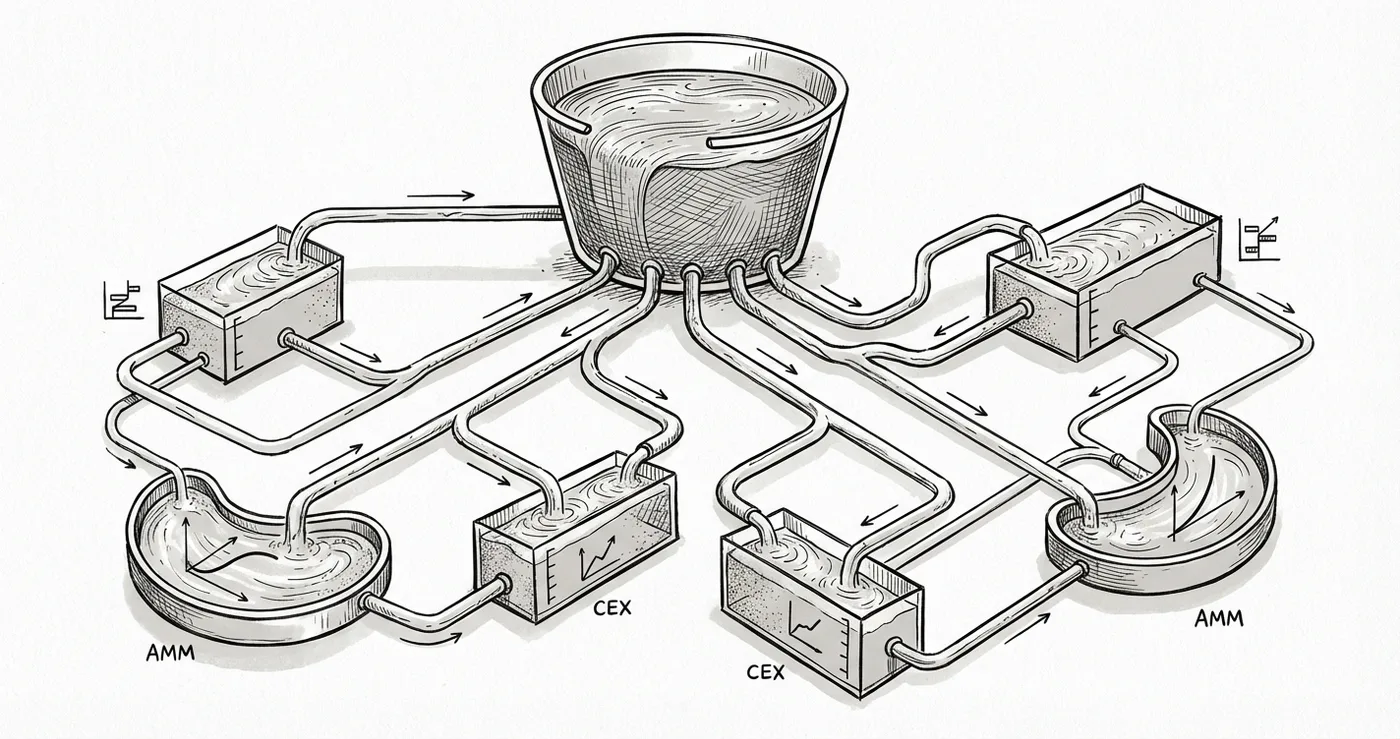
Institutional crypto trading involves navigating a fragmented liquidity landscape that has no parallel in traditional markets. Liquidity for a single asset may be distributed across dozens of centralised exchanges, each with different fee structures, margin requirements, and withdrawal policies, and hundreds of decentralised liquidity pools, each with different pricing curves, fee tiers, and gas costs.
Centralised Exchange Considerations
Centralised exchanges remain the primary venue for institutional crypto trading, offering deeper order books, lower latency, and more familiar execution interfaces. However, the concentration risk of CEX exposure became painfully apparent with the FTX collapse. Institutional best practice now requires distributing exchange exposure across multiple venues, maintaining minimum balances on any single exchange, and implementing real-time monitoring of exchange health indicators.
Pre-funding requirements create capital efficiency challenges. Unlike traditional prime brokerage, where a single credit relationship enables trading across multiple venues, crypto CEX trading typically requires pre-funded accounts at each venue. This fragments capital, reduces portfolio-level capital efficiency, and creates operational complexity in managing balances across venues.
Withdrawal risk is a perpetual concern. The time required to withdraw assets from a CEX during periods of stress is unpredictable. Institutions must maintain sufficient off-exchange reserves to continue operations during periods when exchange withdrawals are delayed or suspended.
Decentralised Exchange Integration
DEX trading offers distinct advantages for institutional participants: self-custody during trading, transparency of execution, and access to long-tail assets that are not listed on centralised venues. However, DEX execution introduces costs and complexities that must be managed carefully.
Slippage and MEV. Large orders on automated market maker protocols experience significant slippage, and the public nature of mempool transactions exposes institutional orders to maximal extractable value attacks. Institutional DEX execution requires sophisticated routing through aggregators, private transaction submission through MEV-protected channels, and careful order splitting to minimise market impact.
Gas cost optimisation. On-chain transaction costs can represent a material percentage of trade value, particularly on Ethereum mainnet during periods of congestion. Institutional operations must factor gas costs into execution cost analysis, route transactions to lower-cost networks where possible, and time non-urgent transactions to periods of lower network utilisation.
Smart contract risk. Every DEX interaction involves trusting the smart contracts that govern the protocol. Institutional risk frameworks must include protocol-level risk assessments, exposure limits per protocol, and monitoring for governance actions or contract upgrades that could affect the security of deposited assets.
Cross-Margining and Portfolio-Level Crypto Risk Management
Managing crypto exposure at the portfolio level, rather than as an isolated allocation, requires frameworks that can assess risk across fundamentally different asset classes with different trading schedules, settlement mechanisms, and risk characteristics.
Cross-margining between crypto and traditional positions remains largely aspirational. A handful of prime brokers offer portfolio margining that recognises offsetting risk between crypto and equity positions, but the infrastructure is nascent compared to the cross-margining arrangements that exist between equities, futures, and options in traditional markets. The absence of cross-margining means that institutional crypto portfolios carry higher capital costs than their standalone risk would suggest.
Correlation instability complicates portfolio-level risk assessment. The correlation between crypto and traditional risk assets is not stable. During calm markets, crypto may behave as a diversifying allocation. During stress events, correlations spike, and crypto can amplify rather than offset losses in traditional positions. Risk models must account for this regime-dependent correlation structure, either through conditional correlation models or through stress testing that assumes worst-case correlation during tail events.
Funding and margin management in a continuous market exposes the tension between the two tiers directly. A margin call can arrive at any hour, and meeting it may require moving assets — an irreversible act that, under the asymmetry above, would normally be human-gated. The resolution is not to automate the transfer but to pre-authorise it: define, in advance and in daylight, the buffers, the eligible sources of liquidity, and the precise conditions under which the system may draw on them to satisfy a margin requirement. Within that authored envelope the action is no longer an unsupervised decision; it is the execution of a decision already made and recorded. An institution that can neither pre-authorise the response nor wake a human to approve one has failed at a basic level of operational preparedness — the 4 AM margin call is not an edge case, it is the design requirement.
Regulatory Considerations for Institutional Crypto Allocation
The regulatory landscape for institutional crypto allocation is evolving rapidly, and institutions must design their operations to accommodate both current requirements and anticipated future regulation.
Position reporting. Regulatory reporting requirements for crypto positions vary by jurisdiction and are expanding. The SEC, CFTC, and their international counterparts are developing frameworks that will require institutional investors to report crypto positions with increasing granularity and frequency. Operations must be designed to capture the data necessary for current and anticipated reporting requirements.
Market manipulation surveillance. Crypto markets are subject to market manipulation regulations in most jurisdictions, even where the regulatory classification of specific assets remains uncertain. Institutions must implement surveillance systems that monitor for manipulative patterns in their own trading activity and flag potential issues before they become regulatory problems.
Tax and accounting complexity. The tax treatment of crypto transactions varies dramatically across jurisdictions and is subject to ongoing changes. Cost basis tracking for assets that may be traded across multiple venues, bridged across chains, staked in protocols, and used as collateral in lending markets creates accounting challenges that traditional portfolio management systems were not designed to handle.
Performance Attribution for Mixed Portfolios
When crypto assets sit alongside equities, fixed income, and alternatives in an institutional portfolio, performance attribution becomes materially more complex. Standard attribution frameworks assume synchronous pricing: all assets are valued at the same point in time, typically market close. Crypto's continuous trading means that the portfolio's crypto positions have moved between the equity close and the time the attribution report is generated.
Institutional-grade performance attribution for mixed portfolios requires either selecting a consistent daily snapshot time that applies across all asset classes, accepting that crypto positions will be valued at a different time than their traditional counterparts, or implementing continuous attribution that attributes returns to crypto positions on a more granular basis than daily.
Benchmark selection adds another layer of complexity. Crypto benchmarks differ in their construction methodology, rebalancing frequency, and constituent selection criteria. The choice of benchmark materially affects how crypto allocation is evaluated, and institutions must ensure that their benchmark selection is consistent with their investment mandate and communicated clearly to stakeholders.

Infrastructure Requirements: Monitoring, Alerting, and Automated Hedging
The technology infrastructure required to operate institutional crypto allocations 24/7 differs fundamentally from infrastructure designed for market-hours operation.
Monitoring must be continuous and multi-dimensional. Price monitoring alone is insufficient. Institutional crypto infrastructure must monitor blockchain network health, protocol-level metrics such as total value locked and utilisation rates, exchange health indicators, oracle accuracy, and cross-chain bridge status. Degradation in any of these dimensions can signal risk that is not yet reflected in prices.
Alerting is the bridge between the two tiers. When a situation calls for a risk-increasing or irreversible decision that policy deliberately withholds from automation, escalation is the mechanism that summons the human who can make it. That places a hard requirement on alert quality: a system generating hundreds of alerts a day trains its responders to ignore the one that matters. Alerts must be prioritised by portfolio impact, correlated to suppress noise, and routed by severity and time of day to a responder who is actually reachable. A position approaching a liquidation threshold, or a drafted withdrawal awaiting release, must reach an authorised human within minutes regardless of the hour — because the entire premise of human-gating an irreversible act collapses if no human can be raised to gate it.
Automated hedging is the act-type asymmetry applied to live tail events. Pre-approved hedging policy executes automatically when portfolio risk metrics cross defined thresholds: reducing directional exposure through futures, buying puts on liquid crypto assets, unwinding leveraged positions. Every one of these reduces risk, so none waits on a human. The same system holds the inverse case to a different standard. Re-establishing the exposure once the stress passes, lifting a hedge, or increasing leverage are risk-increasing acts, and the system drafts them for a person to release rather than executing them on its own. A firm can let software protect the book at 4 AM precisely because software is never allowed to grow the book at 4 AM.
Reconciliation across a fragmented ecosystem of exchanges, wallets, and protocols must run continuously rather than as a batch process, and it is what keeps the audit spine honest. Continuous reconciliation against an authoritative record of expected balances turns a discrepancy — the early signature of a security incident or an operational error — into an immediate, escalated alert rather than a surprise discovered at the next morning's run. The same record that proves what the system did overnight is the record that detects when reality has diverged from it.
Building Institutional-Grade Crypto Operations
The institutions that succeed in managing 24/7 crypto exposure are those that recognise the scope of the operational transformation required and invest accordingly. Bolting crypto onto existing infrastructure designed for market-hours operation is a recipe for operational failures that manifest at the worst possible times.
The dimensions of that investment are by now familiar — infrastructure built for continuous operation with no maintenance windows, risk frameworks calibrated to always-on volatility, staffing models that provide coverage without burning out personnel. But the dimension that ties them together, and the one most often underweighted, is governance: an explicit, encoded definition of which decisions the system may take on its own, which it must hold for a human, and how the second set of decisions reaches that human in time. Every other investment is leveraged or wasted by the quality of this one. Continuous infrastructure without policy is an automated way to lose money faster overnight; alerting without escalation discipline is noise; a risk framework that exists only in a desk's habits evaporates the moment the desk goes home.
The reward for getting it right is access to an asset class that, despite its volatility and operational complexity, offers return and diversification characteristics institutional portfolios increasingly cannot ignore — held under controls that an investment committee and a regulator can both inspect. The structural advantage does not accrue to the firm that automates the most. It accrues to the firm that has drawn the line between machine and human deliberately, encoded it, and can prove where the line sat at any moment in the past.
Adaptic builds for continuous markets by treating governance as the primary system, not a layer on top of it. Risk appetite is set as each account's trading policy and enforced before every order on a single exposure model; protective actions such as stops, exits and loss halts execute on their own, without waiting for a person; and policy decisions, automated actions, and human approvals are written to one append-only record that an investment committee or regulator can read after the fact. The aim is not to promise that the market never catches the firm off guard at 3 AM. It is to make the firm's response at 3 AM the same response it would have authored at noon — and to be able to prove it.