Risk Management in the Age of Algorithmic Trading
Why risk management for algorithmic trading must move from measuring losses after the fact to enforcing controls as policy before the order leaves the system.


On 1 August 2012, a Knight Capital deployment error sent millions of unintended orders into the market and lost the firm $440 million in 45 minutes. No human could read the situation, form a judgment, and intervene at that speed. The losses accrued faster than the controls meant to contain them could act. This is the defining problem of risk management in algorithmic trading: when the machine operates at machine speed, any control that depends on a human noticing, deciding, and reacting is already too slow to matter.
Strategies that execute thousands of trades per day, respond to signals in milliseconds, and run continuously across global time zones do not merely stress traditional risk frameworks. They invalidate the assumption those frameworks were built on, which is that risk can be measured periodically and acted on deliberately. The May 2010 Flash Crash and the March 2020 liquidity crisis each showed, in different ways, that automated systems interacting with market microstructure can produce outcomes no individual system was designed to create, on timescales no human can supervise.
The conclusion that follows is specific, not rhetorical. A risk framework for algorithmic trading cannot be a measurement layer that reports on losses after they occur. It must be an enforcement layer that constrains what the machine is permitted to do before it acts. The controls have to run at the same speed as the strategies they govern, encoded as policy the system executes rather than guidance a person applies. This article sets out what that shift requires, layer by layer, from real-time exposure on a single data model to pre-trade controls compiled as code to an audit record that lets you prove, after the fact, exactly why every order was allowed.
From VaR to Real-Time Risk Intelligence
Value-at-Risk has served as the industry's standard risk measure for three decades. Its appeal lies in its simplicity: a single number that estimates the maximum loss a portfolio is likely to experience over a given time horizon at a specified confidence level. But VaR's well-documented limitations become acute in the context of algorithmic trading.
Temporal mismatch. Traditional VaR is typically calculated on a daily or weekly basis. Algorithmic strategies can accumulate and liquidate positions within minutes or hours. A daily VaR calculation provides no visibility into intraday risk concentrations that may arise and resolve between measurement points. For a strategy that turns over its entire portfolio multiple times per day, end-of-day risk metrics are effectively meaningless.
Distributional assumptions. Parametric VaR models assume returns follow a known distribution, typically Gaussian or Student-t. Algorithmic strategies, particularly those operating in less liquid markets or during periods of market stress, can generate return distributions with complex, time-varying characteristics that defy parametric modeling.
Aggregation blindness. When multiple algorithmic strategies operate simultaneously within a single firm, their interactions create portfolio-level risks that are invisible when each strategy is assessed in isolation. Two strategies that are individually well-hedged may share hidden factor exposures that produce concentrated losses under specific conditions. This is fundamentally a data-model problem: if each strategy maintains its own view of exposure, no system holds the firm's true aggregate position, and the netting that would reveal the concentration never happens. Real-time aggregate risk requires that every strategy, every account, and every open order resolve to one exposure model the controls can read.
The fundamental inadequacy of traditional risk metrics for algorithmic portfolios is not that they are wrong, but that they are slow. In markets where fortunes can be made or lost in seconds, a risk framework that updates daily is architecturally incapable of fulfilling its purpose.
The Shift to Continuous Risk Monitoring
Next-generation risk frameworks replace periodic batch calculations with continuous, streaming risk assessment. These systems ingest real-time market data, position updates, and execution reports, computing risk metrics on a tick-by-tick or second-by-second basis. The technical architecture typically involves event-driven processing pipelines, in-memory computation, and pre-calculated risk sensitivities that can be rapidly updated as market conditions change.
Continuous monitoring enables capabilities that batch-based approaches cannot. Limits can be enforced as they are approached, with automatic position reduction or strategy shutdown when thresholds are breached. Intraday stress tests can fire on specific market events, such as a volatility spike or a large order-flow imbalance. Operations teams gain a live view of the firm's aggregate risk profile rather than a snapshot hours stale.
The distinction that matters, though, is not faster dashboards. A dashboard still asks a human to notice a number and decide what to do about it, and at machine speed that loop is too slow. Continuous monitoring earns its name only when the same data model that displays exposure is the model the controls read to enforce it, so that a breach does not merely surface on a screen but blocks the next order automatically. Monitoring tells you where the risk is; the enforcement layer described in the following sections is what acts on it.
The Unique Risk Taxonomy of Algorithmic Strategies
Algorithmic trading introduces risk categories that have no direct analogue in traditional portfolio management. A comprehensive risk framework must identify, measure, and mitigate each of these distinct risk types.
Model Risk and Signal Decay
Every algorithmic strategy embodies a model of how markets behave. When that model diverges from reality, the strategy will generate losses. This divergence can occur gradually, as market dynamics evolve and previously predictive signals lose their efficacy, or abruptly, when a regime change invalidates the model's core assumptions.
Signal decay is an endemic challenge for quantitative strategies. A signal that delivered consistent alpha for five years may lose its predictive power as competitors discover and exploit the same pattern, as market structure changes reduce the inefficiency the signal was capturing, or as macroeconomic conditions shift the relevant return-generating process. Robust risk management requires continuous monitoring of signal performance, with predefined criteria for reducing exposure to or decommissioning strategies that show signs of decay.

Execution Risk and Market Impact
Algorithmic strategies that appear profitable in backtests may prove unprofitable in live trading due to execution costs that exceed backtest assumptions. Market impact, the price movement caused by the strategy's own trading activity, is inherently difficult to model because it depends on the interaction between the strategy's order flow and the contemporaneous activity of other market participants.
For institutional-scale algorithmic portfolios, execution risk management requires sophisticated transaction cost analysis (TCA) that compares realized execution costs against pre-trade estimates, identifies systematic patterns of underperformance, and feeds this information back into the strategy's execution algorithms. Real-time TCA allows risk managers to detect execution anomalies as they occur, rather than discovering them in post-trade analysis days or weeks later.
Liquidity Risk in Automated Systems
Algorithmic strategies that depend on market liquidity for their operation face a particular form of fragility: liquidity can evaporate precisely when the strategy needs it most. During periods of market stress, bid-ask spreads widen, order book depth diminishes, and the cost of executing large orders increases dramatically. A strategy designed to operate in a liquid market may become trapped in positions it cannot exit at acceptable prices.
This risk is compounded by the tendency of algorithmic strategies to exhibit correlated behavior. When multiple strategies identify the same signal and attempt to trade simultaneously, their aggregate order flow can overwhelm available liquidity, creating a feedback loop of deteriorating execution quality. The risk framework must account for this crowding risk, monitoring for signs that the strategy's competitive environment is changing and adjusting position sizes accordingly.
Technology and Infrastructure Risk
Automated trading systems introduce technology risks that produce immediate and severe financial consequences. A software bug, network failure, or data-feed interruption can cause a strategy to execute erroneous trades at extraordinary speed. Knight Capital, with which this article opened, remains the canonical case precisely because the failure was technological rather than a flawed market view: correct intentions, catastrophic execution, no fast path to stop it.
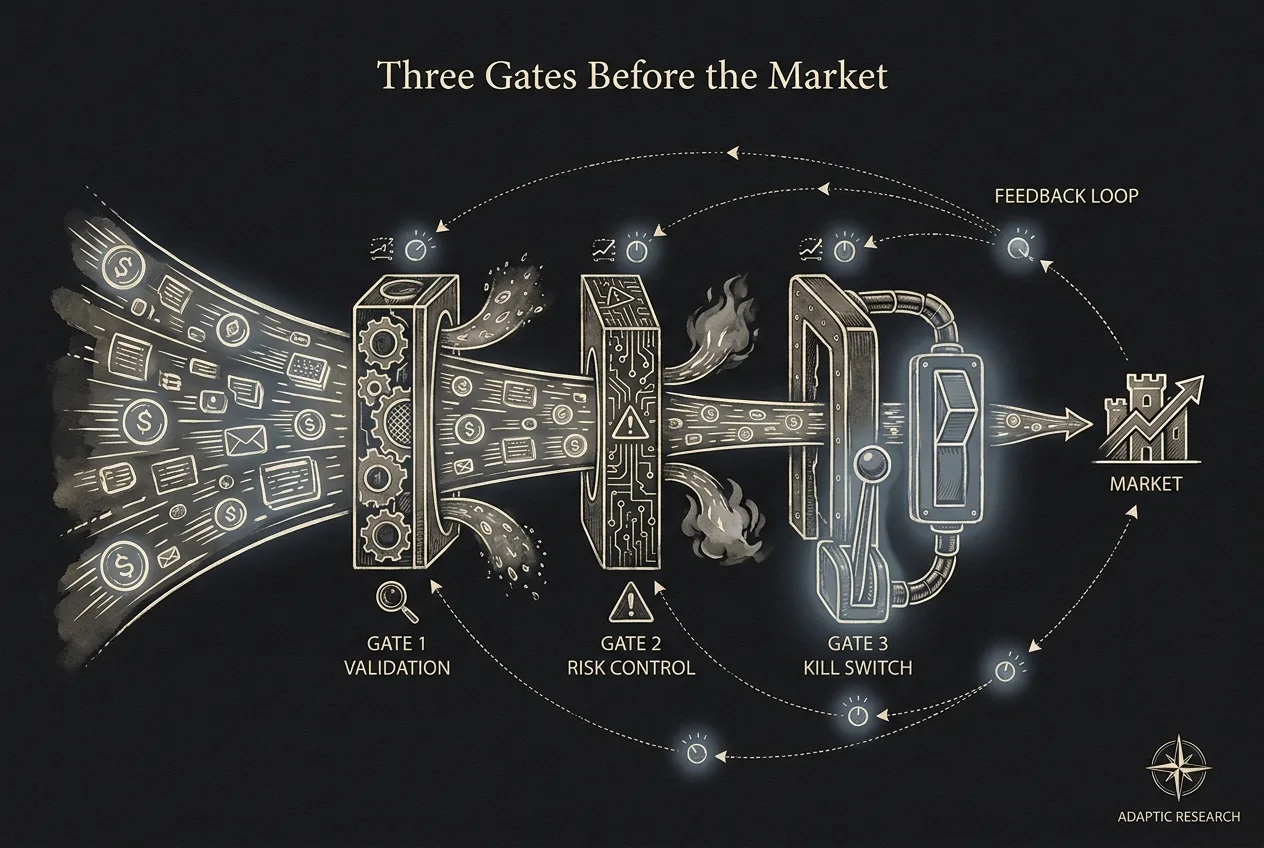
Managing technology risk in algorithmic trading demands engineering discipline beyond traditional financial risk management: rigorous testing with comprehensive regression suites, staged deployment with rollback, redundant infrastructure with automatic failover. The control of last resort is the kill switch, a single mechanism that halts all trading activity instantly when anomalies are detected. Its value depends entirely on being faster than the damage. A kill switch that requires a human to log in, navigate a console, and confirm an action is a kill switch in name only; the design requirement is that it can be triggered automatically, by the same monitoring that detects the anomaly, and that triggering it is always available to a named human who is accountable for the decision to pull it.
Multi-Layered Risk Frameworks
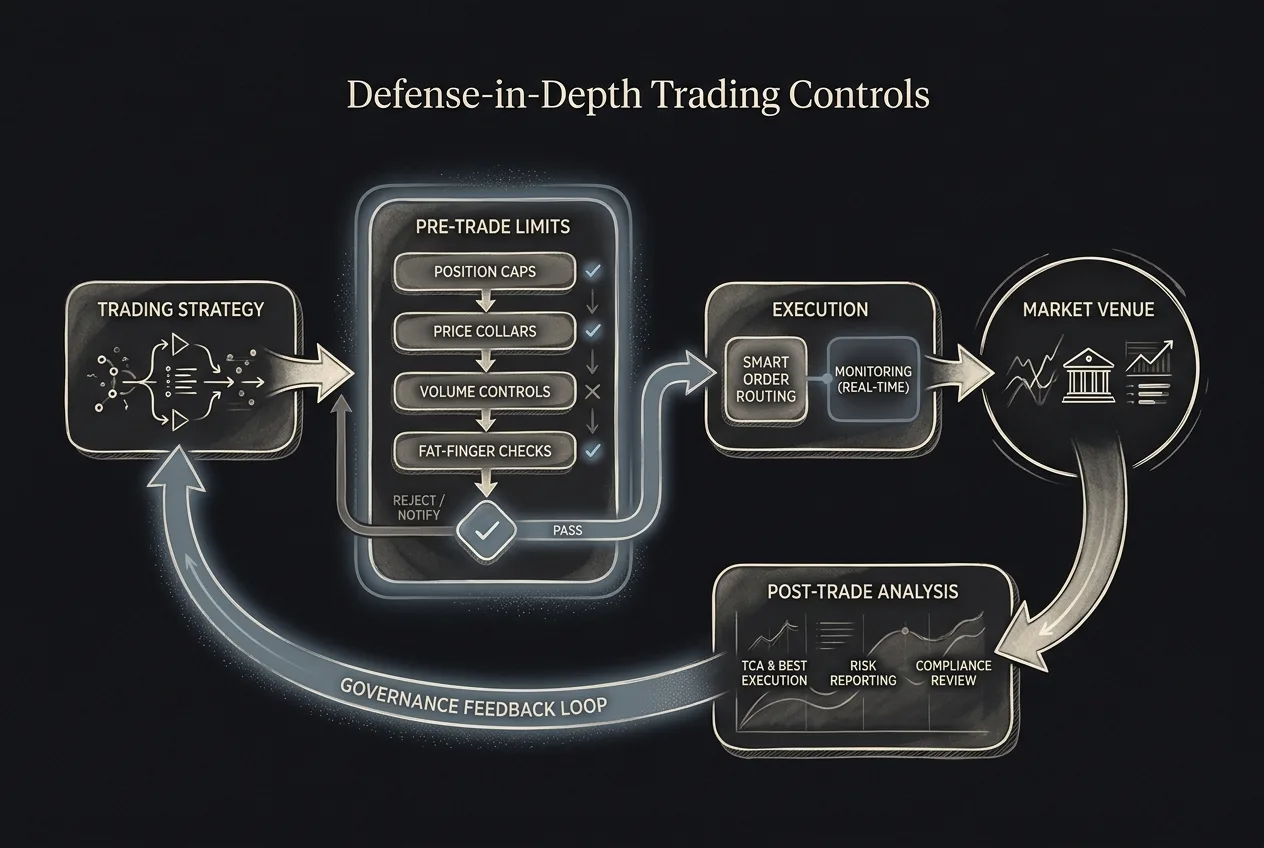
Institutional best practice employs defense-in-depth: multiple independent layers of control, each operating at a different stage of the trading process and providing a distinct kind of protection. The layers are not equal. Pre-trade controls prevent losses; the layers that follow detect and analyze them. In a domain where the first 45 minutes can cost $440 million, prevention is the only layer that addresses the actual problem, and the rest exist to make prevention better over time.
Pre-Trade Controls as Policy-as-Code
Pre-trade controls validate every order before it reaches the market, enforcing hard limits on order size, price deviation, position concentration, and aggregate exposure. The conventional framing treats these as a checklist. The more useful framing treats them as policy compiled into code: a risk policy stated once, in terms a risk officer would recognize, and enforced mechanically on every order without a human in the loop.
The distinction is not pedantic. A control enforced as policy-as-code is enforced before the order, not measured after the loss, which is the entire difference between a framework that prevents the Knight Capital outcome and one that merely produces an excellent post-mortem of it. It applies identically at three in the morning and during a volatility spike, when human attention is least reliable and most needed. And because the policy is explicit rather than buried in imperative logic, it can be reviewed, versioned, and audited as the governing artifact it actually is, so that "why was this order allowed" has an answer that points to a specific clause rather than to a developer's recollection.
Effective pre-trade controls must be fast enough to avoid adding execution latency that degrades performance, yet comprehensive enough to catch damaging orders. The tension is resolved with a tiered approach: simple, inexpensive checks run on every order, while more expensive validation is reserved for orders that exceed specific size or deviation thresholds. The discipline that makes the tiering safe is that no order bypasses the policy gate, regardless of which path it takes through it.
Gating Actions by Reversibility and Consequence
A policy gate decides whether an order is permitted. It does not, by itself, decide whether the system may act on that decision unsupervised. Those are different questions, and conflating them is how automated systems acquire authority no one intended to grant them.
The principle that resolves this is to gate every action by its reversibility and consequence rather than treating all automated actions as equivalent. Routine, reversible, low-consequence actions, such as placing a small order well within limits, can execute automatically. Actions with wider blast radius should notify a human even as they proceed. Actions that approach a material threshold should be approval-gated, executing only once a human authorizes them. The most consequential class, the actions that are irreversible or that commit the firm in ways no later trade can undo, must stop at a named human every time, with no automated path around the requirement.
This is what it means to make accountability architectural rather than procedural. The boundary between what the machine may do alone and what a person must authorize is encoded in the same policy layer that enforces the limits, not left to operator vigilance or after-the-fact review. The maxim is that humans govern and machines operate: the system executes the policy at machine speed, and the policy reserves the consequential, irreversible decisions for the humans who answer for them. A strategy can run fully automated for the ordinary case and still be incapable of taking an unrecoverable action without explicit human authorization, because the two capabilities are governed separately by design.
Execution-Time Monitoring
During execution, real-time monitoring tracks each strategy's behavior against expected parameters. Metrics such as fill rates, execution prices relative to arrival prices, and order-to-trade ratios are watched continuously and compared against normal ranges.
Anomaly detection algorithms, often powered by machine learning, can identify patterns of behavior that suggest a strategy is malfunctioning before the resulting losses become significant. For example, a sudden increase in order submission rate, a deviation from the expected pattern of order sizes, or an unusual distribution of execution prices can all serve as early warning signals.
Post-Trade Analysis and Model Governance
Post-trade analysis provides the feedback loop that improves both strategies and controls over time. Slippage analysis, market-impact estimation, and attribution of returns to specific signals identify where real-world performance diverges from backtested expectations, and feed those findings back into the policy that governs the next order.
This feedback loop is only as trustworthy as the record it runs on. The requirement is an audit spine: a complete, replayable log in which every order is linked to the exact policy clause that permitted it, the exposure state at the moment of decision, and the human authorization where one was required. Replayable means the firm can reconstruct not just what happened but why the system believed it was allowed, deterministically, from the recorded inputs. Clause-linked means an auditor, a regulator, or a risk officer asking "why was this trade placed" is answered by a specific governing rule rather than by reverse-engineering intent from code. An audit record that captures fills but not the policy basis for them documents the symptom and loses the cause.
Model governance processes subject strategies to regular review, with formal criteria for modification, suspension, or retirement. Independent validation, conducted by risk professionals organizationally separate from the strategy developers, checks the optimism that naturally characterizes anyone reviewing their own model. The audit spine is what gives that independent function something objective to review.

Stress Testing for Algorithmic Portfolios
Traditional stress testing, which evaluates portfolio performance under hypothetical adverse scenarios, requires significant adaptation for algorithmic strategies. The challenge is not merely to estimate losses under stressed market conditions, but to model how the strategies themselves would behave during stress.
Behavioral Stress Testing
Unlike a static portfolio of stocks and bonds, an algorithmic portfolio will respond to market stress by executing trades. These trades may reduce risk, as the strategy's risk management logic is triggered, or they may amplify losses if the strategy misinterprets the market environment. Behavioral stress testing simulates the full interaction between the strategy's decision logic and the stressed market environment, producing a more realistic assessment of potential losses.
Liquidity-Adjusted Stress Testing
Standard stress tests typically assume that positions can be liquidated at stressed but still available market prices. For algorithmic strategies that may be operating at the limits of market liquidity even under normal conditions, this assumption can be dangerously optimistic. Liquidity-adjusted stress tests incorporate models of market depth under stress, estimating the market impact of position liquidation and the time required to exit positions at acceptable prices.
Contagion and Correlation Stress Testing
The interconnected nature of algorithmic trading means that stress in one strategy or market can propagate rapidly to others. Correlation stress tests examine how losses in one part of the algorithmic portfolio might trigger risk management actions that affect other strategies, and how the firm's aggregate trading activity during stress might interact with the broader market.
Effective stress testing for algorithmic portfolios must model not just what happens to prices, but what happens to the algorithms. A strategy's response to stress is as important as the stress itself.

Operational Risk in Automated Trading Systems
The operational risk framework for algorithmic trading must address the full technology stack, from data acquisition through strategy execution to post-trade settlement.
Data Integrity and Feed Management
Algorithmic strategies are only as reliable as the data they consume. Corrupted, delayed, or missing market data can cause strategies to generate erroneous signals and execute harmful trades. Data quality monitoring must operate at the same speed as the strategies themselves, detecting anomalies in real time and triggering appropriate responses, from switching to backup data feeds to suspending strategy operation until data quality is restored.
Change Management and Deployment
Software changes to trading systems represent one of the highest-risk operational events. A rigorous change management process includes code review by multiple developers, comprehensive automated testing, staged deployment to simulation environments before production, and monitoring during and after deployment with defined rollback triggers.
Business Continuity and Disaster Recovery
Automated trading systems must maintain continuity of operation through infrastructure failures, natural disasters, and other disruptions. This requires geographically distributed infrastructure, tested failover procedures, and clear protocols for manual intervention when automated systems cannot operate normally.
Regulatory Expectations and Compliance
The regulatory framework for algorithmic trading has matured significantly in recent years, with detailed requirements established under MiFID II in Europe, Regulation SCI and the SEC's proposed rule on electronic trading in the United States, and comparable frameworks in Asia-Pacific jurisdictions. What is notable is how closely these regimes converge on the same two demands the preceding architecture is built around: enforced pre-trade controls, and records detailed enough to reconstruct trading activity after the fact. Regulators arrived at policy-enforced-before-the-order and a replayable audit trail because those are the only mechanisms that work at algorithmic speed. A firm that builds for them as architecture, rather than bolting them on for compliance, finds the regulatory requirement largely satisfied as a byproduct.
MiFID II Requirements
The Markets in Financial Instruments Directive II imposes specific obligations on firms engaged in algorithmic trading, including requirements for algorithmic trading systems to be tested and monitored, effective risk controls including pre-trade limits and kill switches, business continuity arrangements, and record-keeping sufficient to enable regulators to reconstruct trading activity.
MiFID II also introduces the concept of "direct electronic access" controls, requiring firms that provide market access to implement pre-trade risk controls equivalent to those applied to their own proprietary trading.
Dodd-Frank and US Regulatory Framework
In the United States, the Dodd-Frank Act and subsequent CFTC and SEC rulemaking have established requirements for risk controls in automated trading, with particular emphasis on preventing market disruption. The CFTC's Regulation Automated Trading (Reg AT) framework, while evolving, establishes expectations for pre-trade risk controls, order cancellation capabilities, and regulatory reporting.
Cross-Jurisdictional Compliance
For global algorithmic trading operations, compliance with multiple regulatory regimes creates additional complexity. Risk frameworks must be sufficiently flexible to accommodate jurisdiction-specific requirements while maintaining a coherent global approach to risk management. This typically requires a baseline set of controls that satisfies the most stringent applicable regulation, supplemented by jurisdiction-specific adaptations.
Building Institutional Confidence in Automated Risk Management
The ultimate measure of a risk framework is the confidence it earns from the firm's stakeholders: senior management, the board, investors, and regulators. That confidence is earned by demonstration, not assertion. A framework whose controls are encoded as enforced policy can be shown to a skeptical allocator and replayed against the record; a framework that lives in documents and good intentions can only be described. Transparency, governance, and continuous improvement matter precisely because they convert a claim about risk management into something a stakeholder can independently verify.
Transparency and Reporting
Risk reporting for algorithmic strategies must be both comprehensive and comprehensible. Technical risk metrics, while essential for the risk management team, must be translated into language and formats that senior management and board members can understand and act upon. Dashboards that provide real-time visibility into key risk metrics, supplemented by regular written reports that contextualize current exposures and recent risk events, form the foundation of effective risk communication.
Independent Oversight
Independent risk oversight is critical to the credibility of the risk function, and in an algorithmic firm that independence has to be expressed in the architecture, not only in the org chart. The risk team must have the authority to impose limits on or suspend strategies, with escalation paths that reach senior management and, where necessary, the board. When the controls are policy-as-code, that authority becomes concrete: the risk function owns the policy layer, changes to it are versioned and reviewed, and the engineers who write strategies cannot quietly widen a limit that the policy enforces. Reporting lines, compensation, and cultural norms still matter, but they are reinforced by a system in which the separation of governing from operating is built in rather than merely asserted.
This same property is what lets a risk function scale without scaling headcount in proportion to trade volume. A team that supervises trades one at a time is bounded by how many trades a person can watch; a team that supervises a policy governs an unlimited number of orders the moment the policy is correct. Capacity grows by improving the policy, not by adding reviewers, which is the only model that keeps pace when the strategies themselves are automated.
Incident Response and Lessons Learned
Every risk event, whether a minor control breach or a significant trading loss, should be subject to thorough root cause analysis with findings documented and distributed to relevant stakeholders. The willingness to learn from mistakes and near-misses, and to invest in preventing recurrence, is the hallmark of a mature risk management culture.
Continuous Evolution
The risk landscape for algorithmic trading is not static. New strategies, new markets, new technologies, and new regulations continuously reshape the risk environment. A risk framework that is adequate today may be inadequate tomorrow. Institutional confidence in automated risk management ultimately depends on the firm's demonstrated commitment to evolving its risk practices in step with its trading activities.
Conclusion
Risk management for algorithmic trading is not a solved problem, and the frameworks described here, from real-time exposure on a single data model through pre-trade policy enforcement to a replayable audit spine, are a foundation rather than a finished structure. But the thread running through all of them is one architectural commitment: at machine speed, a control that measures is a control that arrives too late. The discipline has to move from reporting on losses to constraining what the machine is permitted to do before it acts.
That commitment also changes what a firm should be willing to claim. When risk policy is encoded as enforced code rather than asserted as intent, it can be demonstrated rather than described. A firm can show an allocator the actual policy that gates its orders, replay a day of trading against the clause that permitted each one, and point to the exact boundary at which an irreversible action stops for human authorization. Proof of this kind is worth more than any promise, because the most dangerous risk in algorithmic trading is not the one you measure but the one your architecture quietly permits.
This is the principle on which Adaptic builds. As the operating system for AI-managed capital, the platform treats risk controls as policy enforced before the order, gated by reversibility and consequence, recorded on an audit spine that links every action to the rule that allowed it. Humans govern; machines operate. The objective is not to make institutional investors trust the system, but to give them the means to verify it.