Kernel
Models are probabilistic. The permission is not.
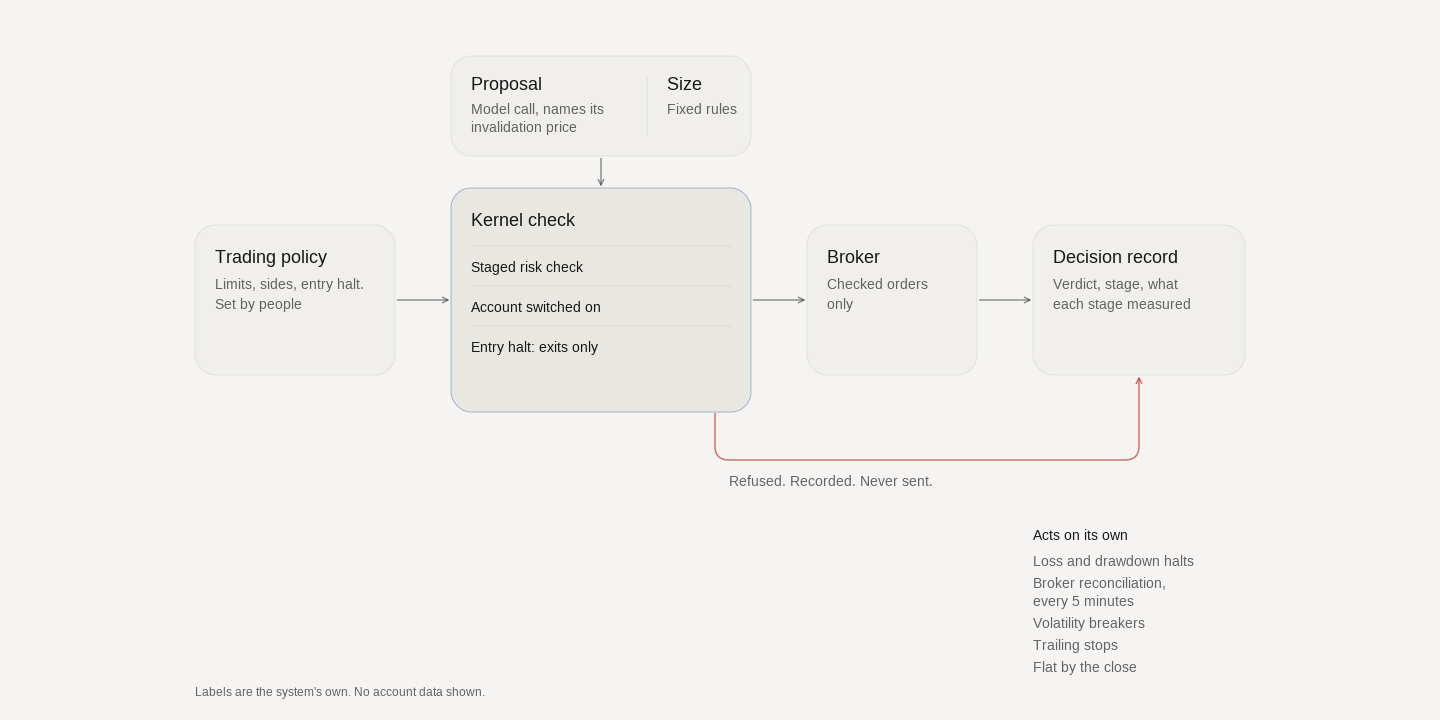
A language model proposes each trade. Fixed rules decide whether it may be sent. Every order is checked against the limits your people set before it reaches the broker, and every verdict is kept on the record.
An order enters at the top and meets each stage in turn, every time. An open that would breach the policy’s exposure caps is refused there and never sent. An order that passes every stage goes on to the broker. 1. System circuit breaker; 2. Account state; 3. Number of open positions; 4. Single-name concentration, against the account’s cap; 5. Leverage; 6. The policy’s gross and net exposure caps; 7. Margin use; 8. Pattern-day-trader rules; 9. Daily loss and drawdown limits; 10. Buying power
Judgment from the model. Certainty from the rules.
Your limits hold on every order.
Exposure, concentration, leverage, margin and loss limits are checked before an order exists. An order that would breach them is refused and never sent.
Risk can always come off.
One switch stops new entries on an account. Exits, cancels and protective stops keep working, so a pause never traps a position.
Nothing is refused silently.
Each verdict is recorded with the check that decided it and what that check measured.
Five checkpoints between a signal and the broker.
Every order meets them in the same order, every time. The model’s view is one input; it never overrides a check.
Screening
Rules on volume, volatility, trend and levels decide which names the model is asked about.
The call
The model makes the buy, sell or pass call and must name the price that would prove it wrong. Fixed rules set the size.
The risk check
Before an order exists, it is tested against concentration, leverage, exposure, margin, loss limits and buying power. A book that cannot be measured cannot add risk.
Nothing is refused silently.
The broker boundary
Only accounts whose policy is switched on can trade. With the entry halt on, only orders that reduce risk go through.
While the position is open
Trailing stops, loss halts and market breakers keep acting until the position is closed.
Every verdict is a record.
Allow, resize, reject or escalate: each verdict names the check that decided and what it measured. Every order that is sent also carries the model, the prompt version and the price that would prove it wrong.
Transcripción
Every order meets the same checks. A language model proposes the trade. It must name the price that would prove it wrong. Fixed rules set the size.
First, the staged risk check, before any order exists. This one would breach the account’s exposure cap. So it is refused, recorded, and never sent.
A smaller order passes every stage. At submission, two more locks. The account must be switched on, and a missing answer counts as no. And if the entry halt is on, only exits, cancels and protective stops pass.
It goes to the broker, and its verdict is recorded too. Models are probabilistic. The permission is not.
Protection does not wait for a signature.
A control that waits for a person is slower than the market it guards against. These act on their own, every market day.
Halts on bad days
New entries stop on daily-loss, drawdown, consecutive-loss, broker-error and data-quality events. Exits still pass.
Breakers for broken markets
Volatility and dislocation breakers can close every open position.
Stops on every position
Trailing stops protect each position, and equity books are flattened before the close every market day.
Checked against the broker
Positions are reconciled with the broker every five minutes in market hours. A mismatch pauses new entries.
No trading on a fallback
If the model is unavailable, the engine stands aside.
Your people set the limits. The kernel holds them.
Each account’s trading policy (exposure and concentration caps, allowed asset classes and sides, and the entry halt) is set by your people in Adaptic OS. Every change is recorded with who made it and why.
Questions risk teams ask.
Watch the checks run on limits you set.
In a six-week shadow pilot your trading policy runs against live market data, with no capital at risk. At the end you read every verdict it recorded.