The Institutional Data Stack: Building Enterprise-Grade Market Data Infrastructure
The architecture, trade-offs, and operational realities of building market data infrastructure where every decision reads from one record—and every datum carries its provenance


Two systems inside the same firm disagree about the price of a security. The execution engine saw one print; the risk system reconciled to another; the end-of-day report, adjusted for a corporate action neither caught in real time, shows a third. None of them is wrong, exactly. Each is reading a different copy of the truth. This is the failure mode that defines institutional market data—not the absence of data, but the proliferation of slightly inconsistent versions of it, each authoritative in its own corner of the firm.
The infrastructure responsible for acquiring, normalizing, storing, and delivering market data is often treated as a back-office cost to be minimized rather than a strategic capability to be engineered. That framing is a mistake. The quality, latency, completeness, and lineage of an institution's data stack directly determine the quality of its investment decisions, the accuracy of its risk measurements, the efficiency of its execution, and the defensibility of its regulatory reporting. For firms running algorithmic and quantitative strategies, where decisions are made in microseconds on automated analysis of feeds, the data stack is not merely infrastructure. It is the substrate every other system reasons over.
The engineering problem, stated plainly, is hard on two axes at once. The first is mechanical: ingest from hundreds of sources with different formats, protocols, and delivery mechanisms; normalize them into a single representation; deliver to consumers with the latency each one demands; and store everything for historical analysis with perfect fidelity—continuously, at scale, while the data landscape itself keeps shifting underneath. The second axis is the one most stacks underinvest in: ensuring that all of those consumers, fast and slow, real-time and end-of-day, read from one record rather than from many copies of it, and that every datum carries enough provenance to answer the question where did this come from, and when did we know it. The sections that follow trace both axes—scale and consistency—through the layers of the stack, because a stack that solves one without the other is not enterprise-grade. It is merely fast, or merely tidy.
The Data Challenge: Scale, Diversity, and Velocity
Before consistency becomes a problem, scale makes it one. The US equity options market alone generates over 100 billion quote messages per day. Add equities, futures, fixed income, foreign exchange, commodities, and cryptocurrency markets across global exchanges, and aggregate volume reaches hundreds of billions of messages daily. For firms that also consume alternative data—satellite imagery, transaction data, news feeds, social sentiment—the footprint grows larger still. Volume is the constraint that forces every downstream design decision: at this rate, you cannot afford to store the same fact twice, reconcile it twice, or audit it twice.
Source Diversity
An institutional trading operation may consume data from 500 or more distinct sources. These include direct exchange feeds delivered via proprietary binary protocols, consolidated tape feeds with standardized formats, broker-provided data via FIX protocol, reference data from vendors like Bloomberg and Refinitiv, alternative data from specialized providers, and internal data generated by the firm's own trading systems.
Each source carries its own formats, delivery mechanisms, update frequencies, error-handling conventions, and commercial terms. The naive response—bespoke integration code per source—becomes unmaintainable as the source count climbs, and worse, it lets each source's quirks leak into downstream logic. The disciplined alternative abstracts source-specific detail behind a common ingestion interface, so that the rest of the system never sees the difference between a binary exchange feed and a vendor REST API. That interface is also where provenance is first stamped: the moment a datum enters the stack, it should be tagged with its source, its receipt timestamp, and the feed configuration that produced it, so that the record can later be traced to its origin without guesswork.
Velocity and Latency Requirements
The latency requirements of the data stack vary dramatically across use cases. A high-frequency trading strategy may require market data delivery in single-digit microseconds, while a portfolio analytics dashboard may tolerate latencies of several seconds. A risk management system needs data that is timely enough to reflect current market conditions but may not require tick-by-tick granularity.
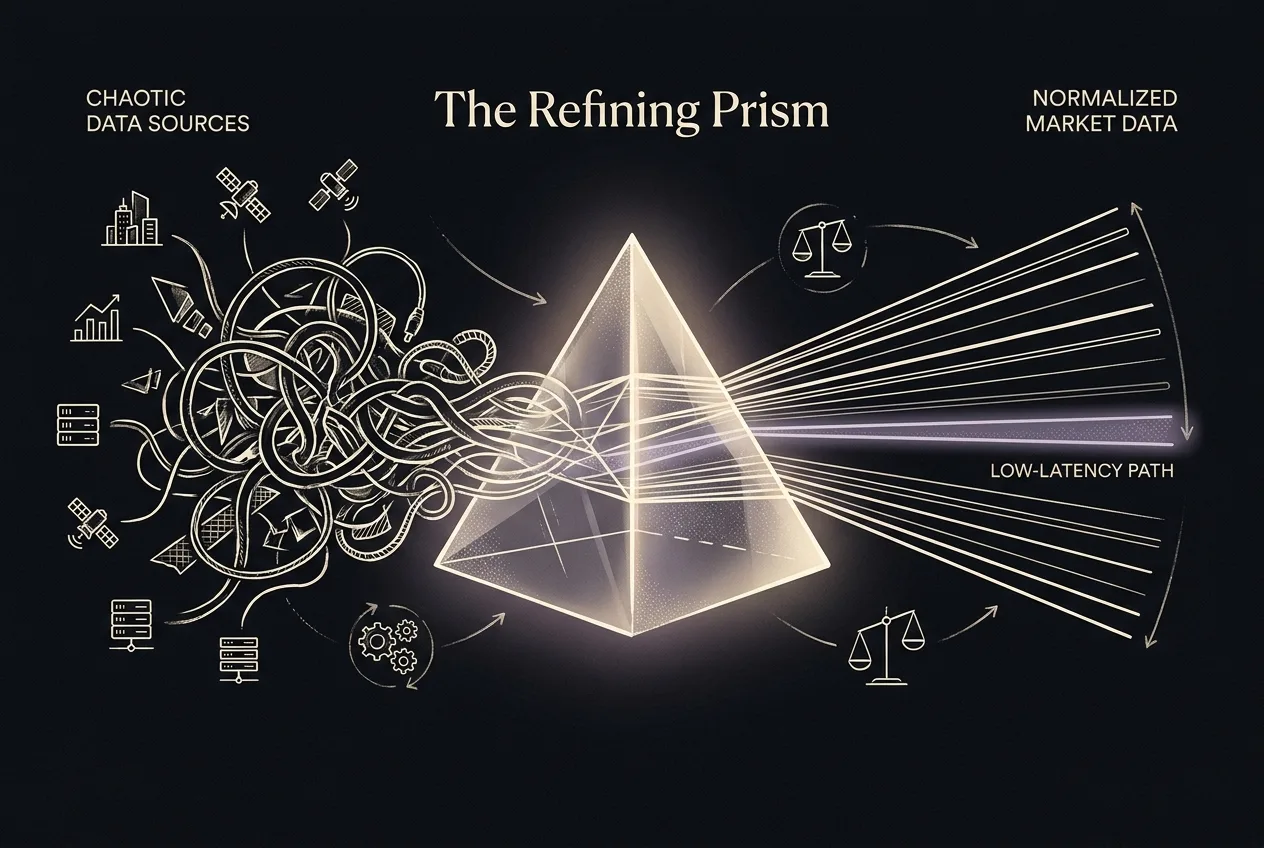
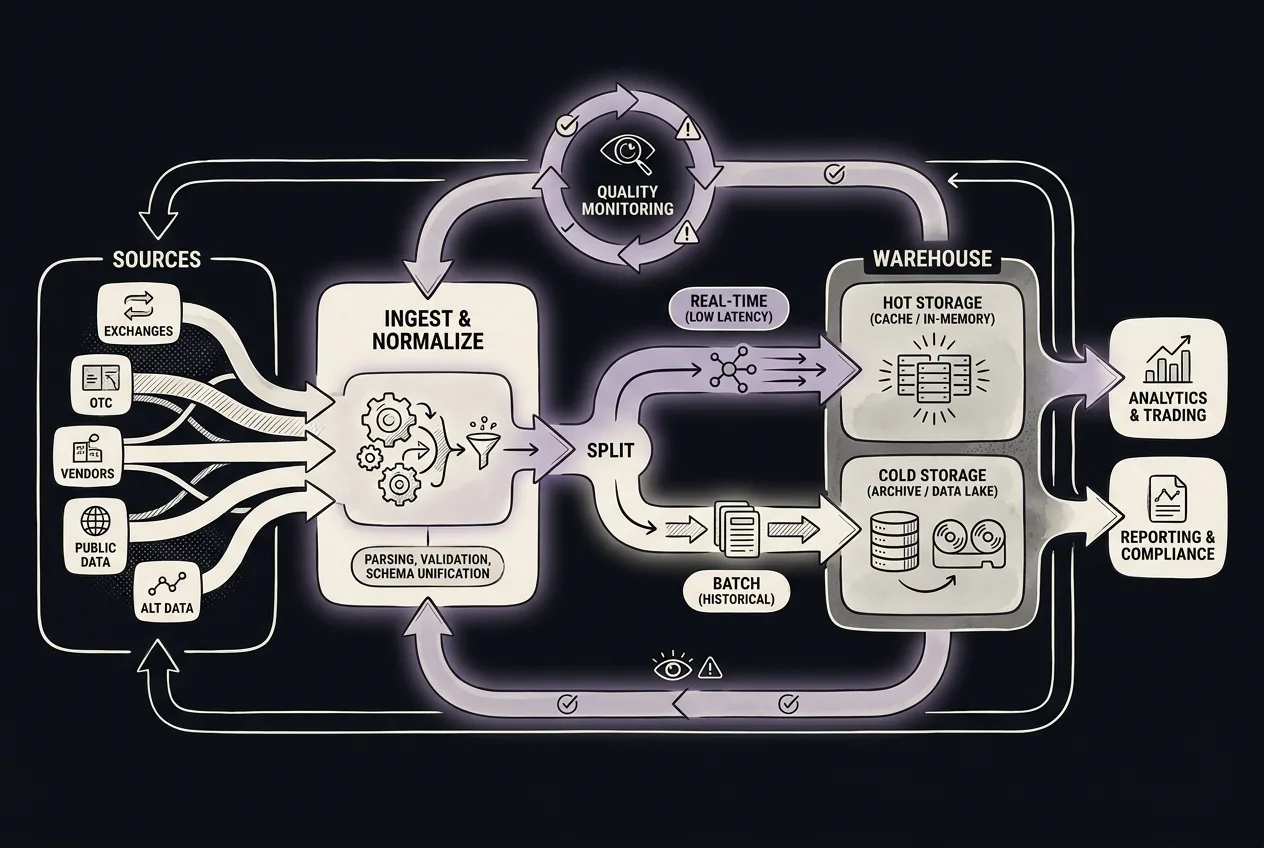
Designing a data stack that serves all of these use cases efficiently requires a tiered architecture in which data flows through different processing and delivery pathways depending on the latency requirements of the consuming application. The fastest path delivers raw, minimally processed data to latency-sensitive strategies. A parallel path performs enrichment, normalization, and aggregation for applications that prioritize data quality and completeness over raw speed.
Real-Time vs. Batch Processing Architectures
The most consequential architectural decision in the data stack is how real-time streaming and batch processing relate to each other. Treated as two independent systems, they become two copies of the truth that drift apart. Treated as two views of one record, they reinforce it. Each has genuine strengths, and a serious stack uses both—but how they are wired together determines whether the firm ends up with one consistent picture or several competing ones.
Streaming Architecture
A streaming architecture processes each data message as it arrives, flowing it through a pipeline of transformation, enrichment, and delivery stages with minimal buffering. The canonical technology choices include message brokers such as Apache Kafka or proprietary low-latency messaging systems, stream processing frameworks like Apache Flink or KDB+/q, and in-memory data grids for maintaining current state.
The advantages of streaming architecture are low latency, continuous updates, and natural alignment with the event-driven nature of financial markets. The challenges are operational complexity, the difficulty of handling late or out-of-order data, and the computational cost of maintaining real-time processing pipelines for high-volume data streams.
The architectural question is not streaming vs. batch. It is how to design a system in which streaming and batch pathways produce consistent results, so that the real-time view of the world and the historical record tell the same story.
Batch Architecture
Batch processing aggregates data over defined time intervals and processes it as a unit. End-of-day processing, which computes official closing prices, corporate action adjustments, and portfolio valuations, is the most common example. Batch architecture excels at producing authoritative, reconciled datasets that serve as the system of record for regulatory reporting, performance measurement, and historical analysis.
The danger of relying exclusively on batch processing is that it introduces an inherent lag between market activity and data availability. For firms operating intraday strategies, batch-only architectures create blind spots that can expose the firm to unmanaged risk.
The Lambda and Kappa Patterns
Two architectural patterns have emerged to address the challenge of combining real-time and batch processing. The Lambda architecture maintains separate streaming and batch processing pathways that produce results which are eventually reconciled. The Kappa architecture, a simplification, processes all data through a single streaming pipeline that can be replayed from a log to produce batch-equivalent results.
In practice, the most defensible institutional stacks resolve the tension in favor of a single source: one append-only log that is the canonical record of what arrived and when. Real-time consumers read the head of the log with minimal buffering; batch processes read the same log from earlier offsets to produce reconciled, quality-assured datasets. The streaming view and the historical view are not two systems that must be kept in sync—they are two readers of one record. This is the architectural expression of the principle that should govern the whole stack: store the truth once, derive every view from it, and never let a derived view become a second original.

Data Normalization Across Asset Classes
One of the most underappreciated challenges in market data infrastructure is normalization: the process of transforming data from hundreds of sources into a consistent internal representation. Normalization encompasses format conversion, identifier mapping, unit standardization, and semantic alignment.
The Identifier Problem
Financial instruments are identified by different codes in different systems. A single equity may be referenced by its ticker symbol, CUSIP, ISIN, SEDOL, FIGI, or internal identifier, depending on the context. These identifiers are not stable: ticker symbols change when companies merge or relist, CUSIPs are reassigned when securities are reissued, and even ISINs can change in the context of corporate reorganizations.
The symbology problem is the "one record" principle applied to identity rather than to price. If two systems disagree about which instrument a ticker refers to, no amount of downstream rigor will save them—trades book against the wrong security, risk calculations fold in incorrect positions, and regulatory reports go out inaccurate. The stack therefore needs a symbology service that is the single authority on instrument identity: it maintains current and historical mappings, resolves the corporate actions that mutate identifiers, and exposes one canonical internal identifier that every other system references. Crucially, those mappings are themselves temporal—the answer to "what did this ticker mean" depends on when you ask, and the service must preserve that history rather than overwrite it.
Cross-Asset Normalization
Different asset classes have fundamentally different data characteristics. Equity markets produce continuous quote and trade data during defined trading hours. Fixed income markets are largely dealer-driven with intermittent, often indicative pricing. Foreign exchange markets operate continuously across global time zones with pricing from multiple competing platforms. Derivatives markets add dimensions of expiration, strike price, and underlier relationships.
Normalizing data across these asset classes into a consistent representation requires careful domain modeling. The data schema must be expressive enough to capture the unique characteristics of each asset class while maintaining sufficient consistency to support cross-asset analytics. This typically involves a hierarchical data model in which common attributes (instrument identifier, timestamp, price, volume) are represented uniformly, while asset-class-specific attributes are stored in extension structures.

Tick Data Management and Historical Warehousing
Historical market data is among the most valuable assets an institutional trading firm possesses. Backtesting quantitative strategies, calibrating risk models, conducting transaction cost analysis, and performing regulatory lookbacks all depend on access to complete, accurate historical data.
Storage Architecture
Tick-level market data is characterized by extreme volume, temporal ordering, and append-only write patterns. These characteristics favor specialized storage solutions optimized for time-series data. Column-oriented databases such as ClickHouse, time-series databases like InfluxDB or TimescaleDB, and purpose-built market data stores like KDB+ are common choices.
The storage architecture must balance several competing requirements. Query performance for analytical workloads, which typically involve scanning large ranges of time-series data, is paramount. Storage efficiency matters because tick data accumulates rapidly; a single year of US equity market data can exceed 50 terabytes at the tick level. Data integrity must be maintained perfectly, as even small errors in historical data can invalidate backtest results and lead to flawed investment decisions.
Corporate Action Adjustment
Historical price data is misleading without proper adjustment for corporate actions. Stock splits, dividends, rights offerings, mergers, and spinoffs all break the continuity of a raw price series. A share that traded at $100 before a 4-for-1 split should read as $25 in the adjusted series; otherwise any analysis spanning the split date sees a 75% overnight crash that never happened.
Corporate action adjustment is more complex than it appears. Different adjustment methodologies produce different results, and the appropriate methodology depends on the intended use of the data. Total return indices that reinvest dividends are appropriate for performance measurement but may be misleading for backtesting strategies that depend on price levels. The data stack must maintain both raw and adjusted data and support multiple adjustment methodologies.
Point-in-Time Data Management
Point-in-time data management is where provenance stops being a nicety and becomes the difference between a valid backtest and a self-deceiving one. A point-in-time view reconstructs the data as it was known at a specific historical moment, before subsequent corrections and revisions. Fundamental data is especially prone to this: companies restate earnings, and vendors quietly correct reference data weeks after the fact.
A stack that stores only the latest version of each datum, overwriting prior values when corrections arrive, contaminates every backtest with look-ahead bias. The corrected number was not available when the strategy would actually have decided; using it lets the model see the future. The fix is bi-temporal storage that records two dates for every fact—the effective date the fact pertains to, and the knowledge date the system learned it. This is the same audit spine that lets the firm replay any decision exactly as it was made: feed the engine the data as it stood at decision time, and the historical record reproduces the past instead of editing it. A stack that cannot answer "what did we know, and when did we know it" cannot honestly validate a strategy, defend a trade to a regulator, or reconstruct an incident.
Data Quality Monitoring and Anomaly Detection
Data quality is not a feature that can be implemented once and forgotten. It requires continuous, automated monitoring that detects issues as they arise and escalates them for resolution before they affect downstream processes.
Common Data Quality Issues
Market data quality problems fall into several categories. Stale data occurs when a feed stops updating but does not signal an error, leaving consuming applications operating on outdated information. Gaps and missing data result from feed interruptions, exchange outages, or ingestion failures. Erroneous ticks include obviously incorrect prices caused by fat-finger errors, exchange glitches, or feed corruption. Duplicate messages can arise from redundant feed configurations or replay events. Timestamp inconsistencies result from clock synchronization issues across different data sources.
Automated Quality Assurance
An effective data quality monitoring system implements multiple layers of automated checks. Completeness checks verify that expected data has been received from all sources within expected timeframes. Range checks flag data points that fall outside plausible bounds. Consistency checks compare data from redundant sources and flag discrepancies. Statistical checks monitor distributional properties of data streams and alert on anomalies that may indicate systematic quality issues.
Machine-learning anomaly detection extends this further, catching subtle issues that rule-based checks miss—a feed whose distribution has drifted, a vendor that has silently changed methodology. Models trained on historical patterns flag deviations from expected behavior. But the right division of labor matters more than the model: machines operate the detection at a scale and speed no human can match, while humans govern which anomalies are real, which are tolerable, and how the thresholds should move. The system should escalate, not decide. Calibrating it to surface genuine issues without burying the desk in false positives is itself a governance task—a policy that humans set and revise, and that the machine then enforces uniformly across billions of messages.
Data quality is not a destination but a continuous process. The market data landscape is constantly changing as exchanges modify their protocols, vendors update their methodologies, and new data sources are introduced. A data quality monitoring system must evolve in tandem with the data it monitors.
Low-Latency Data Delivery for Algorithmic Trading
For algorithmic trading strategies, the latency of data delivery is a critical competitive parameter. The difference between receiving a market data update in 10 microseconds versus 100 microseconds can determine whether a strategy captures or misses a fleeting opportunity.
Feed Handler Optimization
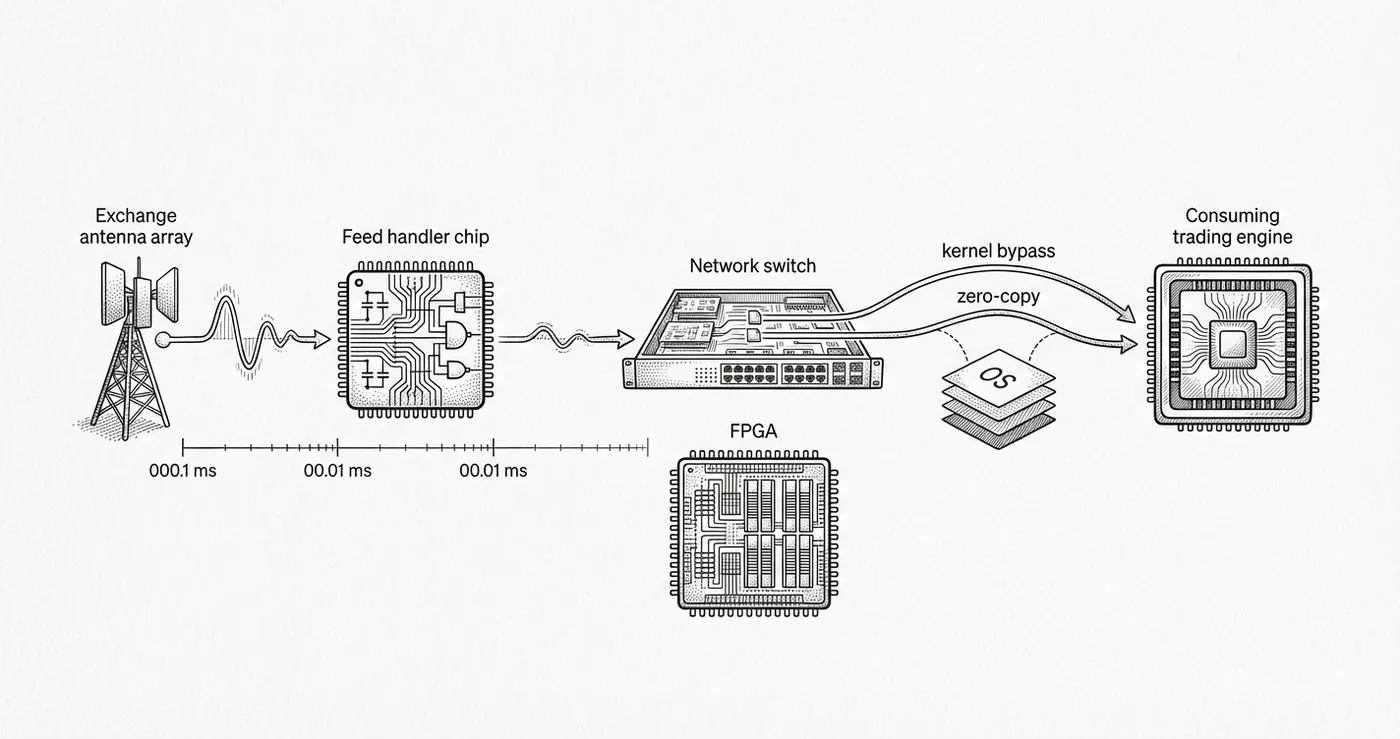
The feed handler, the component responsible for receiving raw market data from exchange feeds and converting it into an internal representation, is the first and often the most critical link in the latency chain. Optimized feed handlers employ techniques from high-performance computing: kernel bypass networking to eliminate operating system overhead, memory-mapped I/O for zero-copy data access, lock-free data structures for concurrent processing, and careful memory layout to maximize CPU cache utilization.
The choice of programming language matters at this level. C and C++ remain dominant for ultra-low-latency feed handlers, though Rust has emerged as a compelling alternative that offers comparable performance with stronger memory safety guarantees. Higher-level languages like Java can achieve acceptable latency for many use cases when carefully tuned, but are typically not competitive for the most latency-sensitive applications.
Network Architecture
The physical network architecture is equally important. Co-location at exchange data centers minimizes the physical distance that data must travel. Direct exchange connections via dedicated network links provide lower and more predictable latency than shared network infrastructure. Within the firm's own data center, high-speed switching fabrics with deterministic forwarding behavior ensure that data reaches consuming applications with minimal and consistent delay.
FPGA (field-programmable gate array) technology has become increasingly common in the data delivery path. FPGAs can process market data messages in hardware with sub-microsecond latency, performing feed normalization, filtering, and routing without the overhead and jitter introduced by software-based processing.
Data Conflation and Smart Filtering
Not every market data update is relevant to every consuming application. A strategy focused on S&P 500 equities does not need to process every quote update from small-cap stocks. A risk management system may only need periodic snapshots rather than every tick. Smart filtering and conflation, in which rapid-fire updates are consolidated into a single message reflecting the latest state, can dramatically reduce the processing load on consuming applications without sacrificing the information they need.
The key is to push filtering as close to the data source as possible, minimizing the volume of data that flows through the system. Exchange feeds often support topic-based subscription that allows consumers to receive updates only for instruments of interest. Internal message distribution systems can provide additional filtering based on application-specific criteria.
Cost Optimization: Smart Data Routing and Vendor Management
Market data is one of the largest non-compensation cost items for institutional trading firms. Global spending on market data and trading technology exceeds $35 billion annually, and costs have been rising steadily as exchanges increase fees and the number of required data sources grows.
Tiered Data Sourcing
Not all data needs require the same quality, latency, or completeness. A tiered data sourcing strategy matches data sources to use cases based on actual requirements rather than defaulting to the most comprehensive (and expensive) option for every application.
Direct exchange feeds, which provide the lowest latency and highest fidelity, are essential for latency-sensitive trading strategies. Consolidated tape feeds, which aggregate data from multiple exchanges with slightly higher latency, may be sufficient for portfolio management and risk applications. Delayed data or end-of-day snapshots can serve research, compliance, and reporting use cases at a fraction of the cost of real-time feeds.
Usage Monitoring and Optimization
Many firms pay for data they never use, or route premium feeds to applications a cheaper source would satisfy. The reason tiering scales is the same reason the rest of the stack does: because every consumer reads from one fabric with known provenance, the firm can see exactly which application touched which source and how often, and re-route by policy rather than by adding people to chase invoices. Systematic usage monitoring turns cost control into a configuration change instead of a headcount line—an entitlement rule that any new consumer inherits automatically.
Vendor contract management compounds the savings. Market data contracts are intricate, with pricing keyed to user counts, device counts, data volume, or application-specific licensing. Mapping actual usage against each model—again, possible only when usage is observable from a single record—surfaces where the firm is paying for permissions it does not exercise.
Cloud-Native vs. On-Premise Infrastructure
The question of whether to deploy market data infrastructure in the cloud, on-premise, or in a hybrid configuration is one of the most consequential architectural decisions facing institutional firms today.
The Case for Cloud
Cloud infrastructure offers compelling advantages in elasticity, operational simplicity, and capital efficiency. The ability to scale compute and storage resources dynamically, paying only for what is used, is particularly valuable for workloads with variable demand. Historical data analysis, backtesting, and research computing are natural cloud workloads that benefit from the ability to spin up large clusters for short-duration computations.
Cloud providers have invested heavily in financial services capabilities, offering dedicated instances, direct connectivity to exchanges, and compliance certifications that address many of the concerns that historically kept financial firms on-premise. Multi-region deployment provides geographic redundancy that is expensive to replicate with owned infrastructure.
The Case for On-Premise
For the most latency-sensitive workloads, on-premise infrastructure in exchange co-location facilities remains essential. The physics of data transmission impose a hard floor on cloud latency that cannot be overcome through software optimization. For high-frequency trading strategies where competitive advantage is measured in microseconds, co-located infrastructure is not optional.
On-premise infrastructure also provides greater control over the security and isolation of sensitive data. While cloud security has improved dramatically, some institutional investors, particularly those subject to regulatory requirements around data sovereignty, prefer the certainty of physical control over their data.
Hybrid Architectures
Most institutional firms are converging on hybrid architectures that deploy latency-sensitive workloads on-premise in co-located facilities while leveraging cloud infrastructure for compute-intensive but latency-tolerant workloads. This approach captures the performance advantages of co-location for real-time trading while exploiting the elasticity and cost efficiency of the cloud for research, backtesting, and analytics.
The challenge of hybrid architecture is, once again, the single-record problem in a new guise. Splitting workloads across two environments invites two divergent copies of the truth—an on-premise reality for trading and a cloud reality for research that quietly disagree. Data generated on-premise must be replicated to the cloud for analysis, and results computed in the cloud fed back for real-time decisions, all without either side becoming a second original. This demands high-bandwidth, low-latency interconnections and a replication discipline that preserves ordering and provenance across the boundary, so the cloud copy remains a faithful derivation of the canonical log rather than a fork of it.
Building for Scale: Handling Market Microstructure Data
As markets become more electronic and more fragmented, the volume and complexity of market microstructure data continue to grow. Order book data, which captures the full depth of supply and demand at each price level, provides rich information about market dynamics but presents extreme data management challenges.
Full Order Book Reconstruction
Reconstructing the full limit order book from exchange messages requires processing every order submission, modification, and cancellation in sequence. For actively traded instruments, this can involve thousands of messages per second, each of which modifies the state of the book in a specific way. The computational cost of maintaining a real-time reconstructed order book for thousands of instruments simultaneously is substantial.
Efficient order book management requires data structures optimized for the specific access patterns involved: frequent insertions and deletions at arbitrary price levels, rapid retrieval of the best bid and offer, and efficient scanning of multiple price levels for depth analysis. Balanced tree structures and skip lists are common choices, though the optimal data structure depends on the specific characteristics of the exchange's matching engine and message protocol.
Market Microstructure Analytics
Institutional investors increasingly use market microstructure data for purposes beyond immediate trade execution. Order flow analysis can detect informed trading activity, identify potential market manipulation, and measure the information content of different types of orders. These analytics require the ability to process and analyze enormous volumes of order-level data, often in real time.
The computational demands of microstructure analytics are driving adoption of GPU-accelerated computing, which can process large-scale parallel computations on tick data orders of magnitude faster than traditional CPU-based approaches. Libraries such as RAPIDS cuDF and custom CUDA kernels enable institutional firms to perform analyses on billions of data points that would be impractical with conventional hardware.
Operational Resilience and Disaster Recovery
Market data infrastructure must operate continuously during market hours. A failure in the data stack can blind the firm's trading systems, risk management processes, and compliance monitoring at precisely the moments when accurate data is most critical.
Redundancy at Every Layer
Enterprise-grade data infrastructure implements redundancy at every layer of the stack. Multiple independent connections to each data source ensure that a single feed failure does not interrupt data flow. Redundant processing pipelines running on separate hardware provide continued operation if a processing node fails. Replicated storage systems protect against data loss from hardware failures.
The redundancy architecture must be regularly tested through controlled failover exercises. A redundant system that has never been activated in a failure scenario provides false confidence. Institutional best practice includes scheduled failover testing, chaos engineering exercises that introduce controlled failures into the production environment, and automated monitoring that continuously verifies the health of redundant components.
Disaster Recovery
Beyond component-level redundancy, the data stack must be designed for recovery from catastrophic failures affecting an entire data center. This requires geographic replication of both data and processing capabilities, with automated or rapid manual failover procedures. Recovery time objectives and recovery point objectives must be defined for each component of the data stack, with the most critical components, those supporting active trading, requiring near-zero recovery times.
Conclusion
Return to the three systems that disagreed about a price. Every layer in this article exists to make that disagreement impossible: one append-only log so streaming and batch read the same record; one symbology service so every system means the same instrument by the same identifier; bi-temporal storage so the firm can always answer what it knew and when. The unifying idea is not faster data or cheaper data—it is one record, with provenance attached, that every other system reasons over. Scale, normalization, latency, and cost are all engineering problems downstream of that single decision.
The reason it matters beyond elegance is that everything a serious firm must do later—validate a strategy, defend a trade, reconstruct an incident, govern an automated decision—is a query against the data stack. A governed decision is only as trustworthy as the record it was made against, and a replay is only honest if the data can be restored to exactly how it stood at decision time. The data stack is the foundation those guarantees rest on. Build it on many copies of the truth and no amount of downstream rigor recovers what was lost; build it on one record with lineage, and audit, replay, and governance become reads rather than reconstructions.
At Adaptic, the data fabric is built to this standard because the rest of the platform depends on it. Decisions are made by machines and governed by humans, and that governance is only meaningful if every decision can be traced to the exact data it consumed. We treat ingestion, normalization, and delivery not as plumbing to be hidden but as the audit spine the platform is accountable to—a record a firm can interrogate, not a black box it must trust. The standard we hold ourselves to is proof over promotion: the value of a data stack is not in what it claims, but in whether it can show its work.