The Institutional Case for AI Portfolio Optimization
The institutional case for AI portfolio optimization rests not on the model but on the system around it: governed operation, accountable by architecture.


Most arguments for AI in portfolio management are made on the wrong terms. They claim the model is smarter: that a neural network sees patterns a covariance matrix cannot, that machine learning will find alpha where human researchers exhausted it. Some of that is true and some of it is overstated, but none of it is the institutional case. An allocator does not adopt a system because it is clever. An allocator adopts a system because, when it is wrong, someone is accountable, the decision is explicable, and the loss is bounded.
This is the argument worth making, and it is harder than the one usually offered. AI portfolio optimization earns an institutional place not on the strength of the model but on the strength of the system built around it: who governs it, what it is permitted to do, and how every decision it takes can be reconstructed after the fact. The model is the easy part. The accountability is the product.
The honest premise is that the classical framework is genuinely strained. For more than half a century, mean-variance optimization has served as the intellectual bedrock of institutional portfolio construction. Harry Markowitz's elegant framework, which earned him a Nobel Prize, gave allocators a mathematically rigorous method for balancing risk and return. As markets have grown more interconnected and prone to sudden regime shifts, its limitations have become difficult to ignore. But the answer to a strained framework is not a cleverer black box. It is a third operating model, between manual control and unaccountable automation, in which humans govern and machines operate.
The Fractures in Mean-Variance Optimization
The appeal of mean-variance optimization lies in its simplicity: given estimates of expected returns, variances, and covariances, the model produces an "efficient frontier" of portfolios offering the highest return for each level of risk. In practice, however, this simplicity conceals a series of well-documented pathologies.
Estimation error amplification. Mean-variance optimization is notoriously sensitive to input parameters. Small changes in expected return estimates can produce wildly different portfolio allocations. As Richard Michaud demonstrated in his foundational research, the optimizer tends to overweight assets with large estimated returns, low estimated variances, and low estimated correlations, precisely those parameters most likely to contain estimation errors. The resulting portfolios are, in Michaud's memorable phrase, "error maximizers."
Static assumptions in a dynamic world. The framework assumes that the statistical properties of asset returns are stationary: that the correlations and volatilities observed in historical data will persist into the future. This assumption fails spectacularly during market crises, when correlations spike toward one and volatility regimes shift abruptly. The portfolios that appeared well-diversified under normal conditions can become dangerously concentrated in their factor exposures precisely when diversification matters most.
Gaussian distribution blindness. Mean-variance optimization implicitly assumes that returns follow a normal distribution. Decades of empirical evidence have established that financial returns exhibit fat tails and negative skewness, meaning that extreme losses occur far more frequently than a Gaussian model would predict. A framework that ignores these tail risks is fundamentally misspecified for institutional portfolios where drawdown management is paramount.
The central paradox of traditional portfolio optimization is that the model works best when its assumptions hold, which is precisely when investors need it least. During market stress, when optimization is most critical, its assumptions break down most completely.


How AI Reframes the Optimization Problem
Before defending the system, the model deserves an honest accounting of what it actually does and where it fails. AI-driven optimization does not merely substitute better algorithms into the same framework; it reconceives the problem. Rather than relying on closed-form solutions derived from stylized assumptions, machine learning approaches treat portfolio construction as a high-dimensional, sequential decision problem in which the relationships between inputs and outcomes are learned from data.
That capability is real, and so is its principal danger. A model with the freedom to learn arbitrary relationships also has the freedom to learn relationships that exist only in its training sample. Overfitting is not a peripheral risk to be footnoted; it is the central failure mode, and every claimed advantage below is conditional on disciplined out-of-sample validation. The case for these methods is not that they are immune to error but that their errors can be detected, bounded, and governed.
Regime Detection and Adaptive Allocation
One of the most consequential capabilities of AI-based systems is their ability to detect and respond to market regime changes in near-real time. Hidden Markov Models, recurrent neural networks, and more recently transformer-based architectures can identify shifts in market conditions, such as the transition from a low-volatility carry regime to a risk-off deleveraging event, and adjust portfolio allocations accordingly.
This differs qualitatively from the traditional approach of using a single covariance matrix derived from a trailing window of historical data. An AI system trained across multiple regimes can learn the conditional distribution of returns given the current market state, producing allocations adapted to the prevailing environment rather than averaged across all of them.
The honest limit is that a model can only recognize regimes resembling those in its training data. A genuinely novel dislocation, the kind that arrives once a decade and rewrites correlation structure, is precisely the event no historical sample contains. Regime detection narrows the window of surprise; it does not close it. This is the strongest argument for keeping a human at the strategic helm: the model handles the regimes it has seen, and the governing mandate constrains its exposure to the ones it has not.
Non-Linear Correlation Modeling
Traditional optimization relies on linear correlation as its measure of co-movement between assets. This metric captures only the simplest form of dependence and can be deeply misleading. Two assets may exhibit near-zero linear correlation during calm markets but become highly correlated during selloffs, a phenomenon known as asymmetric dependence.
Machine learning models, particularly deep neural networks and copula-based approaches enhanced by gradient boosting, can capture these non-linear and state-dependent relationships. The resulting portfolio allocations reflect the true structure of asset co-movement across different market conditions, providing more reliable diversification when it is most needed.
Continuous Learning and Model Adaptation
Perhaps the most profound difference between classical and AI-based optimization is the capacity for continuous learning. Traditional models are estimated once and applied until the next rebalancing date. AI systems can be designed to update their parameters incrementally as new data arrives, detecting gradual shifts in market dynamics that would go unnoticed by static models.
This adaptive capability is particularly valuable in the current environment, where secular trends such as the green energy transition, deglobalization, and the rise of passive investing are continuously reshaping the statistical properties of asset returns. An optimization framework that cannot adapt to these structural changes is, by definition, operating with a stale model of the world.

Factor-Based vs. AI-Based Construction: A Practical Comparison
Factor-based portfolio construction, which allocates to systematic risk premia such as value, momentum, quality, and low volatility, represented the most significant advance in portfolio theory between Markowitz and the advent of machine learning. It remains the dominant framework at many large institutional investors. Understanding how AI-based approaches differ from, and potentially complement, factor-based methods is essential for allocators evaluating the transition.
Dimensionality and Feature Space
Factor models typically operate with a modest number of well-researched factors, usually between three and ten. This parsimony is a strength in terms of interpretability and robustness, but it necessarily limits the information set that drives portfolio construction. AI-based systems can operate across hundreds or thousands of features, encompassing not only traditional financial metrics but also alternative data such as satellite imagery, web traffic, patent filings, and supply chain signals.
Signal Decay and Crowding
Established factor premia have experienced significant decay as they have become widely adopted. The value factor, for example, has delivered disappointing returns over the past decade as capital has crowded into value strategies. AI-based systems, by continuously scanning a broader feature space and detecting novel patterns, can identify alpha sources that are less susceptible to crowding. However, this advantage is not permanent: as AI adoption accelerates, the alpha from machine learning signals will also face competitive pressure.
Turnover and Transaction Cost Management
A common criticism of AI-driven portfolios is that they tend to generate higher turnover than factor-based approaches, eroding returns through transaction costs. This concern is legitimate but increasingly addressed through turnover-penalized objective functions, where the optimization explicitly trades off expected alpha against estimated transaction costs. Modern reinforcement learning approaches can learn optimal execution strategies that minimize market impact, a capability that static factor models lack entirely.
Risk Budgeting and Constraint Optimization with Machine Learning
Institutional portfolios operate under complex constraint sets that extend far beyond the simple long-only or leverage constraints of textbook optimization. Pension funds must manage liability-matching requirements. Endowments face spending rules and illiquidity budgets. Sovereign wealth funds navigate political and ESG mandates. Insurance companies must satisfy regulatory capital requirements.
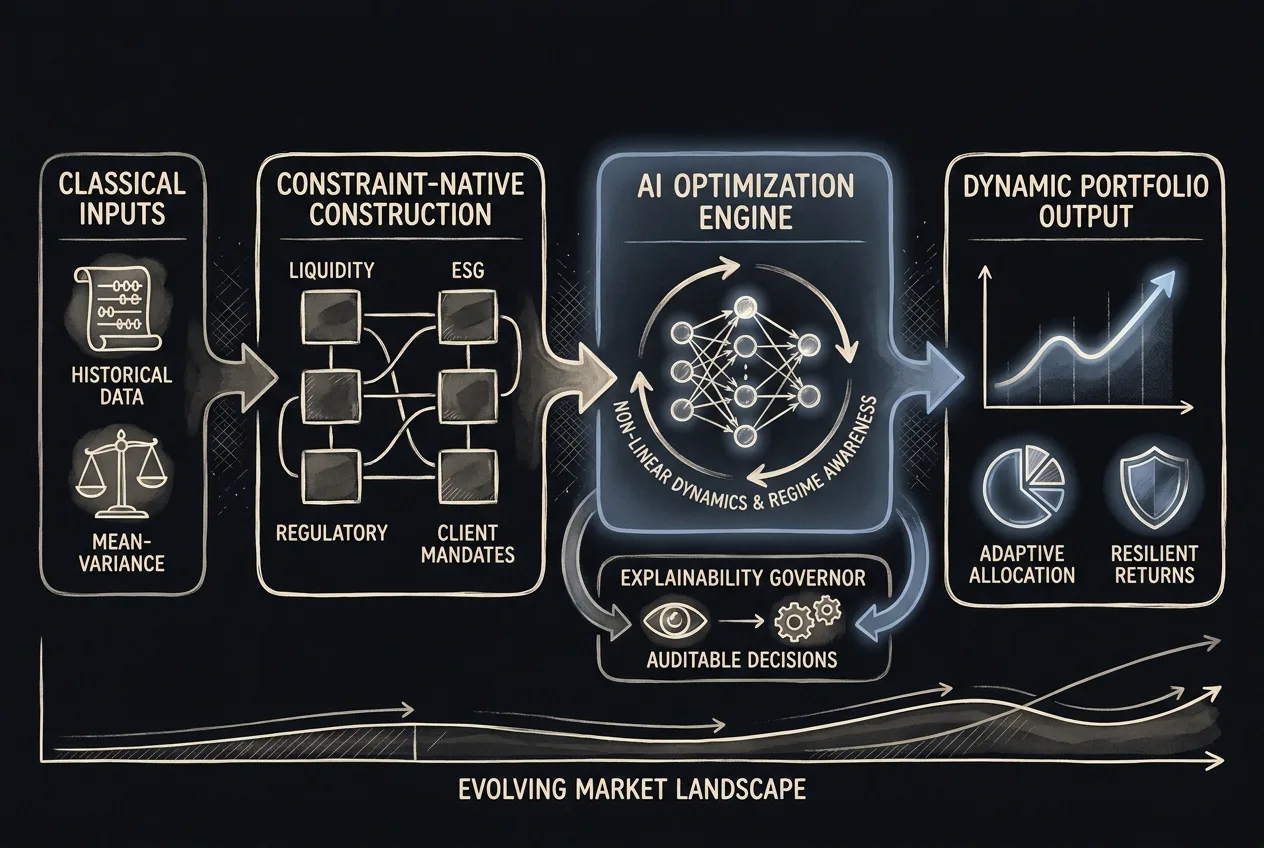
AI-based optimization frameworks can incorporate these constraints natively, treating them not as afterthoughts bolted onto a mean-variance solution but as integral components of the objective function. Several approaches have proven particularly effective.
Hierarchical Risk Parity with ML Enhancement
Hierarchical Risk Parity, introduced by Marcos Lopez de Prado, uses machine learning clustering algorithms to group assets by their correlation structure and then allocates risk equally across these clusters. This approach avoids the instability of covariance matrix inversion that plagues traditional optimization while producing portfolios with genuine structural diversification.
AI enhancements to this framework can dynamically adjust the clustering structure as market regimes evolve, ensuring that the risk allocation reflects current rather than historical correlation patterns.
Conditional Value-at-Risk Optimization
For institutions with explicit tail-risk mandates, Conditional Value-at-Risk (CVaR) optimization using machine learning offers a powerful alternative to traditional VaR-based approaches. Neural network-based models can estimate the full conditional distribution of portfolio returns, enabling CVaR optimization that accounts for fat tails, asymmetric dependence, and regime-dependent risk.
Multi-Objective Optimization
Institutional mandates rarely reduce to a single objective. A pension fund may simultaneously seek to maximize expected returns, minimize tracking error relative to a liability benchmark, satisfy ESG criteria, and maintain sufficient liquidity for benefit payments. Multi-objective optimization using evolutionary algorithms or Bayesian optimization can navigate these competing objectives, presenting allocators with a Pareto frontier of solutions rather than a single "optimal" portfolio.
Implementation Challenges at Institutional Scale
The theoretical advantages of AI-driven optimization are compelling, but institutional implementation introduces a set of practical challenges that must be addressed with the same rigor as the algorithmic design.
Liquidity and Capacity Constraints
Strategies that appear attractive in backtests may prove unimplementable at institutional scale. A signal that works for a $50 million allocation may generate unacceptable market impact when applied to a $5 billion portfolio. AI-based optimization must incorporate realistic models of market liquidity and capacity, adjusting allocations to account for the portfolio's own price impact.
This is an area where machine learning offers a distinct advantage: models can be trained on actual execution data to estimate market impact as a function of order size, market conditions, and time of day, producing capacity-aware allocations that degrade gracefully as portfolio size increases.
Turnover and Tax Efficiency
For taxable investors, the transaction costs of portfolio rebalancing extend beyond commissions and market impact to include capital gains taxes. AI-driven optimization can incorporate tax-lot-level information, harvesting losses and deferring gains to maximize after-tax returns. This capability, while technically demanding, can add significant value for endowments, family offices, and other tax-sensitive institutional investors.
Operational Integration
Integrating an AI-based optimization system into an existing institutional investment process is a non-trivial operational challenge. The system must interface with order management systems, risk platforms, compliance engines, and custodial infrastructure. Data pipelines must be robust, with failover mechanisms to handle interruptions in data feeds. Model outputs must be validated before execution, with human oversight at critical decision points.
Case Framework: AI Optimization for a Multi-Billion Dollar Portfolio
Consider a hypothetical $8 billion multi-asset portfolio for a large public pension fund, allocated across global equities, investment-grade and high-yield credit, government bonds, real estate, and private equity.
Before AI Optimization
Under the traditional approach, the investment committee establishes a strategic asset allocation based on long-term capital market assumptions, typically updated annually. Tactical tilts are implemented quarterly based on the views of the investment staff. Rebalancing occurs on a calendar basis, typically monthly, with fixed bands around target allocations. Risk is monitored using a static covariance matrix estimated from the trailing three to five years of data.
This framework tends to produce portfolios that are slow to respond to changing conditions, insufficiently diversified at the factor level despite appearing well-diversified across asset classes, and prone to significant drawdowns during market dislocations.
After AI Optimization
The AI-enhanced framework introduces several critical improvements. Regime-aware allocation adjusts the portfolio's risk profile in response to detected shifts in market conditions, reducing equity exposure ahead of recessionary environments and increasing it during early recovery phases. Dynamic correlation modeling ensures that the portfolio's factor exposures remain genuinely diversified, accounting for the state-dependent nature of asset co-movement. Continuous rebalancing, informed by real-time estimates of transaction costs and market impact, replaces the rigid calendar-based approach.
A backtest can show what such a framework might have done, and the order of magnitude sophisticated investors pursue is modest and worth stating plainly: improvements measured in tens of basis points of Sharpe and a few hundred basis points of drawdown reduction, net of estimated implementation costs, not the doubling of returns that marketing material tends to imply. But a backtest is the weakest possible evidence, because the same flexibility that lets a model fit genuine structure lets it fit the test. Any specific figure presented here would be a curve fitted to a known past.
This is why the honest standard is proof rather than promotion. The credible path is to run the system under the same governance and the same audit spine that would apply to client assets, and let a forward record accumulate. An allocator should weight a claimed backtest at close to zero and a governed live track record at close to everything. Until that record exists, the right stance is to assert no track record in advance.
Accountability as Architecture
Everything to this point concerns what the model can do. The institutional case turns on what the system around it guarantees, and that is a question of architecture, not analytics. Two design commitments do the work: governing the model through policy expressed as code, and recording its every decision on an audit spine that makes the past reconstructible.
Consider the alternative this displaces. Manual control gives an institution accountability but not scale: every position reflects a human decision, traceable to a person, but the number of decisions a desk can make is bounded by headcount. A black box gives scale but not accountability: it acts at machine speed and cannot say why. The third operating model resolves the tension. Humans set policy; machines execute within it. Scale comes from better policy, not more headcount, because one well-specified mandate governs ten thousand decisions as readily as ten.
Policy as Code
In a governed system, the constraints an institution lives by are not informal guidelines applied by analysts under deadline pressure. They are executable policy: position limits, sector caps, liquidity floors, drawdown thresholds, ESG exclusions, and leverage ceilings encoded as rules the optimizer cannot violate. The model proposes allocations; the policy layer is what permits or rejects them, deterministically, every time. This inverts the usual relationship between speed and control. A human desk trades control for speed under pressure; a policy-as-code layer enforces control at the speed of the machine, with no fatigue and no exception made at the worst possible moment.
The Audit Spine
The second commitment is that every decision the system takes is recorded with the inputs, the active policy, the model version, and the rationale that produced it. This audit spine is what makes an AI allocation answerable in the way a human one is. When an investment committee asks why an exposure was reduced in March, the answer is not a post-hoc reconstruction but a retrieved record: this regime signal crossed this threshold, this policy constraint bound, this allocation followed. Accountability stops being a narrative imposed after the fact and becomes a property of the system's memory.
Explainability techniques sit on top of this spine rather than substituting for it. SHAP values can decompose an individual decision into the contributions of specific features. Attention weights in transformer-based models reveal which inputs the model leaned on. Hierarchical architectures can produce explanations at multiple levels, from a regime narrative to a granular signal decomposition. These methods are valuable, but they explain a decision only if the decision and its full context were recorded in the first place. The spine is the precondition; the techniques are the lens.
The institutions that succeed with AI-driven optimization treat explainability not as a constraint on model complexity but as a design requirement that shapes the architecture from the outset. A decision that cannot be reconstructed cannot be governed, however sophisticated the model that produced it.
This architecture is also what makes the system legible to the people who must answer for it. Dashboards that translate model outputs into the language of an investment committee, attribution reports that connect performance to specific governed decisions, and regular model governance reviews are not cosmetic. They are how an accountable system reports to the humans who remain accountable for it.
Regulatory Considerations and Fiduciary Duty
Institutional allocators operate within a web of regulatory requirements and fiduciary obligations that must be satisfied regardless of the technology employed. The adoption of AI-driven optimization does not alter these obligations; if anything, it intensifies the need for rigorous governance.
Fiduciary prudence. Under the prudent investor rule and its equivalents across jurisdictions, fiduciaries must exercise the care, skill, and diligence that a prudent person would employ. This standard increasingly requires consideration of advanced analytical tools where they can demonstrably improve investment outcomes. However, it also requires that fiduciaries understand the tools they employ, reinforcing the importance of explainability.
Model risk management. Regulatory guidance such as the Federal Reserve's SR 11-7 establishes expectations for model risk management at financial institutions. AI-based optimization systems must be subject to independent validation, ongoing performance monitoring, and regular review. The complexity of machine learning models demands more sophisticated validation approaches than traditional statistical models, including out-of-sample testing, adversarial stress testing, and sensitivity analysis.
Data privacy and vendor risk. AI systems that incorporate alternative data must comply with data privacy regulations such as GDPR and CCPA. Institutions must also manage the vendor risk associated with third-party data providers and technology platforms, ensuring that critical investment processes are not unduly dependent on external providers.
The Path Forward for Institutional Allocators
The institutional case for AI portfolio optimization does not rest on the promise of extraordinary returns, and an allocator who buys it on those terms has bought the wrong thing. It rests on a narrower, more durable claim: that markets have outgrown the classical frameworks built to model them, and that the responsible answer is not an unaccountable machine but a governed one. The model earns its place because it can be supervised, bounded, and reconstructed, not because it is brilliant.
For allocators considering the transition, several principles follow directly from that position:
- Start with risk management, not return enhancement. The most compelling early use cases for AI in portfolio construction involve improved risk estimation and tail-risk management, areas where the benefits are measurable and the downside of the status quo is well understood.
- Invest in infrastructure before algorithms. The quality of an AI system's outputs depends critically on the quality of its data inputs. Robust data pipelines, clean historical datasets, and reliable real-time feeds are prerequisites for effective optimization.
- Demand explainability from the outset. Systems that cannot explain their decisions will not survive institutional governance processes, regardless of their backtested performance.
- Keep humans governing and machines operating. The boundary is not a slogan but an operating discipline: humans hold authority over strategy and policy, machines execute within it, and the audit spine makes the handoff reconstructible in both directions. An implementation that blurs this line forfeits the accountability that justified the system in the first place.
The transition from classical to AI-driven optimization is a spectrum, not a binary choice. An institution can begin by delegating a single function, covariance estimation or regime detection, under full governance, and widen the model's mandate only as the audit record earns that trust. Confidence should be a function of accumulated evidence, never of conviction about the technology.
This is the infrastructure Adaptic is building: a governed operating model in which humans set policy and machines operate within it, every decision is recorded on an audit spine, and the constraints an institution lives by are enforced as code rather than asserted as intent. We hold ourselves to the same standard we have described. The future of portfolio construction will not belong to whoever has the most powerful model. It will belong to institutions that can harness the complexity of modern markets without surrendering the accountability that fiduciary duty demands, because in the end an allocation is only as defensible as the system that can explain it.