Automated Portfolio Rebalancing: Precision Allocation at Institutional Scale
Rebalancing is a continuous constrained optimization, not a maintenance task. How intelligent systems hold allocation precision against transaction cost and tax drag — and why it belongs inside a governed policy, not a black box.


A 60/40 portfolio that drifts to 68/32 over a quarter is no longer the portfolio its investment committee approved. Its risk profile has changed without anyone deciding to change it. Restoring the intended weights sounds mechanical — sell the overweight, buy the underweight — and at the level of a single account, it is. Across a multi-billion-dollar, multi-asset book, it is one of the most consequential and least appreciated decisions in institutional asset management, because every trade that corrects allocation simultaneously incurs cost, realizes tax, and signals intent to the rest of the market.
That is the real shape of the problem. Rebalancing is not the act of restoring weights; it is the continuous reconciliation of competing objectives — allocation precision, transaction cost, tax consequence, factor exposure, liquidity, and information leakage — none of which can be optimized in isolation. Done with discipline, it adds value: practitioner estimates for the rebalancing premium typically fall in the range of 20 to 60 basis points of annual return, sourced from improved risk control and the systematic harvesting of mean reversion. Done carelessly — too often, too late, or without regard to cost basis — it gives that premium back through turnover and tax. The discipline is the difference, and discipline at scale is an engineering problem.
The Challenge of Multi-Asset Drift
A diversified institutional portfolio, spanning global equities, fixed income, real assets, private markets, and increasingly digital assets, drifts continuously. In a strong equity market, a 60 percent equity target may reach 68 percent within a single quarter. During a credit selloff, fixed income allocations can compress well below their benchmarks. Private market allocations, which cannot be rebalanced with the same precision as liquid assets, introduce a denominator effect that distorts the entire allocation picture: as illiquid valuations lag, the liquid sleeves must absorb the entire correction.
The challenge is compounded by the multi-dimensional nature of modern portfolio mandates. An institution may define targets not only at the asset class level but also across geographies, sectors, factor exposures, duration buckets, credit quality tiers, and ESG ratings. Drift in one dimension can cascade through others: an overweight in U.S. large-cap growth simultaneously affects the equity allocation, the geographic allocation, the growth-versus-value factor balance, and potentially the portfolio's carbon intensity target.
The most sophisticated rebalancing systems do not merely restore allocations to their targets. They optimize across all relevant dimensions simultaneously, treating rebalancing as a constrained multi-objective optimization problem rather than a series of independent adjustments.

Rebalancing Methodologies: From Calendar to Predictive
Calendar-Based Rebalancing
The simplest approach rebalances on a fixed schedule, typically monthly or quarterly. Calendar-based rebalancing has the virtue of simplicity and predictability, but it is inherently suboptimal. It ignores the magnitude of allocation drift between rebalancing dates, potentially allowing significant deviations to persist for weeks. Equally problematic, it may trigger trades when drift is minimal, incurring unnecessary transaction costs. For large institutional portfolios, where a single rebalancing event may involve hundreds of millions in trades, this inefficiency is consequential.
Threshold-Based Rebalancing
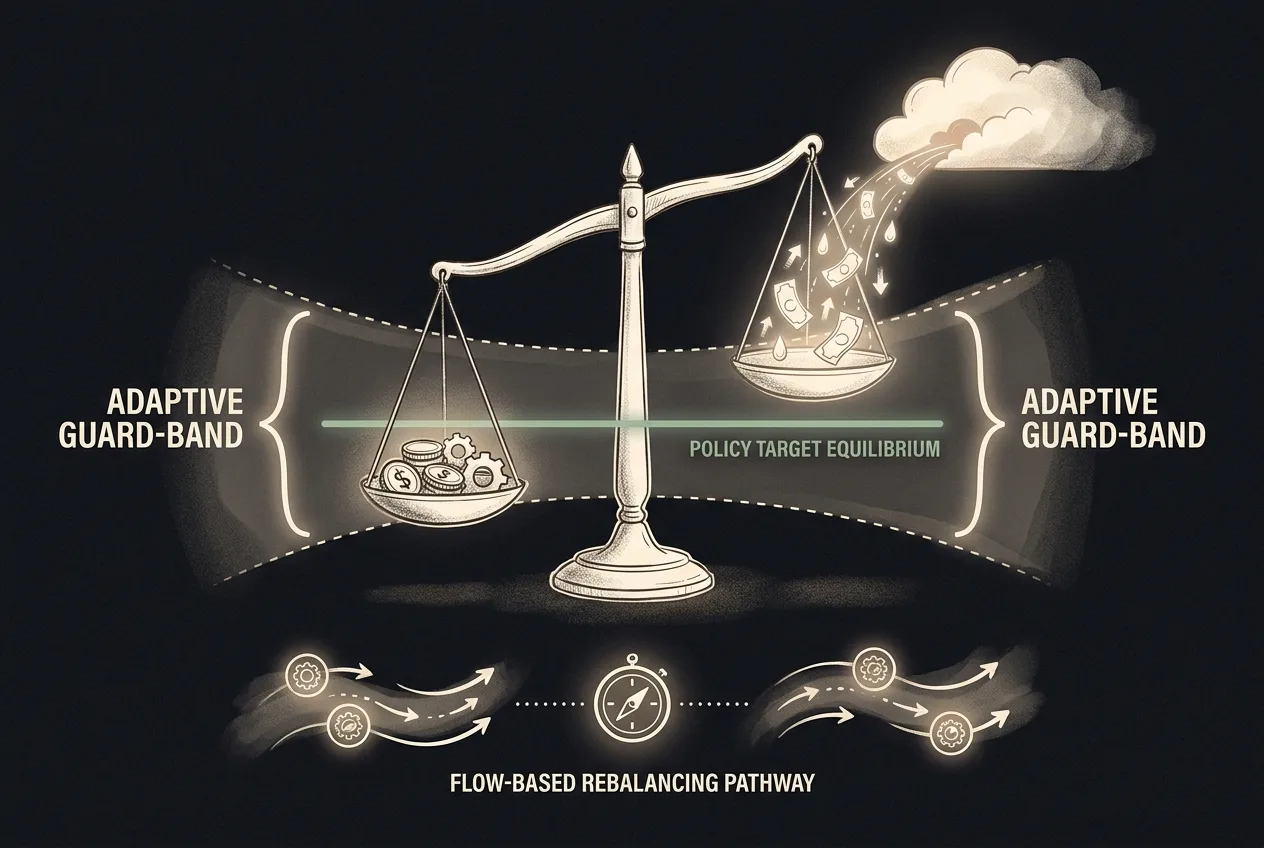
A more refined approach triggers rebalancing only when an allocation deviates from its target by more than a predefined threshold, typically expressed as an absolute or relative band. A common implementation might specify that equities should be rebalanced when the allocation drifts more than 3 percentage points from target, while a narrower band of 1 percentage point might apply to a more precisely managed fixed income sleeve.
Threshold-based rebalancing is a meaningful improvement over calendar approaches. It ensures that trades are motivated by genuine drift rather than arbitrary timing. However, the selection of thresholds involves a fundamental tension: narrow bands reduce tracking error but increase turnover and transaction costs, while wide bands reduce costs but permit larger deviations from the intended risk profile. Static thresholds cannot adapt to changing market conditions, where the optimal band width depends on volatility, correlation structures, and the cost of trading.
Predictive and AI-Driven Rebalancing
The next step is to treat the threshold itself as a decision rather than a constant. Predictive rebalancing applies machine learning to determine not only whether to rebalance but when, how much, and in what sequence — incorporating several capabilities that static approaches lack.
Volatility-adaptive thresholds. Rather than applying fixed bands, the system adjusts rebalancing thresholds dynamically based on current and forecasted volatility. In high-volatility environments, wider thresholds prevent excessive trading driven by transient price swings. In low-volatility regimes, tighter thresholds maintain allocation precision when the cost of doing so is modest.
Optimal timing models. Machine learning models trained on historical execution data can identify periods when rebalancing is likely to achieve better execution, accounting for intraday liquidity patterns, seasonal effects, and the anticipated activity of other large institutional flows. Avoiding rebalancing during periods of thin liquidity or elevated market impact can materially reduce implementation costs.
Cross-asset coordination. AI-driven systems can sequence trades across asset classes to minimize net market exposure during the rebalancing process. Rather than executing all buy and sell orders simultaneously, an intelligent system might first sell overweight positions in highly liquid markets, temporarily park proceeds in short-term instruments, and then build positions in less liquid target allocations over a series of days, reducing the aggregate market impact.
Transaction Cost Optimization
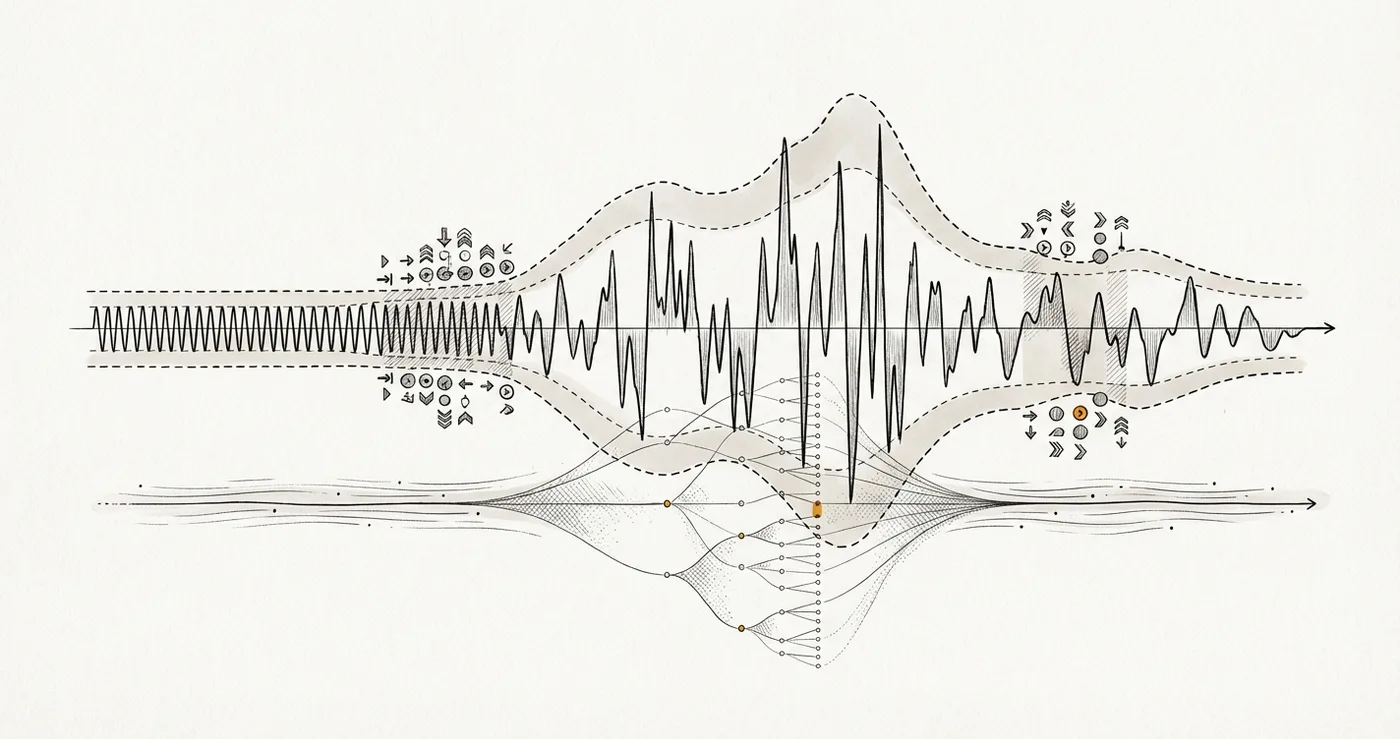
For an institutional portfolio turning over billions in annual rebalancing trades, transaction costs represent a significant drag on performance. These costs extend well beyond explicit commissions to include bid-ask spreads, market impact from large orders, opportunity costs from delayed execution, and the information leakage that occurs when market participants detect institutional flow.
Effective rebalancing systems incorporate a transaction cost model that estimates the all-in cost of each proposed trade as a function of order size, market conditions, and venue characteristics. The rebalancing optimizer then treats these estimated costs as a penalty in the objective function, producing a trade list that balances allocation precision against implementation cost.
This framing naturally produces partial rebalancing, where allocations are moved toward but not all the way to their targets when the marginal cost of the final increment exceeds the marginal benefit of improved allocation precision. For many institutional portfolios, this approach dominates full rebalancing on a risk-adjusted basis.
Tax-Loss Harvesting Integration
For taxable investors, including endowments, family offices, and certain insurance portfolios, the integration of tax-loss harvesting into the rebalancing process can be the single largest source of value-add. When a rebalancing trade involves selling a position at a loss, the realized loss offsets capital gains elsewhere in the portfolio, deferring the associated tax liability.
An intelligent rebalancing system maintains a tax-lot-level view of the portfolio, identifying positions where unrealized losses can be harvested during rebalancing without disrupting the overall allocation or introducing wash-sale violations. The system can also defer rebalancing trades that would realize short-term capital gains, instead allowing those positions to mature to long-term holding periods where the tax rate is substantially lower.
The interaction between rebalancing and tax management is inherently complex: the optimal trade from an allocation perspective may be suboptimal from a tax perspective, and vice versa. Multi-objective optimization frameworks that jointly optimize across allocation targets, transaction costs, and after-tax returns represent the state of the art for tax-sensitive institutional portfolios.
Drift Monitoring and Alert Architecture
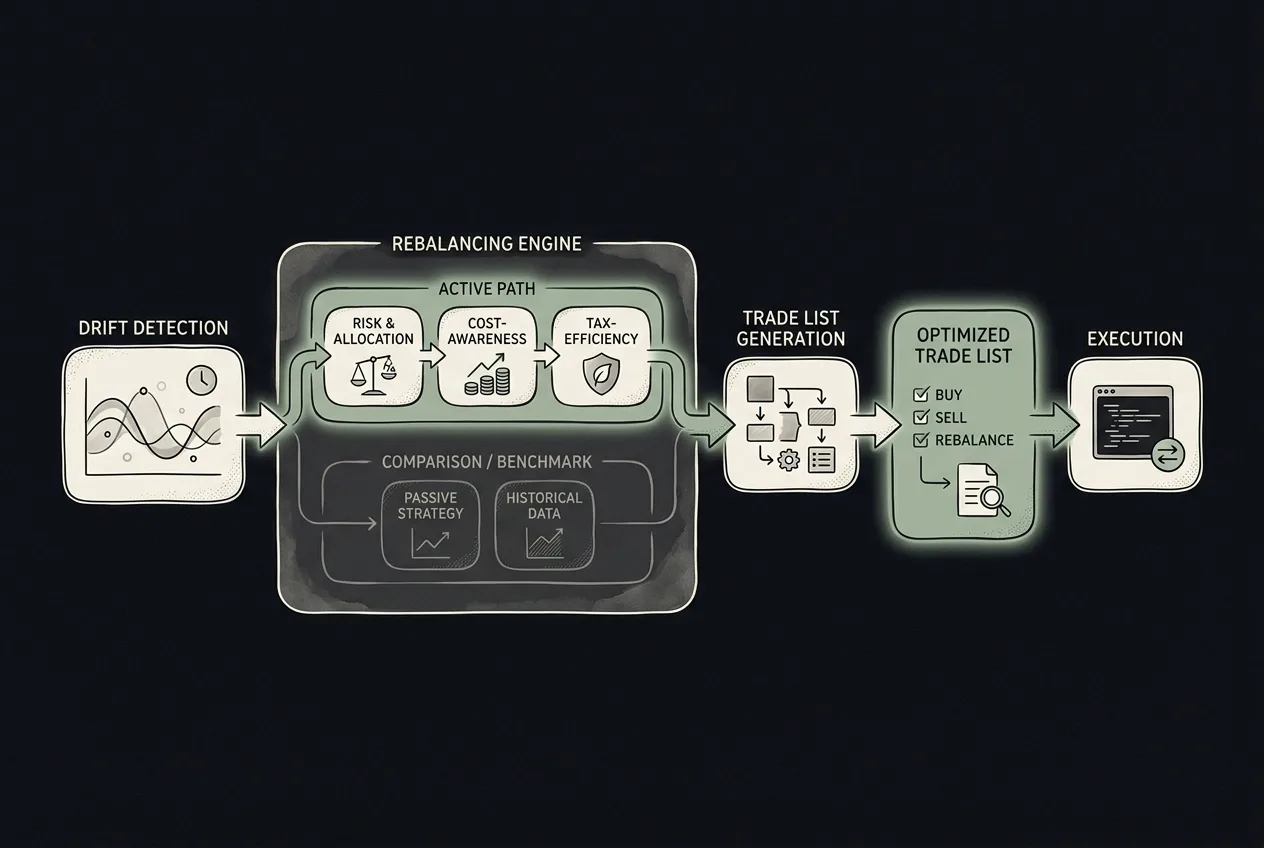
Continuous drift monitoring is the foundation of any rebalancing program. Modern monitoring systems track allocation drift in real time across all relevant dimensions, incorporating live market data, pending trades, anticipated cash flows, and corporate actions that may affect position sizes.
Effective alert systems operate on a tiered basis, and the tiers map directly onto who is allowed to act. Minor drift within acceptable bands is flagged for information only, aggregated into daily or weekly reports. Drift inside a sleeve's approved policy can be corrected automatically, because the mandate already authorizes it; the system trades and records what it did. Drift that would breach a threshold, or a single rebalancing order above a notional limit, is approval-gated — it routes to a named human with the proposed trade list attached, and nothing executes until that person signs off. Extreme drift events, such as those driven by sudden market dislocations, escalate to immediate alerts with pre-computed recommendations that a portfolio manager can review and release rapidly. This is the distinction between automation and abdication: rebalancing within policy runs on its own, while every consequential threshold is a decision a person is accountable for.
The sophistication of these monitoring systems extends to predictive alerts. Using forecasted cash flows, scheduled corporate actions, and anticipated market movements, the system can project future drift trajectories and flag allocations that are on track to breach thresholds before they actually do. This forward-looking capability enables proactive rebalancing that avoids the reactive scramble that often accompanies sudden threshold breaches.
Cash Flow-Directed Rebalancing
One of the most efficient rebalancing techniques available to institutional investors is the use of incoming and outgoing cash flows to adjust allocations without executing dedicated rebalancing trades. For a pension fund receiving monthly contributions or a fund experiencing regular subscriptions and redemptions, these cash flows provide a natural rebalancing mechanism.
When new cash enters the portfolio, it is directed preferentially to underweight asset classes. When cash must be raised for distributions or benefit payments, it is sourced from overweight positions. This approach, sometimes called cash flow rebalancing or synthetic rebalancing, can significantly reduce the volume of explicit rebalancing trades required, lowering transaction costs and minimizing taxable events.
The optimization of cash flow-directed rebalancing requires accurate forecasting of future cash flows and careful coordination with the broader rebalancing strategy. An intelligent system can model anticipated cash flows, overlay them onto projected drift trajectories, and determine the degree to which incoming flows will naturally reduce drift versus the extent to which additional trades will be required. For portfolios with regular, predictable flows, disciplined cash flow management can absorb a substantial share of rebalancing need before a single dedicated trade is placed — frequently the majority of it — which is why the most efficient rebalancing trade is often the one never executed.

Impact on Tracking Error and Portfolio Efficiency
The ultimate measure of a rebalancing program is its impact on portfolio efficiency: the degree to which the portfolio delivers its intended risk and return characteristics net of all implementation costs. Two metrics are particularly relevant.
Tracking error to policy portfolio. The policy portfolio, defined by the target allocations the investment committee approved, is the intended risk profile made explicit — the same mandate the rebalancing system executes against. Tracking error to this benchmark measures how closely the actual portfolio mirrors that intent. An effective rebalancing program minimizes this tracking error while accounting for the cost of doing so.
Rebalancing alpha. Systematic rebalancing generates a return premium by selling assets that have appreciated (and are statistically more likely to mean-revert) and buying assets that have declined. This contrarian dynamic, when executed with discipline and cost-awareness, has been documented across multiple asset classes and time periods. The magnitude of rebalancing alpha depends on the dispersion of returns across asset classes and the negative serial correlation of relative returns, both of which tend to be higher during volatile markets.
The interaction between these objectives creates a Pareto frontier: for any given level of tracking error, there is a maximum achievable net return after transaction and tax costs. The role of an optimized rebalancing system is to operate on this frontier, extracting the maximum portfolio efficiency from each unit of tracking error budget.
Building Institutional-Grade Rebalancing Infrastructure
The transition from ad hoc rebalancing to a systematic approach requires several infrastructure components: real-time position and market data feeds, a transaction cost model calibrated to the institution's actual trading patterns, a tax-lot management system for taxable portfolios, integration with order management and execution platforms, and — the component most often underbuilt — a governance framework that defines who is authorized to do what at each stage. The first four make rebalancing fast. The last is what makes it fast and accountable.
The governance layer is where most automated rebalancing quietly fails. The default choices are both wrong. Fully manual control does not scale: a person cannot watch drift across thousands of positions in real time, and the latency of human review forfeits the execution windows the optimizer worked to find. A fully automated black box scales but cannot be governed, because no one can say why a particular trade fired, reconstruct the state that justified it, or reverse it on demand. The workable model is a third one: an investment committee authors the mandate — target weights, bands, cost and tax penalties, the notional limit above which a human must sign — as policy the system executes, not as a document filed away. Within that policy, rebalancing runs autonomously. At its edges, it stops and asks a named person. And every action it takes is logged, explained against the clause that authorized it, and reversible — an audit spine that lets a portfolio manager replay any rebalancing decision after the fact and see exactly which rule produced which trade under which market state.
At Adaptic, we are building rebalancing as an integrated component of this kind of governed system rather than as a standalone tool bolted onto a workflow. Our approach treats rebalancing not as periodic maintenance but as continuous optimization under an explicit, machine-readable mandate — dynamically balancing allocation precision, transaction efficiency, tax consequence, and factor exposure across the full complexity of institutional multi-asset portfolios, with every consequential trade traceable to the policy that permitted it. The result is a capability that scales from single-strategy mandates to enterprise-wide allocation programs: not by adding headcount to chase drift, but by writing better policy and letting the system hold the line. The institution keeps the precision and cost discipline it requires, and the accountability it cannot operate without.