Quantum Computing and Portfolio Optimization: Separating Hype from Horizon
A sober assessment of where quantum computing genuinely advances portfolio optimization and risk simulation, where the claims outrun the hardware, and what institutional investors should actually do today.


Two claims about quantum computing in finance are circulating at once, and both are wrong. The first, from hardware vendors and conference stages, holds that quantum machines are about to render classical portfolio optimization and risk models obsolete. The second, from the reflexive skeptics, holds that quantum computing is a science-fair distraction with no bearing on how capital is actually managed. The defensible position sits between them, and it is more demanding than either: quantum computing offers real, mathematically grounded advantages for a narrow set of problems central to institutional investing, but none of those advantages is available on the hardware that exists today, and the timeline to practical relevance is measured in years, not quarters.
That gap between theory and hardware is the entire story, and it is where the hype consistently breaks down. A quantum speedup that holds in a proof on paper can vanish entirely once you account for qubit count, connectivity, error rates, and circuit depth on a real device. The discipline this subject demands is the same discipline a trading system demands: a claim earns its place only when it survives the constraints of the machine it has to run on. What follows is an attempt to apply that standard — to mark precisely where quantum computing is genuinely promising for portfolio optimization and risk simulation, where it is overstated, and what an institutional investor should do in the interval before the technology arrives.
The Computational Landscape of Portfolio Optimization
Quantum computing can only help where classical computing genuinely struggles, so the right starting point is to locate that boundary precisely. The canonical Markowitz mean-variance problem — finding the portfolio weights that minimize variance for a given expected return — is quadratic programming, which classical computers solve efficiently at modest scale. For a universe of a few hundred assets with a well-conditioned covariance matrix, a modern laptop returns the optimum in milliseconds. There is no quantum advantage to chase here, and any vendor claiming one for plain mean-variance optimization is selling the wrong problem.
The difficulty arrives with the constraints that make a real mandate real, which turn a continuous problem combinatorial. Integer constraints — whole lots, or a cap on the number of positions — convert the smooth quadratic into a mixed-integer quadratic program. Transaction-cost models that depend on whether a position is being opened, increased, or closed introduce non-convexities. Cardinality constraints, which limit the portfolio to a maximum number of holdings, make the problem NP-hard. Multi-period optimization, which prices the sequential, path-dependent costs of rebalancing rather than treating each decision in isolation, compounds the dimensionality further.
Stack these together — thousands of candidate assets, dozens of constraints, several asset classes, a multi-period horizon — and finding the true global optimum can exceed what classical solvers deliver inside a usable time budget. Practitioners respond with heuristics, relaxations, and approximations that produce good solutions without proving optimality. These methods work, and they underpin most production portfolio construction today. But they leave a question that is difficult to answer from inside the classical regime: how much value is forfeited by settling for an approximate rather than an exact solution? That residual is the prize quantum optimization is reaching for, and keeping its size in view is what separates a sober assessment from a sales pitch.
Quantum Annealing for Combinatorial Optimization
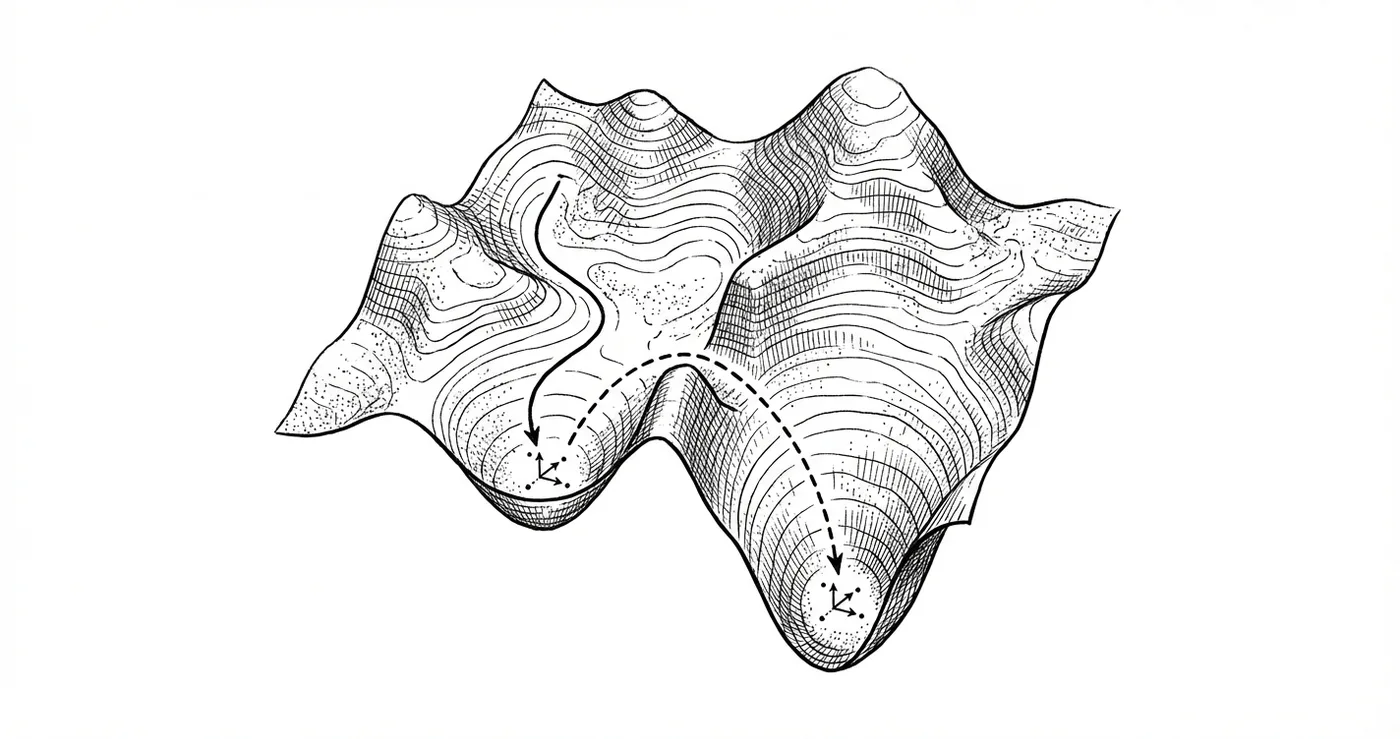
Of the available quantum paradigms, quantum annealing maps onto portfolio optimization most directly, which is exactly why it draws the most overstatement. Quantum annealers, commercially available from D-Wave Systems, are built to find the ground state of an Ising model — equivalently, to minimize a Quadratic Unconstrained Binary Optimization (QUBO) problem. Because cardinality-constrained portfolio selection can be cast as a QUBO, it can be handed to an annealer with a clean formulation rather than a contrived one. That clean mapping is the strongest near-term reason to take quantum annealing seriously for this domain.
The intuition behind it is sound. Classical algorithms can stall in local minima on highly non-convex, heavily constrained problems. Quantum annealing exploits quantum tunneling — the ability of a quantum system to pass through an energy barrier rather than climb over it — to escape basins that trap a classical search and, in principle, settle into a lower-energy solution.
The intuition, however, has not yet converted into measured advantage. Multiple research groups have formulated portfolio problems on D-Wave hardware and obtained valid solutions, but on like-for-like instances those solutions have not consistently beaten classical solvers. At problem sizes that fit current annealers — several thousand qubits with sparse connectivity — established solvers such as Gurobi and CPLEX typically match or beat them in comparable or shorter wall-clock time. Any advantage is more plausible on the larger instances that genuinely stress classical solvers, and those instances do not yet fit on the hardware. This is the recurring shape of the field: the regime where quantum would help is precisely the regime the machines cannot yet reach.
Connectivity is the constraint that most often goes unmentioned in the optimistic version. A portfolio QUBO needs a coupling between every pair of qubits whose assets have non-zero covariance — and a dense covariance matrix implies near-all-to-all coupling. D-Wave's Pegasus topology provides only sparse native connectivity, so each logical variable that exceeds it must be encoded as a chain of physical qubits forced to act as one. Chaining consumes the qubit budget, shrinking the effective problem size, and adds a failure mode of its own: when a chain breaks mid-anneal, the logical variable it represented is left inconsistent. Connectivity, not raw qubit count, is the binding limit, and headline qubit numbers obscure it.

The Quantum Approximate Optimization Algorithm
The gate-model alternative, the Quantum Approximate Optimization Algorithm (QAOA), trades the annealer's specialized analog process for a programmable circuit. Because it runs on universal gate-based hardware, it applies to a broader class of problems and composes more flexibly than a fixed annealing schedule.
QAOA alternates two operations: a problem operator that encodes the objective, and a mixing operator that moves probability mass across the solution space. A set of tunable angles controls each layer, and adding layers tightens the achievable approximation — in theory, an arbitrarily deep circuit converges to the optimum. For portfolio selection, QAOA targets the same QUBO that an annealer would, so the comparison between the two is direct.
Depth is also where the theory collides with the hardware. Each added layer lengthens the circuit, and on current noisy intermediate-scale quantum (NISQ) devices, noise accumulates with every gate. In practice a device can run only a handful of QAOA layers before that noise drives solution quality below what classical methods already deliver. Error-mitigation techniques claw some of it back, but at a computational cost that eats into any nominal speedup. The honest summary is that QAOA does not beat classical optimization on practically sized portfolio problems today — and the discipline this article argues for means saying so plainly, even while QAOA remains one of the most credible candidates to demonstrate genuine advantage as hardware matures.
Monte Carlo Simulation Speedup
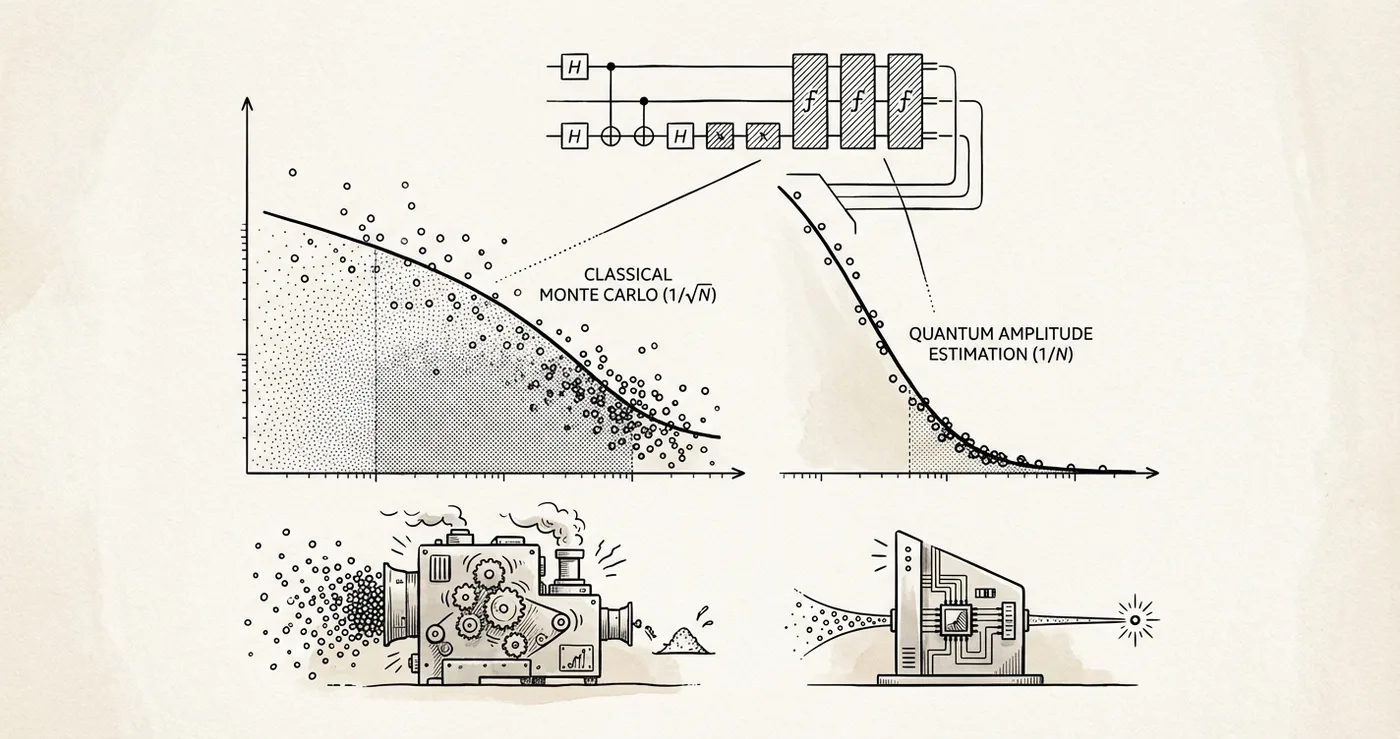
The strongest quantum case in finance is not optimization at all but simulation, and it rests on firmer theoretical ground than anything discussed so far. Classical Monte Carlo, the workhorse of risk computation, converges at a rate proportional to one over the square root of the sample count: cutting the error in half costs four times the samples. Quantum amplitude estimation reaches the same precision with operations proportional to one over the precision itself — a quadratic improvement that is provable, not conjectured, and survives as a clean theoretical result rather than an empirical hope.
The payoff would land where institutional risk actually runs: value-at-risk, expected shortfall, derivative pricing, and scenario analysis are all Monte Carlo at their core. A risk calculation that takes an hour classically could, on a sufficiently capable quantum computer, finish in minutes. Where latency gates the work — intraday risk reporting, hedging decisions that cannot wait for an overnight batch — that compression would make feasible what is currently out of reach.
The qualifier doing the heavy lifting is "sufficiently capable," and it is doing a great deal of it. Amplitude estimation needs deep circuits with long chains of sequential operations, and the speedup is acutely sensitive to error: accumulated noise does not merely slow the result, it destroys the quadratic advantage outright. Executing these circuits reliably requires fault-tolerant, error-corrected machines, and fault tolerance at this scale demands millions of physical qubits to yield the thousands of logical qubits the algorithm needs — a capability that is, on any honest reading, several years out and plausibly a decade or more.
Shallower near-term variants exist, but they buy compatibility with present hardware by surrendering part or all of the theoretical speedup, which forfeits the very property that made the approach attractive. The provable advantage is real; the machine that realizes it is not yet built. For Monte Carlo risk simulation, quantum advantage remains demonstrated on paper and aspirational in practice.
Current Hardware Limitations
Every promise above is gated by the same hardware, so it is worth stating the gap in concrete numbers rather than adjectives. As of 2026, the largest gate-based processors hold roughly one to two thousand physical qubits, with per-gate error rates in the range of one tenth to one hundredth of a percent. Annealers offer more raw qubits — on the order of five thousand — but carry the connectivity and precision limits described earlier, so the larger number buys less than it appears to.
Set that against what the applications demand. A five-hundred-asset portfolio QUBO needs roughly five hundred qubits for the decision variables alone, before any qubits spent on constraint encoding or the overhead of error mitigation and correction. Scale to five thousand assets — an ordinary institutional universe, not an extreme one — and the requirement climbs to tens of thousands of logical qubits, which under current error-correction schemes translates to millions of physical qubits. The shortfall is not a tuning gap to be closed in a release cycle; it is three to four orders of magnitude.
Qubit count is only half the constraint. Coherence time — how long a qubit holds its quantum state before it decoheres — bounds how deep a circuit can run before the computation dissolves into noise. Superconducting coherence times of tens to hundreds of microseconds confine gate-based algorithms to circuits of hundreds to low thousands of operations, while the financially interesting algorithms, amplitude estimation foremost among them, call for depths that exceed that ceiling by orders of magnitude. Width and depth are short at the same time, and progress on one does not relieve the other.
A Realistic Timeline
A timeline is necessarily a forecast, so it should be offered with its uncertainty attached rather than as a roadmap. With that caveat, the current hardware trajectory and pace of algorithmic work suggest three rough phases.
In the near term, over the next two to three years, quantum computing stays a research tool for financial institutions. Proof-of-concept work on small instances continues to refine algorithms and narrow the field of promising applications. The most practical near-term payoff is likely to come not from quantum hardware at all but from quantum-inspired classical algorithms — methods that borrow mathematical structure from quantum mechanics yet run on the machines firms already operate.
In the medium term, roughly three to seven years, early fault-tolerant machines with hundreds of logical qubits could deliver the first demonstrations of genuine advantage on problems of practical scale. Monte Carlo speedup for risk computation is the likeliest first beneficiary, on the strength of its provable foundation and obvious commercial value. Constrained portfolio optimization could begin to show an edge on the largest, hardest instances — the ones where classical solvers are already straining.
In the longer term, beyond seven years, larger fault-tolerant systems could reshape several corners of quantitative finance: full optimization over large universes with complex constraints, real-time risk across multi-asset global books, and pricing for complex structured products. Predictions at this horizon are genuinely uncertain, because they depend on fundamental hardware advances that are anticipated but not guaranteed. The further out the claim, the less weight any institution should place on it — including this one.
Hybrid Classical-Quantum Approaches
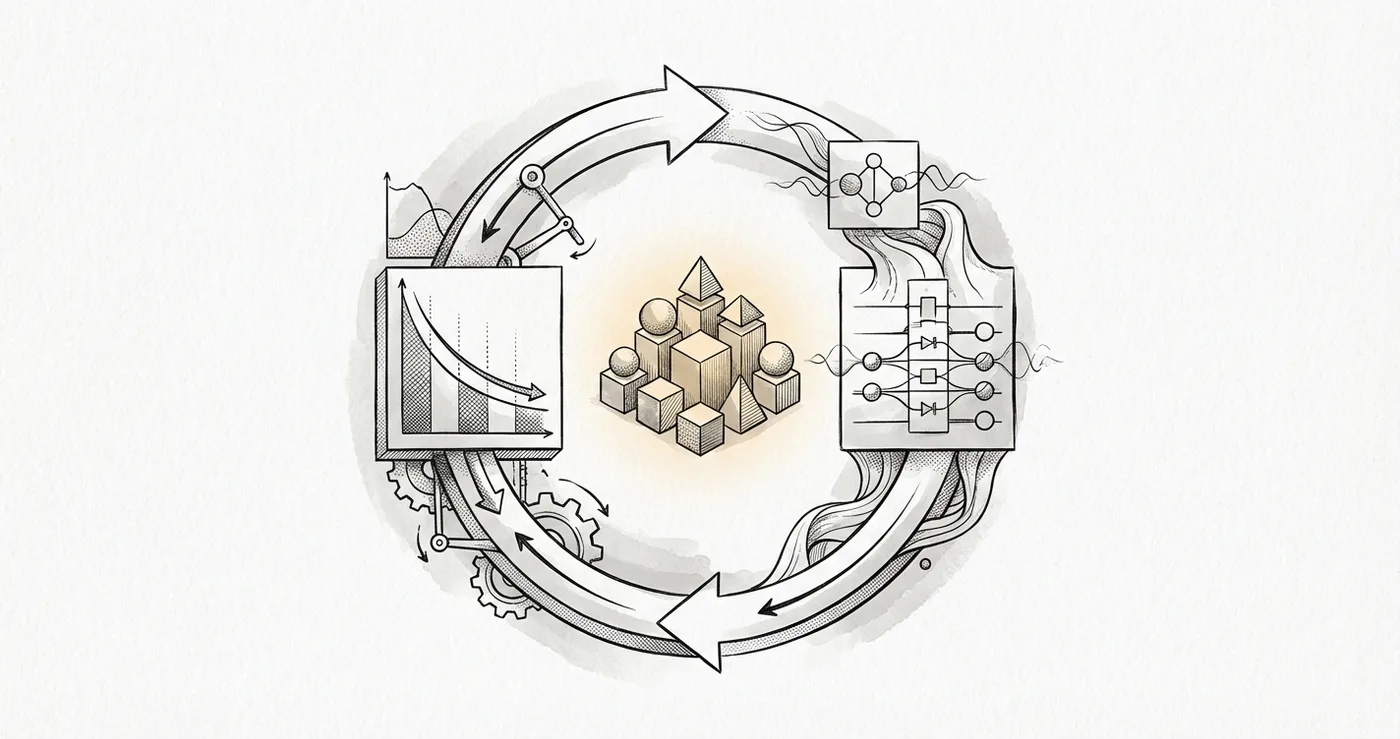
If pure quantum methods are years from production, the pragmatic move is not to wait but to adopt the hybrid architecture that delivers value incrementally as hardware improves. Hybrid algorithms keep classical computers on the parts of a computation where they dominate and route only specific subroutines to a quantum processor — and only where the quantum method offers an edge, even a modest one. The design assumption is honest about the hardware: the quantum device is a coprocessor for a narrow task, not a replacement for the stack around it.
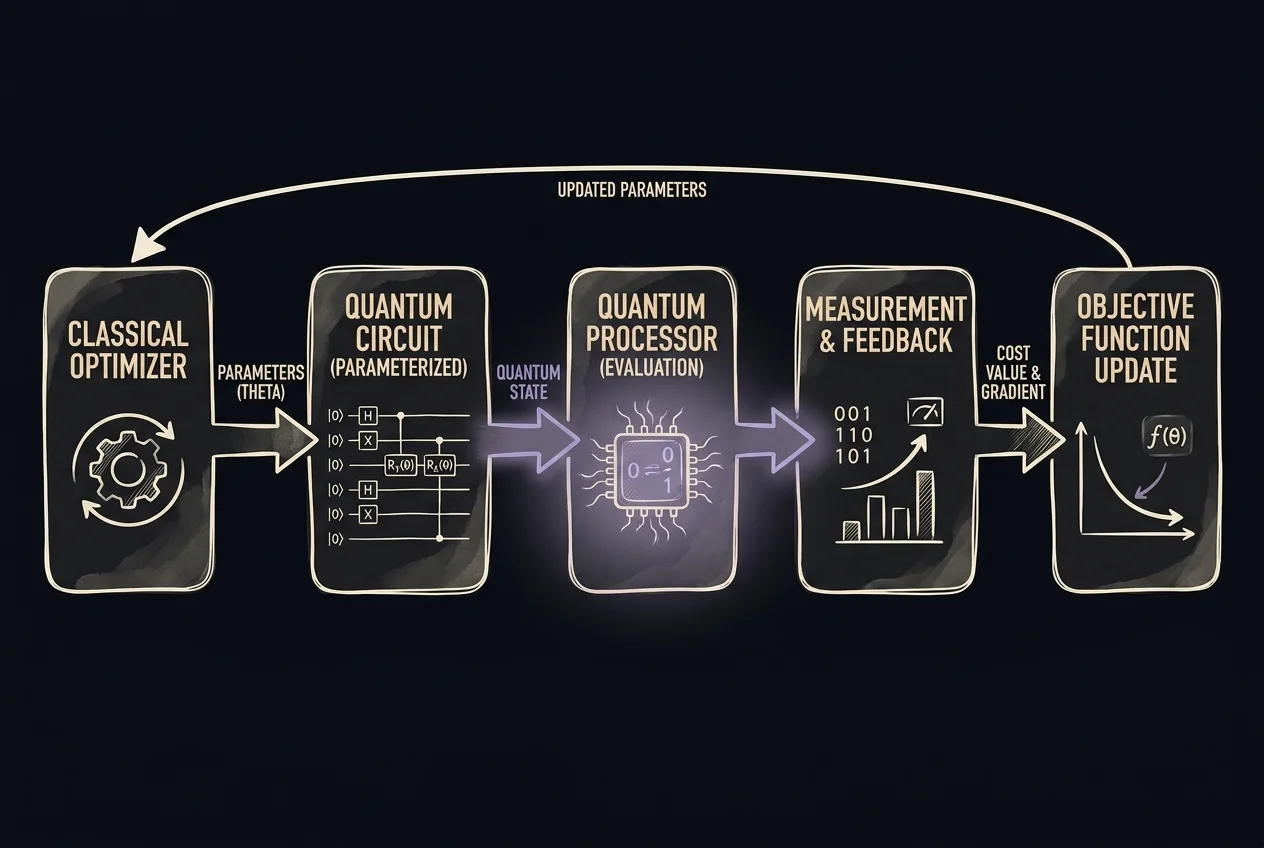
The variational quantum eigensolver and QAOA-style hybrids make this concrete. A classical optimizer iteratively tunes the parameters of a shallow quantum circuit, while the quantum processor evaluates the objective at each step. Keeping the circuit shallow is the point: shorter circuits accumulate less noise, which is what makes the scheme survivable on NISQ hardware. For portfolio construction, the continuous optimization stays classical while the quantum processor probes the combinatorial decision space — the part where classical search is most prone to stall.
Quantum-inspired classical algorithms are the other half of the strategy, and the more useful one today. Tensor-network methods and simulated quantum annealing borrow mathematical structure from quantum mechanics but execute entirely on classical hardware, and they have produced real gains on specific optimization and sampling problems. They run on infrastructure a firm already owns, deliver improvement now rather than on a vendor's roadmap, and build the organizational fluency that will matter when genuine quantum hardware arrives. Crucially, whichever path produces the allocation, its output is a proposed set of weights — a recommendation that still has to pass the firm's risk limits, constraint checks, and governance before a single order is placed. A quantum or quantum-inspired optimizer changes how a candidate portfolio is computed; it does not, and should not, change who is accountable for approving it. The machine searches the space faster; the institution still decides what to hold.
Institutional Preparedness
The operative question for an asset manager is not whether quantum computing will eventually matter but what to do in the interval before it does. The answer is deliberately unglamorous, and every item on it pays off whether or not the quantum timeline holds.
First, build literacy good enough to filter vendors. Investment, risk, and technology leaders need enough fluency to separate a grounded claim from a marketed one — to know which algorithm a pitch rests on, what its theoretical advantage actually is, and which hardware limit will decide whether that advantage shows up. This is not a demand for physicists; it is a demand for the technical discrimination that keeps a firm from buying the wrong problem.
Second, formulate the valuable problems in quantum-compatible terms now. Recasting a firm's most important optimization and simulation problems as QUBOs or variational circuits is work that can be done today, against hardware that does not yet exist, and it is the cheapest insurance available: when capable machines arrive, the firm deploys rather than scrambles. The act of formalizing also tends to expose constraints that were never written down precisely, which improves the classical pipeline immediately.
Third, engage providers at low commitment. Early-access programs, research collaborations, and proof-of-concept projects build the knowledge and relationships that convert a research capability into a production one — without betting capital on a timeline no one controls.
Fourth, invest in the classical infrastructure that any quantum future will sit on top of. High-performance computing, well-tuned classical solvers, and clean data pipelines remain essential in a quantum-enabled world and return their cost today. None of this spend is stranded if the quantum horizon slips.
The firms that handle quantum computing well will treat it the way they treat any unproven edge: with disciplined curiosity, neither dismissing it as hype nor pricing it in as imminent. The discipline that this title calls for — separating hype from horizon — is not a one-time judgment but a standing posture. The right time to prepare for quantum computing is now. The right time to depend on it has not arrived, and the institutions that keep those two dates distinct will be the ones positioned to capture the advantage when it finally becomes real.