The Evolution of Fund Administration: From Back-Office to Strategic Advantage
When administration becomes a byproduct of the operating system rather than a separate downstream process, NAV, reconciliation, and reporting fall out of one record — and scale comes from better policy, not more headcount.


For most of the hedge fund industry's history, fund administration was a downstream process. The portfolio was managed in one system; days or weeks later, a separate function reconciled positions, struck a net asset value, processed subscriptions and redemptions, and produced the reports investors and regulators required. The work was essential but architecturally severed from the act of investing. No fund manager ever won an allocation because of their administrator, and no investor ever chose one fund over another because of the elegance of its NAV calculation.
That separation is the problem. When administration is a downstream copy of the truth rather than a direct consequence of it, the copy drifts: trades are rekeyed, prices are re-sourced, breaks accumulate, and the NAV that investors rely on is reconstructed after the fact rather than read off the record that governed the trade in the first place. The firms now pulling ahead have inverted the relationship. They treat the book of record — the audit spine that captures every order, fill, price, and cash movement — as the primary artifact, and let NAV, reconciliation, and reporting fall out of it as byproducts. Administration stops being a department that reconstructs the truth and becomes a property of the system that produced it. The firms still operating the old way are not merely less efficient; they are accumulating operational debt that compounds with every instrument, investor, and jurisdiction they add.
The Traditional Fund Administration Model
To see why the inversion matters, it helps to be precise about what traditional fund administration actually does. At its core, it spans three functions: accounting, investor servicing, and regulatory reporting. Each, in the legacy model, operates on a copy of data that originated somewhere else.
Fund accounting is the process of maintaining the books and records of the fund, including trade capture, position valuation, income accrual, expense allocation, and the calculation of Net Asset Value. NAV is the fundamental metric of a fund's value, and its accurate calculation is essential for pricing subscriptions and redemptions, computing management and performance fees, and reporting to investors and regulators. For simple equity long/short funds, NAV calculation is relatively straightforward. For funds trading complex instruments, including over-the-counter derivatives, structured products, illiquid credit, and digital assets, valuation requires specialized expertise and robust pricing methodologies.
Investor servicing encompasses all interactions with the fund's investors, from initial onboarding and Know Your Customer and Anti-Money Laundering verification, through ongoing subscription and redemption processing, capital call and distribution management for private funds, tax reporting, and investor communication. For funds with dozens of share classes, side pockets, investor-specific fee arrangements, and investors in multiple jurisdictions with different tax and regulatory requirements, investor servicing is a complex operational challenge.
Regulatory reporting has grown dramatically in scope and complexity over the past two decades. Funds must file Form PF with the SEC, AIFMD Annex IV reports with European regulators, CPO-PQR with the CFTC, and various other jurisdiction-specific reports. Each filing requires specific data in specific formats on specific timelines, and the penalties for late or inaccurate filings can be substantial.
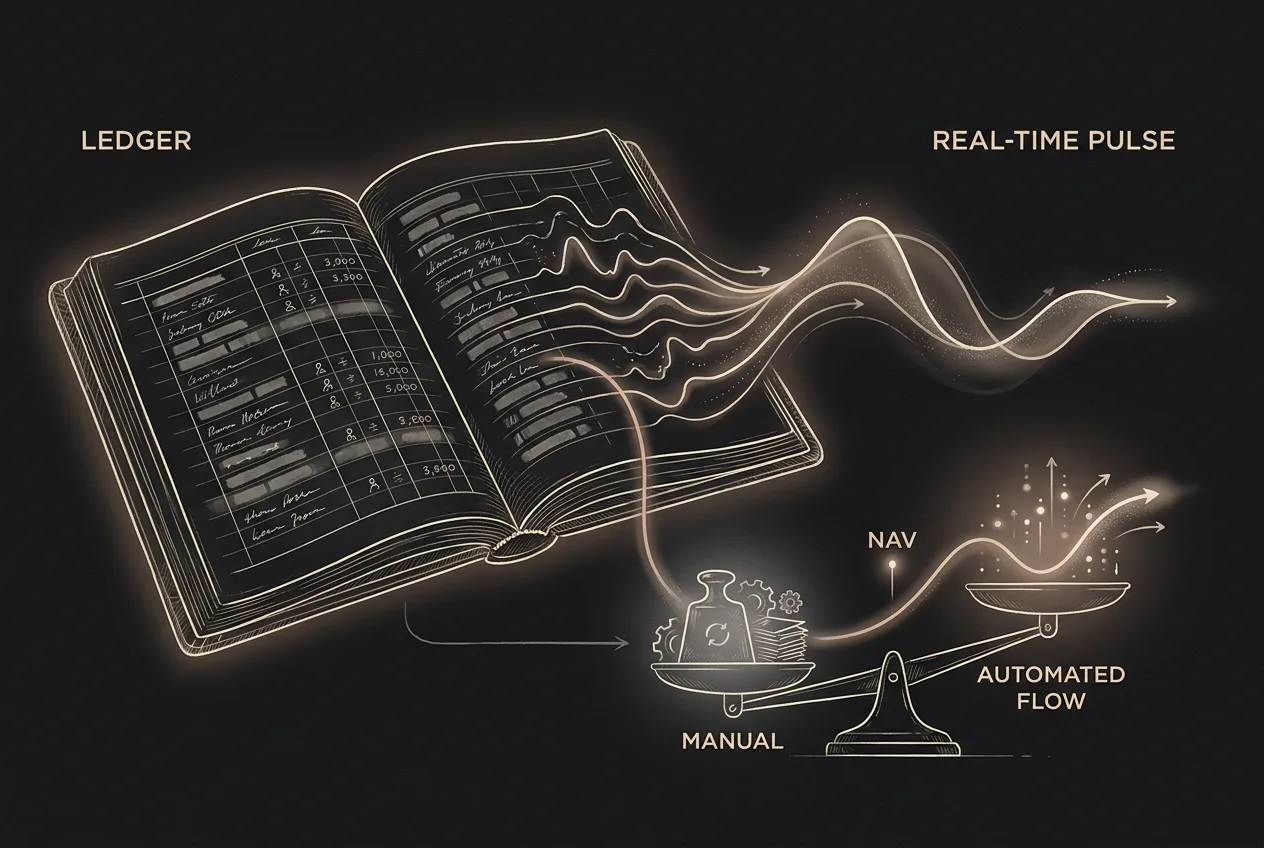
Traditionally, these functions ran on spreadsheets, legacy accounting systems, and manual handoffs. A fund administrator would receive trade files from the manager, typically by email or FTP, reconcile them by hand against broker and custodian records, rekey the data into an accounting system, strike the NAV, produce reports, and distribute them. Every step was a translation from one representation of the truth to another, and every translation was a place errors could enter. The process was labor-intensive, error-prone, and slow: monthly NAV was the norm, with preliminary results landing days or weeks after month-end. The deeper flaw was structural. There was no single record of what had happened — only a chain of partial copies that had to be painstakingly forced back into agreement.
The Limitations of Legacy Administration
The limitations of this traditional model become increasingly acute as fund complexity increases. A fund that trades a single asset class with a small number of investors can manage with monthly NAV calculations and manual reconciliation. A multi-strategy fund trading across equities, fixed income, derivatives, commodities, and digital assets, with hundreds of institutional investors across multiple share classes and jurisdictions, cannot.
The most fundamental limitation is timeliness. In the traditional model, the fund manager and investors operate with stale information. The most recent NAV reflects the portfolio's value days or weeks ago, not today. In volatile markets, the gap between the last reported NAV and the portfolio's current value can be substantial, creating uncertainty for investors considering subscription or redemption decisions and for the fund manager attempting to manage risk and liquidity.
Accuracy is the second limitation, and it follows from the same root cause as the first. Every manual translation between copies — rekeying a trade, re-sourcing a price, hand-matching a reconciliation — is an opportunity for error, and errors compound silently until a NAV is struck on top of them. A misbooked trade, a missed corporate action, an incorrect price, or a miscalculated fee cascades through the accounting process and surfaces as a NAV that must be corrected after the fact. NAV restatements are operationally disruptive, damage investor confidence, and carry legal and regulatory consequences. They are not bad luck; they are the predictable output of a process that has no single source of truth to check against.
Scalability is the third and most consequential limitation, because it is the one that ultimately caps growth. The traditional model scales linearly with complexity: more instruments mean more reconciliation, more investors mean more servicing, more jurisdictions mean more filings. Each increment is absorbed by adding people. That is the defining weakness of administration-as-copy — capacity is a function of headcount, so the back office must grow in proportion to the fund, consuming an ever-larger share of the expense budget and, more scarcely, of senior management attention. An operating system inverts this. When reconciliation and reporting are encoded as policy that executes against a single record, adding a counterparty or a share class is a configuration change, not a hiring decision. Scale comes from better policy, not more headcount. That is the difference between an administration function that constrains growth and one that compounds with it.

NAV Automation and Real-Time Valuation
If administration is a byproduct of the record, NAV is the clearest demonstration of the principle. In the legacy model, NAV is a calculation performed on a copy; in an operating-system model, it is a value read off the same record that governed every trade. The transition from periodic reconstruction to continuous valuation follows directly, made possible by automated trade capture, electronic market data feeds, model-based pricing, and the computation to run them on demand.
Automated trade capture removes the manual handoff between the trading systems and the accounting system — and with it, the first copy. Through direct API integration or standardized messaging protocols such as FIX, each order and fill enters the book of record as it happens, without rekeying. The position that gets valued is the same position that was traded, not a re-entered approximation of it. The lag and the transcription error that defined file-based delivery simply have nowhere to occur.
Electronic market data feeds provide the pricing inputs needed for continuous valuation. For listed securities with observable market prices, the valuation is straightforward: the position's value is its quantity multiplied by the current market price. For less liquid or more complex instruments, valuation requires models that incorporate market data inputs such as interest rate curves, credit spreads, and implied volatility surfaces. Modern administration platforms embed these pricing models and update valuations continuously as market data changes.
The result is an indicative NAV available intraday, reflecting the portfolio's current mark-to-market value. The distinction between this and the official NAV matters, and continuous valuation does not erase it. An indicative NAV is computed continuously and automatically; the official NAV — the figure that prices subscriptions, strikes fees, and binds the fund to its investors — should not be. A NAV strike is a human-gated event. The machine assembles the inputs, applies the pricing policy, and surfaces the candidate figure along with every exception it could not resolve on its own; a named officer reviews it and authorizes the strike. This is the operational expression of a principle that runs through institutional-grade systems generally: humans govern, machines operate. Automation collapses the cost of producing a current, defensible view of value to near zero, but the authority to declare that value official stays with a person who is accountable for it. The payoff is asymmetric. The fund manager and risk officers gain a continuous view of portfolio value and can act on risk in real time, while the figure of record retains the deliberate, reviewable gate that institutional capital requires.
Investor Onboarding, KYC, and AML Automation
Investor onboarding is one of the most friction-laden processes in fund administration. Before an investor can subscribe to a fund, the administrator must collect and verify identity documents, perform KYC and AML checks, confirm the investor's eligibility under the fund's offering documents and applicable regulations, and process the subscription agreement. For institutional investors, this process involves multiple layers of entity verification, beneficial ownership analysis, sanctions screening, and politically exposed person checks.
Traditionally, this process was paper-based and manual. Investors submitted physical or scanned documents, which were reviewed by compliance staff who performed checks against sanctions lists and adverse media databases. The process could take weeks, particularly for complex institutional structures involving multiple entities across jurisdictions.
Modern onboarding platforms digitize this process end to end. Investors complete subscription documents electronically, with digital signature capabilities and smart forms that adapt based on investor type and jurisdiction. Identity verification leverages electronic databases and, increasingly, biometric verification. Sanctions screening and adverse media monitoring are automated and continuous, running against up-to-date databases and flagging potential matches for human review. Entity verification services automatically parse corporate structures and identify ultimate beneficial owners, reducing the manual effort required for complex institutional investors.
The efficiency gains are substantial: what once took weeks now takes days or hours. But the strategic value runs deeper than speed. Onboarding is the first operational interaction an allocator has with a fund, and allocators read it as a sample of everything they cannot see. A clean, digital, well-governed process signals that the systems behind it are equally disciplined; a cumbersome one suggests the opposite, and institutional investors and their consultants increasingly decline funds whose onboarding hints at broader infrastructure deficiencies. The same record-keeping discipline that produces a clean NAV produces a clean onboarding, because both are surfaces of the same underlying system. That coherence is the point: operational quality is not a set of independently polished touchpoints but the visible output of one well-designed operating system.
Transfer Agency and Reconciliation Automation
Transfer agency, the maintenance of the fund's register of investors and the processing of subscriptions, redemptions, transfers, and distributions, is another domain being transformed by automation. Traditional transfer agency relied on manual processing of investor instructions, with staff entering transaction details into registry systems, verifying instructions against standing settlement instructions, and processing cash movements through banking systems.
Automated transfer agency platforms accept investor instructions through electronic portals, validate them against fund rules and investor-specific constraints, calculate subscription and redemption amounts based on the applicable NAV and fee schedule, and initiate settlement through integrated banking connectivity. Straight-through processing, where a transaction flows from investor instruction to settlement without manual intervention, is now achievable for standard transaction types.
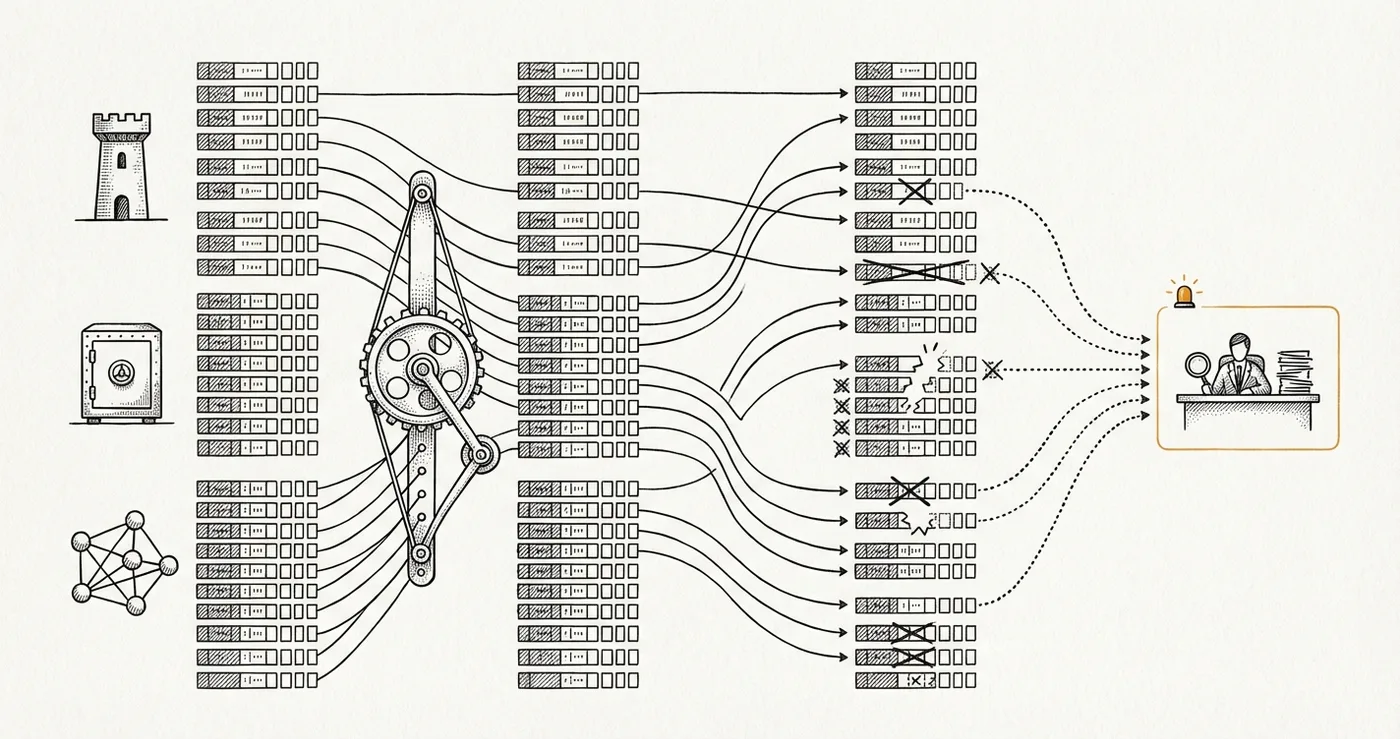
Reconciliation is where the book-of-record architecture pays off most directly, and it deserves to be understood not as a task but as a continuous test of the spine's integrity. Verifying that the fund's records agree with its counterparties' is the moment the internal record is checked against the outside world. A multi-strategy fund may face multiple prime brokers, executing brokers, custodians, and counterparties, and reconciling positions, trades, cash, and corporate actions across all of them daily is an enormous manual task — precisely the task that grows with every new relationship. Automated reconciliation engines match records across sources continuously, classify discrepancies by type and materiality, auto-resolve the routine cases against policy, and route only genuine breaks to a named operator. The shift is not merely less manual effort. Because every match and every exception is written back to the same record, reconciliation stops being a periodic clean-up exercise and becomes a live, auditable property of the system: at any moment, the fund can show not only what its books say but how recently and against whom they were proven correct.
The Outsourced Versus Insourced Debate
The question of whether to outsource fund administration to a third-party administrator or build insourced capabilities is one of the most consequential operational decisions a fund manager makes. Both models have compelling arguments.
Outsourcing provides independence and credibility. An independent third-party administrator produces NAV calculations and investor reports that carry greater weight with institutional allocators, who value the separation of duties between the entity managing the portfolio and the entity valuing it. Outsourcing also provides scalability without proportional headcount growth, access to specialized expertise in areas such as tax reporting and regulatory compliance, and the ability to leverage the administrator's technology platform without building one internally.
Insourcing provides control, speed, and customization. A fund that administers itself can tailor processes and systems to its specific needs, implement changes without negotiating with a third party, and maintain direct control over the quality and timeliness of its operations. For complex strategies where standard administration processes are inadequate, insourcing may be the only viable option.
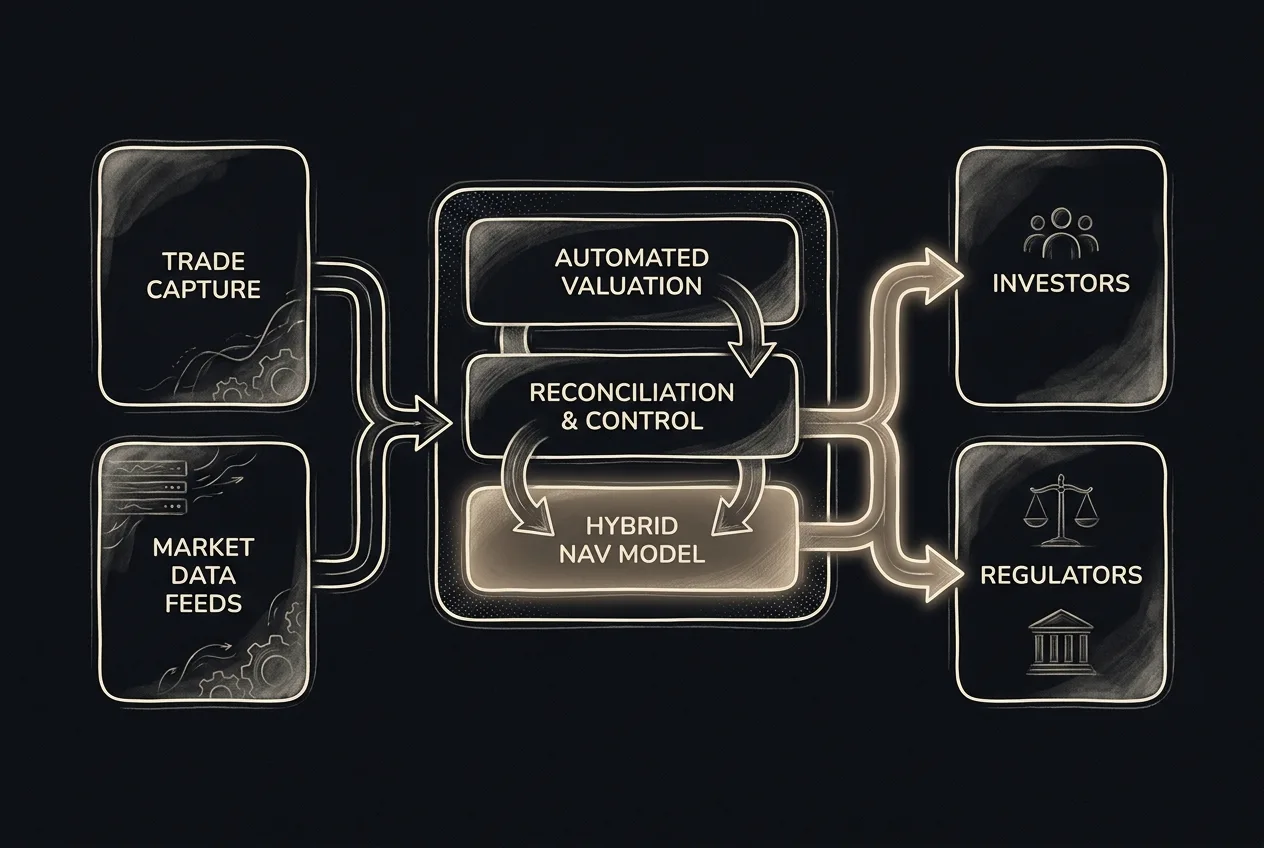
The emerging model is a hybrid, and it resolves the debate along exactly the governance line drawn earlier. Many sophisticated funds outsource the official NAV strike and investor servicing to an independent administrator — the human-gated, accountable figure of record benefits from being struck by a party that does not manage the portfolio. At the same time, they keep an insourced shadow-accounting capability: their own book of record, running in real time, producing indicative NAV, portfolio analytics, and operational monitoring. The two are not redundant. The insourced spine is the system the fund operates against day to day; the independent administrator provides the external check that turns the fund's internal truth into an attested one. The hybrid does not split the difference between control and credibility so much as assign each to the layer suited to it — speed and analytics to the system the fund owns, independent attestation to the party whose separation gives the official NAV its weight.

Technology Enablers and the Future
The technology making this possible is converging with the broader enterprise software stack, and the throughline among the pieces is the single record. Cloud-native architectures supply the scalability and resilience to keep one authoritative book always available. API-first design lets that book draw directly from trading systems, market data providers, banking platforms, and investor portals rather than from emailed files. Machine learning improves reconciliation by learning to classify and auto-resolve common break types, narrowing the set of exceptions a human must touch. Distributed ledger approaches remain largely prospective for fund administration, but the ambition behind them — a shared, permanent record several counterparties can trust without re-reconciling — is the same architectural instinct carried to its limit: collapse the copies, and the reconciliation burden collapses with them.
The trajectory is clear, and it is not really about technology. Fund administration is moving from a downstream function that reconstructs the truth to a byproduct of the system that produces it. The firms making that shift do not simply administer their funds more cheaply; they operate from a record that is current, reconciled, and auditable by construction, and they scale that capability through policy rather than payroll.
For allocators conducting operational due diligence, this changes what administration infrastructure signals. It is no longer a checkbox confirming that someone strikes a NAV. It is evidence of whether the fund operates from one governed record or from a chain of copies held together by manual effort — and, by extension, of its fitness to manage institutional capital at all. In an industry where operational failures are as costly as investment failures, that is the real measure: not whether a fund can produce the reports, but whether the system underneath them is sound enough that the reports were never in doubt.