Institutional Liquidity Management: Balancing Alpha Capture with Redemption Readiness
Why liquidity discipline survives a redemption shock only when it is enforced as policy before the trade — liquidity ladders, stress migration, gates, and swing pricing computed pre-trade on one exposure model rather than reconstructed after the fact.


A fund rarely fails because it was wrong about an asset. It fails because it could not sell that asset fast enough to meet an obligation it could not defer. Liquidity is the silent architecture beneath every position: invisible when it holds, and the only thing that matters when it does not. When it gives way, it forces fire sales, triggers gate provisions, and destroys investor trust that took years to build. The history of financial crises is, in large part, a history of this single failure mode. From the collapse of Long-Term Capital Management to the March 2020 fixed-income seizure, the pattern repeats with punishing regularity: the obligation arrives on a fixed date, and the means to meet it has evaporated.
The reason it repeats is that liquidity discipline is almost always enforced too late. Most funds know their liquidity rules — the maximum illiquid allocation, the cash floor, the redemption ladder — and most discover at the worst possible moment that those rules lived in a policy document, a quarterly committee review, and a risk team's spreadsheet rather than in the path of every trade. A position that breaches the illiquid ceiling is found weeks after it was opened. The redemption coverage shortfall is reconstructed after the redemption notice lands. By then the only available actions are the expensive ones.
The underlying tension is genuine and cannot be engineered away. Alpha often requires holding less liquid instruments, concentrated positions, or complex structures that earn a premium precisely because they are hard to trade. Redemptions, margin calls, and operational cash demands require the opposite: assets that convert to cash on a known schedule without moving the market. The thesis of this article is narrow and practical. The tension is not resolved by better intentions or more frequent reviews; it is resolved by expressing the fund's liquidity bounds as enforced policy that sits ahead of execution — checked before each trade, computed continuously on the live portfolio, and never reconstructed after a shock. The frameworks below describe what those bounds should contain. The closing sections describe what it takes to make them binding.
The Liquidity Mismatch Problem
The fundamental vulnerability is a structural mismatch between the liquidity of a fund's assets and the liquidity promised to its liabilities. An open-ended fund that offers quarterly redemptions but holds positions requiring weeks or months to exit at reasonable prices carries a latent risk that may not surface for years and, when it does, can be terminal.
This mismatch is not carelessness; it is a feature of most strategies that generate excess return. Academic research consistently finds that less liquid assets command an illiquidity premium that compensates holders for accepting constraints on their ability to sell. A fund holding only the most liquid instruments forgoes that premium and competes on a field where information advantages are arbitraged away almost as fast as they appear. The manager's task is to harvest the premium without building a structural vulnerability that threatens the fund under stress — which means the illiquid allocation is not a number to monitor but a bound to enforce.
The mismatch is made worse by a second-order property: liquidity is negatively correlated with the need for it. In calm markets, redemptions are modest and asset liquidity is ample. In crises, redemptions surge at the precise moment asset liquidity evaporates. A buffer sized for normal conditions is, in extremis, a buffer calibrated for a world that no longer exists. This is why the bound must be defined against the stressed state, not the current one — a distinction the classification framework below makes operational.

Liquidity Classification Frameworks
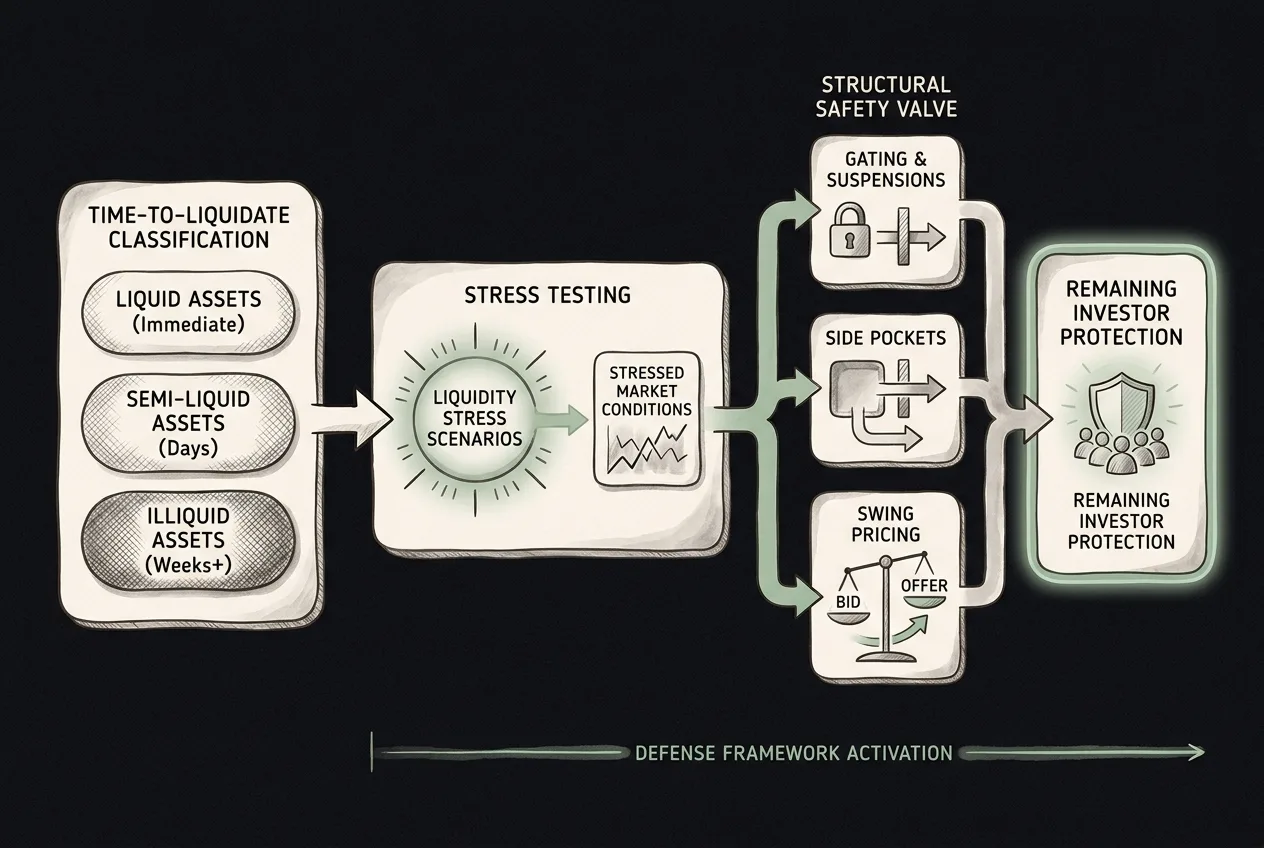
Liquidity management begins with classifying every position by its expected time-to-liquidate, not by asset label. A binary liquid-or-illiquid split is too coarse to govern anything; institutional practice assigns each holding to a tier defined by how long it would take to exit without excessive market impact. The classification is the data structure on which every downstream rule — the illiquid ceiling, the redemption ladder, the sweep order — is computed.
A typical framework defines four to six tiers. The first holds positions liquidable within one business day: large-cap equities at high daily volumes, sovereign government bonds, listed derivatives on major exchanges. The second covers two to seven business days — mid-cap equities, investment-grade corporate bonds, liquid alternatives. The third spans one to four weeks: small-cap equities, high-yield bonds, structured credit, thinner ETF positions. Beyond these sit the multi-month holdings — private credit, real estate, direct lending, private equity co-investments — that no buffer can convert to cash on demand.
The decisive property of this framework is that the tiers are not static. A position resting comfortably in the second tier under normal conditions migrates to the third or fourth during a dislocation, as depth thins and spreads widen. Effective frameworks therefore carry dual classifications for every holding: a baseline tier for normal conditions and a stressed tier for a severe but plausible event. The gap between them is the fund's latent liquidity risk — the additional time and cost to exit the portfolio at exactly the moment liquidity is most urgently needed. Treating that stressed classification as the binding one is the difference between a liquidity policy that holds in a crisis and one that was calibrated for the wrong world. A bound that references the baseline tier looks comfortable until the day it has to be true; a bound that references the stressed tier is the one worth enforcing pre-trade.

Stress Testing Methodologies for Liquidity Events
Stress testing turns the classification framework into forward-looking scenarios that quantify whether the fund can meet its obligations under adverse conditions. Unlike conventional stress tests, which focus on mark-to-market losses, a liquidity stress test asks a sharper question: can the fund generate enough cash, fast enough, to satisfy redemptions without setting off a self-reinforcing liquidation spiral?
The most informative tests combine three dimensions at once. The first models investor behaviour — not only the aggregate redemption rate but the concentration of redemptions among large investors whose exit forces disproportionate selling. The second models asset liquidity: how bid-ask spreads, market depth, and daily volumes deteriorate under the scenario. Prior crises supply calibration, but the scenario must allow for current microstructure behaving differently from historical precedent. The third, and most often neglected, models the interaction: as the fund liquidates to fund redemptions, its own selling depresses prices and widens spreads, feeding back into the deterioration. A test that omits this reflexive term systematically understates the tail.
The output of these tests is most useful when it does not stay an output. A stress run that produces a redemption coverage ratio or a stressed illiquid percentage is informative; the same figure wired in as the threshold a pre-trade policy check enforces is what actually changes behaviour. The stress test defines where the bound should sit; the policy layer is what makes a position that would breach it impossible to open in the first place. Run quarterly and filed, a stress test documents a risk. Recomputed continuously and enforced, it prevents one.
Regulatory frameworks — including the SEC's 2024 amended liquidity risk management rule and ESMA's guidelines for European managers — increasingly require funds to demonstrate that they can meet redemptions under stress without material deviation from their stated strategy. The most disciplined managers go beyond the minimum, running bespoke scenarios tailored to their portfolio composition and investor base, and feeding the results directly into the constraints that govern day-to-day execution.

Gate Mechanisms, Side Pockets, and Redemption Management
Structural tools govern the pace of outflows when conditions threaten to force value-destructive selling. They are not substitutes for prudent liquidity management; they are safety valves for the moment conditions exceed the parameters the buffer was designed for. Their effectiveness depends entirely on the rules around their activation being unambiguous in advance — which makes them a natural fit for policy-as-code, where the activation condition is a written clause and the trigger is a computed threshold rather than a judgment call made under duress.
Redemption gates cap the percentage of net asset value redeemable in any single period. A typical structure limits quarterly redemptions to fifteen or twenty-five percent of NAV, so the fund is never forced to liquidate more than a manageable fraction of the portfolio in a compressed window. Gates must be disclosed clearly in fund documentation, and the conditions under which they activate should be defined with enough specificity that investors trust the mechanism will not be invoked arbitrarily. That specificity is what allows the gate to be expressed as policy rather than discretion: the distance to the gate threshold becomes a number the system tracks continuously, and approaching it raises an escalation before the period closes rather than a surprise after it.
Side pockets segregate illiquid or hard-to-value positions from the main portfolio, preventing redeeming investors from forcing the sale of assets that cannot be realised at fair value. When a position is side-pocketed, redeeming investors receive their share of liquid assets and retain a residual interest in the segregated holdings, distributed or liquidated when conditions permit. The mechanism protects both sides: departing investors are not forced to accept fire-sale prices, and remaining investors are not left holding a portfolio stripped of its liquid assets.
Governance is the load-bearing element. Independent valuation committees, board-level oversight, and clear escalation procedures ensure these tools serve all investors rather than postpone a reckoning with portfolio problems. The principle that humans govern while machines operate applies precisely here: the decision to gate or to side-pocket belongs to people, but the conditions that make it actionable — the breach detection, the escalation routing, the record of who approved what and against which clause — should be enforced and logged by a system that cannot forget to do so under pressure.
Cash Buffer Optimization and Sweep Strategies
The cash buffer is the fund's first and most accessible source of redemption liquidity, and sizing it is a direct expression of the alpha-versus-redemption tradeoff. Too large a buffer drags on performance in rising markets; too small a buffer leaves the fund exposed to distressed selling under stress. The buffer is where the abstract tension becomes a concrete number the policy layer can hold.
That number should not be static. Dynamic cash management adjusts the target allocation against observable indicators of redemption risk and market liquidity: the concentration of the investor base, the proximity of redemption notice dates, the prevailing volatility regime, and the aggregate liquidity profile of the portfolio. A fund with a diversified investor base holding liquid instruments in a calm regime can run a thinner buffer than one with concentrated investors holding illiquid positions during elevated volatility. Expressed as policy, the cash floor becomes a function of these inputs rather than a fixed line — a bound that tightens automatically as the portfolio's stressed liquidity profile deteriorates, without waiting for a committee to notice.
Sweep strategies extend the effective buffer through a defined hierarchy of increasingly liquid positions that can be converted to cash with minimal market impact. The first sweep tier covers money market instruments and short-duration government bonds; the second adds liquid large-cap equities and exchange-traded funds that supply quick liquidity without materially altering the portfolio's risk profile. The manager fixes the order in which tiers are tapped, so the most liquid, lowest-impact sources are exhausted first. That ordering is itself a policy: encoded once and applied deterministically, it removes the discretion — and the hesitation — that turns an orderly raise into a fire sale when a redemption lands.
Swing Pricing and Anti-Dilution Measures
When investors redeem, the transaction costs of raising the cash fall on the investors who remain unless protective measures are in place. Over time this is a corrosive, near-invisible drag on long-term holders — a standing subsidy from those who stay to those who leave. The mechanics that correct it are, again, fundamentally rule-driven: a threshold, a factor, a trigger, all of which are better enforced by a system than remembered by a desk.
Swing pricing corrects the dilution by adjusting net asset value on days when net redemptions or subscriptions exceed a defined threshold. When net outflows are significant, NAV is marked down by a swing factor reflecting the estimated cost of liquidating — bid-ask spreads, market impact, brokerage commissions. Redeeming investors then bear the cost of the liquidity they consume, and remaining investors are held whole. Because the trigger is a threshold and the adjustment is a formula, swing pricing is the canonical case for policy-as-code: the threshold breach is detected on the live flow data, the factor is computed from current transaction-cost estimates, and the adjustment is applied automatically and recorded, rather than depending on someone to catch the threshold crossing on a busy redemption day.
Calibrating swing factors requires continuous analysis of realised transaction costs across the portfolio's holdings, refreshed as market conditions move. Anti-dilution levies pursue the same end through a different mechanism — a fee charged directly to transacting investors rather than an NAV adjustment. Both allocate the cost of liquidity to those who demand it instead of socialising it across the fund. The economic outcome is identical; what makes either reliable in practice is that the rule fires every time it should and leaves a record of why.
Technology Solutions for Real-Time Liquidity Monitoring
Every framework above shares a precondition: it has to be computed on something. Liquidity tiers, stress migration, redemption coverage, sweep order, swing thresholds — none of them mean anything unless they reference the same live picture of what the fund actually holds and owes. The recurring failure of liquidity management is not the absence of rules but their fragmentation: positions in one system, redemption notices in another, the stress model in a spreadsheet, and the policy in a PDF. When a redemption shock arrives, the fund spends its scarcest hours reconstructing a coherent view it should have had all along.
The remedy is structural. Position data, market data, and investor activity belong on one exposure model, evaluated continuously rather than sampled at quarter-end. On that model, time-to-liquidate is estimated per position from live order-book depth, spreads, and volumes, calibrated against the fund's own execution history rather than generic market averages. As conditions move, positions re-classify across tiers and the aggregate profile recomputes — so the stressed illiquid percentage and the projected coverage ratio are current readings, not last quarter's. The same model carries the liability side: pending redemption notices, the concentration of upcoming windows, the behaviour of the investor base under prior stress. Asset-side monitoring and liability-side monitoring are not two systems to reconcile; they are one equation, and liquidity is only ever true when both halves are evaluated together.
Once the model is unified, the liquidity rules stop being documentation and become enforcement. The illiquid ceiling, the cash floor, the gate distance, the swing threshold — each is a clause that the system checks before a trade is allowed to add exposure and monitors continuously thereafter. A breach is not a line in a report read after the fact; it is an event with a defined consequence. Minor drift notifies the desk. A material approach to a gate threshold or coverage shortfall is approval-gated, holding the action until a portfolio manager signs off. A breach of a hard regulatory or mandate limit is human-gated, stopping until explicit authorisation is given. Critically, every check and every consequence is written to a replayable, clause-linked record — so the question an allocator or regulator inevitably asks, "show me that this position never violated the liquidity mandate, and show me who approved the exception when it approached one," is answered by retrieval rather than reconstruction.
This is the distinction between visibility and control, and it is the one that matters in a crisis. A dashboard that surfaces the coverage ratio, the per-horizon liquidable percentage, and the distance to each gate is necessary but not sufficient; it still depends on a human seeing the number in time and acting on it. Enforcement does not. The bound is in the path of the trade, so the value-destructive position is never opened, and the orderly raise runs on a pre-defined sweep order rather than improvised under duress. The pattern lets a fund scale on better policy rather than more headcount — the same enforced bounds govern one strategy or fifty, one account or a thousand, without a proportional expansion of the people watching screens.
For allocators conducting operational due diligence, this is the dividing line worth probing. A manager can describe a sophisticated liquidity framework; far fewer can demonstrate that the framework is enforced pre-trade, computed on a single live model, and recorded in an audit trail they can replay on request. That demonstration — pre-authorisation that the bounds held, evidenced rather than asserted — is a different category of assurance than static reporting and periodic review can offer. In markets where liquidity can shift in hours, the ability to see liquidity data is table stakes; the ability to prove the fund could not breach its own liquidity discipline, on any day, is the fiduciary standard worth holding to.