Smart Beta 2.0: AI-Enhanced Factor Investing for Institutional Portfolios
Machine learning is reshaping factor investing through dynamic timing, crowding detection, and non-linear risk premia capture. The harder problem is governing those models so factor exposures remain explainable and auditable.


Smart beta earned its place by being legible. When the approach emerged in the early 2000s, it offered institutional investors a middle path between passive indexing and expensive active management: systematically harvest well-documented risk premia through transparent, rules-based strategies that anyone on an investment committee could understand. The transparency was the product. Two decades later, the returns have thinned. Factor premia have compressed under trillions of dollars chasing the same signals, static rebalancing rules have proven brittle across regimes, and the linear frameworks underpinning the original construction never captured the non-stationary relationships that actually drive cross-sectional returns.
Machine learning addresses each of these failures directly. Applied to factor timing, crowding detection, alternative data, and non-linear interaction modeling, it lets exposures respond to the market as it is rather than as a backtest assumed it would be. But it reintroduces the problem smart beta was built to avoid. A gradient-boosted ensemble that reweights factor exposures from forty conditioning variables is not legible the way a price-to-book sort is. The substantive question for an institutional allocator is therefore not whether ML improves factor capture — the evidence that it can is reasonable — but whether the resulting system can be governed: whether every exposure shift can be attributed, every model decision can be audited, and the strategy's constraints can be enforced rather than merely hoped for. That governance layer, not the model sophistication, is what separates a defensible institutional strategy from a black box with a backtest.
The Limitations of Static Factor Tilts
Traditional smart beta strategies construct portfolios by tilting toward one or more academically validated factors: value, momentum, quality, size, and low volatility. The implementation is typically mechanical. A value strategy might rank stocks by price-to-book ratio, select the cheapest quintile, and rebalance quarterly. A momentum strategy might sort by trailing twelve-month returns, buy winners, and sell losers on a fixed schedule.
This approach worked remarkably well in the decades when these premia were harvested by a relatively small number of sophisticated investors. The foundational research by Fama and French on value and size, Jegadeesh and Titman on momentum, and Frazzini and Pedersen on low volatility provided robust empirical evidence that these factors delivered persistent excess returns over long horizons.
The problem is that factor premia are not constants of nature. They are compensation for bearing systematic risks, and the magnitude of that compensation varies with market conditions, investor positioning, and macroeconomic regimes. A static value tilt that performed admirably from 1990 to 2006 suffered a historic drawdown during the subsequent decade as growth stocks dominated and traditional valuation metrics failed to account for the economics of intangible-heavy businesses. Momentum strategies, meanwhile, are prone to catastrophic reversals during sudden regime shifts, as investors discovered during the March 2009 momentum crash.
Fixed rules assumed factor premia were stable enough to harvest mechanically. Adaptive models concede that the premia are dynamic — but adaptivity is not free. Every degree of freedom a model gains to chase a moving premium is a degree of freedom it can use to overfit the past, and an exposure shift that no one can explain is an operational risk regardless of its backtested merit.

Dynamic Factor Timing with Machine Learning
The most consequential departure from traditional smart beta is the shift from static factor exposures to dynamic factor timing. Rather than maintaining a constant tilt toward value or momentum, AI-enhanced strategies adjust their factor exposures from predictive models that synthesize dozens of conditioning variables.
This is also the departure most prone to self-deception. Factor timing has a long history of working in-sample and disappointing out-of-sample, because the number of plausible conditioning variables vastly exceeds the number of independent regime episodes a model can learn from. A discipline applies before any of the mechanisms below earns capital: the model must demonstrate edge on data it never touched during training, its timing signals must survive realistic transaction costs, and the cases where conditioning fails must be cataloged rather than smoothed over. Treated as a continuous learning problem under that discipline, dynamic timing is defensible. Treated as a license to fit regimes in hindsight, it is a more expensive way to lose money than a static tilt.
Macro-Regime Conditioning
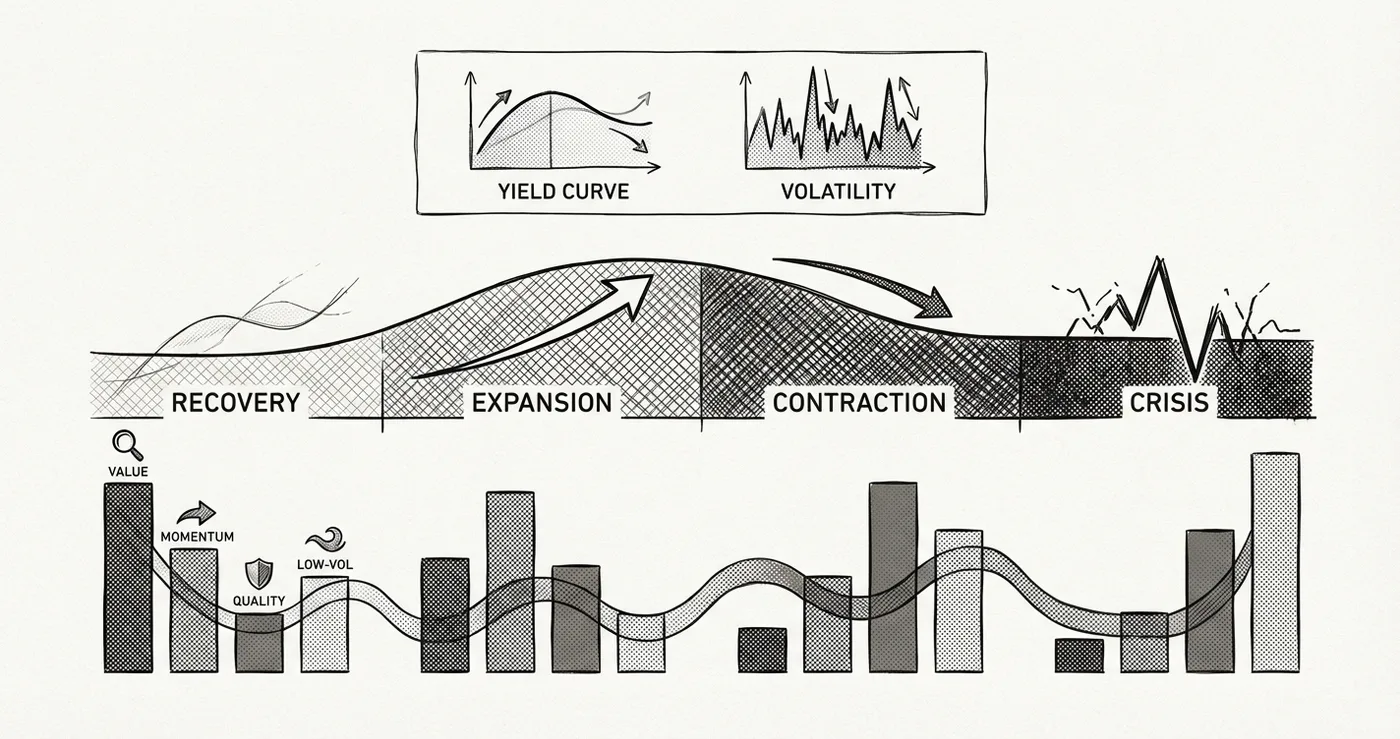
Factor returns exhibit strong regime dependence. Value tends to outperform during economic recoveries and periods of rising interest rates, while quality and low volatility factors dominate during late-cycle contractions and flight-to-safety episodes. Momentum performs well in trending markets but suffers during sharp reversals.
Machine learning models, particularly gradient-boosted tree ensembles and recurrent neural networks, can learn these conditional relationships from decades of cross-sectional return data linked to macroeconomic indicators. The models ingest variables such as yield curve slope, credit spreads, manufacturing PMI, inflation expectations, and central bank policy stance to estimate the probability distribution of factor returns over the coming period. Portfolio exposures are then tilted toward the factors with the most favorable risk-adjusted outlook given current conditions.
Volatility-Regime Adaptation
Factor behavior shifts markedly across volatility regimes. During low-volatility environments, momentum and size factors tend to deliver their strongest returns as markets reward risk-taking. In high-volatility regimes, defensive factors such as quality and low volatility outperform as capital seeks safety. Traditional smart beta strategies, blind to these regime dynamics, maintain constant exposures and suffer the consequences.
AI-based factor timing models incorporate realized and implied volatility surfaces, VIX term structure dynamics, and cross-asset volatility spillover patterns to identify regime transitions earlier than realized factor returns reveal them. The benefit is measured in degree, not foresight: volatility regimes are more persistent and faster to register in derivatives markets than factor premia are, so a model conditioned on them can begin rotating exposures somewhat ahead of the move rather than purely in reaction to it. It does not predict the regime shift; it reads the earliest credible evidence of one. The discipline here is to size that rotation to the model's actual hit rate, since a timing system that rotates confidently on weak signal converts a defensive feature into a source of whipsaw.
Factor Crowding Detection
Perhaps the most valuable application of machine learning in factor investing is the detection of factor crowding, the condition where too much capital is pursuing the same factor signal, compressing expected returns and increasing the risk of violent unwinds.
Crowding is notoriously difficult to measure with traditional tools. Standard valuation spreads can indicate whether the value factor is cheap or expensive relative to history, but they cannot capture the dynamic flow of capital into and out of factor strategies, the leverage employed by factor-tilted portfolios, or the correlation of positioning across market participants.
Machine learning models approach crowding detection by integrating multiple data streams that individually provide only partial visibility but collectively paint a comprehensive picture. These include short interest concentration, options positioning skew, ETF flow data, securities lending utilization rates, and the cross-sectional dispersion of factor exposures within institutional 13F filings. Natural language processing applied to earnings call transcripts and analyst reports can even detect shifts in the narrative themes that drive factor rotation, providing a leading indicator of future positioning changes.
When crowding signals reach critical thresholds, the strategy reduces exposure to the crowded factor and reallocates toward factors with more favorable supply-demand dynamics. Expressed as a policy constraint rather than a discretionary call — a hard ceiling on exposure to any factor whose crowding score exceeds a defined level — this becomes an automatic pressure valve against the crowded-trade unwinds that have historically produced the most severe factor drawdowns. The constraint is enforced in the optimizer, so the limit holds whether or not the timing model happens to agree with it on a given day.
Honesty requires acknowledging the recursive problem. A factor strategy that successfully detects and exits crowded trades is, at sufficient scale, itself a contributor to crowding — and its de-crowding trades add to the unwind it is trying to avoid. Crowding detection does not exempt a strategy from the capacity limits that govern every factor approach; it makes those limits measurable. The honest use of these signals is to size the strategy to the liquidity it can actually command and to treat a persistently elevated crowding reading as a reason to cap assets under management, not merely to rotate within them.

Capturing Non-Linear Factor Interactions
Traditional multi-factor models assume that factor returns combine linearly: the expected return of a portfolio tilted toward both value and momentum is simply the sum of the value premium and the momentum premium, adjusted for their respective loadings. This assumption is both convenient and wrong.
In practice, factor interactions are complex, state-dependent, and often non-linear. Value and momentum, for instance, exhibit negative correlation over long horizons, which is one reason they are frequently combined. But during certain market regimes, particularly around macro inflection points, this negative correlation breaks down and both factors can sell off simultaneously. Quality interacts with value in ways that depend on the credit cycle: high-quality value stocks outperform low-quality value stocks by a wider margin when credit conditions are tightening, a non-linearity that a simple additive model cannot capture.
Deep neural networks and ensemble methods such as XGBoost are well suited to modeling these interaction effects. By learning the joint distribution of factor returns conditional on market state, these models can identify combinations of factor exposures that are synergistic under current conditions rather than merely additive in expectation. The resulting portfolios can exhibit more stable return profiles, because they avoid factor combinations that appear diversifying on average but become correlated during stress.
This is precisely where model power and model governance pull against each other. The same flexibility that lets a deep network capture a state-dependent interaction makes its output hard to attribute: when the model recommends trimming the value-momentum overlap, an investment committee is owed an explanation of why, not an appeal to its training loss. The resolution is not to abandon the expressive model but to instrument it. Attribution tooling — feature-importance and interaction-strength methods applied per decision — turns an interaction the network found into a statement a human can interrogate and approve or reject. An interaction effect the model cannot explain in those terms is not yet ready to move capital, however well it backtests. Expressive where it earns its keep, explainable everywhere it touches a position.
Alternative Data for Factor Signal Enhancement
The original factor definitions drew on two inputs: financial statements and market prices. Alternative data widens that information set, and where the original signals have grown noisy it can sharpen or redefine them. The caveat travels with the technique. Alternative datasets are shorter, noisier, and more prone to look-ahead contamination than decades of audited fundamentals, and a signal that adds explanatory power in a three-year sample may be measuring a transient artifact of how the data was collected. Each enhancement below is worth pursuing only if it survives the same out-of-sample discipline demanded of the timing models, and only if its provenance is documented well enough to defend in a due-diligence review.
Value enhancement. Traditional price-to-book ratios are increasingly misleading for companies whose value resides in intangible assets such as software, patents, and brand equity. Machine learning models can construct adjusted valuation metrics by incorporating patent citation networks, web traffic trajectories, employee review sentiment, and R&D productivity measures to produce a more accurate assessment of intrinsic value.
Momentum refinement. Price momentum is a blunt signal that conflates information-driven trends with speculative excess. NLP models applied to news flow, social media sentiment, and analyst revision patterns can decompose momentum into its fundamental and speculative components, allowing the strategy to maintain exposure to information-driven trends while avoiding the overextended positions most vulnerable to reversal.
Quality augmentation. Traditional quality metrics such as return on equity and earnings stability can be enhanced with supply chain resilience scores derived from shipping data, management credibility assessments from earnings call analysis, and customer satisfaction trends from app store reviews and survey data. These alternative signals provide earlier and more granular visibility into the durability of a company's competitive position.

Portfolio Construction with AI-Optimized Factor Exposures
The translation from factor signals to portfolio weights is where many smart beta strategies introduce unnecessary risk. Traditional approaches use simple sorting and equal-weighting within factor buckets, ignoring the continuous nature of factor scores and the interaction effects between factors and portfolio-level constraints.
AI-optimized portfolio construction treats weight determination as a constrained optimization problem whose objective balances expected factor alpha against transaction costs, tracking error relative to benchmarks, sector concentration limits, and liquidity constraints. The distinction that matters for governance is between objectives and constraints. Tracking error and turnover are terms the model trades off; mandate limits — single-name caps, sector ceilings, leverage and liquidity floors — are constraints the optimizer cannot violate regardless of how attractive the alpha looks. Encoded as hard bounds rather than penalty terms, those limits hold by construction, which is what lets a portfolio manager delegate the weighting to a model without delegating the mandate. Reinforcement learning approaches are effective at the trade-off problem, learning rebalancing policies that account for the path-dependent nature of transaction costs and the market impact of trading factor-tilted positions, while the constraint set keeps the learned policy inside the authorized envelope.
The result is a portfolio that achieves its target factor exposures more efficiently, with lower turnover, tighter risk control, and more precise alignment between intended and realized factor loadings. For institutional allocators operating under tight tracking error budgets, this precision is not a marginal improvement. It is the difference between a strategy that delivers its promised factor premia and one that dissipates them through implementation friction.
Performance Attribution Across Factor Regimes
Robust performance attribution is essential for institutional governance, and AI-enhanced factor strategies require attribution frameworks that match their complexity. Traditional Brinson-style attribution, which decomposes returns into allocation and selection effects relative to a benchmark, is insufficient for strategies where factor exposures change dynamically.
The appropriate framework attributes returns across four dimensions: static factor premia capture, the baseline return from maintaining exposure to compensated factors; factor timing alpha, the incremental return from dynamically adjusting factor exposures based on regime predictions; interaction alpha, the return from identifying and exploiting non-linear factor combinations; and implementation efficiency, the return preserved through intelligent execution and turnover management.
This decomposition is the audit spine of the strategy. It lets an investment committee see whether the AI system is adding value at each layer or merely adding complexity, and it does so in terms a human governor can act on: if timing alpha is negative over a meaningful window, the timing model can be constrained or switched off without dismantling the rest of the strategy. That separability is what makes the division of labor real. Machines operate the factor capture — synthesizing conditioning variables, scoring crowding, solving the constrained optimization at a cadence no committee could match — while humans retain the authority to set the constraints, read the attribution, and revoke a layer that stops earning its mandate. Attribution at this granularity also exposes the managers who have repackaged a static tilt under a machine learning label: a strategy whose return is almost entirely static premia capture is a smart beta product with a more expensive fee, whatever its marketing claims.

The Road Ahead
None of this repudiates factor investing. The evidence that systematic risk premia exist and can be harvested remains compelling. What machine learning changes is the precision, adaptability, and breadth with which those premia are captured: static rules give way to dynamic models, linear assumptions to non-linear interactions, financial statements to a wider information set. Each of those gains, though, is purchased with model risk — more degrees of freedom to overfit, more opacity to audit through, more capacity pressure as the approach scales. The strategies that compound over the coming decade will be the ones that hold both halves at once.
That is the discharge the original smart beta offered for free and the new generation has to earn deliberately. The era of a fixed multi-factor tilt rebalanced quarterly is drawing to a close, but its successor is not a more powerful black box. It is a strategy that treats factor investing as a continuous learning problem and wraps that learning in governance: every exposure shift attributed, every mandate limit enforced in the optimizer, every model layer accountable to a human who can read its contribution and revoke it. The alpha lies not in knowing which factors work, but in knowing when, how, and in what combination they work — and being able to prove it to the committee that has to answer for the result. Adaptivity is the easy half. Governing it is the half that separates an institutional strategy from a backtest.