AI-Driven ESG Integration: Quantifying Sustainability in Institutional Portfolios
How machine learning and alternative data move ESG analysis from subjective ratings toward rigorous, quantitative investment signals — and why the resulting scores must be auditable to be trusted.


Environmental, social, and governance investing has a measurement problem. The global ESG fund market now exceeds $30 trillion in assets under management, yet the data infrastructure supporting these allocations remains strikingly primitive. Two major ESG rating agencies can look at the same company and reach opposite conclusions. A firm rated as an ESG leader by one provider may be classified as a laggard by another, with correlation coefficients between major rating agencies hovering around 0.5, roughly the equivalent of a coin flip. For institutional investors with fiduciary obligations to deploy capital responsibly and generate competitive returns, this level of disagreement is not a minor inconvenience. It is a structural barrier to serious ESG integration.
The root cause is not that ESG does not matter. It is that the methodologies used to quantify ESG factors have historically relied on self-reported corporate disclosures, subjective analyst assessments, and opaque scoring algorithms that conflate materiality with availability. The companies that produce the most ESG data are not necessarily the most sustainable. They are the ones with the largest investor relations departments. This creates a systematic bias that rewards disclosure volume over actual performance, undermining the very purpose of ESG analysis.
Artificial intelligence is beginning to narrow this gap. Machine learning, natural language processing, satellite imagery, and geospatial analytics enable a generation of ESG analysis that moves beyond self-reported data to independently verify environmental claims, detect emerging social risks, and evaluate governance quality with a rigor that was previously impossible at scale. But a more capable model is only half the answer. A score an allocator cannot interrogate is no more defensible than the rating agencies it replaces; it merely relocates the opacity. The institutional investors that benefit will be those who treat an ESG signal not as a number to consume but as a judgment to be evidenced — derived from inspectable inputs, weighted by a stated policy, and reconcilable after the fact against what actually happened.
The ESG Data Challenge: Why Ratings Disagree
To understand why AI-driven ESG integration represents such a significant advance, it is necessary to appreciate the depth of the current data problem. ESG rating agencies face three fundamental challenges: inconsistent scope, incomplete disclosure, and subjective weighting.
Scope divergence refers to the fact that different rating agencies include different factors in their assessments. One agency may include lobbying expenditures in its governance evaluation while another excludes them. One may weight water usage heavily for a technology company while another considers it immaterial for that sector. These scope differences are not transparent to end users, who receive a single composite score without visibility into what it includes or excludes.
Incomplete disclosure compounds the problem. Despite the proliferation of sustainability reporting frameworks, including GRI, SASB, TCFD, and the newer ISSB standards, corporate ESG disclosure remains voluntary in most jurisdictions and highly uneven in quality. Large-cap companies in Europe tend to disclose extensively. Small and mid-cap companies globally often disclose little or nothing. Emerging market companies face additional barriers related to regulatory environments, reporting infrastructure, and language. The result is a universe where ESG data availability is inversely correlated with ESG risk, the companies most likely to have material environmental or social issues are the least likely to disclose them.
Subjective weighting is the final layer of disagreement. Even when agencies examine the same data, they assign different weights to different factors based on proprietary methodologies. One agency may prioritize carbon emissions intensity while another emphasizes board diversity. These weighting decisions reflect value judgments, not objective measurement, and reasonable people can disagree about them. The problem is that these judgments are embedded in ratings that are presented as objective assessments, obscuring the subjectivity beneath a veneer of quantitative precision.
For institutional investors, the practical consequence is that relying on any single ESG rating provider outsources a material investment judgment to a methodology they cannot see, reproduce, or contest. The alternative is to bring the analysis in-house — and the discipline this article argues for throughout is that doing so only improves matters if the proprietary system is more transparent than the black box it replaces, not less. AI raises the ceiling on what can be measured; whether it also raises the floor on what can be defended depends entirely on how the system is built.

NLP for ESG Signal Extraction
Natural language processing has transformed the extraction of ESG-relevant information from unstructured text. Corporate sustainability reports, SEC filings, earnings call transcripts, news articles, and NGO publications collectively contain orders of magnitude more ESG-relevant information than structured databases. The challenge has always been processing this volume of text at a speed and scale relevant to investment decision-making.
Modern large language models address this challenge directly. Fine-tuned on domain-specific corpora of sustainability reports and regulatory filings, these models can extract specific ESG metrics from narrative text with high accuracy on well-structured disclosures. A model can read a 200-page sustainability report and identify the company's scope 1, 2, and 3 emissions figures, its water withdrawal volumes, its employee turnover rates, and its board composition statistics, all within seconds. More valuable than the speed is the cross-referencing the speed makes affordable: the same model can flag inconsistencies between sections of a single report, isolate vague or hedging language that may indicate greenwashing, and compare current disclosures against prior-year commitments to assess whether a company is meeting its own targets. The caveat worth stating plainly is that extraction is not interpretation — a number pulled cleanly from a footnote is only as meaningful as the disclosure behind it, and an extraction pipeline that does not retain a link back to its source page is faster but no more trustworthy than manual reading.
Earnings call analysis adds another dimension. Management commentary on ESG topics during earnings calls provides real-time insight into how seriously a company takes sustainability issues. NLP sentiment analysis can detect shifts in tone, from proactive and specific to defensive and vague, that often precede negative ESG events. A study of over 10,000 earnings call transcripts found that companies whose management used increasingly evasive language when discussing environmental risks were significantly more likely to face environmental controversies within the subsequent twelve months.
News and media monitoring extends the information set further. NLP systems can process millions of news articles daily across dozens of languages, identifying ESG-relevant events such as regulatory violations, labor disputes, environmental incidents, and governance controversies in near real time. By correlating these events with structured ESG data, AI systems can update ESG assessments continuously rather than waiting for the annual sustainability report cycle.
The aggregate effect is a shift from periodic, disclosure-dependent ESG assessment to continuous, multi-source ESG monitoring. This is not merely an improvement in data freshness. It represents a fundamental change in the information advantage available to investors who adopt these capabilities.
Satellite and Geospatial Data for Environmental Monitoring
Perhaps the most transformative development in ESG data is the application of satellite imagery and geospatial analytics to environmental monitoring. Unlike corporate disclosures, satellite data cannot be manipulated by the company being observed. It provides an independent, objective record of environmental conditions that can be used to verify or contradict self-reported metrics.
Methane emissions monitoring illustrates the potential. The International Energy Agency estimates that the oil and gas industry underreports methane emissions by 60% or more. Satellite-based methane detection, using instruments such as those deployed by the MethaneSAT mission and commercial providers, can identify individual emission plumes from specific facilities, quantify their volume, and track changes over time. For an investor evaluating the environmental profile of an oil and gas company, satellite-derived methane data provides a far more accurate picture than the company's own disclosures.
Deforestation monitoring is another high-value application. Companies with agricultural supply chains often make zero-deforestation commitments, but verifying compliance at scale is impossible through traditional audit methods. Machine learning models trained on multispectral satellite imagery can detect deforestation events across millions of hectares, attribute them to specific concessions, and link those concessions to publicly traded companies through supply chain mapping. An investor holding a consumer goods company with palm oil in its supply chain can receive automated alerts when deforestation is detected in regions where its suppliers operate.
Water stress assessment combines satellite data with hydrological models to evaluate the physical water risk facing industrial facilities. Normalized difference water index (NDWI) calculations from satellite imagery can track changes in surface water availability near major facilities, while thermal imagery can detect cooling water discharge that may indicate usage beyond permitted levels. When combined with facility-level data, these analyses provide a granular assessment of water risk that is impossible to derive from corporate disclosures alone.
The integration of geospatial data into ESG analysis also addresses the coverage gap. Satellite data is available for every company with physical operations, regardless of whether that company publishes a sustainability report. This is particularly valuable for emerging market equities and small-cap companies, where traditional ESG data coverage is thinnest and environmental risks are often highest.

Building Composite ESG Scores with Machine Learning
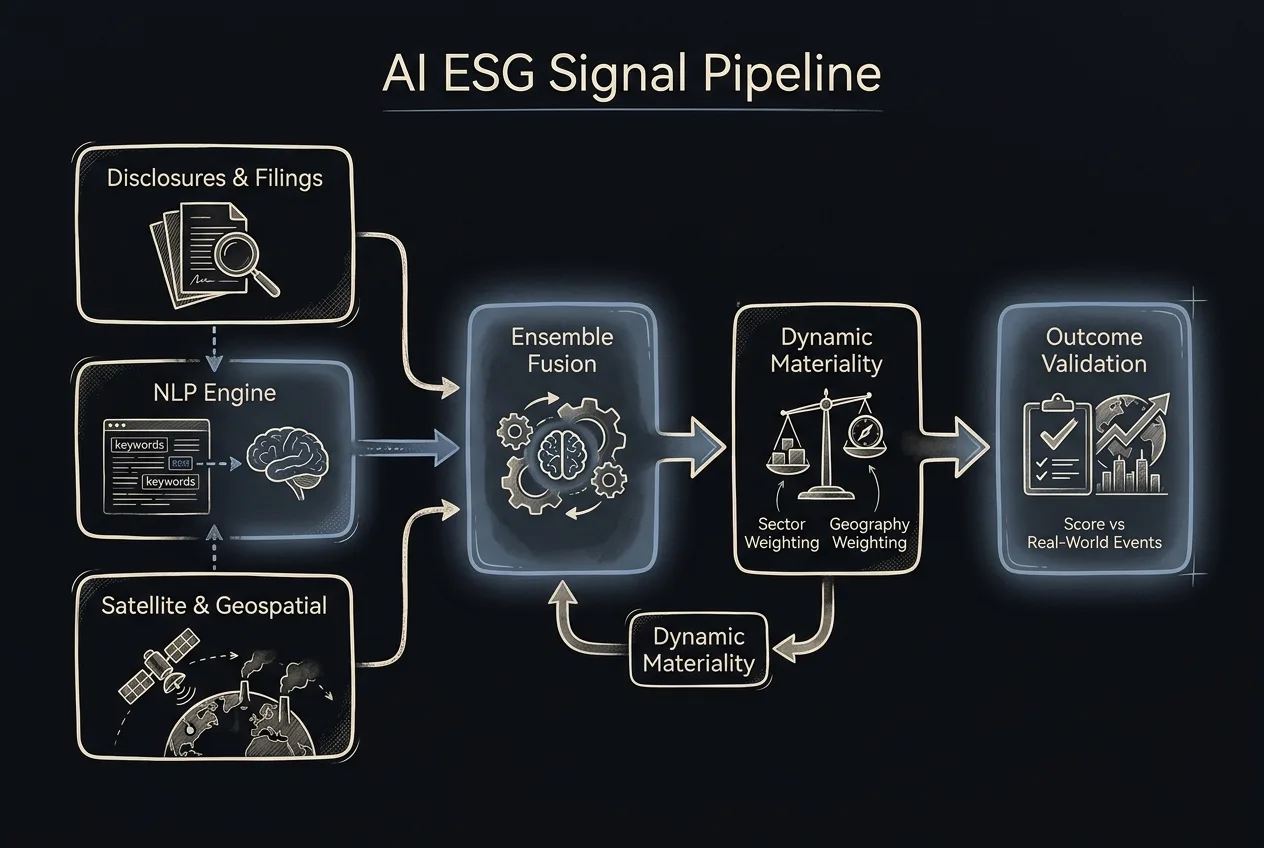
The proliferation of ESG data sources creates its own challenge: synthesis. An institutional investor with access to corporate disclosures, NLP-derived signals, satellite data, news sentiment, and regulatory filings must combine these disparate inputs into a coherent assessment that can be integrated into the investment process. This is fundamentally a machine learning problem.
The most effective approaches use ensemble methods that combine multiple models, each specialized for a different data type, into a unified scoring framework. A gradient-boosted model might process structured financial and ESG metrics. A fine-tuned language model handles unstructured text. A convolutional neural network analyzes satellite imagery. The outputs of these specialized models are then combined through a meta-learning layer that learns the optimal weighting across data sources, sectors, and time horizons.
Crucially, the weighting is not static. Machine learning enables dynamic materiality assessment, adjusting the importance of different ESG factors based on sector, geography, and current conditions. Water usage is highly material for a semiconductor manufacturer but largely irrelevant for a software company. Labor practices are critical for a retailer with a large hourly workforce but less central for a capital-light technology firm. AI-driven scoring systems can learn these materiality distinctions from data rather than imposing them through subjective analyst judgment.
The validation of composite ESG scores is equally important. A well-designed system validates its scores against observable outcomes: do companies with deteriorating ESG scores subsequently experience more regulatory actions, more environmental incidents, more employee lawsuits, or more shareholder activism? This outcome-based validation creates a feedback loop that continuously improves the scoring methodology, in contrast to traditional ESG ratings that are rarely validated against real-world outcomes.
There is a temptation, in describing an ensemble of this sophistication, to treat its output as self-justifying. It is not. The same machinery that lets a meta-learner weight a dozen inputs also makes the resulting score harder to explain than any single rating agency's — the very failure the exercise set out to correct. The discipline that keeps an AI score defensible is to log the derivation, not just the result. For any score, an analyst should be able to ask why and receive an answer in the system's own records: which inputs contributed, what each contributed, which materiality weights applied for this sector and date, and which source documents the underlying figures were extracted from. Treat that derivation as part of the score's definition rather than as a debugging convenience, and an audit, a regulator query, or an internal challenge becomes a matter of replaying the record rather than reconstructing a decision from memory. Explainability designed in at the point of scoring is cheap; explainability bolted on after a contested allocation is often impossible.
Integration Approaches: From Screening to Impact
ESG integration is not a single strategy but a spectrum of approaches with different objectives, constraints, and performance implications. AI-driven analytics enhance each approach, but the nature of the enhancement varies. A point worth holding throughout this section: better analytics determine what a constraint should be, but they do not enforce it. A screen that exists in a research note and a screen that blocks an order before it executes are different objects. The closer an ESG rule sits to the moment of trading — expressed as code that the execution path consults and refuses to override — the smaller the gap between a fund's stated policy and its actual holdings.
Negative screening, the exclusion of companies or sectors that fail to meet minimum ESG standards, is the simplest form of ESG integration. AI improves negative screening by expanding the information set beyond binary exclusion criteria. Rather than simply excluding all fossil fuel companies, an AI-enhanced screen might exclude only those companies whose satellite-verified emissions significantly exceed their disclosed figures, targeting the worst actors while avoiding the indiscriminate capital withdrawal that characterizes crude exclusionary approaches. The mechanism that makes such a screen reliable is mundane and decisive: the exclusion is encoded as a pre-trade check, evaluated against current data every time an order is constructed, so that a position the policy forbids cannot be opened without an explicit, logged override. Sophistication in the criterion is wasted if the criterion is advisory.
Best-in-class selection identifies the top ESG performers within each sector, maintaining sector neutrality while tilting toward sustainability leaders. Machine learning improves this approach by identifying companies whose ESG trajectories are improving, not just those with the highest current scores. A company that has reduced its emissions intensity by 30% over three years and is investing heavily in renewable energy may be a better investment than a company with a higher absolute ESG score but a flat or deteriorating trajectory.
Thematic investing targets specific sustainability themes such as clean energy, water infrastructure, or circular economy. NLP analysis of corporate filings, patent databases, and capital expenditure disclosures can identify companies with genuine exposure to these themes, distinguishing between companies whose revenues are primarily derived from sustainable products and those that merely market a green narrative while generating the bulk of their income from conventional operations.
Impact investing requires the most sophisticated ESG analytics, demanding not only the identification of positive ESG characteristics but the measurement of actual impact. AI systems can estimate the emissions avoided by a renewable energy investment, the water saved by an efficient irrigation technology, or the employment created by a social enterprise, providing the quantitative impact metrics that institutional impact investors increasingly require.
Performance Attribution: Isolating ESG Alpha
One of the most contentious debates in institutional investing is whether ESG integration generates alpha or merely imposes constraints that reduce the opportunity set. AI-driven performance attribution is beginning to resolve this debate with greater analytical rigor than was previously possible.
The challenge in ESG performance attribution is disentangling the ESG signal from confounding factors. Companies with strong ESG profiles tend to be larger, more profitable, and less leveraged than their peers. A portfolio that overweights ESG leaders may outperform simply because it has a quality factor tilt, not because ESG factors themselves are predictive.
Machine learning-based attribution models address this by controlling for a comprehensive set of known factors, including size, value, momentum, quality, low volatility, and sector exposures, and measuring the residual contribution of ESG signals. These models can also test whether the alpha from ESG signals persists out of sample and across different market regimes, providing more robust evidence than simple backtests.
The emerging evidence suggests that the relationship between ESG and performance is more nuanced than either advocates or skeptics acknowledge. ESG momentum, the rate of change in ESG metrics, appears to be a more reliable alpha signal than absolute ESG levels. Companies improving their ESG profiles tend to outperform on a risk-adjusted basis, while companies with high but static ESG scores do not consistently generate excess returns. This finding has important implications for portfolio construction: an AI-driven ESG strategy should focus on identifying ESG improvers, not just current leaders.
Regulatory Requirements: Navigating the Disclosure Landscape
The regulatory environment for ESG investing has shifted dramatically in recent years, moving from voluntary guidance to mandatory disclosure requirements. Institutional investors must navigate an increasingly complex web of regulations that vary by jurisdiction and are evolving rapidly.
The EU Sustainable Finance Disclosure Regulation (SFDR) classifies funds into Article 6, 8, and 9 categories based on their sustainability characteristics, with progressively stringent disclosure requirements for each classification. Article 9 funds, which have sustainable investment as their objective, must demonstrate that their investments make a measurable contribution to environmental or social objectives without significantly harming any other objective. The data requirements for this demonstration are substantial and ongoing.
The EU Taxonomy Regulation establishes a classification system for environmentally sustainable economic activities, requiring asset managers to disclose the proportion of their portfolios aligned with the taxonomy. Taxonomy alignment assessment requires detailed analysis of company revenues, capital expenditures, and operating expenditures against technical screening criteria for each eligible economic activity. AI systems that can process corporate financial disclosures at scale and map them to taxonomy criteria provide a significant operational advantage.
The SEC's climate disclosure rules, while subject to ongoing legal challenges, signal the direction of US regulatory travel. These rules would require public companies to disclose scope 1 and 2 greenhouse gas emissions, climate-related risks and risk management processes, and the governance structures overseeing climate risk. For institutional investors, these disclosures will create a new body of structured data that AI systems can process systematically.
The convergence of these regulatory frameworks creates both challenges and opportunities. The challenge is compliance complexity: a single global fund may need to satisfy SFDR, EU Taxonomy, SEC, and other jurisdictional requirements simultaneously. The opportunity is that AI-driven ESG analytics, built to process diverse data sources and generate multiple output formats, are uniquely suited to meet these overlapping requirements efficiently.
Carbon Footprint Tracking and Scope 3 Measurement
Portfolio carbon footprint measurement has become a standard requirement for institutional investors committed to net-zero targets. Measuring scope 1 (direct) and scope 2 (purchased energy) emissions is relatively straightforward when companies disclose them. The frontier challenge is scope 3, the indirect emissions occurring throughout a company's value chain, which often represent 80% or more of total emissions but are far more difficult to measure.
Scope 3 measurement is fundamentally a supply chain mapping problem. A company's scope 3 emissions depend on the emissions profiles of its suppliers, customers, and the end-of-life treatment of its products. Traditional approaches use sector-average emission factors applied to financial expenditure data, producing estimates with wide uncertainty ranges and limited specificity.
AI-driven approaches improve scope 3 estimation through several mechanisms. NLP analysis of supplier disclosures, procurement data, and industry reports can build more detailed supply chain maps than financial data alone. Machine learning models trained on companies that do disclose scope 3 data can predict emissions for companies that do not, using operational characteristics as features. And satellite-based monitoring can directly verify emissions from major supply chain facilities, providing ground truth data that improves model accuracy.
The practical implications for portfolio management are significant. Accurate scope 3 measurement enables investors to identify the true carbon intensity of their portfolios, rather than the misleadingly low figures that result from scope 1 and 2 measurement alone. It also enables more targeted engagement with portfolio companies, focusing on the specific supply chain activities that contribute most to their carbon footprint.
Greenwashing Detection Using AI
As ESG investing has grown, so has the incentive for companies and fund managers to overstate their sustainability credentials. Greenwashing, the practice of making misleading claims about environmental or social performance, erodes investor trust and undermines the credibility of the entire ESG investment ecosystem. AI provides increasingly powerful tools for detecting it.
NLP-based greenwashing detection works by comparing a company's sustainability claims against its actual performance data. A company that prominently highlights a 10% reduction in emissions in its sustainability report while omitting the fact that its absolute emissions increased due to acquisition activity can be flagged by an AI system that cross-references reported metrics with financial data. Similarly, a company that makes forward-looking net-zero commitments without disclosing a credible transition plan can be identified by analyzing the specificity and feasibility of its stated targets.
At the fund level, AI can evaluate whether a fund's actual holdings are consistent with its stated ESG strategy. An Article 9 fund under SFDR that holds significant positions in high-carbon companies may be engaging in classification greenwashing, claiming a sustainability objective without implementing it in practice. Automated portfolio analysis can detect these inconsistencies at scale, providing regulators and investors with a monitoring capability that would be impossible through manual review.
The sharper observation is that an after-the-fact detector is treating as a forensic problem what should have been a design constraint. The reason a fund drifts from its stated objective is almost always that the objective lived in a prospectus while the trades were made elsewhere. If the same definition that classifies a fund as Article 9 is also the rule the order path enforces — the prohibited-exposure threshold encoded once and consulted at execution — classification greenwashing becomes structurally harder to commit, not merely easier to catch. The most credible answer to "does this fund do what it claims" is a system in which the claim and the constraint are the same artifact, and every deviation from it is a logged exception with a name attached rather than an anomaly a model has to rediscover.
Temporal analysis adds another dimension. By tracking a company's ESG communications over time, AI systems can detect patterns of strategic disclosure, publishing positive ESG data during reporting periods while burying negative information in regulatory filings or footnotes. These patterns, invisible in any single document, become clear when analyzed across the full corpus of a company's communications.

The Business Case: ESG Integration as Risk Management
Ultimately, the strongest argument for AI-driven ESG integration is not ethical but financial. ESG factors represent material risks that traditional financial analysis systematically underweights. Environmental liabilities can impair asset values. Social controversies can damage brand value and increase regulatory scrutiny. Governance failures can destroy shareholder value overnight. AI-driven ESG analysis provides a more accurate and timely assessment of these risks than any alternative methodology.
The empirical evidence supports this framing. A meta-analysis of over 2,000 studies found that the majority show a positive relationship between ESG performance and financial performance, with the strongest evidence in the areas of risk reduction and cost of capital. Companies with strong ESG profiles tend to have lower stock price volatility, fewer regulatory penalties, and better access to capital markets. These are not ethical benefits. They are financial benefits with direct implications for portfolio construction and risk management.
For institutional investors, the question is no longer whether to integrate ESG factors but how to do it with sufficient rigor to satisfy fiduciary obligations. Self-reported data and subjective ratings are not adequate for this purpose. AI-driven analytics — combining NLP, satellite data, machine learning, and continuous monitoring — provide the quantitative foundation that institutional ESG integration requires.
The foundation, though, is necessary rather than sufficient. The recurring argument of this article is that the advantage does not lie in the model alone. A more capable model that produces an unexplainable score, or a sharper screen that the execution path can quietly ignore, reproduces the opacity and the drift that made ESG ratings untrustworthy in the first place. The durable position belongs to firms that treat the ESG signal as a judgment to be governed: humans set the policy — what to exclude, what to weight, what threshold defines the mandate — and the system enforces that policy at the point of trading and records every input, weight, and exception in a form that an allocator, an auditor, or a regulator can replay. ESG done at institutional standard is less a matter of having the best data than of being able to prove, after the fact and on demand, that the portfolio did what its mandate said it would.