The Architecture of Institutional AI: From Black Box to Glass Box
A technical framework for accountable AI in institutional portfolio management — the operating model in which humans govern and machines operate, built on acts graded by how reversible they are, an audit trail that is added to rather than rewritten, and limits written as rules the system checks, so that accountability is a property of the architecture rather than a department.


Executive Summary
Institutional asset management has two established operating models for deploying AI, and both are inadequate. The first keeps a human in manual control of every decision, which does not scale and forfeits the speed advantage that motivated automation. The second hands control to an autonomous system whose internal mechanisms no one can reconstruct — a black box that cannot be governed, only trusted or switched off. As AI-driven portfolio systems grow more capable, the second model becomes the default, and its opacity creates material risk across three dimensions: regulatory compliance, fiduciary defensibility, and operational trust.
This paper specifies a third operating model: humans govern, machines operate. Humans set policy, define limits, and retain release authority over consequential actions; machines execute within those constraints at machine speed and produce a complete, reconstructable account of what they did and why. The central claim is architectural, not procedural. Accountability in this model is not a department, a review meeting, or a report generated after the fact. It is a property of the system — established by construction at the point each decision is made.
We develop this model layer by layer. Every action the system can take is classified by its reversibility and consequence and routed through a corresponding act-type, so that an irreversible act cannot execute until a named human releases it. Every action — proposed, gated, or executed — is written to an append-only audit spine that is logged, explained, and reversible by construction, and that can replay any decision from signal to settlement. The constraints humans impose are expressed as policy-as-code over a single data model, so that one record governs the entire firm rather than a patchwork of dashboards and spreadsheets. Explainability, the property most of the industry now demands, falls out of this architecture as one face of the audit spine rather than as a feature bolted onto an opaque core.
The question is no longer whether institutional AI can be trusted. It is whether your architecture can govern what the machine does — gate the consequential, reverse the mistaken, and reconstruct any decision on demand — at the speed the market requires.

Why the Two Existing Models Fail
The choice institutions face today is usually framed as manual control versus autonomy, and each pole has a fatal property. Manual control is accountable but does not scale: a human who must authorize every order becomes the bottleneck the automation was meant to remove, and the firm's capacity is capped by its headcount. Autonomy scales but is not governable: once a system acts on its own inferences faster than any human can review them, the only available controls are blanket trust and a kill switch. Neither pole gives an institution what it actually needs, which is to operate at machine speed while remaining answerable for every action at human standards.
The reason autonomy resists governance is the black box, and the black box has changed character. The term predates deep learning by several decades. Proprietary trading strategies have always operated behind informational barriers, and allocators have long accepted a degree of opacity in exchange for demonstrated performance. What has changed is the nature of the opacity itself.
A traditional quantitative strategy — a multi-factor equity model, a statistical arbitrage system, a systematic macro overlay — operates on principles that can be articulated in human terms even if the specific parameters are proprietary. The portfolio manager can explain that the model is long value and short momentum in a given regime, or that the carry signal is driving fixed income positioning. The mechanism is interpretable even when the calibration is confidential.
Modern deep learning systems operate differently. A transformer-based model ingesting order book microstructure, alternative data feeds, macroeconomic time series, and cross-asset correlation surfaces produces outputs that emerge from billions of learned parameters. The model does not decompose its reasoning into factors that map cleanly to investment intuition. Its internal representations are distributed, non-linear, and context-dependent in ways that resist post-hoc rationalization.
A system whose reasoning cannot be reconstructed cannot be governed, and the ungovernability shows up as three categories of institutional risk:
Regulatory risk. Financial regulators are converging on the principle that algorithmic decisions affecting client portfolios must be explainable. A model that cannot articulate why it recommended a particular position change creates compliance exposure that grows with each regulatory update.
Fiduciary risk. Investment committees and boards of trustees bear personal liability for decisions made on behalf of beneficiaries. An allocation decision justified only by "the model recommended it" is indefensible in any governance framework that takes fiduciary duty seriously.
Operational risk. When a model produces an anomalous signal — and all models eventually do — diagnosing whether it reflects a genuine market insight or a data artifact depends on the ability to decompose the signal into its contributing factors, and on the ability to undo the action before the artifact becomes a loss. Black box systems make the diagnosis slow or impossible and offer no clean path to reversal.
These risks share a single root: the absence of a reconstructable record at the point of decision. The constraint is practical: an allocator who cannot reconstruct why a model acted cannot defend the allocation to an investment committee, whatever the track record, capacity or fees. The transparency deficit is not an abstract concern. It is a capital formation constraint — and it is a direct consequence of choosing autonomy without governance.
Governance Requires Precise Definitions
"Humans govern, machines operate" is only enforceable if we can say precisely what humans must be able to see in order to govern. The industry's discussion of AI transparency obscures this by using "explainability," "interpretability," and "transparency" interchangeably despite their referring to distinct properties — and a governing human needs different ones than a model validator does. A rigorous architecture requires rigorous definitions.
Transparency refers to the degree to which a system's internal mechanisms are accessible to inspection. A linear regression is transparent: every coefficient can be examined and its contribution to the output calculated directly. A deep neural network with 500 million parameters is not transparent in this sense, regardless of what post-hoc analysis is applied.
Interpretability refers to the degree to which a human observer can understand the relationship between a system's inputs and outputs. Interpretability does not require full transparency. A model that is not transparent in its internal mechanics can still be interpretable if its input-output relationships can be characterized in terms that domain experts find meaningful.
Explainability refers to the ability of a system to produce, for any given output, a human-readable account of the factors that contributed to that output and their relative importance. Explainability is an active capability — something the system does — rather than a passive property of its architecture.
A governable system satisfies all three properties at levels appropriate to the humans who govern it. The quant researcher requires transparency into model internals. The portfolio manager requires interpretability of signal behavior across market regimes. The compliance officer requires explainability in terms that map to regulatory reporting templates. The investment committee requires a narrative that connects model output to investment thesis. Each of these is a precondition for a specific governing act: validating a model, overriding a signal, attesting to a regulator, approving a strategy.
Explainability is not the goal; it is the instrument. The goal is governability — a sophisticated model that exposes, to each human who must answer for it, exactly what that human needs to see to govern it.
The architecture achieves this through a layered explanation system that generates multiple representations of the same decision, each calibrated to a governing role and the act that role performs. These representations are not a separate reporting product. They are projections of the same audit record the system writes for every decision, which the remainder of this paper develops.
The Explanation Layer

Before a human can govern a decision, the machine must be able to account for it. The explanation layer is the part of the operating system that produces that account for every signal the model emits. It is the technical substrate beneath the definitions above and the raw material the audit spine records.
Separating Prediction from Explanation
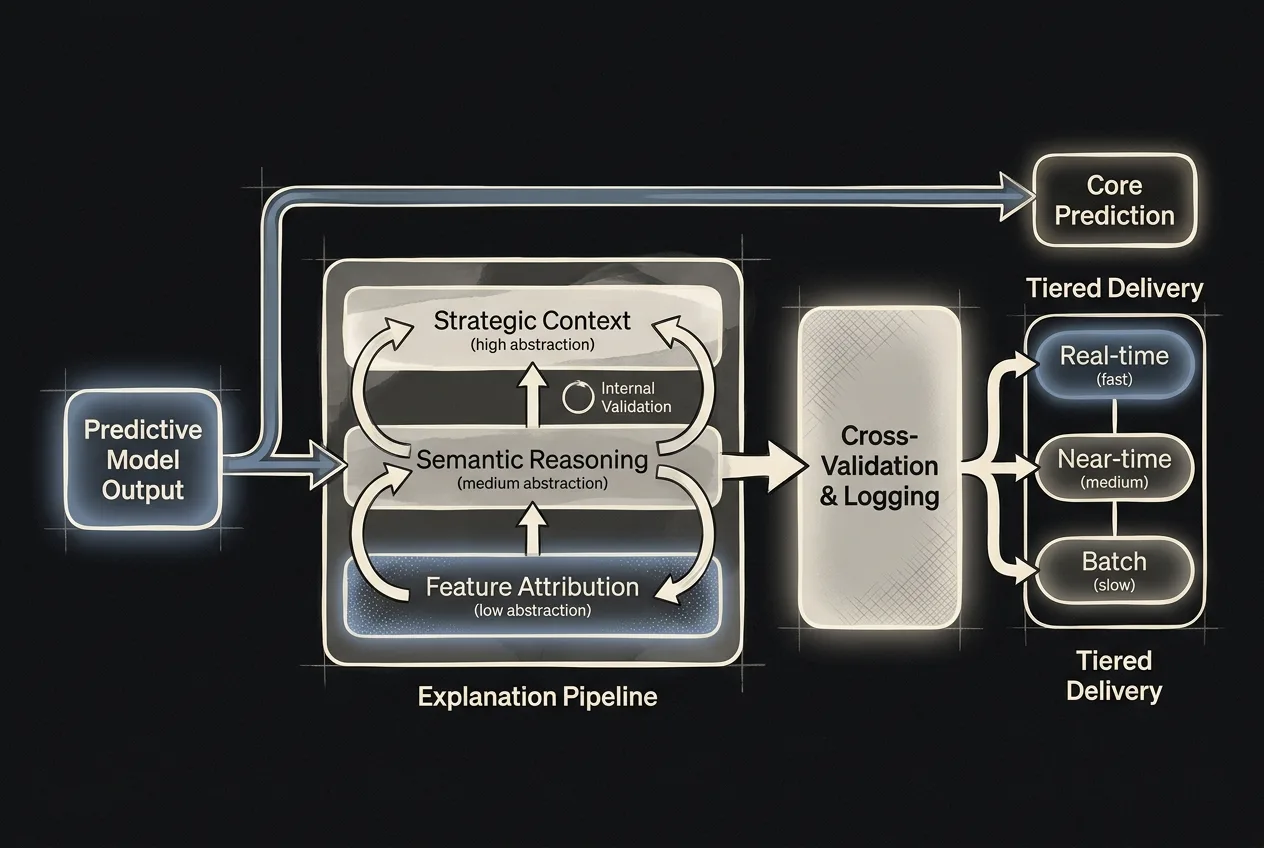
The foundation of the explanation layer is the separation of the prediction path from the explanation path. These are distinct computational paths that operate on the same input data but produce different outputs: the prediction path generates the trading signal, and the explanation path generates a structured account of why that signal was produced.
This separation is essential for two reasons. First, it allows the prediction model to use whatever architecture maximizes predictive performance — including architectures that are inherently opaque — without constraining that choice to models that happen to be interpretable. Second, it allows the explanation layer to be updated, refined, and extended independently of the prediction model, which is important because explanation requirements evolve faster than model architectures.
The explanation layer operates at three levels of abstraction:
Level 1: Feature Attribution. For each prediction, the system generates a vector of attribution scores indicating how much each input feature contributed to the output. This is the most granular level of explanation and is primarily consumed by quantitative researchers and model validators.
Level 2: Factor Decomposition. The attribution scores are aggregated into higher-level factors that correspond to investment concepts — momentum, value, quality, volatility regime, liquidity conditions, macro sensitivity. This mapping is maintained by domain experts and updated as the investment process evolves. Factor decomposition is the primary explanation surface for portfolio managers.
Level 3: Narrative Generation. The factor decomposition is transformed into natural language explanations suitable for investment committee memos, regulatory filings, and client reports. This transformation uses template-based generation for regulatory contexts where precision is paramount, and large language model generation for contexts where readability and nuance are valued.
Attention Visualization
For transformer-based models — which have become the dominant architecture for multi-modal financial data processing — attention mechanisms provide a native interpretability surface. Attention weights indicate, for each output, which elements of the input sequence the model weighted most heavily in producing that output.
In a financial context, this translates to concrete questions: when the model generated a sell signal for a particular equity, was it attending primarily to the stock's own price history, to sector-level order flow data, to macroeconomic indicators, or to cross-asset correlation shifts? The attention pattern provides a first-order answer.
However, attention visualization must be handled carefully. Research has demonstrated that raw attention weights can be misleading as explanations — a high attention weight indicates that the model used that input, but does not indicate the direction or magnitude of its influence on the output. An explanation a governing human cannot rely on is a liability, not an asset; the architecture addresses this by combining attention patterns with gradient-based attribution methods that capture both salience and directional influence, and never presents a raw attention weight as an explanation on its own.
Feature Attribution

The system implements multiple attribution methods and cross-validates their outputs to ensure explanation robustness:
Integrated Gradients compute attribution by integrating the gradient of the model's output with respect to each input feature along a path from a baseline input to the actual input. This method satisfies the axioms of sensitivity and implementation invariance, making it theoretically well-grounded for financial applications where attribution consistency is important.
SHAP (SHapley Additive exPlanations) values, grounded in cooperative game theory, distribute the prediction among input features based on their marginal contributions across all possible feature coalitions. SHAP values are computationally expensive for high-dimensional inputs but provide the strongest theoretical guarantees of fair attribution.
Gradient-weighted Class Activation Mapping (Grad-CAM), adapted for time series and tabular data, produces spatial attribution maps that highlight which regions of the input were most influential. In a financial context, this reveals whether the model is responding to recent price action, to a structural break in a longer time series, or to a cross-sectional pattern across assets.
The system computes all three attribution methods for each prediction and generates a concordance score measuring the degree to which they agree on the most important features. High concordance increases confidence in the explanation. Low concordance triggers a review flag, alerting the model governance team that the prediction may be driven by subtle interactions that resist stable attribution.
The Audit Spine
Attribution and explanation are inert until they are recorded in a way that survives the decision and binds to its consequences. That record is the audit spine: a single, append-only ledger through which every action the system takes must pass, and from which every action can be reconstructed. The spine has three properties, each established by construction rather than by policy:
Logged. Every prediction the system produces is written to a structured audit record before any action follows from it. Each record contains the complete set of input features at the time of prediction, with their provenance and quality scores; the model version, hyperparameters, and training-data vintage; the raw output and any post-processing applied; the feature-attribution vectors from all implemented methods; the factor decomposition at the investment-concept level; the concordance score across attribution methods; and the act-type the action was routed through. Human interventions are first-class entries: any override carries the identity and rationale of the person who applied it, and any release of a gated action carries the identity of the person who released it.
Explained. The attribution, factor decomposition, and narrative described in the preceding sections are not generated on demand and discarded; they are persisted with the record. The account of why travels with the action permanently, so that a decision examined a year later carries the same explanation that was available when it was made.
Reversible. Each record captures enough state to undo the action it describes where the action is reversible at all. The spine therefore distinguishes, for every action, what can be unwound from what cannot — which is precisely the distinction the act-type system uses to decide what a machine may execute on its own.
Records are added to, never rewritten, and retained for the longer of the regulatory retention period or seven years. Because the spine is the single path every action takes, it can replay any decision end to end — from the originating signal through the act-type that gated it to the resulting settlement — and link each step to the policy clause that governed it. It is this replayable, clause-linked chain, not a quarterly report, that forms the evidentiary basis for regulatory examinations, model reviews, and post-mortems.
Act-Types: Gating by Reversibility and Consequence
The audit spine records what happened; the act-type system decides what is allowed to happen without a human in the loop. Every action the operating system can take — placing an order, adjusting an allocation, sending a client communication, changing a risk limit — is classified along two axes, reversibility and consequence, and routed to one of five act-types:
- Auto. Low-consequence, reversible actions execute immediately and are logged. The human governs by reviewing the record, not the action.
- Notify. The action executes but a named human is informed in the same step, so that anomalies surface without blocking machine-speed operation.
- Approval-gated. The action is prepared in full but does not execute until a named human approves it; the prepared action and the approval are both recorded.
- Propose → approve. The machine drafts a complete proposal, including its rationale and projected effect, and a human accepts or rejects it. This is the default for consequential, hard-to-reverse actions.
- Human-gated. Irreversible or maximally consequential actions remain a draft. They cannot execute under any circumstances until a named human explicitly releases them, and the release is itself a logged, attributable act.
The governing principle is that the cost of being wrong sets the gate. An action that can be cheaply unwound can run autonomously because the audit spine makes the reversal mechanical. An action that cannot be unwound stays a draft until a person with the authority to own the consequence releases it. This is how "humans govern, machines operate" becomes a runtime property rather than an aspiration: the machine operates freely exactly where operating is safe, and not one step further.
Regulatory Imperatives
The act-type and audit-spine architecture is not built to satisfy regulation; it is built because consequential capital decisions require it. But it happens to answer, by construction, a body of regulation that is converging across jurisdictions on the same demand: that a firm be able to explain, document, and stand behind every AI-driven decision affecting a client. Read the requirements below as independent confirmations of the architectural claim — each regulator is, in its own language, asking for a governed system rather than an autonomous one.
MiFID II and the European Framework
The Markets in Financial Instruments Directive II (MiFID II) does not explicitly address AI explainability, but its requirements for best execution documentation, suitability assessment, and product governance create an implicit mandate. Article 25 requires that firms demonstrate the suitability of each investment recommendation for the specific client, including the reasoning behind the recommendation. When that reasoning is generated by an AI system, the firm must be able to articulate it in terms that satisfy the suitability assessment framework.
The European Securities and Markets Authority (ESMA) has been increasingly explicit about the implications. Its 2025 guidance on the use of AI in investment services states that firms "must be able to explain the rationale for individual recommendations in a manner that is comprehensible to the client and documentable for supervisory review." This language effectively requires the explanation infrastructure described in this paper.
The EU AI Act, which entered its enforcement phase in 2025, classifies AI systems used in creditworthiness assessment and investment management as "high-risk," subjecting them to requirements for transparency, human oversight, accuracy, and robustness. While the Act's provisions are still being operationalized through technical standards, the direction is unambiguous: high-risk AI systems must be explainable, and investment management AI qualifies.
SEC and the United States Framework
The U.S. Securities and Exchange Commission has approached AI regulation through existing authority rather than new legislation. The 2024 Predictive Data Analytics rule proposal, though subsequently revised, signaled the Commission's view that AI-driven investment recommendations create potential conflicts of interest that must be disclosed and managed. The Commission's examination priorities for 2025 and 2026 explicitly include "the use of AI and machine learning models in portfolio management and trading, with particular attention to model governance, validation, and the ability to explain model-driven decisions."
The Commodity Futures Trading Commission (CFTC) has taken a parallel approach, issuing guidance that algorithmic trading systems must maintain "sufficient documentation to allow examination staff to understand the logic and decision-making process of the algorithm." For AI-based systems, this requires explanation capabilities that go beyond source code review.
DFSA and the Middle East Framework
The Dubai Financial Services Authority (DFSA) has emerged as one of the more forward-looking regulators on AI governance. Its 2025 framework for AI in financial services requires that firms using AI for investment decisions maintain "a clear and documented methodology for explaining individual AI-driven decisions to affected clients, senior management, and the Authority upon request." The framework also mandates annual independent reviews of AI explanation systems, creating an ongoing assurance obligation rather than a point-in-time compliance check.
Regulatory convergence on explainability is no longer a forecast; it is observable across jurisdictions. The firms that fare best will be those whose obligations are encoded as executable policy the system enforces at decision time — rather than as procedures a compliance team reconstructs after the fact.
Implementation Patterns
SHAP Values in Production
Deploying SHAP values in a production trading environment requires careful engineering to manage computational cost. Exact SHAP computation has exponential complexity in the number of features, making it impractical for models with hundreds or thousands of input dimensions.
The practical approach uses KernelSHAP or TreeSHAP approximations calibrated against exact values on a representative subset of predictions. The calibration process establishes error bounds for the approximate values, allowing the system to report attribution with quantified uncertainty. For ensemble models combining gradient-boosted trees with neural networks, a hybrid approach computes TreeSHAP for the tree components (where it is exact and fast) and KernelSHAP for the neural network components, then aggregates the attributions at the ensemble level.
Production systems must also handle the temporal dimension of SHAP values. A feature's attribution for a single prediction is a point estimate; the portfolio manager needs to understand how that feature's importance has evolved over time, whether its current attribution is anomalous relative to its historical distribution, and whether attribution patterns are shifting in ways that indicate model drift. The architecture maintains rolling SHAP distributions for all features and generates alerts when attribution patterns deviate significantly from historical norms — and, because drift is itself a consequential event, routes the alert through the act-type that requires a human to acknowledge it.
LIME for Local Interpretability
Local Interpretable Model-agnostic Explanations (LIME) provide a complementary approach by fitting a simple, interpretable model (typically a sparse linear model) in the neighborhood of each prediction. The local model approximates the complex model's behavior for inputs similar to the one being explained, producing an explanation that is valid locally even if it does not capture the model's global behavior.
In portfolio management, LIME is particularly useful for explaining individual position recommendations. When the model recommends increasing exposure to a particular security, LIME can identify which features of that security — relative valuation, earnings momentum, order flow characteristics, sector sentiment — are driving the recommendation in the current market context. The explanation is specific, concrete, and expressed in terms that portfolio managers use naturally.
The limitation of LIME is that the local approximation can be unstable: small perturbations to the input can produce different local models and therefore different explanations. The architecture addresses this by computing LIME explanations across multiple perturbation samples and reporting only those attributions that are stable across samples, along with a stability score that indicates explanation confidence.
Counterfactual Explanations
Counterfactual explanations answer the question: "What would need to change about the inputs for the model to produce a different output?" In an investment context, this translates to questions like: "What would need to change about this equity's characteristics for the model to recommend a buy instead of a hold?" or "Under what market conditions would the model have avoided this drawdown?"
Counterfactual generation requires solving an optimization problem: finding the smallest perturbation to the input features that changes the model's output past a decision threshold, subject to constraints that keep the perturbed input within the domain of realistic market scenarios. The realism constraint is critical — a counterfactual that requires a stock's volatility to be negative or its market capitalization to increase by a factor of ten is mathematically valid but operationally meaningless.
The architecture generates counterfactual explanations using constrained optimization with domain-specific feasibility bounds derived from historical feature distributions. The resulting counterfactuals serve dual purposes: they explain individual decisions in intuitive terms, and they reveal the model's decision boundaries, helping portfolio managers understand the conditions under which the model's positioning would change.
Integrated Gradients in Practice
Integrated Gradients offer an attribution method that is both theoretically principled and computationally tractable. The method works by computing the integral of the model's gradients along a straight-line path from a baseline input (typically a zero or market-neutral input) to the actual input. The resulting attribution for each feature reflects its cumulative contribution to the prediction relative to the baseline.
In production, the integral is approximated using Riemann summation with a configurable number of interpolation steps. More steps yield more accurate attribution at higher computational cost. The architecture uses adaptive step counts — more steps for high-conviction or high-notional predictions, where attribution accuracy matters most and the act-type is more likely to require human release, fewer steps for routine predictions where approximate attribution is sufficient.
One practical consideration is baseline selection. The choice of baseline encodes an assumption about what constitutes "absence of signal," and different baselines can produce materially different attributions. The architecture supports configurable baselines per model and per asset class, with the default being a market-neutral feature vector derived from cross-sectional medians.
Institutional Deployment Considerations
Latency vs. Interpretability Trade-offs
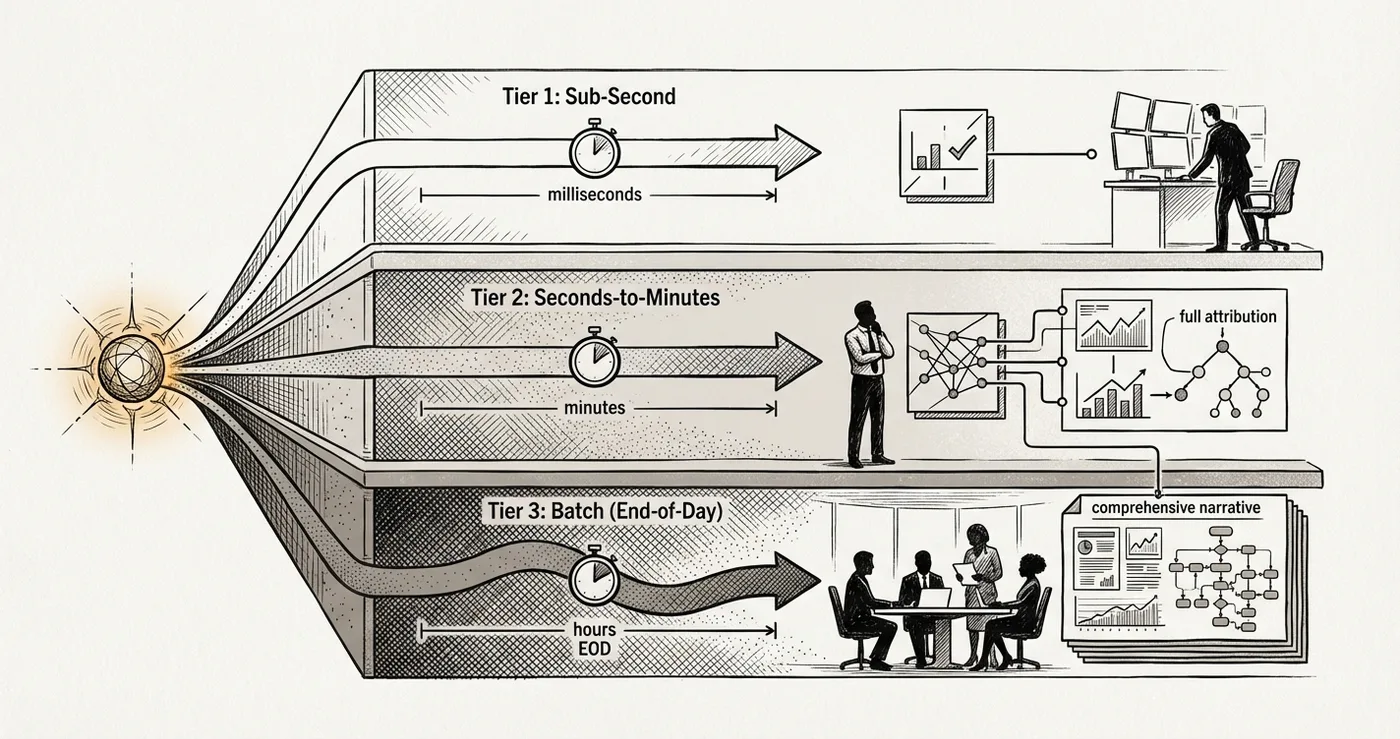
The fundamental engineering trade-off in a governed system is between explanation quality and explanation latency, because an explanation is only useful to a human if it arrives before the gate it is meant to inform. Full SHAP attribution for a neural network with 1,000 input features can require minutes of computation. A portfolio manager releasing a human-gated action during a market event cannot wait minutes; an investment committee reviewing the same action a day later can afford the full computation. The architecture resolves this by matching explanation depth to the act-type's decision horizon, through a tiered explanation system:
Tier 1: Real-time (sub-second). Uses pre-computed attention weights and fast gradient attribution to produce approximate explanations suitable for trading desk consumption. These explanations identify the top contributing features and their directional influence but do not provide full attribution or concordance analysis.
Tier 2: Near-real-time (seconds to minutes). Computes full SHAP values, LIME explanations, and counterfactuals for all predictions generated in the current session. These explanations are available for review within minutes of the prediction and are the primary explanation surface for intraday decision review.
Tier 3: Batch (end-of-day). Performs comprehensive attribution analysis across all predictions, computes concordance scores, generates narrative explanations, and updates the rolling attribution distributions used for drift detection. Batch explanations are the primary input to regulatory reporting, model governance reviews, and investment committee documentation.
This tiered approach ensures that the explanation available at any moment matches the act-type that depends on it: enough to release a gated action at the desk in real time, and the full, concordance-checked account by the time a governance review or regulatory filing requires it. Speed and depth are not traded against each other; they are delivered to different governing acts.
Real-Time Explanation Generation
Generating explanations in real time requires architectural choices that are not typical of research-oriented explainability implementations. Specifically:
Explanation caching. For models that process overlapping input data across multiple securities, explanation components can be shared and reused. If the macroeconomic feature attributions are stable across a sector, they need not be recomputed for each security individually.
Incremental attribution. When a model's input changes by a small delta from one timestep to the next — as is typical in market data streams — the attribution can be updated incrementally rather than recomputed from scratch. The architecture maintains a running attribution state and applies first-order corrections for small input changes, with periodic full recomputation to prevent error accumulation.
Explanation pre-computation. For predictable scenarios — scheduled rebalances, earnings releases, economic data announcements — explanation templates can be pre-computed for likely model outputs, then filled in with actual values when the prediction is generated. This reduces real-time explanation latency to a lookup and template-fill operation.
Worked Example: A Governed Sell Decision
Consider a multi-factor alpha model that generates daily position signals for a global equity portfolio of 2,000 securities. The model ingests 150 features per security spanning fundamental data, technical indicators, alternative data (satellite imagery-derived foot traffic, web scraping sentiment, patent filing activity), and macro regime indicators.
On a given day, the model generates a strong sell signal for a European pharmaceutical company that the portfolio currently holds as a 1.2% position. Because liquidating a full position of this size is materially consequential, the act-type system routes the action to propose → approve: the order is drafted and recorded but does not execute until a portfolio manager accepts it. To accept or reject responsibly, the manager needs to understand why — and the explanation layer delivers that account at three resolutions matched to the time available.
The Tier 1 real-time explanation, available within 200 milliseconds of the signal, identifies three dominant contributing features: a sharp deterioration in the company's clinical trial sentiment score (derived from NLP analysis of medical journal publications and conference proceedings), an anomalous increase in short interest relative to sector peers, and a macro regime shift toward risk-off positioning in European healthcare.
The Tier 2 near-real-time explanation, available within 90 seconds, provides full SHAP attribution confirming the Tier 1 features as the top three contributors and adding nuance: the clinical trial sentiment feature accounts for 34% of the signal magnitude, the short interest feature accounts for 22%, and the macro regime feature accounts for 18%. The remaining 26% is distributed across 12 secondary features, none individually contributing more than 4%. The concordance score across SHAP, Integrated Gradients, and LIME is 0.87, indicating high explanation stability.
The counterfactual analysis reveals that the signal would remain negative even if the short interest feature returned to its historical median, but would flip to neutral if the clinical trial sentiment score recovered to its level of 30 days prior. This tells the portfolio manager that the clinical trial sentiment is the critical driver, and the position should be monitored against developments in that specific domain.
The Tier 3 batch explanation, generated overnight, produces a narrative summary suitable for the investment committee: "The model's sell recommendation is driven primarily by a material deterioration in clinical trial sentiment for the company's Phase III oncology pipeline, as captured by natural language analysis of recent medical literature. This signal is corroborated by elevated short interest suggesting that specialized healthcare investors share the model's negative assessment. The macro environment — characterized by rising European sovereign spreads and defensive sector rotation — provides additional headwind. The model's conviction in this signal is high (87th percentile of historical signal magnitudes), and the explanation is stable across multiple attribution methods."
On this basis the manager approves the order, and the approval — their identity, the timestamp, and the explanation they acted on — is written to the audit spine alongside the executed trade. Every governing role is served by the same record: the quant researcher can examine the raw attribution vectors, the portfolio manager had actionable factor-level insight at the moment of release, the compliance team has a documentable rationale linked to the policy clause that required approval, and the investment committee has a narrative it can evaluate using its own domain expertise. The machine proposed; a named human governed; the system recorded both. Had the manager rejected the order, that too would be a logged, attributable act, and the position would remain untouched — the gate did its work either way.
The Architectural Principle
The argument of this paper reduces to a single structural claim. Accountability for an AI-managed portfolio cannot be added to a system after it is built. It is either a property of the architecture — established at the point each decision is made — or it does not exist, and what looks like governance is a report assembled after the consequences have already landed. Manual control and the black box both fail this test: one is accountable but cannot scale, the other scales but cannot be governed. The third model resolves the conflict by making the governance mechanical. Act-types decide what a machine may do alone by the cost of being wrong. The audit spine makes every action logged, explained, and reversible by construction, and replayable from signal to settlement. Policy-as-code over one data model means the firm operates from one record rather than a patchwork of dashboards.
This architecture has a property the two older models lack: scale comes from better policy, not more headcount. In manual control, capacity is bounded by how many decisions humans can personally make; in the black box, capacity is bought by surrendering the ability to govern. When humans govern and machines operate, a firm raises its capacity by sharpening the policy the machine enforces — by gating one more class of action correctly, or by encoding one more constraint as code — not by hiring another reviewer. The human role moves up the stack, from authorizing every order to authoring the rules under which orders are authorized.
Two honest limits remain. First, explainability has a known failure mode: raw attention weights and unstable local approximations can produce explanations that look authoritative and are not, which is why the architecture cross-validates across methods and reports concordance rather than trusting any single attribution. An explanation a human cannot rely on is worse than none, and closing the remaining gap between plausible and faithful explanation is unfinished work, here and across the field. Second, an architecture is a claim about how a system behaves, not evidence that it behaves well. That evidence has to be earned. The discipline we hold ourselves to is proof before promotion: let the record — not a marketing claim or a borrowed track record — establish whether the architecture delivers what it promises.
Accountability is not a department, a committee, or a quarterly report. In a system where machines operate at machine speed, accountability is an architectural property or it is a fiction. The institutions that internalize this will define how AI is governed in capital markets; the rest will be retrofitting it onto systems that were never built to provide it.
Humans govern. Machines operate. The architecture is what makes the distinction hold.