Explainability in AI Trading: From Black Box to Glass Box
Why institutional adoption of AI-driven investment strategies depends on moving from black-box opacity to glass-box accountability — built into the architecture, not bolted on as a department


A portfolio manager receives a signal from the fund's AI system recommending a significant reduction in emerging market exposure. The model's backtest performance is strong, its risk-adjusted returns are compelling, and the signal is timely. But when the investment committee asks why the model is making this recommendation, the answer amounts to a shrug: the model's internal representations are too complex to decompose into a human-readable explanation.
This scenario plays out with increasing frequency across institutional investment management. The models generating the signals are becoming more powerful, but the ability to explain those signals to stakeholders, regulators, and investment committees has not kept pace. For an industry built on fiduciary duty and governed by regulations that demand suitability justification, this gap between capability and explainability is becoming untenable.
We frame the problem as a transition from black box to glass box. A black box produces an answer and withholds its reasoning; a glass box produces the same answer and exposes the path that led to it — the inputs that mattered, the weight each carried, the constraints that bounded the decision, and the human or machine that released it. The distinction is not cosmetic. It determines whether an institution can stand behind a decision when a beneficiary, an allocator, or a regulator asks why.
The institutions that solve this problem will capture a disproportionate share of institutional capital. Those that do not will find themselves unable to satisfy the transparency requirements that allocators and regulators are tightening with each passing year.
The Explainability Imperative for Institutional Capital
Institutional investors operate under constraints that retail investors do not. Pension funds have fiduciary obligations to their beneficiaries. Sovereign wealth funds answer to government oversight bodies. Endowments report to boards of trustees. In each case, the decision-makers bear personal and institutional liability for investment outcomes, and that liability requires the ability to articulate why a particular investment decision was made.
Traditional quantitative strategies largely satisfied this requirement. A factor-based model that overweights value and momentum can explain its positioning in terms that investment committees understand: the portfolio is tilted toward stocks with low price-to-earnings ratios and positive price momentum because historical evidence suggests these factors generate excess returns over time. The explanation may be simplified, but it is coherent and defensible.
Modern deep learning models break this explanatory chain. A transformer-based model processing alternative data streams, satellite imagery, sentiment signals, and cross-asset correlations may generate superior returns, but its decision process is distributed across millions of parameters in ways that resist human interpretation. The model does not "think" in terms of value and momentum. It learns representations that are mathematically optimal for prediction but semantically opaque to human observers.
The fundamental tension in institutional AI adoption is not between performance and risk. It is between performance and accountability. Institutions cannot be accountable for decisions they cannot explain.
This tension is not merely philosophical. It has concrete consequences for capital allocation. Allocators who cannot see why a model acted cannot defend the allocation to their own committees, so interpretability becomes a gate on capital before performance is even discussed. The explainability gap keeps institutional money on the sidelines.

Technical Approaches to Model Explainability
The machine learning research community has developed several approaches to model interpretability that are increasingly relevant to institutional investment applications. These are the instruments that turn a black box into a glass one — but each illuminates a different facet of the model, and each has strengths and limitations that practitioners must understand before they trust its explanations.
SHAP Values: Quantifying Feature Contribution
SHAP (SHapley Additive exPlanations) values, grounded in cooperative game theory, provide a principled method for attributing a model's output to its input features. For each prediction, SHAP computes the marginal contribution of each feature, accounting for interactions between features.
In a portfolio context, SHAP analysis can reveal that a model's decision to underweight a particular sector was driven primarily by deteriorating credit spreads (contributing negative 1.2% to the expected return estimate), partially offset by strong earnings momentum (contributing positive 0.4%). This level of granularity transforms a black-box signal into a decomposed, auditable decision.
The limitations are computational and interpretive. SHAP values for complex models with thousands of features can be expensive to compute, particularly for time-sensitive trading decisions. And while SHAP provides local explanations for individual predictions, aggregating these into coherent narratives about overall portfolio positioning requires additional analytical frameworks.
LIME: Local Interpretable Model-Agnostic Explanations
LIME takes a different approach, approximating the behaviour of a complex model in the neighbourhood of a specific prediction using a simpler, interpretable model. For a given trading signal, LIME constructs a local linear model that approximates the complex model's decision boundary, making it possible to identify which features are most influential for that particular prediction.
The advantage of LIME is its model-agnostic nature. It can be applied to any model architecture without requiring access to internal parameters. The disadvantage is that local approximations may not accurately represent the global behaviour of the model, and the choice of neighbourhood size introduces a parameter that can significantly affect results.
Attention Mechanisms and Transformer Interpretability
For models based on transformer architectures, attention weights offer a natural window into the model's decision process. Attention mechanisms determine which parts of the input the model focuses on when generating its output, and visualising these attention patterns can reveal which data points, time periods, or features the model considers most relevant.
In financial applications, attention analysis might show that a model's bearish signal for a particular equity is driven primarily by attention to recent options market activity and changes in institutional ownership patterns, with relatively little weight given to traditional fundamental metrics. This insight is valuable both for understanding the model's reasoning and for identifying potential blind spots or biases.
However, attention weights should be interpreted with caution. Research has shown that attention patterns do not always correspond to feature importance in the way that intuition suggests. Attention may reflect processing patterns rather than causal reasoning, and over-reliance on attention-based explanations can create a false sense of understanding.

Regulatory Requirements: The Compliance Dimension
Model explainability is not merely a commercial consideration. It is increasingly a regulatory requirement. Several regulatory frameworks either explicitly or implicitly demand that AI-driven investment decisions be explainable.
The EU AI Act and Financial Services
The European Union's AI Act, which entered full application in 2025, classifies AI systems used in creditworthiness assessment and certain financial decisions as high-risk. High-risk AI systems are subject to requirements including transparency obligations, human oversight provisions, and documentation standards that demand a level of model interpretability that many current implementations do not achieve.
While the AI Act's application to portfolio management is still being clarified through regulatory guidance, the direction is unambiguous: AI systems that influence financial decisions affecting individuals or institutions will be held to explainability standards that pure black-box approaches cannot satisfy.
MiFID II Suitability and Best Execution
The Markets in Financial Instruments Directive already requires that investment firms demonstrate that their recommendations and execution decisions are suitable for each client and that best execution has been achieved. When these decisions are informed or driven by AI models, the suitability and best execution obligations extend to the model's outputs.
An investment firm using an AI system to generate portfolio allocation recommendations must be able to explain, for each client, why the recommended allocation is suitable given the client's risk profile, investment objectives, and constraints. A black-box model that produces optimal allocations without interpretable justifications creates compliance risk under existing regulations, regardless of the AI Act's provisions.
SEC and FINRA Guidance
In the United States, the Securities and Exchange Commission and FINRA have issued guidance on the use of AI and machine learning in financial services, emphasising the importance of model governance, testing, and documentation. While the US regulatory approach is less prescriptive than the EU's, the expectation of explainability is embedded in existing fiduciary duty standards and is likely to become more explicit as regulatory frameworks evolve.
Signal Attribution and Factor Decomposition
Beyond model-level explainability, institutional investors need to understand their portfolio's return attribution at a higher level. When a fund using AI-driven strategies outperforms or underperforms its benchmark, stakeholders need to understand the sources of that performance in terms they can evaluate and discuss.
Factor decomposition provides this bridge. By mapping the AI model's positions to a set of interpretable risk factors, such as market beta, sector exposure, style tilts, and idiosyncratic positions, portfolio managers can explain performance in terms that are consistent with established investment frameworks while still capturing the AI model's unique insights.
The key is maintaining fidelity between the decomposition and the model's actual decision process. A factor decomposition that explains returns through a lens entirely disconnected from the model's reasoning provides a comforting narrative but not genuine transparency. Effective decomposition frameworks must be calibrated against the model's internal representations to ensure that the explanatory factors genuinely correspond to the drivers of the model's decisions.
Multi-Horizon Attribution
AI models often operate across multiple time horizons simultaneously, capturing short-term mean reversion alongside medium-term momentum and long-term structural shifts. Traditional attribution frameworks that operate on a single time horizon cannot adequately explain the behaviour of multi-horizon models.
Institutional-grade explainability requires attribution that decomposes performance across time horizons, revealing how much of the portfolio's return was generated by short-term tactical signals versus longer-term strategic positioning. This decomposition helps investment committees understand the model's behaviour during different market regimes and evaluate whether the model's time-horizon allocation aligns with the fund's investment mandate.
Human-in-the-Loop: Oversight Without Bottlenecks
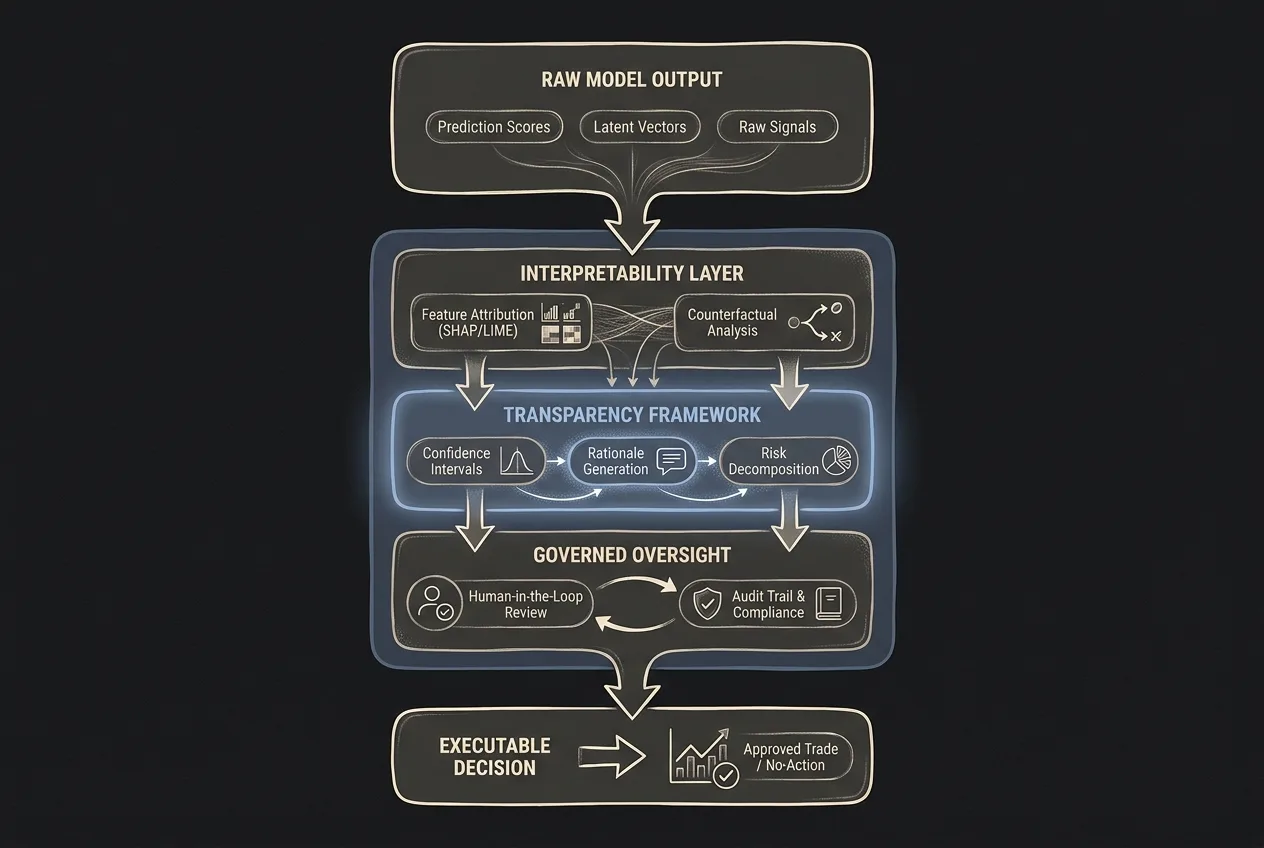
The goal of explainable AI in institutional trading is not to replace human judgment with algorithmic transparency. It is to establish a third operating model — neither the black box that decides and executes without recourse, nor the manual desk where every decision waits on a human keystroke. In that third model, humans govern and machines operate. Humans set the policy, the constraints, and the thresholds; machines execute within them at speed and scale, surfacing the decisions that exceed their remit.
Human oversight is essential for several reasons that extend beyond regulatory compliance:
Regime detection. AI models trained on historical data may fail to recognise unprecedented market conditions. Human portfolio managers bring contextual awareness, intuition developed through experience, and the ability to reason about scenarios that fall outside the model's training distribution.
Ethical and reputational considerations. Investment decisions have consequences beyond financial returns. A model might identify a profitable opportunity in a sector or company that raises ethical concerns for the fund's stakeholders. Human oversight ensures that these considerations, which are difficult to encode algorithmically, are incorporated into the decision process.
Model failure detection. Even well-designed AI systems can fail in subtle ways. Data pipeline disruptions, distribution shifts, and adversarial inputs can cause model behaviour to deviate from expectations. Human overseers who understand the model's normal behaviour patterns are often the first line of defence against these failures.
The challenge is designing oversight that captures these benefits without creating bottlenecks that negate the speed and scale advantages of AI-driven strategies. The error most implementations make is treating oversight as a single switch — on or off, automated or manual. Effective oversight is finer-grained than that. It classifies every action the system can take by its reversibility and consequence, and binds each class to an explicit act-type:
- Auto — the action executes without human involvement. Reserved for decisions that fall within well-defined parameters, are readily reversible, and have modest portfolio impact.
- Notify — the action executes, and a named human is informed after the fact. Used where speed matters and the action is bounded, but a human should remain aware of what the system did.
- Approval-gated — the action is prepared and held until a human approves it. Used for decisions that exceed risk thresholds, involve unusual positions, or occur during periods of elevated market stress.
- Propose-then-approve — the system constructs a full recommendation, complete with its attribution and rationale, and presents it for human review; nothing executes until a human accepts it. Used for decisions that materially alter the portfolio's risk profile or concentrate exposure in individual positions.
- Human-gated — the irreversible category. Any action that cannot be unwound stays a draft until a named human releases it. The system can do everything up to the point of no return; it cannot cross that line alone.
The governing principle is that irreversibility raises the bar. Routine, reversible decisions run at machine speed; consequential and irreversible ones acquire a named human owner before they bind the fund. This is not a workflow imposed on top of the model — it is the boundary that makes machine speed safe to use.

Audit Trails and Model Governance
Institutional investors and their regulators require comprehensive audit trails that document not only what decisions were made but how and why. For AI-driven strategies, this requirement extends to the model development lifecycle, including data provenance, feature engineering decisions, model selection and training procedures, validation results, and deployment protocols.
The deeper point is that the audit trail cannot be a reporting layer assembled after the fact. Accountability is a property of the architecture, not a department that reconstructs it on request. The audit trail should be a spine that runs the length of the system: every signal is logged with the inputs and attribution that produced it, every decision is explained at the moment it is made, and the act-type that governed it — auto, notify, approval-gated, propose-then-approve, or human-gated — is recorded alongside the named human who released it where one was required. The path from signal to settlement should be replayable, and each consequential action linked back to the policy clause that authorised it. Reversibility is established by construction rather than promised in prose. When the audit trail is the spine rather than the afterthought, "why did the system do this" has a precise, retrievable answer instead of a reconstruction.
The Model Governance Framework
A robust model governance framework for AI-driven investment strategies encompasses several dimensions:
Development governance establishes standards for model development, including requirements for data quality, out-of-sample testing, sensitivity analysis, and documentation. Every model deployed in production should have a model card that documents its architecture, training data, known limitations, and expected performance characteristics.
Deployment governance defines the processes for moving models from development into production, including sign-off requirements, shadow-running periods, and rollback procedures. The goal is to ensure that no model enters production without adequate testing and review.
Monitoring governance specifies how model performance is tracked in production, including performance metrics, drift detection thresholds, and escalation procedures. When a model's behaviour deviates from expectations, the governance framework should define clear response protocols.
Retirement governance establishes criteria for when models should be retrained, replaced, or retired. Models that no longer perform within acceptable parameters should be systematically decommissioned, with the reasoning documented for regulatory and audit purposes.

Building Trust with Allocators
For fund managers seeking institutional allocations, explainability is a competitive differentiator. The due diligence process for institutional allocators increasingly includes detailed questions about model interpretability, governance frameworks, and oversight procedures. Managers who can provide clear, comprehensive answers to these questions have a material advantage in capital raising.
The trust-building process operates at multiple levels. At the technical level, allocators want to see that the manager has invested in explainability infrastructure and can decompose model decisions into interpretable components. At the governance level, they want evidence that constraints are expressed as policy-as-code — encoded thresholds and act-types the system enforces at runtime, not guidelines that live in a procedures document and depend on someone remembering to apply them. At the cultural level, they want confidence that the organisation treats explainability as a property it builds rather than a compliance checkbox it ticks.
The most credible evidence is proof rather than promotion. A manager that puts every decision through the same glass-box pipeline before inviting external allocation — accepting the same constraints, the same audit spine, the same human-gated releases on irreversible acts — demonstrates conviction in a way no pitch deck can. Holding the firm to the discipline it asks allocators to trust is the strongest signal that the transparency is real.
The managers who will dominate institutional AI-driven investing are not those with the most powerful models. They are those who combine powerful models with the most compelling transparency frameworks.
This observation reflects a broader truth about institutional finance: performance alone does not win mandates. Performance combined with the ability to explain, govern, and audit that performance is what builds the enduring relationships that institutional capital allocation requires.
The Competitive Advantage of Explainable AI
There is a persistent misconception that explainability comes at the cost of performance, that the most accurate models are inherently the least interpretable, and that transparency requires sacrificing returns. This framing is misleading.
First, the explainability-performance tradeoff is less severe than commonly assumed. Modern interpretability techniques can be applied to complex models without constraining their architecture or training process. SHAP values, attention analysis, and factor decomposition operate post-hoc, explaining the model's decisions after the fact without limiting its ability to learn complex patterns during training.
Second, explainability often improves model quality. The process of decomposing and interpreting model decisions frequently reveals data quality issues, overfitting patterns, and spurious correlations that would otherwise go undetected. Models that are regularly subjected to interpretability analysis tend to be more robust and reliable than those that operate as unexamined black boxes.
Third, explainability enables faster iteration. When model developers can understand why a model is making particular decisions, they can diagnose problems more quickly, develop targeted improvements, and validate that changes have the intended effect. This feedback loop accelerates the pace of model improvement and reduces the risk of unintended consequences from model updates.
The competitive advantage, then, is not merely about satisfying regulators and allocators. It is about building better models, managing risk more effectively, and iterating faster than competitors who treat their models as inscrutable oracles.
At Adaptic, the glass box is not a feature we added to the system; it is the way the system is built. Signal attribution, factor decomposition, the act-type ladder from auto to human-gated, and an append-only record that traces each decision from signal to fill are load-bearing parts of the architecture, not a reporting layer wrapped around an opaque core. Humans govern, machines operate, and every consequential action carries a name and a reason. We hold the view that the future of institutional AI belongs to strategies that are powerful and accountable at once — and that accountability, to mean anything, has to be engineered in from the first line.