The Future of Institutional Alpha: AI-Driven Investment Strategies
The durable edge in institutional investing is shifting from the model to the system around it. A founder's view on why governance, not raw prediction, will decide who captures the next generation of alpha.


For the past decade, the contest in quantitative investing has been a contest of models. Whoever held the better predictor, trained on the better data, captured the edge. I think that era is ending. As capable models become commodities — pre-trained, fine-tunable, available to any desk with a budget — the durable advantage shifts from the model to the system built around it: the governance, the controls, and the accountability that decide whether an institution can actually deploy machine intelligence at size and stand behind the result.
This is the premise Adaptic is built on. The hard problem in institutional AI was never prediction. It is operating a system that learns, acts, and remains explainable to the people who carry fiduciary and regulatory liability for what it does. The firms that solve that operating problem will define the next generation of institutional alpha. The firms chasing a marginally better model in isolation will watch the edge arbitrage away while the governance gap keeps their capital on the sidelines.
The Edge Has Moved
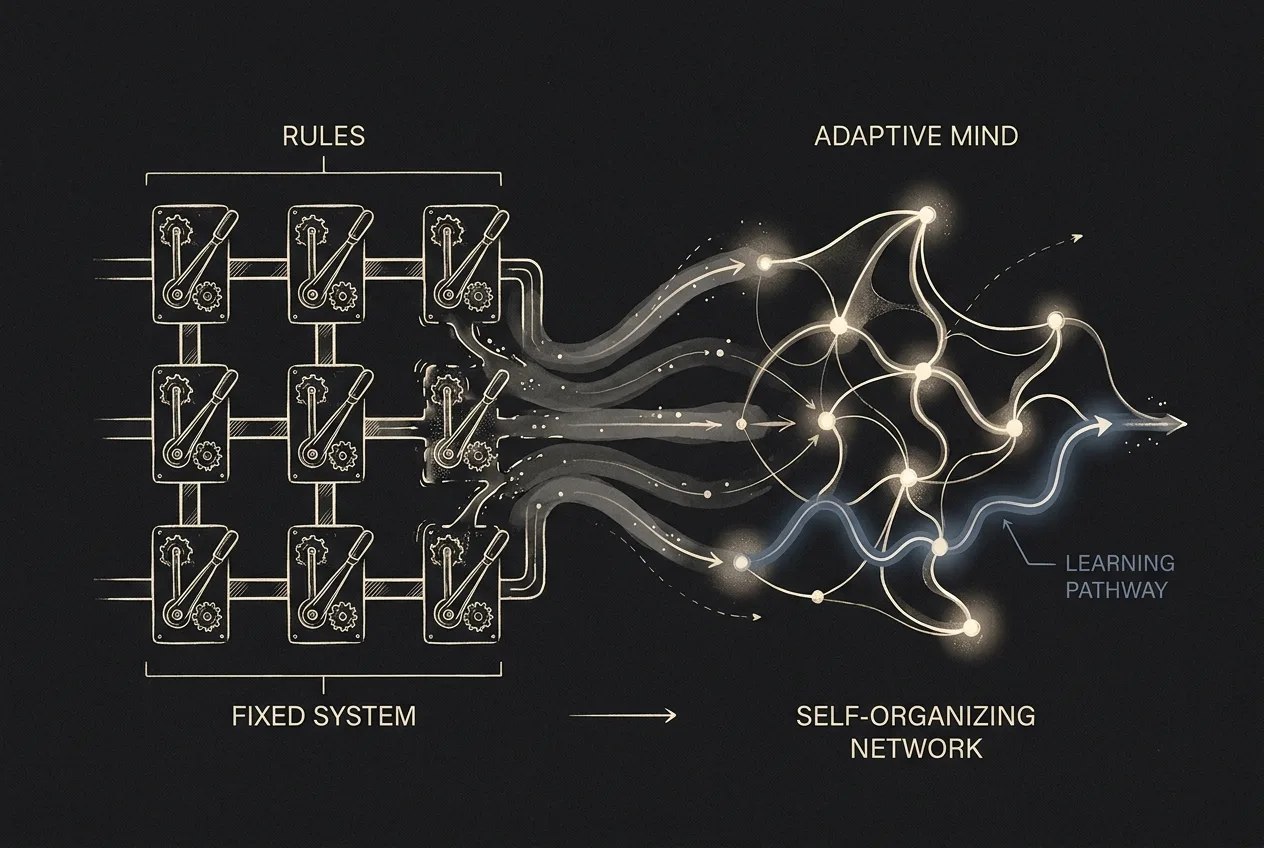
Traditional quantitative strategies relied on a small set of factors and explicit rules. They were transparent and defensible, but brittle: when correlations broke down and historical patterns stopped predicting, the models broke with them. Machine learning loosened that constraint. Modern systems can find structure across thousands of variables, ingest alternative data and unstructured text, and adapt as conditions change.
But raw capability is no longer where firms separate. The frontier models are widely accessible, and predictive performance converges quickly once everyone fishes in the same data with similar architectures. What does not converge is the institutional machinery required to put a learning system into production — to size its positions, bound its risk, explain its decisions, and assign responsibility when it is wrong. That machinery is hard to build, hard to copy, and compounds over time. It is where the next decade of alpha will be won.
A Third Operating Model
Institutions today choose between two unsatisfying options. The first is manual control: humans make every consequential decision, which keeps the firm accountable but caps it at the speed and breadth of human attention. The second is the black box: a model runs the book, which scales beautifully until a regulator, an allocator, or a beneficiary asks why a position was taken and no one can answer. Neither is acceptable for capital held in trust.
The model worth building is a third one — machines operate, humans govern. The system generates signals, sizes positions, and manages risk continuously, across more instruments and at finer resolution than a human team could supervise directly. But it does so inside a policy the firm sets and can change: mandate constraints, risk limits, exclusions, escalation thresholds. People are not in the loop on every trade; they are in command of the rules the loop obeys. The work shifts from making each decision to authoring and auditing the policy that produces them — which is precisely the work that scales. Better returns come from better policy, not from more headcount on the desk.
This reframes what the celebrated AI capabilities are actually for. Non-linear signal generation, machine-learned tail-risk modelling, reinforcement-learned rebalancing — each is real, and each is covered in depth elsewhere in this series. The point at the firm level is that none of them is deployable in size until it sits inside a governing system that can constrain it, explain it, and be held responsible for it. Capability is the input. Governed capability is the product.
Accountability as Architecture
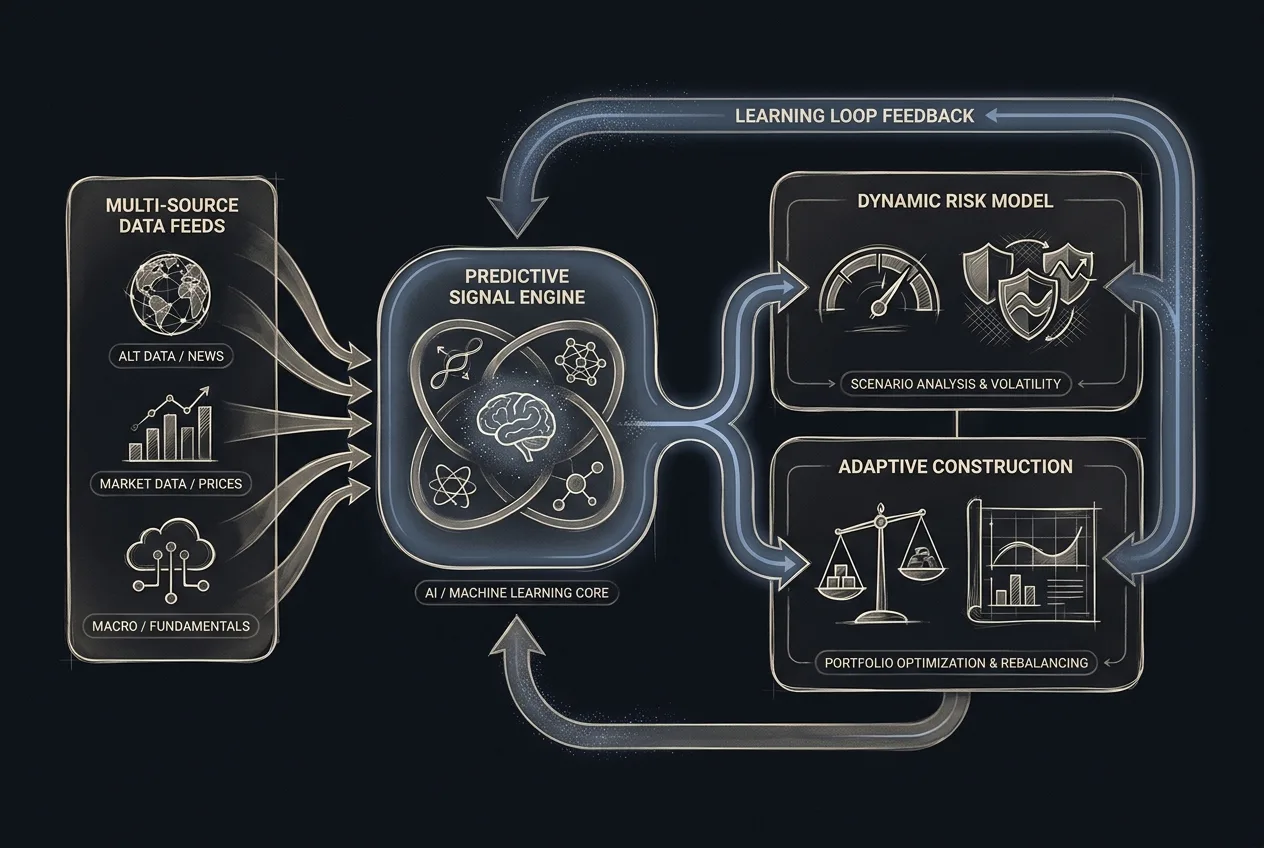
If governance is the edge, then accountability cannot be a policy document bolted on after the fact. It has to be built into the system — a property of the architecture, not a promise in a compliance manual. In practice that means a single mechanism running underneath everything: an audit spine that records, for every decision, what the system saw, which policy applied, what action it took, and who or what released it. The same record that satisfies a regulator's inquiry is the record that lets the firm debug its own behaviour. Explainability stops being a feature request and becomes the byproduct of how the system is wired.
That spine is what makes the genuinely hard problems tractable rather than merely acknowledged. Data quality and provenance — especially for the alternative datasets that lack the oversight of traditional financial data — become traceable from input to position, so a bad signal can be sourced rather than guessed at. Model behaviour becomes reconstructable after the fact, which deep networks resist by default; the answer is not to abandon them but to instrument the decisions they drive. And regulatory expectations around algorithmic accountability are tightening, which favours firms that can already produce the record on demand over those scrambling to assemble one.
I want to be precise about what is and is not solved here. Recording a decision is not the same as explaining the internal reasoning of a large model, and the research frontier on interpretability remains genuinely open. The honest claim is narrower and more useful: a system that captures the full context and lineage of every action can be held accountable for its outcomes even where the model's internals stay partly opaque. That is the standard institutional capital should demand, and it is achievable today.
Where This Goes
If the edge is moving from the model to the system, the competitive question facing every institutional manager changes shape. It is no longer "do we have the best signal," because signals are converging toward a shared frontier. It is "can we operate machine intelligence at the scale of our mandate while remaining answerable for every decision it makes." That is an operating-model question, and operating models are slow to copy. The advantage they confer is therefore more durable than any individual model's edge — which is exactly why I expect this to be where institutional capital concentrates.
I hold this as a conviction, not a settled fact. The third operating model is early, the interpretability research it leans on is unfinished, and claims in this space should be met with skepticism — including ours. Which is why the only honest way to advance the argument is to put the system to work. We claim no external track record, and no performance we cannot put a governed audit trail behind. The proof has to come from the system doing the work, observed and recorded, not from the strength of the thesis.
That is the standard I want this firm judged against, and the standard I believe the next generation of institutional alpha will be built on. The winners will not be whoever owns the cleverest model. They will be whoever builds the system disciplined enough to deploy it — and accountable enough to be trusted with capital that is not their own.