Institutional Governance for AI-Managed Funds: Building Trust at Scale
The governance of AI-managed capital requires a third operating model between manual control and the black box: humans author intent as policy, machines execute within it, and accountability becomes a property of the architecture rather than a department.


In August 2012, a software deployment error at Knight Capital generated $440 million in losses in 45 minutes and pushed a 17-year-old market maker into insolvency by the end of the week. No model was wrong. No strategy failed. The system did exactly what its code instructed, faster than any human could intervene. What was missing was not intelligence but governance: a deployment process that could not have shipped the defective code, a control surface that could have halted the runaway orders, and a chain of accountability that made the failure containable. The lesson generalizes well beyond that single morning. When capital is deployed through automated systems, the binding constraint on safety is rarely the sophistication of the model. It is the sophistication of the governance around it.
AI-managed strategies make this lesson urgent rather than historical. The industry has rushed to deploy systems that synthesize more data, react faster, and act more autonomously than any human desk, while leaving in place governance frameworks adapted from a world of human discretion: quarterly committees, trading-authority matrices, and the assumption that a named individual can always explain a decision after the fact. That mismatch between machine capability and human-era oversight is, in my view, the most consequential unmanaged risk in institutional finance today. It is also entirely solvable.
My thesis is that the governance of AI-managed capital requires a third operating model, distinct from the two that dominate practice. The first is manual control, where humans make each decision and automation is merely an accelerant; it does not scale to the speed or breadth that makes AI valuable. The second is the black box, where capital is handed to an opaque system and the institution hopes for the best; it does not survive contact with a fiduciary duty or a regulator. The third model is the one institutions actually need: humans author intent as policy, machines execute within that policy, and accountability is engineered into the architecture rather than delegated to a department. The investor authors the mandate, watches it run against a complete and replayable record, and intervenes with judgment when the situation warrants. The discipline of this article is to describe what that model demands, concretely, of a fund that intends to manage institutional capital at scale.
Humans Govern, Machines Operate
The third operating model rests on a single division of labor: humans govern, machines operate. Humans hold the responsibilities that cannot be delegated to a machine without abandoning the fiduciary relationship itself, the authorship of intent, the setting of limits, and the judgment to intervene. Machines hold the responsibilities at which they are categorically better than humans, the disciplined, tireless, sub-second execution of that intent across thousands of instruments. The error of the manual-control model is to deny machines the operating role they are suited for. The error of the black-box model is to surrender the governing role that must remain human. The third model refuses both errors.
This matters because traditional fund governance rests on assumptions that automated strategies break. The conventional model assumes that investment decisions are made by identifiable individuals who can reconstruct their reasoning, that decisions arrive at a pace permitting real-time human review, and that the primary control is the professional judgment of the portfolio manager. None of these hold for a system that makes thousands of decisions a day, synthesizes inputs no human could process in real time, and executes in milliseconds. A quarterly investment committee cannot meaningfully review a system that has traded tens of thousands of times since it last met.
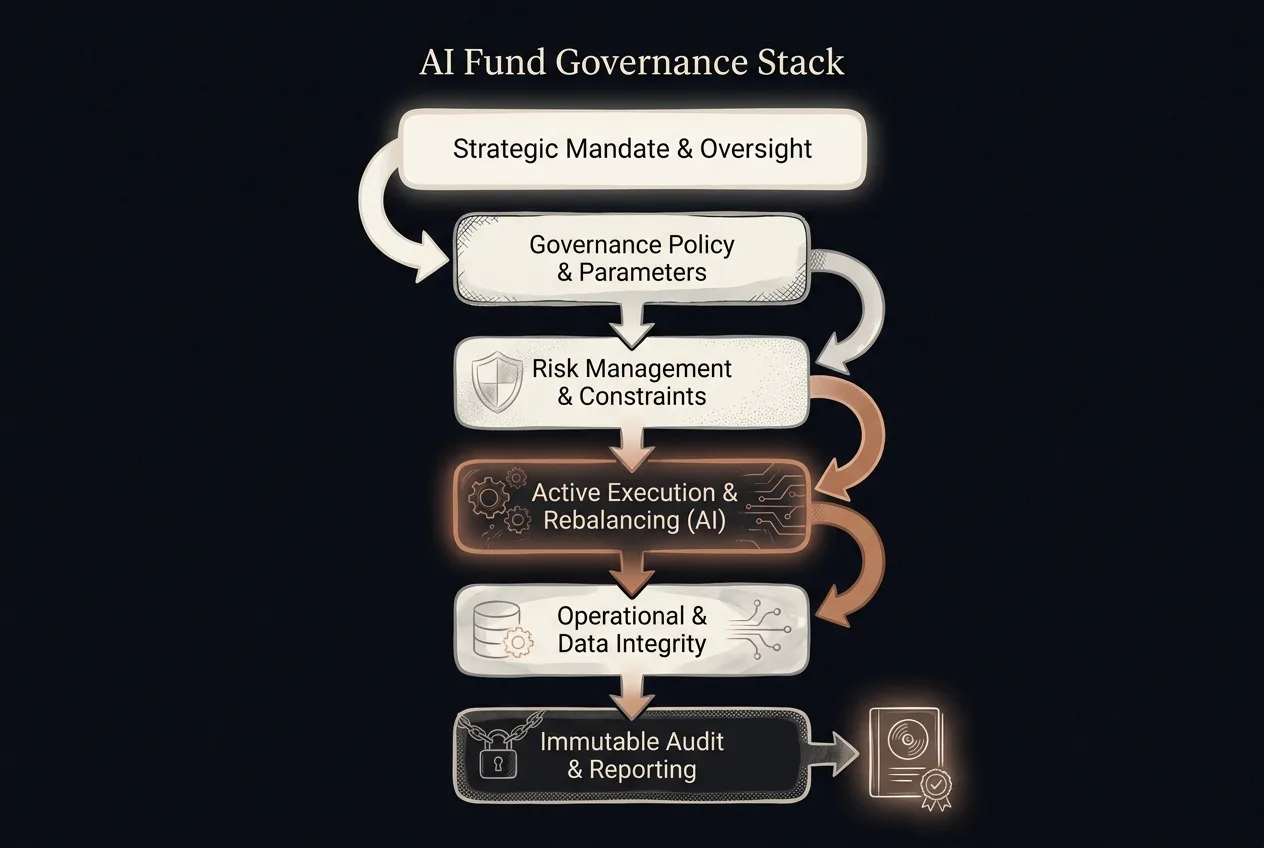
The instinctive response is to slow the machine down until a human can keep pace, but that response misunderstands where the human belongs. Governance that depends on a human approving each action does not scale and discards the speed that makes automation worth having. Governance that asks a human to explain each action after the fact is theater, because the explanation is reconstructed rather than authored. The resolution is to move the human decision earlier and higher: the human governs by authoring the policy that the machine will execute, not by approving the individual actions the policy produces. Intent, expressed once as enforceable policy, governs every action the machine takes thereafter. The sections that follow trace what this requires, from the board that authors and oversees the mandate, through the models that operate within it, to the audit architecture that makes the whole arrangement verifiable.
Why Existing Frameworks Fall Short
Most fund governance frameworks were codified when the primary risks were conflicts of interest, style drift, and unauthorized trading by human managers. The controls built to address those risks, investment committee approvals, trading-authority matrices, and periodic portfolio reviews, fail against automated strategies in three specific ways, each of which the policy-authoring model is designed to answer.
First, the pace of machine decision-making renders periodic review inadequate. A control that fires once a quarter cannot govern a system that acts every second. Governance must be continuous, which means it must be encoded in advance rather than convened on a schedule. A policy that the machine enforces on every action is, by construction, always in session.
Second, the opacity of complex models defeats oversight mechanisms that rely on professionals evaluating a stated rationale. A committee can judge whether a human's thesis for a trade is sound; it cannot judge whether a weight matrix is. The answer is not to demand that the model narrate itself, which produces post-hoc rationalization, but to constrain what the model is permitted to do and to record what it did, so that judgment is exercised over the policy and the evidence rather than over an unauditable internal state.
Third, the failure surface is the entire stack, not the final trade. Data pipelines, feature engineering, model training, and execution logic form one tightly coupled system, and a fault anywhere in it becomes a position in the market. Governance must therefore reach every layer that can move capital, which is precisely why it cannot live in a committee room and must instead be built into the architecture through which capital moves.

The Board as Author of the Mandate
In the policy-authoring model, the board is not a periodic reviewer of decisions the machine has already made. It is the body that authors the mandate the machine operates within and holds the authority to revise or revoke it. This reframes the board's competencies and information needs. Its work product is the policy envelope, the limits, the permitted instruments, the risk budget, the conditions under which the strategy must stand down, and its standing obligation is to verify that the machine has operated inside that envelope and to exercise judgment at the edges where policy meets a situation its authors did not foresee.
Board Composition and Competency Requirements
Effective governance of AI-managed funds requires board members who collectively possess expertise in three domains: investment management, technology and data science, and regulatory compliance. The technology dimension is critical and often underrepresented. Board members need not be machine learning engineers, but they must possess sufficient technical literacy to ask informed questions about model architecture, training methodology, data quality, and system reliability.
Leading institutional fund boards are addressing this competency gap through several mechanisms. Some have appointed dedicated technology committee chairs with deep expertise in AI and quantitative methods. Others have established advisory panels of independent technologists who provide the board with technical assessments of the fund's AI systems. A growing number of fund governance codes now explicitly recommend that boards of AI-managed funds include at least one member with relevant quantitative or technology expertise.
Board Information and Reporting
The information flows that enable effective board oversight must be redesigned for AI-managed strategies. Traditional board packs, consisting of static performance reports and portfolio snapshots, are insufficient. Boards overseeing AI strategies require regular reporting on model performance metrics, including alpha decay analysis and signal efficacy trends; risk limit utilization, including instances where automated circuit breakers were triggered; operational incidents, including system outages, data quality issues, and execution anomalies; model changes, including any modifications to the strategy's algorithms, features, or parameters; and compliance status, including any regulatory inquiries or examination findings.
This reporting must be presented in a format that enables non-technical board members to understand the key messages and identify areas requiring their attention. Effective AI governance reporting translates complex technical metrics into business language, using visualizations, trend analysis, and exception-based highlighting to direct attention to matters that require board action.
Escalation and Intervention Protocols
Authoring a mandate is only half of governing; the other half is the authority to intervene once the mandate is running. Boards must define, in advance, the circumstances requiring immediate notification, significant drawdowns, model failures, regulatory action, and the board's power to suspend or modify operation, including quorum requirements and delegated authority for decisions that cannot wait for a meeting. Crucially, the intervention must be exercisable through the system itself: a board whose only lever is a phone call to an engineer does not, in any operational sense, control the strategy. The control surface that lets a human pause, throttle, or unwind the machine is part of the governance architecture, not an afterthought to it.
The harder problem is calibration. Intervention protocols must be responsive enough to address fast-moving situations without inviting counterproductive interference. A board that overrides the strategy on insufficient grounds reintroduces, through the back door, the discretionary errors that systematic management was meant to remove; a board too hesitant to act fails the investors it serves. The discipline that resolves this tension is the same one that governs the machine: intervention should itself follow a pre-authored policy, with defined triggers and named authorities, so that the decision to override is principled rather than improvised under pressure.
Model Governance: How Machines Operate Within the Mandate
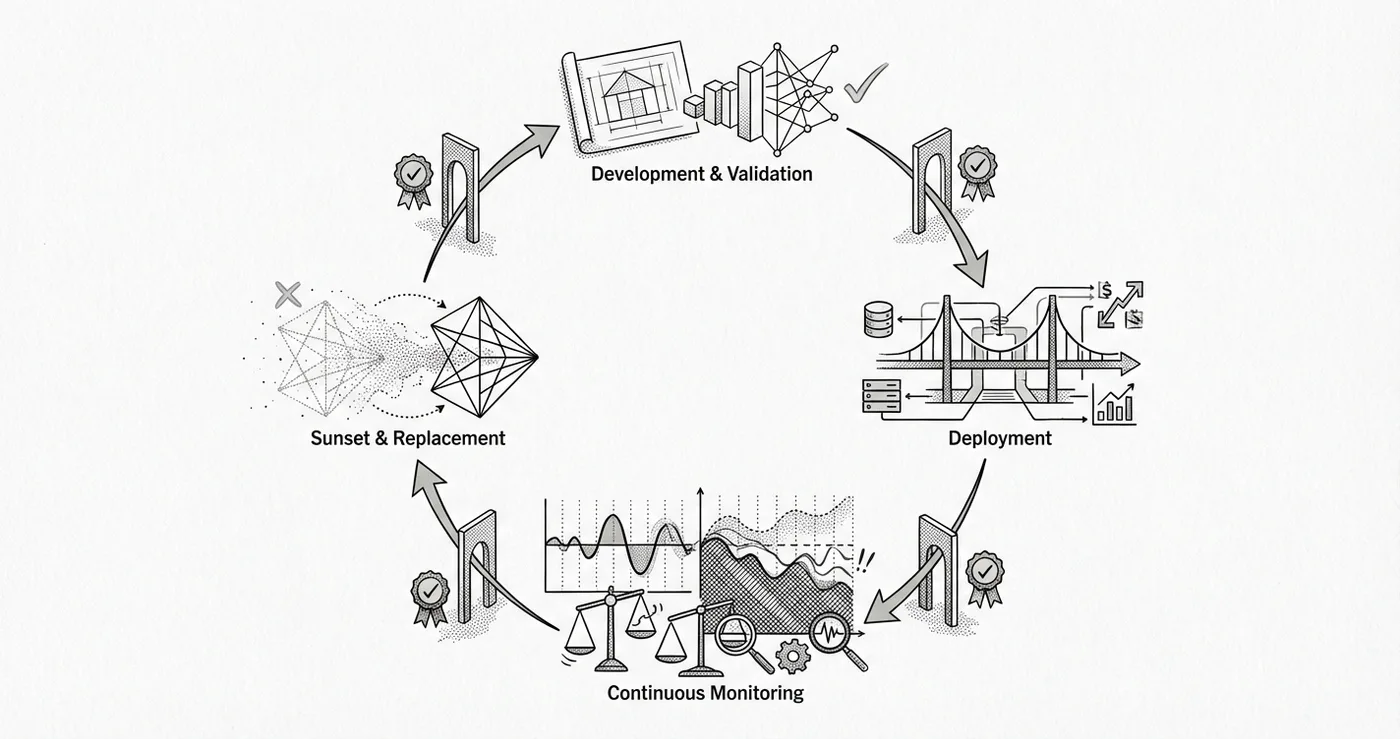
If the board authors the mandate, the model is the machine that operates within it, and model governance is the set of controls that keep operation faithful to intent. It ensures the fund's models are fit for purpose before they touch capital, remain fit for purpose as markets move beneath them, and are retired when they no longer earn their place. Before turning to the lifecycle of a model, it is worth naming the mechanism that keeps a model's actions inside the policy envelope at the moment of action, because it is where the govern-operate division becomes concrete.
Act-Types: Gating by Reversibility and Consequence
Not every action a model proposes carries the same weight, and a governance architecture that treats them identically is either too slow to be useful or too permissive to be safe. The resolution is to classify every action the system can take by its reversibility and its consequence, and to route each class through a different gate. A rebalancing trade well inside risk limits is an automatic act: the policy has already authorized it, and the machine executes without pause. An action that approaches a limit is a notify act: it proceeds, but a human is told. An action that crosses a materiality threshold is approval-gated: the machine prepares it and a named human releases it. The most consequential class is the model that proposes and a human approves, where the system does the analytical work and a person makes the call. Irreversible acts, those that cannot be unwound once executed, remain human-gated by construction: the machine may draft them, but they stay a draft until a named human releases them.
This is the operational form of "humans govern, machines operate." Speed is preserved exactly where it is safe, because the overwhelming majority of actions are reversible and well within policy, and human judgment is concentrated exactly where it is irreplaceable, at the threshold of consequence and irreversibility. The act-type of every action is itself a matter of policy, authored in advance and enforced by the system, not negotiated in the moment.
Model Development and Validation
Before an AI model is deployed for live trading, it must undergo rigorous validation by a team that is independent of the model development team. This independent validation process should assess the soundness of the model's theoretical foundation, the quality and representativeness of the training data, the robustness of the model's performance across different market regimes, the model's sensitivity to key parameters and assumptions, and the adequacy of the model's risk controls and failsafe mechanisms.
The validation process should produce a formal model approval document that records the validation methodology, findings, and any conditions or limitations on the model's deployment. This document becomes part of the fund's permanent governance record and provides the foundation for subsequent model reviews.
Continuous Model Monitoring
Once deployed, AI models must be subject to continuous monitoring that tracks their behavior against expected parameters. Monitoring systems should detect model drift, where the model's predictions gradually diverge from observed outcomes; data quality degradation, where changes in input data characteristics affect model performance; regime sensitivity, where the model performs well in some market environments but poorly in others; and interaction effects, where the model's behavior changes in response to the deployment of other models or strategies within the same portfolio.
Monitoring systems should generate automated alerts when model performance metrics breach predefined thresholds, triggering review processes that may result in parameter adjustments, position reductions, or model suspension. The thresholds themselves should be subject to periodic review to ensure they remain appropriate as market conditions and strategy characteristics evolve.
Model Sunset and Replacement
Every model has a finite useful life. Markets evolve, competitive dynamics shift, and the signals that generated alpha in one period may become commoditized or obsolete in the next. A mature model governance framework includes explicit criteria for model retirement, defined in terms of performance metrics, risk-adjusted returns, and signal decay indicators.
The sunset process should be orderly and documented. It should include a wind-down period during which the model's positions are gradually reduced, a post-mortem analysis that extracts lessons for future model development, and an archival process that preserves the model's code, data, and performance history for audit and regulatory purposes.
The Audit Spine: Accountability as Architecture
Everything to this point, the authored mandate, the act-types that gate actions, the protocols for intervention, rests on a single assumption: that the institution can know, with certainty, what the machine actually did and why. Without that, governance is aspiration. The audit spine is the mechanism that makes it fact. It is the part of the architecture that converts "we trust the system" into "we can prove what the system did," and it is the reason accountability can be a property of the architecture rather than the responsibility of a department.
Every Action Logged, Explained, and Reversible by Construction
The standard is exacting and non-negotiable: every action the system takes is logged, explained, and reversible by construction. Logged means a complete record of every order generated, modified, or cancelled; the market data and model outputs that informed it; every model change, parameter update, feature addition, and code modification; every risk-limit breach, circuit-breaker activation, and manual intervention; and every data-quality exception and the correction applied. Explained means each action is linked to the policy clause that authorized it, so the question "why did the system do this" resolves to "because this clause, authored by these humans, permitted it under these conditions," rather than to an unrecoverable internal state. Reversible by construction means the path to unwind an action is designed before the action is permitted, not improvised after it goes wrong, which is the architectural precondition for the human-gated treatment of irreversible acts described earlier.
The decisive property is replayability. A mature audit spine can reconstruct the complete causal chain from signal to settlement: this datum arrived, this model produced this output, this policy clause classified the resulting action as this act-type, this gate released it, and this fill returned from the market. An institution that can replay that chain for any action, on demand, can answer any question an investor, a board, or a regulator can pose, not with assurances but with evidence. The records must be append-only, timestamped, and stored so that retrospective modification is detectable, because an audit trail that can be quietly edited is no audit trail at all. Cryptographic techniques that make tampering evident serve this end; the requirement is detectable modification and clause-linked replayability, not any particular ledger technology.
Independent Review and Attestation
External independent reviews provide an additional layer of assurance that cannot be achieved through internal processes alone. These reviews may take several forms: annual technology audits conducted by specialized firms with expertise in AI and quantitative systems; periodic model validation reviews by independent quantitative analysts; operational due diligence assessments focused on the fund's technology infrastructure and controls; and regulatory examinations, which provide an external perspective on the fund's compliance with applicable requirements.
The findings of independent reviews should be reported to the board and made available to investors, with appropriate protections for proprietary information. Transparency about the scope and findings of independent reviews builds investor confidence and demonstrates the fund's commitment to accountability.
Investor Transparency and Reporting Obligations
Institutional investors in AI-managed funds have legitimate expectations for transparency that go beyond traditional fund reporting. The opacity of AI decision-making creates a heightened need for reporting that enables investors to understand and evaluate the fund's activities.
Enhanced Reporting Standards
Best-practice reporting for AI-managed funds includes regular strategy performance reports with attribution analysis that identifies the sources of returns; risk reports that describe the fund's current exposures, risk limit utilization, and stress test results; model governance reports that summarize model performance, any changes made to models, and the results of validation activities; operational reports that describe any significant technology incidents, their impact, and the corrective actions taken; and compliance reports that confirm adherence to regulatory requirements and the fund's own governance policies.
The frequency of reporting should reflect the pace of the fund's activities. For high-frequency AI strategies, monthly reporting may be the minimum acceptable frequency, with more frequent updates available on request. For lower-frequency strategies, quarterly reporting supplemented by event-driven updates may be sufficient.
Investor Access and Engagement
Beyond formal reports, institutional investors increasingly expect direct access to the fund's risk and technology teams for questions and due diligence. Governance frameworks should accommodate investor inquiries through defined channels and response timelines, periodic investor calls or webinars that provide deeper insight into the fund's AI systems and governance processes, and on-site or virtual due diligence visits that allow investors to observe the fund's operations firsthand.
This engagement builds the relationship of trust that is essential for long-term institutional partnerships. Investors who understand and have confidence in a fund's governance framework are more likely to maintain their allocations through periods of underperformance and to increase their commitments as the fund grows.
Policy-as-Code and the Segregation of Duties
The audit spine records what happened; segregation of duties governs who is permitted to make it happen. In traditional governance this principle, that no single individual holds unchecked control over a process, is enforced by organizational design and human sign-offs. In automated systems it must be enforced the same way the rest of the mandate is: as code. When the rules that separate development from deployment from operation are written as policy the system mechanically enforces, segregation stops being a control a person can forget, fudge, or be pressured to bypass, and becomes a property of the architecture. This is what it means for accountability to live in the architecture rather than in a department: the constraint is enforced at the point of action, not asserted in a manual.
Development, Deployment, and Operations Separation
The teams responsible for developing AI models, deploying them to production, and monitoring their operation should be organizationally distinct, with separate reporting lines and access controls. A model developer should not have the ability to deploy code directly to the production trading environment. A deployment engineer should not have the ability to modify model parameters without going through the formal change management process. And the operations team responsible for monitoring live trading should have the authority to suspend strategy operation without requiring approval from the development team.
This separation is enforced through technical access controls, code review requirements, and automated deployment pipelines that ensure every change passes through defined approval gates before reaching production. The audit trail captures every action taken by every participant in the process, enabling reconstruction of the complete chain of events for any model change or operational decision.
Conflict of Interest Management
AI-managed funds must address potential conflicts of interest that are unique to automated systems. These include the risk that model developers may optimize for metrics that benefit their compensation rather than investor returns; the risk that the fund's trading activity may interact with other activities of the fund manager or its affiliates; and the risk that the fund's AI systems may be influenced by data or signals that create conflicts with the fund's fiduciary obligations.
Governance frameworks should include policies that explicitly address these conflicts, with monitoring mechanisms that detect potential violations and reporting channels that enable whistleblowing without fear of retaliation.

Smart Contract Governance and Upgrade Mechanisms
For AI-managed funds that operate on blockchain infrastructure, smart contract governance represents an additional governance dimension with its own unique challenges and requirements.
Smart Contract Lifecycle Management
Smart contracts that govern fund operations, including investment logic, fee calculations, and investor rights, must be subject to governance processes that mirror those applied to the fund's AI models. This includes formal review and audit of smart contract code before deployment, testing in simulation environments that replicate production conditions, staged deployment with monitoring and rollback capabilities, and ongoing monitoring for vulnerabilities and performance issues.
The permanence of deployed smart-contract code, while a feature from a transparency perspective, creates governance challenges when updates are needed. Upgrade mechanisms, such as proxy patterns that allow contract logic to be updated while preserving state data, must themselves be subject to governance controls that prevent unauthorized modifications while enabling legitimate upgrades.
Multi-Signature and Timelock Controls
On-chain, the act-type discipline takes a concrete and familiar form. Critical operations, upgrades, parameter changes, emergency shutdowns, should require multi-signature authorization from independent parties, which is simply the human-gated treatment of irreversible acts expressed in cryptography: the change stays a draft until multiple named humans release it, and no single individual or system can move unilaterally. Timelock mechanisms, which impose a mandatory delay between the initiation and execution of a change, give the propose-then-approve pattern a built-in window for review and, where warranted, veto. A 24-hour timelock may suffice for a routine parameter update; changes to fund logic or investor rights warrant longer delays and explicit governance approval. The principle is constant across substrates: the more consequential and less reversible the act, the more human authority its release demands.
Regulatory Expectations Across Jurisdictions
AI-managed funds operating across multiple jurisdictions must navigate a patchwork of regulatory expectations that are evolving rapidly as regulators develop frameworks for AI in financial services.
European Union: AIFMD and the AI Act
The EU's regulatory framework for AI-managed funds is shaped by the Alternative Investment Fund Managers Directive and the emerging AI Act. AIFMD establishes requirements for risk management, transparency, and governance that apply to all alternative investment funds, including those managed by AI systems. The AI Act, which classifies AI systems by risk level, may classify certain financial AI applications as high-risk, subjecting them to additional requirements for transparency, human oversight, and technical documentation.
Fund managers operating in the EU must demonstrate that their AI governance frameworks satisfy both sets of requirements, which may include maintaining detailed technical documentation of AI systems, implementing human oversight mechanisms appropriate to the level of risk, conducting regular conformity assessments, and establishing AI governance structures that satisfy the AI Act's organizational requirements.
United States: SEC and CFTC Expectations
US regulators have taken an enforcement-led approach to AI governance in financial services, using existing authority under the Investment Advisers Act, the Securities Exchange Act, and the Commodity Exchange Act to establish expectations for AI oversight. The SEC has signaled particular concern about conflicts of interest in AI-driven investment advice, the adequacy of disclosure about AI use in investment management, and the robustness of testing and monitoring for AI trading systems.
Fund managers registered with the SEC must ensure that their compliance programs adequately address the risks specific to AI-managed strategies, including model risk, technology risk, and the potential for AI systems to act in ways that conflict with the fund's fiduciary obligations.
Singapore and DIFC: Emerging AI Governance Frameworks
The Monetary Authority of Singapore and the Dubai International Financial Centre have both developed forward-looking frameworks for AI governance in financial services. Singapore's FEAT (Fairness, Ethics, Accountability, and Transparency) principles provide guidance on the governance of AI in financial services, with particular emphasis on explainability and accountability. The DIFC's regulatory framework incorporates AI-specific requirements into its broader financial services licensing regime, including requirements for AI risk management and governance.
These jurisdictions offer interesting models for other regulators, as they attempt to balance the promotion of financial technology innovation with the protection of investor interests and market integrity.
Scale Comes From Better Policy, Not More Headcount
The purpose of all of this is not compliance for its own sake. It is to make scale safe. And here the policy-authoring model delivers an advantage that the manual and black-box models cannot: when governance is encoded as policy and enforced by architecture, the cost of overseeing more capital does not grow with the capital. A traditional desk scales oversight by hiring, more analysts, more reviewers, more committee hours, and discovers that human attention is the bottleneck precisely as the stakes rise. A fund whose governance lives in policy scales by authoring better policy. Doubling the assets does not double the number of people who must watch the machine; it raises the standard to which the policy must be written and the rigor with which the audit spine must hold. Scale comes from better policy, not more headcount, which is the property institutional capital is actually looking for, since it is the only kind of scale a fiduciary can defend.
The Governance Maturity Model
Institutional governance for AI-managed funds can be assessed along a maturity continuum. At the foundational level, the fund has basic policies and procedures for AI oversight but may lack consistent implementation and independent verification. At the developing level, governance processes are consistently implemented and documented, with regular internal review. At the established level, governance is supported by independent verification, comprehensive audit trails, and regular reporting to investors. At the leading level, governance is deeply integrated into the fund's culture and operations, with continuous improvement driven by lessons learned and evolving best practices.
Institutional allocators are increasingly using governance maturity assessments as a key criterion in manager selection and monitoring. Funds that can demonstrate established or leading governance maturity have a significant competitive advantage in attracting and retaining institutional capital.
The Trust Dividend
Robust governance generates a measurable competitive advantage that can be described as the trust dividend. Funds with strong governance frameworks attract capital at lower marketing costs, retain investors through periods of underperformance, negotiate more favorable terms with service providers, and experience smoother regulatory interactions.
This trust dividend compounds over time. As a fund's governance track record lengthens and its independent verification history deepens, the confidence of its investor base grows, enabling the fund to raise larger amounts of capital and to access a broader universe of institutional investors.
Proof, Not Promotion
The governance of AI-managed capital is not a solved problem, and I would distrust anyone who claimed otherwise. It is an evolving discipline that must keep pace with advances in the technology, shifts in regulatory expectation, and the rising sophistication of allocator demands. Parts of the model I have described are well-proven, the segregation of duties, the append-only audit trail, the human gate on irreversible action. Other parts, the precise calibration of act-type thresholds, the right depth of replayability for a given strategy, are genuinely still being worked out, and honesty requires saying so. What I hold with conviction is the shape of the answer: humans govern, machines operate, and accountability is built into the architecture rather than bolted onto it. The particulars will be refined for years.
For an allocator, the practical implication is direct. The quality of governance matters at least as much as the quality of the models, because a capable model inside a weak governance framework is a liability wearing the costume of an asset. The harder question is how a fund proves its governance is real rather than rehearsed, and there is only one credible answer: proof, not promotion. A governance architecture is demonstrated by running it, not by describing it. The right sequence is to operate the system under independent review and let the audit spine accumulate a record that outsiders can inspect, before asking anyone else to entrust their capital to it. This is a posture of earning the right to manage outside money by submitting the machine and its controls to scrutiny first.
That is the standard we hold ourselves to at Adaptic. We are building the governance architecture described here: the authored mandate, the act-type gating, the clause-linked audit spine. We make no claim to a track record we have not earned; the point of the model is precisely that such claims should be demonstrable rather than asserted. In the era of AI-managed capital, governance is not a constraint on performance. It is the architecture within which trustworthy performance becomes possible at all.