The RegTech Revolution: How Regulatory Technology Is Reshaping Institutional Compliance
How regulatory technology lets institutions express compliance as executable, version-controlled rules enforced before trades reach the market, rather than reviewed after the fact.


The regulatory landscape facing institutional asset managers has reached a level of complexity that would have been unrecognizable a decade ago. Global compliance spending in financial services now exceeds $300 billion annually, with the average large asset manager dedicating between 6% and 10% of total operating expenses to regulatory functions. Headcount in compliance departments has grown at roughly three times the rate of front-office hiring since 2018. And the pace of regulatory change shows no sign of abating: Thomson Reuters estimates that financial institutions must track an average of 257 regulatory updates per business day, up from 10 per day in 2004.
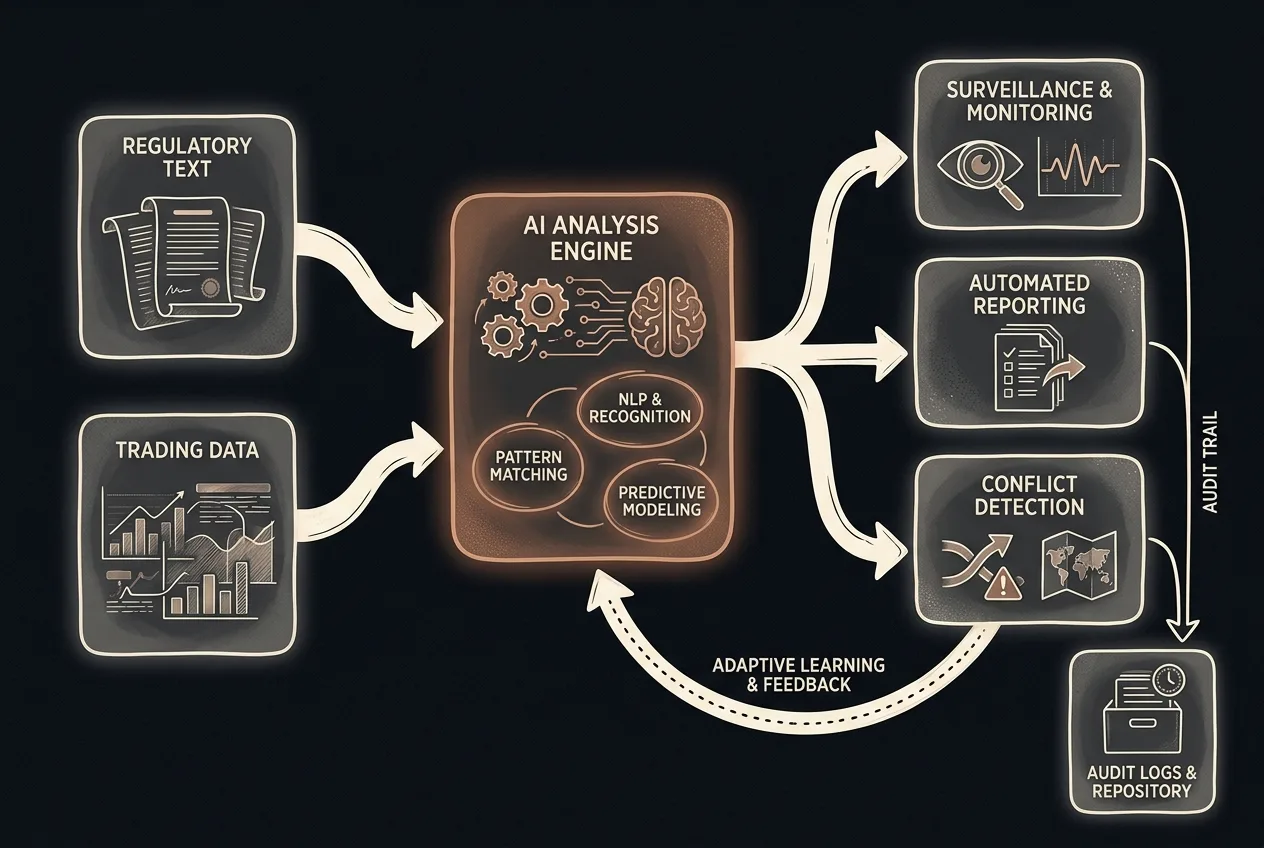
The conventional response to this load has been to add people. Headcount, however, scales linearly with obligation, and obligation is growing faster than any compliance budget can absorb. Regulatory technology, or RegTech, offers a different premise: that a growing share of compliance can be expressed as code rather than performed by analysts. The distinction matters. Earlier waves of compliance software digitized existing manual processes, leaving the underlying logic in policy memos and the judgment in the heads of senior staff. The more durable shift now underway treats a firm's obligations as machine-readable, executable rules — versioned like software, enforced before an order reaches the market, and logged in a form a regulator can replay. Where that holds, a firm scales its compliance posture by writing better policy, not by hiring more reviewers.
The Regulatory Burden on Institutional Asset Managers
The scale of the modern compliance challenge is best understood through the lens of a typical mid-to-large institutional asset manager. A firm managing $20 billion across multiple strategies, vehicle types, and jurisdictions may be subject to oversight from fifteen or more regulatory authorities simultaneously. In the United States alone, the SEC, FINRA, CFTC, and NFA each impose distinct registration, reporting, and conduct requirements depending on the strategies employed and instruments traded. European operations introduce MiFID II, AIFMD, SFDR, EMIR, and national regulator requirements. Asian operations add MAS, SFC, and JFSA obligations to the matrix.
Each of these regulatory regimes carries its own reporting cadence, data standards, calculation methodologies, and examination procedures. The data elements required for an SEC Form PF filing overlap with but do not precisely match those needed for AIFMD Annex IV reporting. Position-level disclosures required under MiFID II differ in scope and format from those mandated by the SEC's proposed Form N-PORT amendments. The result is that a single underlying portfolio generates dozens of distinct regulatory representations, each requiring its own data pipeline, validation logic, and submission workflow.
Beyond periodic reporting, real-time compliance monitoring adds continuous operational demands. Pre-trade compliance checks must verify adherence to investment guidelines, regulatory restrictions, concentration limits, and client mandates before every order reaches the market. Post-trade surveillance must detect patterns consistent with market manipulation, insider trading, and best execution failures. Client lifecycle management must satisfy evolving AML, KYC, and beneficial ownership transparency requirements that vary by jurisdiction and investor type.
For most firms, these obligations are managed through a patchwork of vendor systems, internal tools, spreadsheets, and manual processes assembled incrementally over years. The result is an operational architecture that is fragile, expensive to maintain, and poorly suited to the velocity and complexity of modern markets. More to the point, the controls live everywhere except where they can be enforced consistently: a concentration limit stated in an investment management agreement, restated in a compliance manual, and re-implemented by hand in three downstream systems is three opportunities for drift. The sections that follow trace how the more rigorous applications of RegTech close that gap by moving the rule itself into the execution path.

AI-Powered Trade Surveillance and Market Abuse Detection
Trade surveillance is the clearest place to see the limits of the older model and the shape of the newer one. Traditional rule-based surveillance systems suffer from two structural weaknesses: they generate overwhelming volumes of false positive alerts, and they cannot detect forms of market abuse that do not match a pattern someone anticipated in advance.
Industry estimates commonly place the false positive rate of conventional surveillance systems above 90% — alerts that require investigation but resolve to no actual violation. For a large manager processing thousands of alerts a month, reviewing that noise consumes dedicated teams of analysts whose time would be better spent on genuine risk. The cost is not only labor. A high false positive rate trains reviewers toward fatigue, which is precisely the condition under which a real signal gets dismissed.
Machine learning shifts the basis of detection from fixed thresholds to learned context. Rather than firing whenever a parameter is breached, these systems build behavioral baselines for each trader, desk, and strategy, then flag statistically significant deviations from them. A jump in trading velocity that is unremarkable during an index rebalance may be anomalous on a quiet Tuesday afternoon; a context-aware model distinguishes the two, cutting noise while raising sensitivity to what matters.
Unsupervised techniques extend this further by surfacing behavior no one specified as suspicious in advance. Layering, spoofing, wash trading, and front-running each leave characteristic statistical signatures in order flow, but their specific manifestations evolve as participants adapt. Models that generalize from historical enforcement actions and confirmed violations can catch variations a static rule set would miss. The tradeoff is that statistical anomaly is not proof of misconduct, and a model that flags the unfamiliar will flag legitimate novelty too. This is why surveillance belongs to the same discipline as the rest of compliance: the model proposes, a human disposes, and the basis for every disposition is recorded.
More capable platforms integrate communications monitoring alongside trading data, using natural language processing to scan emails, chat messages, and voice transcripts for language associated with collusion, the handling of material non-public information, and other conduct risks. Cross-referencing a communication anomaly against a trading anomaly produces a more complete picture than either source alone — and, kept in an append-only log, a defensible one.

Natural Language Processing for Regulatory Change Management
Keeping pace with regulatory change is one of the most labor-intensive parts of compliance. New rules, guidance documents, consultation papers, enforcement actions, and interpretive letters are published continuously across dozens of authorities. Each must be reviewed for relevance, analyzed for impact on existing policies and procedures, and translated into operational changes where necessary — work that, done by hand, is reactive by construction. A firm learns it is out of step when an analyst gets to the document.
Natural language processing moves this function ahead of that lag. NLP systems can ingest the output of global regulatory authorities, classify documents by topic and relevance, extract the operative provisions, and map them against a firm's existing controls to surface gaps and conflicts. The value is not the reading; it is the mapping. A change is only actionable once it is connected to the specific rule, system, or limit it affects.
The more capable implementations perform semantic analysis rather than keyword classification, reading not just what a regulation states but what it implies for a particular book of business. When a regulator issues a new interpretation of an existing rule, such a system can identify which current practices are affected, estimate the operational change required, and draft a preliminary remediation plan for a compliance officer to review. The output is a proposal, not a decision — the analysis is automated so that human judgment can be spent where it is scarce.
Regulatory knowledge graphs add another dimension to this capability. By representing regulatory requirements as structured, interconnected data rather than unstructured text, these systems enable automated reasoning about cross-jurisdictional implications. When the European Securities and Markets Authority amends its short-selling disclosure thresholds, the system can automatically identify whether the change creates a conflict with existing obligations under SEC Regulation SHO or MAS short-selling rules, and flag the potential issue for human analysis.
Over time, these systems accumulate institutional knowledge that would otherwise live only in the minds of senior compliance staff. When a firm's regulatory understanding is captured in a structured, queryable system rather than in personal notes and tribal memory, the departure of an experienced chief compliance officer carries less of the latent risk it once did. The knowledge is a property of the firm, not of an individual.

Automated Regulatory Reporting and Filing
Regulatory reporting is the most mechanical application of RegTech, which is exactly why it rewards automation. For a global asset manager, the annual calendar may include hundreds of individual filings across jurisdictions, each with its own data requirements, calculation rules, formatting standards, and deadlines. Preparing these by hand consumes thousands of analyst hours a year and carries a standing risk of error, and an erroneous filing is itself a compliance event.
Automated reporting platforms address this by maintaining a single data model that maps the firm's underlying portfolio, transaction, and entity data to the requirements of each filing. As a deadline approaches, the system extracts the relevant data, applies the prescribed calculation methodology, formats the output to the regulator's specification, and assembles the submission for review and approval. The calculation logic lives in one definition rather than being re-derived by whichever analyst happens to own the report.
The deeper benefit is consistency under audit. Because every filing draws on the same definitions, the inconsistencies that arise when different analysts apply slightly different assumptions disappear. More important, the system records every data element, transformation, and validation check it performs — the audit spine that regulators expect and that manual processes struggle to produce reliably. Each figure can be traced back to its source and the rule that shaped it, and the workflow validates against known regulatory checks before submission, catching errors on the firm's side of the wall rather than the regulator's.
Captured this way, filing data also becomes analyzable in its own right. Held in a structured format over time, it lets a firm track trends in its own regulatory profile and reason about where examination attention is likely to fall, before it falls.
Cross-Jurisdictional Compliance Orchestration
For managers operating across multiple regulatory regimes, the challenge is not merely complying with each jurisdiction's requirements in isolation but managing the interactions and potential conflicts between them. A data localization requirement in one jurisdiction may conflict with a consolidated reporting obligation in another. A marketing restriction applicable in Europe may not apply in Asia but may create complications for global materials. Privacy regulations may limit the data sharing necessary to comply with beneficial ownership transparency requirements.
Platforms built for cross-jurisdictional compliance hold structured representations of requirements across all relevant regimes, which is what makes automated conflict detection possible. When a manager weighs launching a new fund or entering a new market, the system can produce a regulatory impact assessment that identifies the applicable requirements, flags conflicts with existing obligations, and estimates the operational cost of compliance — and flags them as candidates for human resolution rather than resolving them outright, because a genuine conflict between two regulators is a judgment call, not a lookup.
This matters more as regimes diverge. Differing EU, US, and Asian approaches to digital asset regulation, ESG disclosure, and data privacy leave global managers with an overlapping and occasionally contradictory web of obligations. When the requirements are encoded rather than narrated, a decision taken in one jurisdiction can be assessed for its implications in every other one as it is made, instead of weeks later when someone notices the collision.

The Cost-Benefit Analysis of RegTech Adoption
The economics of RegTech adoption have shifted decisively in favor of investment. A 2025 analysis by Deloitte estimated that comprehensive RegTech deployment can reduce total compliance costs by 30% to 50% within three years, primarily through reductions in manual labor, false positive alert volumes, and remediation costs associated with reporting errors.
Beyond direct cost savings, RegTech generates significant indirect benefits. Faster client onboarding improves investor experience and reduces time-to-capital. Real-time compliance monitoring reduces the frequency and severity of regulatory findings, lowering the risk of enforcement actions, fines, and reputational damage. Automated documentation strengthens the firm's position in regulatory examinations and investor due diligence processes.
There is also a competitive dimension. As institutional allocators fold operational due diligence into manager selection, the quality of a firm's compliance infrastructure has become something they probe directly. A manager that can demonstrate surveillance, automated reporting, and structured regulatory change management — and produce the audit trail behind each — presents a different risk profile than one relying on spreadsheets and manual review. The point is not that the controls exist; it is that the firm can prove how they operated on any given day.
The costs are not trivial. A comprehensive deployment for a mid-sized institutional manager commonly runs $2 million to $8 million over 18 to 24 months, covering technology licensing, data integration, process redesign, and training. Reported payback periods cluster in the 12-to-18-month range, driven largely by reductions in routine compliance headcount and in the remediation that follows regulatory findings. These figures are directional rather than guaranteed: the return depends heavily on data quality and on whether the firm redesigns its processes around the system or merely bolts the system onto the processes it already has. RegTech does not absolve a firm of poor data or poorly drafted policy — it enforces whatever policy it is given, faithfully, which is an argument for getting the policy right before encoding it.
Future Regulatory Trends and Technology Implications
Three developments point in the same direction, and each raises the cost of staying manual.
First, regulators are themselves becoming more technologically capable. The SEC's Division of Examinations uses data analytics to identify outliers in filings, which means inconsistencies that once passed unremarked in a manual review now invite examination focus. A firm whose own figures it cannot fully reconstruct is exposed in a way it was not a decade ago.
Second, reporting timelines are compressing. The European Central Bank's Integrated Reporting Framework and proposed amendments to the SEC's Form PF both contemplate shorter cadences. As collection moves toward near-real-time, the hand-preparation of periodic filings stops being merely expensive and starts being infeasible, which turns automated reporting from an edge into a precondition for operating at all.
Third, regulatory scope is expanding into territory with no manual precedent — AI model governance, ESG verification, digital asset oversight. These are domains where the obligation is itself partly about how a firm's automated systems behave, and they cannot be answered with a spreadsheet. A firm that already expresses its controls as code, and can replay how those controls acted, is positioned to absorb such requirements. A firm starting from policy memos is positioned to fall behind.
Strip away the category label and the substance of RegTech is unremarkable, in the best sense: it is the practice of writing a firm's obligations down in a form a machine can enforce and a regulator can replay. A concentration limit becomes a check that runs before the order, not a line in a manual reviewed after the loss. A reporting rule becomes a single definition rather than an assumption re-derived under deadline. A surveillance policy becomes a logged, reproducible decision rather than an analyst's recollection.
That reframing changes where accountability lives. It stops being the responsibility of a department that inspects work after the fact and becomes a property of the architecture itself — controls enforced in the execution path, every consequential decision logged, explained, and replayable, each one traceable to the clause that authorized it. Humans still govern: they write the policy, adjudicate the genuine conflicts, and own the judgment the machine is not equipped to make. The machine operates: it applies the policy consistently, at volume, without fatigue. Run that way, a firm scales its compliance posture by improving its policy rather than expanding its headcount — and can prove, on any given day, exactly how that policy behaved.