Fiduciary Duty in the Age of AI: Legal Frameworks for Automated Investment Decisions
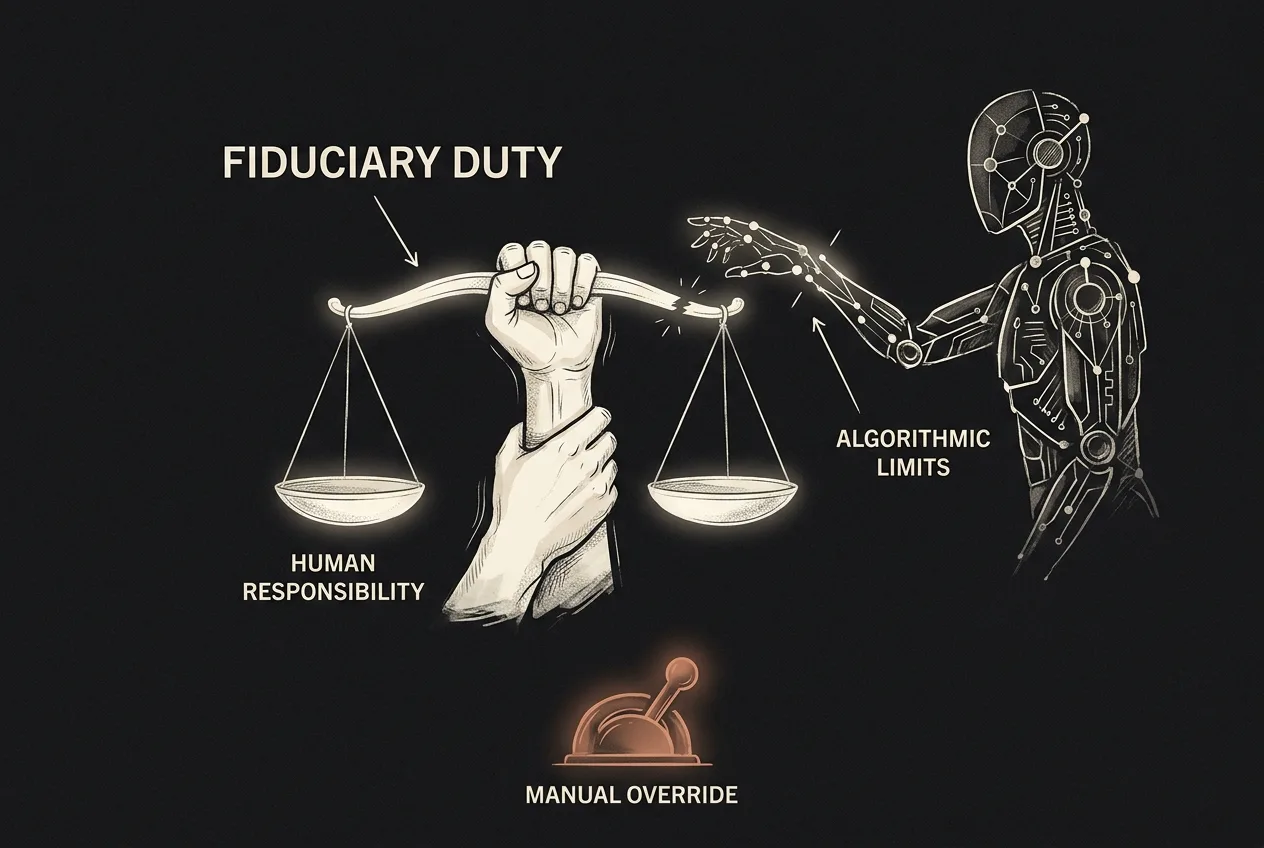
When algorithms make portfolio decisions, fiduciary duty does not dissolve. It has to be discharged by design — through named human authority, enforced mandates, and a record that can be replayed.


In 2024, a mid-sized pension fund's AI-driven portfolio management system executed a series of trades that, in isolation, were each defensible. The system identified a cluster of undervalued energy stocks based on a confluence of technical signals, fundamental metrics, and NLP-derived sentiment from earnings transcripts. It sized positions according to its risk models, executed within approved limits, and documented each decision with the precision that only an automated system can achieve. Over the subsequent three months, the energy sector experienced a sharp correction triggered by an unexpected shift in OPEC production policy. The portfolio lost 8% of its value in a sector that the investment committee had never explicitly approved as a concentration risk.
The fund's beneficiaries filed suit. Their argument was narrow but pointed: the board had delegated investment authority to a system whose decision-making process no board member could fully explain, and that delegation itself constituted a breach of fiduciary duty. The case settled before trial, but it crystallized a question the institutional investment industry can no longer defer. When an algorithm makes an investment decision that harms beneficiaries, who is responsible? And, more fundamentally, can fiduciary duty — a concept refined over centuries of human decision-making — survive a world in which the most consequential portfolio decisions are executed by machines?
The answer this article argues toward is that it can, but not by accident. Fiduciary duty does not transfer to an algorithm, and it does not evaporate when one is deployed. It has to be discharged deliberately — built into the architecture of the system rather than appended as a layer of disclosures. That distinction, between accountability as a department and accountability as a property of the system itself, is where the legal and the technical questions meet. These are not hypothetical concerns: they are being litigated, legislated, and debated across every major financial jurisdiction, and the answers will shape how institutional capital is managed for decades.
Fiduciary Duty Fundamentals: Prudence, Loyalty, and Care
Fiduciary duty is among the oldest and most deeply embedded concepts in financial law. Its origins trace to English trust law, where a trustee was obligated to manage property for the benefit of another with the same care that a prudent person would exercise in managing their own affairs. Over centuries, this principle has been codified, refined, and adapted across jurisdictions, but its core elements remain remarkably consistent.
The duty of prudence requires that a fiduciary make investment decisions with the skill, diligence, and judgment that a reasonable professional would exercise under similar circumstances. In the United States, the Uniform Prudent Investor Act explicitly requires diversification, consideration of the portfolio as a whole, and a risk-return analysis appropriate to the trust's objectives. The duty does not require perfect outcomes. It requires a sound process.
The duty of loyalty demands that the fiduciary act solely in the interest of the beneficiary, avoiding conflicts of interest and self-dealing. This duty is absolute. A fiduciary who generates superior returns through a conflicted transaction has still breached the duty of loyalty, regardless of the outcome.
The duty of care requires ongoing monitoring and supervision. A fiduciary cannot make an investment decision and walk away. They must continuously evaluate whether the investment remains appropriate and take corrective action when circumstances change.
Each of these duties was developed for human decision-making, where the decision-maker can explain their reasoning, demonstrate their diligence, and show that they weighed the beneficiary's interests at every step. Each duty therefore presumes something an algorithm does not natively provide: a traceable account of how a decision was reached, and a person who stands behind it. AI does not abolish that presumption. It relocates the work of satisfying it from the explanatory capacity of an individual to the design of the system around them.
Legal Liability When Algorithms Make Investment Decisions
The liability question created by algorithmic investment management is deceptively simple to state and extraordinarily complex to resolve. When an AI system makes an investment decision that causes a loss, the legal framework must determine whether the loss resulted from a breach of fiduciary duty and, if so, who bears responsibility.
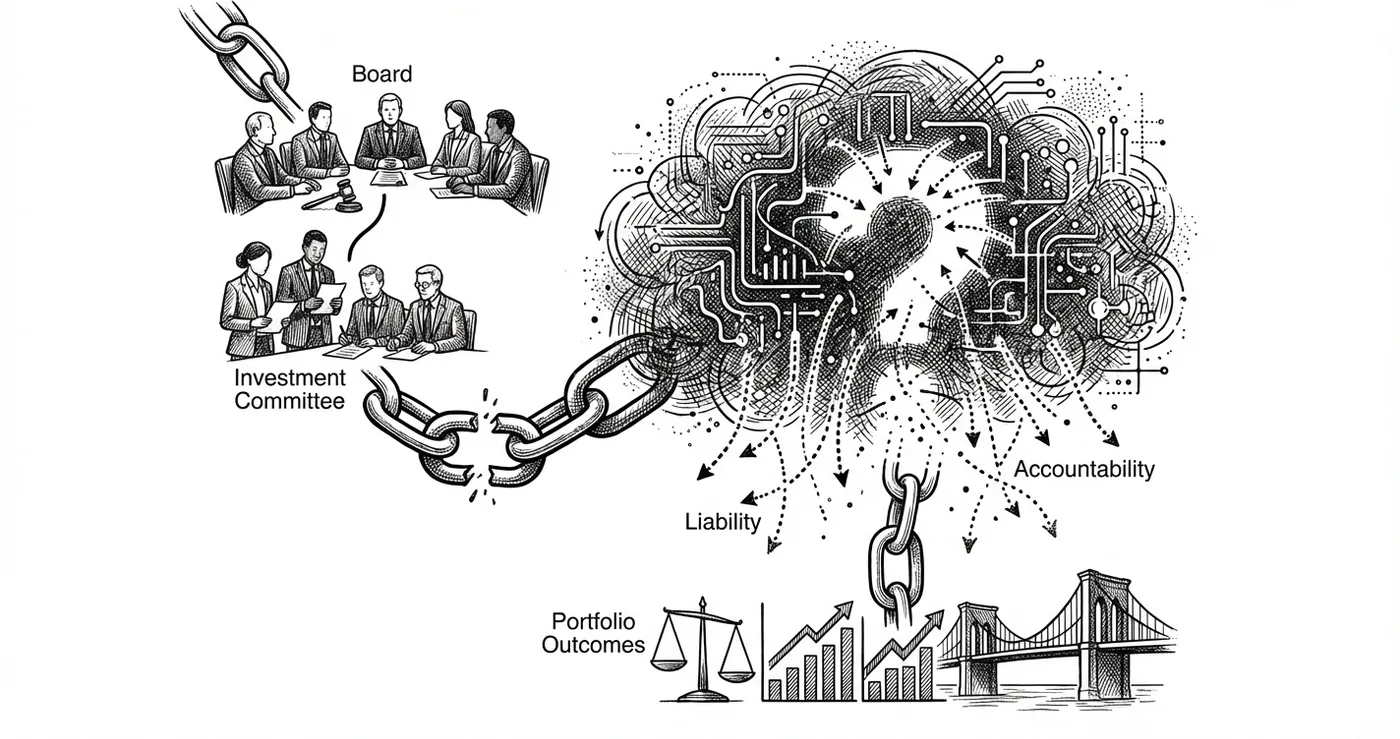
The traditional liability chain in institutional investment management is relatively clear. The board of trustees or directors establishes the investment policy. The investment committee selects and oversees external managers or internal teams. The portfolio managers make specific investment decisions within the approved mandate. When something goes wrong, liability flows upward: the portfolio manager may be liable for negligent execution, the investment committee for inadequate oversight, and the board for failing to establish appropriate policies and controls.
AI disrupts this chain by introducing a decision-making agent that is neither a natural person nor a traditional corporate entity. An AI system does not have legal personhood. It cannot be sued, sanctioned, or held personally liable. It cannot testify about its reasoning or explain why it made a particular decision in the way that a human portfolio manager can. This creates what legal scholars term an "accountability gap," a space in the decision-making process where the connection between human judgment and investment outcome becomes attenuated.
The accountability gap manifests differently depending on how the AI system is deployed. In an advisory model, where the AI generates recommendations that human portfolio managers review and approve, the liability analysis is relatively straightforward. The human decision-maker retains full authority and full responsibility. The AI is a tool, analogous to a financial model or research report, and the human bears the fiduciary duty to evaluate its recommendations with appropriate skepticism and judgment.
In a discretionary model, where the AI executes trades autonomously within predefined parameters, the liability analysis becomes more complex. The humans who designed the system, selected its training data, defined its objectives, and set its operating parameters all bear some degree of responsibility. But the connection between their decisions and any specific trade outcome may be separated by millions of intermediate computations and thousands of intervening market events. Establishing proximate causation, a necessary element of most liability claims, becomes a formidable evidentiary challenge.
In a fully autonomous model, where the AI adapts its own strategy in response to market conditions without human intervention, the liability question becomes acute. If the system learns a strategy that was never explicitly programmed or approved, and that strategy causes a loss, who is responsible? The developers who built the learning algorithm? The investment committee that approved the system's deployment? The board that approved the policy permitting autonomous AI management? The legal frameworks of most jurisdictions provide no clear answer.
The accountability gap is often described as a flaw in the technology. It is more accurately a flaw in how the technology is governed. The gap appears precisely where an irreversible or highly consequential act is allowed to execute without a named human standing behind it. It narrows — and in the well-designed case closes — when the system is built so that every action is classified by its reversibility and its consequence, and the irreversible, high-consequence acts are routed to a specific, accountable person before they execute. Under that design the question "who is responsible?" has an answer that does not depend on tracing causation back through millions of computations: the named human who authorized the consequential act, operating against a mandate the machine was not permitted to exceed. Humans govern; machines operate. The fiduciary does not disappear into the model. The fiduciary is the gate the model has to pass through.
The Delegation Question: Can Fiduciary Duty Be Delegated to AI?
Fiduciary law has always grappled with delegation. The original common law rule was strict: a trustee could not delegate investment authority at all. This proved unworkable as investment management became more complex, and the law evolved to permit delegation under specific conditions. The Uniform Prudent Investor Act in the United States allows delegation provided the trustee exercises reasonable care, skill, and caution in selecting the agent, establishing the scope and terms of the delegation, and periodically reviewing the agent's actions and performance.
The critical question is whether these delegation principles, designed for the delegation of authority to human agents, can accommodate delegation to an AI system. The analogy between hiring an external investment manager and deploying an AI system is tempting but imperfect.
When a trustee delegates to a human investment manager, the trustee can evaluate the manager's track record, investment philosophy, organizational stability, and professional qualifications. The manager is subject to regulatory oversight, professional standards, and legal liability. The manager can explain their decisions, respond to questions, and adjust their approach based on the trustee's feedback. The relationship is governed by a contractual framework that allocates rights, responsibilities, and liabilities with reasonable clarity.
An AI system shares some of these characteristics but lacks others. A system's backtest performance can be evaluated, its architecture can be reviewed, and its operating parameters can be defined contractually. But an AI system does not have professional qualifications, is not subject to individual regulatory oversight, and cannot be held personally liable for its decisions. More fundamentally, a complex machine learning model may not be able to explain its decisions in terms that a human trustee can evaluate, making the ongoing monitoring required by delegation principles difficult or impossible to perform meaningfully.
Several legal scholars have argued that delegating investment authority to an AI system is permissible under existing law, provided the fiduciary satisfies heightened standards of due diligence, documentation, and ongoing monitoring. Others contend that true fiduciary duty requires a human decision-maker who can exercise judgment, empathy, and ethical reasoning — qualities no current AI system possesses. The debate is unresolved, and its resolution will likely vary by jurisdiction.
The framing of that debate, however, conceals a more useful question. The delegation analogy fails not because an AI is less explainable than a human manager — human managers explain their reasoning imperfectly and after the fact, often reconstructing it — but because the obligation to monitor presumes there is something monitorable. A human manager is monitored through reports, reviews, and conversations. An AI system is monitored through whatever record it produces of its own conduct. If that record is a black box, the delegation is unmonitorable and the fiduciary cannot discharge the duty of care. If the record is complete, replayable, and tied back to the mandate the system was operating under, the duty becomes more satisfiable with the machine than without it, because the machine leaves a more exhaustive account of its conduct than any human team could. Whether delegation to AI is prudent, in other words, turns less on the model's intelligence than on the quality of the record it is built to keep.

Regulatory Perspectives: How Global Regulators Are Responding
Financial regulators across major jurisdictions are actively developing frameworks for AI in investment management, but their approaches differ significantly in scope, specificity, and enforcement posture.
United States: SEC and ERISA
The SEC has taken an increasingly active stance on AI in investment management. Its 2024 proposed rule on predictive data analytics would have required investment advisers to evaluate and eliminate conflicts of interest associated with their use of AI and predictive models. Although the rule was not finalized in its proposed form, it signaled the SEC's view that AI-driven investment decisions are subject to the full panoply of fiduciary obligations under the Investment Advisers Act.
The Department of Labor, which oversees ERISA-governed retirement plans, has issued guidance stating that plan fiduciaries who use AI tools remain fully responsible for the outcomes of those tools. The guidance emphasizes that the use of technology does not alter or diminish fiduciary obligations and that fiduciaries must understand the tools they use well enough to evaluate their appropriateness.
The practical implication is that US fiduciaries cannot use AI as a shield against liability. The use of AI in the investment process is permitted, but the human fiduciaries who deploy it bear full responsibility for its outcomes and must demonstrate that they exercised appropriate care in its selection, implementation, and oversight.
European Union and United Kingdom
The EU AI Act, which entered into force in 2024 with a phased implementation timeline, classifies AI systems used in creditworthiness evaluation and certain financial services as high-risk, subjecting them to requirements for risk management, data governance, transparency, human oversight, accuracy, and robustness. While the Act does not directly address fiduciary duty, its requirements effectively establish minimum standards for AI governance that fiduciaries must satisfy.
The UK Financial Conduct Authority has adopted a principles-based approach, emphasizing outcomes rather than prescriptive rules. Its guidance on AI in financial services requires firms to ensure that AI systems are used in a manner consistent with the FCA's principles for businesses, including treating customers fairly, managing conflicts of interest, and maintaining adequate systems and controls. The FCA has also established an AI sandbox for firms to test AI applications under regulatory supervision, recognizing that prescriptive rules may be premature for a rapidly evolving technology.
Asia-Pacific: MAS and DFSA
The Monetary Authority of Singapore has been among the most proactive regulators in addressing AI in financial services. Its FEAT (Fairness, Ethics, Accountability, and Transparency) principles provide a framework for the responsible use of AI, emphasizing the need for clear accountability structures, robust model governance, and meaningful human oversight. MAS has also published detailed guidance on model risk management for AI systems used in investment management.
The Dubai Financial Services Authority has incorporated AI governance into its broader regulatory framework for investment management, requiring DIFC-licensed firms to maintain adequate controls over algorithmic and AI-driven trading systems. The DFSA's approach emphasizes the fiduciary's obligation to understand and oversee the technology they deploy, with particular attention to the risks of model opacity and data quality.
Due Diligence Requirements for AI System Selection
The fiduciary's obligation to exercise care in selecting investment tools translates into specific due diligence requirements when the tool is an AI system. These requirements are more demanding than those for traditional investment tools because AI systems introduce risks that simpler tools do not.
Model validation is the first requirement. A fiduciary considering the deployment of an AI system for investment management must evaluate the system's methodology, including its training data, feature engineering, model architecture, and validation approach. This evaluation must be performed by individuals with sufficient technical expertise to assess the system's strengths and limitations. Relying on the vendor's marketing materials or backtest results is not adequate due diligence.
Data quality assessment is equally critical. AI systems are only as reliable as the data on which they are trained and the data they consume in production. A fiduciary must evaluate the quality, completeness, and potential biases of the training data, as well as the ongoing data feeds that the system uses to generate investment decisions. Data gaps, survivorship bias, look-ahead bias, and temporal instability in data relationships are all risks that must be assessed and documented.
Stress testing and scenario analysis must extend beyond traditional financial scenarios to include AI-specific failure modes. What happens when the system encounters market conditions outside its training distribution? How does it behave during data feed interruptions or latency spikes? What safeguards prevent the system from taking concentrated positions or engaging in rapid-fire trading during periods of market stress? These questions must be answered before deployment, not after a loss occurs.
Vendor due diligence adds another layer when the AI system is provided by a third party. The fiduciary must evaluate the vendor's organizational stability, development practices, security posture, and track record. The contractual framework must address intellectual property rights, liability allocation, service level agreements, and data ownership. Given the pace of AI development, the fiduciary must also consider the risk that the vendor's technology becomes obsolete or that the vendor itself ceases to operate.
Documentation and Audit Trail Requirements
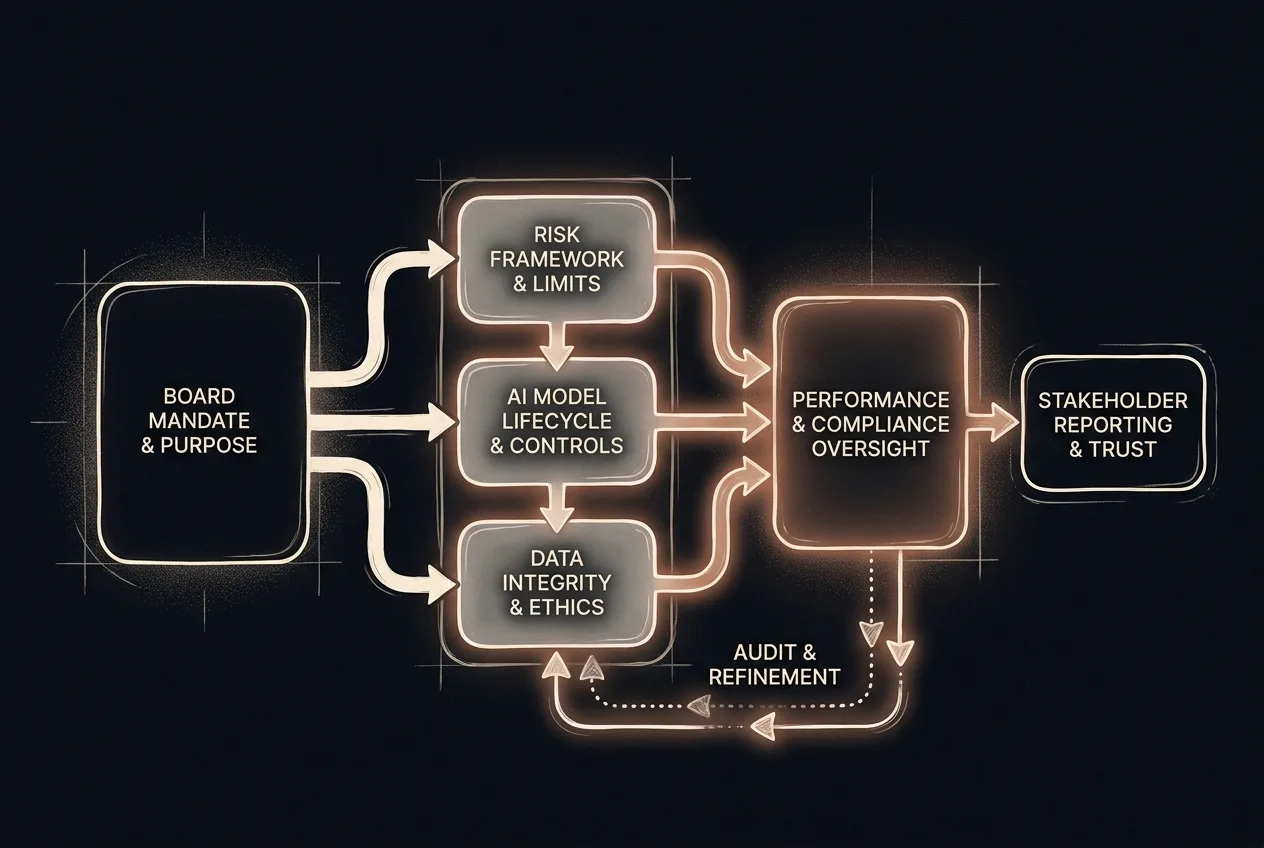
If due diligence is the preventive element of fiduciary compliance, documentation is the evidentiary element — and in an automated system it is the load-bearing one. A fiduciary must be able to demonstrate, after the fact, that they exercised appropriate care in every aspect of AI deployment. When the decision-maker is a model that executed hundreds of trades while the relevant humans slept, the only way to demonstrate care is to be able to reconstruct what the system did, why it was permitted to do it, and against what mandate. The record is not a compliance artifact produced alongside the decisions. It is the decisions, captured in a form that can be re-examined. This requires a documentation framework that is comprehensive, contemporaneous, and — critically — replayable.
The investment policy statement must explicitly address the use of AI in the investment process. This includes the scope of activities that AI is authorized to perform, the limits on its discretion, the human oversight mechanisms in place, and the criteria for evaluating its performance. A generic authorization to use "technology tools" is insufficient. The policy must reflect a considered judgment about the specific AI capabilities being deployed and their role in the overall investment process.
Model governance documentation must record the technical specifications of the AI system, the rationale for its selection, the results of initial validation testing, and any modifications made during deployment. This documentation should be maintained by individuals with the technical expertise to evaluate the system, not by compliance officers reading from a script.
Decision logs present the central challenge in AI-driven investment management, and the central opportunity. Traditional decision logs record the rationale for specific decisions: the factors considered, the alternatives evaluated, the basis for the chosen course of action. A system that processes thousands of data points and executes hundreds of trades per day cannot produce a hand-written narrative for each one. But it can produce something a human committee cannot — a complete, machine-generated record in which each action is linked to the inputs that triggered it and the policy clause that authorized it. The aspiration is not a folder of after-the-fact summaries but an audit spine: an ordered, append-only record dense enough that a reviewer can replay any decision, see the state the system observed, and confirm the action fell within the mandate. Aggregate metrics — factor exposures, concentration levels, turnover, risk utilization — and flagged exceptions where behavior deviated from expected patterns sit on top of that spine; they are summaries of it, not substitutes for it. Where the record is structured this way, the fiduciary's evidentiary position is stronger after automation than before, because nothing is reconstructed from memory.
Regular review documentation must demonstrate that the fiduciary is actively monitoring the AI system's performance and behavior, not merely receiving periodic reports. This includes records of investment committee discussions about the system's performance, documentation of any concerns raised and how they were addressed, and evidence of corrective action taken when the system's behavior warranted intervention.
The Prudent Investor Rule Applied to Algorithmic Strategies
The prudent investor rule, as codified in the Uniform Prudent Investor Act and its equivalents in other jurisdictions, provides the most directly relevant legal standard for evaluating AI-driven investment strategies. The rule requires that investment decisions be evaluated not in isolation but in the context of the overall portfolio, with consideration for the trade-off between risk and return appropriate to the trust's objectives.
Applied to AI-driven strategies, the prudent investor rule raises several specific questions. First, is the strategy's risk-return profile appropriate for the portfolio's objectives? An AI system optimized for maximum return without adequate risk constraints may generate impressive backtests but violate the prudent investor standard by exposing the portfolio to unacceptable downside risk. The fiduciary must ensure that the system's objective function reflects the portfolio's actual risk tolerance, not merely the model developer's default settings.
Second, does the strategy contribute to adequate diversification? An AI system that concentrates in a narrow set of securities or factors may violate the diversification requirement, even when the concentration is justified by the model's confidence in its predictions. The remedy is not to trust the model to restrain itself. It is to express the mandate as enforced policy — concentration ceilings, sector limits, and position caps encoded as constraints the system checks before it acts and cannot override regardless of signal strength. A diversification requirement that lives only in the investment policy statement is an aspiration. The same requirement compiled into the execution path is a control. The prudent investor standard is far better served by the second.
Third, is the strategy's cost structure reasonable in relation to its expected benefits? AI-driven strategies can generate significant costs through high turnover, market impact, technology infrastructure, and data fees. The prudent investor rule requires that these costs be justified by the expected incremental return, and the fiduciary must evaluate this trade-off with the same rigor applied to traditional manager fee negotiations.
Fourth, has the fiduciary considered the strategy's behavior in adverse conditions? The prudent investor rule does not require that investments never lose money. It requires that the fiduciary considered the potential for loss and determined that the risk was acceptable in context. For AI-driven strategies, this means stress testing the system against historical crisis periods and hypothetical adverse scenarios, and documenting the results and the fiduciary's evaluation of them.
Insurance and Liability Frameworks for AI-Driven Losses
The insurance industry is adapting to the emergence of AI-driven investment management, but coverage frameworks remain in early stages of development. Traditional errors and omissions (E&O) insurance for investment advisers covers negligent acts, errors, or omissions in the provision of investment advice. Whether the deployment of a flawed AI system constitutes an "error or omission" within the meaning of a standard E&O policy is an open question that has not been definitively resolved by litigation.
Technology errors and omissions coverage, sometimes offered as a supplement to traditional E&O policies, may provide broader protection for AI-related claims. These policies typically cover losses arising from defects in technology products or services, including software bugs, data errors, and system failures. For an investment firm deploying proprietary AI systems, technology E&O coverage addresses risks that traditional investment management E&O may not.
Cyber insurance adds another layer of relevant coverage. AI systems are vulnerable to data poisoning attacks, adversarial inputs, and infrastructure failures that could cause investment losses. Cyber policies that cover business interruption and third-party liability arising from technology failures may provide coverage for these scenarios, depending on policy terms.
The emerging trend is toward purpose-built AI liability coverage that specifically addresses the unique risks of AI-driven decision-making. Several specialty insurers have begun offering policies that cover losses arising from AI model failure, algorithmic bias, and automated decision errors. These policies are typically underwritten based on the insured's AI governance framework, model validation processes, and human oversight mechanisms, creating a direct financial incentive for robust AI governance.
For institutional fiduciaries, insurance is a complement to, not a substitute for, sound governance practices. An insurance policy that pays out after a loss does not restore the fiduciary's reputation or satisfy the fiduciary's obligation to prevent foreseeable harm. The primary purpose of insurance in this context is to provide financial protection for losses that occur despite the exercise of reasonable care, not to excuse the absence of care.
Practical Governance: How Institutional Boards Oversee AI Investment Systems
The translation of legal principles into practical governance structures is where fiduciary duty meets operational reality. Institutional boards overseeing AI-driven investment systems must establish governance frameworks that satisfy legal requirements while remaining operationally feasible.
The first governance element is a clear allocation of responsibility. The board must designate specific individuals or committees with authority and accountability for AI oversight. This includes a technology committee or subcommittee with sufficient technical expertise to evaluate AI systems, an investment committee that understands the AI's role in the investment process, and a compliance function that monitors the system's adherence to regulatory requirements and investment guidelines.
The second element is a defined escalation framework, and it is best understood as a classification of acts rather than a list of alerts. Not every trade requires board-level review; routine, reversible, low-consequence actions should execute on the system's authority and not consume human attention. What the framework must specify is the boundary — the act-types that may not execute on the machine's authority alone. Concentration breaches, unusual factor exposures, significant drawdowns, the liquidation of a core holding, and model-behavior anomalies are not merely things to be alerted about after the fact; they are decisions that should be gated to a named human before they take effect. Calibrating escalation is therefore less about tuning alert thresholds than about drawing the reversibility-and-consequence line correctly: low enough that genuinely consequential acts are caught, high enough that the oversight function is not desensitized by noise it cannot act on.
The third element is regular independent review. The AI system should be subject to periodic independent review by qualified experts who are not involved in the system's development or operation. This review should evaluate the system's performance, its adherence to its stated methodology, the continued validity of its underlying assumptions, and the effectiveness of the controls surrounding it. The results of these reviews should be reported directly to the board, not filtered through management.
The fourth element is a kill switch, a mechanism for immediately suspending the AI system's trading authority when circumstances warrant. The conditions for activation should be predefined and documented, and the authority to activate the kill switch should reside with individuals who are available at all times the system is operational. The existence of a kill switch addresses one of the fundamental concerns about AI delegation: the fear that once authority is granted to a machine, it cannot be reclaimed quickly enough to prevent harm.
The fifth element is ongoing education. Board members cannot oversee what they do not understand. Institutional boards that deploy AI systems must invest in the technical education of their members, ensuring that oversight is informed rather than nominal. This does not require every board member to understand gradient descent. It requires a sufficient collective understanding of how the AI system works, what it can and cannot do, and what risks it introduces, to enable meaningful governance.

The Path Forward: Principles for Fiduciary AI Governance
The legal frameworks governing AI in investment management are evolving rapidly, and the specific rules will continue to change. But the underlying principles of fiduciary duty, prudence, loyalty, and care, are stable and provide a reliable foundation for governance design.
Prudence in the age of AI means understanding the tools before deploying them, testing them rigorously, and maintaining realistic expectations about their capabilities and limitations. It means recognizing that backtest performance is not live performance, that models trained on historical data may fail in novel conditions, and that the complexity of an AI system is not a virtue in itself.
Loyalty in the age of AI means ensuring that the system's objectives are aligned with the beneficiary's interests, not with the developer's convenience or the portfolio manager's compensation structure. It means scrutinizing the data sources and model features for conflicts of interest, and ensuring that the system does not inadvertently prioritize certain outcomes at the expense of the beneficiary.
Care in the age of AI means continuous, informed oversight, not periodic, perfunctory review. It means investing in the technical expertise necessary to evaluate the system's behavior, maintaining documentation sufficient to demonstrate diligence, and being willing to override or shut down the system when the evidence warrants.
The institutions that internalize these principles will find that fiduciary duty and AI-driven investment management are not in tension — provided the duty is engineered into the system rather than asserted around it. An AI system bounded by an enforced mandate, gating its consequential acts to named humans, and leaving a replayable record of everything it did, becomes a tool for fulfilling the fiduciary obligation more completely: more rigorous analysis, more consistent execution, more comprehensive and more auditable risk management than a human team could sustain alone.
But the obligation itself does not move. Accountability is not a feature one buys or a department one staffs; it is a property of how the system is built, and it has to be designed in from the first decision about what the machine is permitted to do without asking. No algorithm, however sophisticated, can bear the weight of fiduciary duty. The architecture can carry the evidence; the gate can hold a name. The duty belongs to people, and it always will.