The Convergence of Traditional and Digital Market Structure
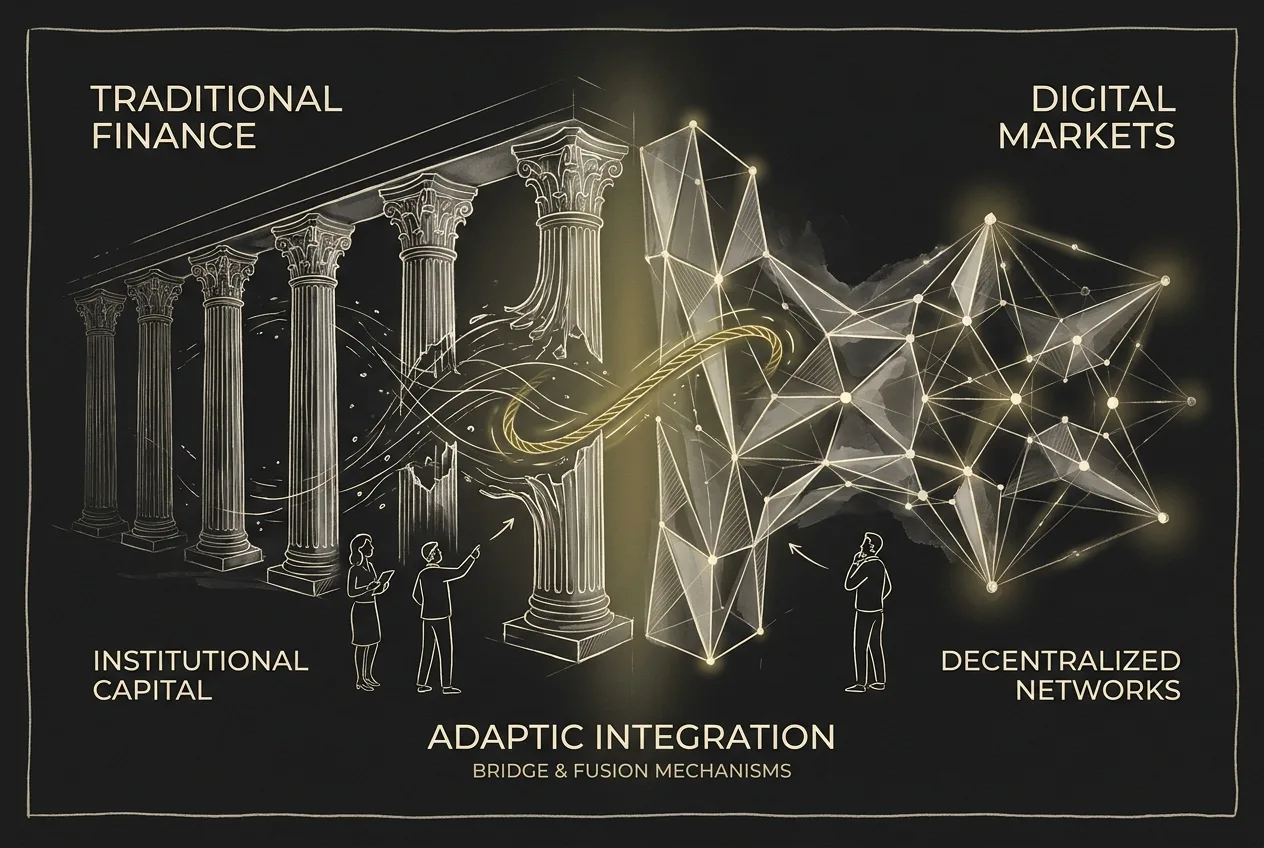
Traditional and digital markets are converging onto shared rails. The institutions that win will run one operating system across both, not two stacks bolted together.


Equities trade on exchanges governed by rules written in the 1930s. Fixed income clears through systems designed in the 1970s. Cryptocurrencies settle on decentralized ledgers born in the 2010s. For most of their histories, these markets ran as parallel universes — each with its own infrastructure, its own intermediaries, and its own assumptions about how markets should work. That separation is dissolving. A regulated US Treasury can now settle on a blockchain; a tokenized money-market fund can serve as institutional collateral; the same desk that routes an equity order may simultaneously source liquidity from an automated market maker. Convergence is no longer a panel topic at fintech conferences. It is an operational reality reshaping how institutional capital moves across asset classes, jurisdictions, and settlement rails.
The strategic question this raises is rarely stated plainly. Institutions confronting convergence tend to bolt a digital-asset stack onto their existing equities and fixed-income infrastructure — a second set of connectivity, a second risk system, a second book of record, reconciled nightly. That architecture treats the traditional-digital boundary as permanent. The thesis of this article is that the boundary is an artifact of legacy infrastructure, not a property of markets, and that the institutions best positioned for the converged landscape will run a single operating system across both: one data model, one record, one policy and audit spine that does not care whether a venue is a central limit order book or a chain. The sections below trace the mechanics of convergence — fragmentation, routing, settlement, liquidity, regulation, market making, and execution quality — and what each demands of the system underneath.
The Fragmentation Problem

The modern institutional investor confronts a market landscape of extraordinary complexity. In the United States alone, equity trading is distributed across more than 16 national securities exchanges, over 30 alternative trading systems (ATS), and numerous single-dealer platforms and systematic internalizers. Add global fixed income venues, commodity exchanges, derivatives clearinghouses, digital asset exchanges, and decentralized trading protocols, and the total number of execution venues available to a sophisticated institutional investor exceeds 60 and is growing.
This fragmentation did not emerge by accident. In traditional markets, regulatory initiatives such as Regulation NMS in the United States and MiFID II in Europe deliberately encouraged competition among trading venues, shattering the monopoly power of legacy exchanges in favor of a more competitive marketplace. The result was tighter spreads and lower explicit trading costs, but at the expense of a dramatically more complex execution landscape.
Digital asset markets evolved through a different path toward the same fragmented outcome. The permissionless nature of blockchain technology enabled anyone to create a trading venue, resulting in hundreds of centralized exchanges and thousands of decentralized liquidity pools. Liquidity for a single token might be distributed across Binance, Coinbase, Kraken, Uniswap, Curve, and dozens of smaller venues, each with different fee structures, settlement mechanisms, and counterparty risk profiles.
For institutions deploying capital across both worlds, this fragmentation creates overhead that scales non-linearly with the number of venues. Connectivity, data normalization, risk aggregation, compliance monitoring, and settlement reconciliation must each be managed across fundamentally different infrastructure stacks. The cost is not merely technological. It manifests as missed opportunities, execution slippage, and operational risk that compounds with every additional venue and asset class.
The conventional response — a dedicated team and toolchain per market type — does not reduce that complexity so much as relocate it. Two risk systems still have to be reconciled into one firm-level exposure. Two compliance regimes still have to agree on what a given account is permitted to hold. The reconciliation seam between the stacks becomes the place where errors hide and latency accumulates. The alternative is to absorb fragmentation at the venue layer and present a single model upward: one representation of an order, a position, and a fill regardless of whether it originated on an exchange, an ATS, or a chain. Fragmentation at the venue level is a fact of modern markets. Fragmentation at the system level is a choice.
Smart Order Routing Across Market Boundaries
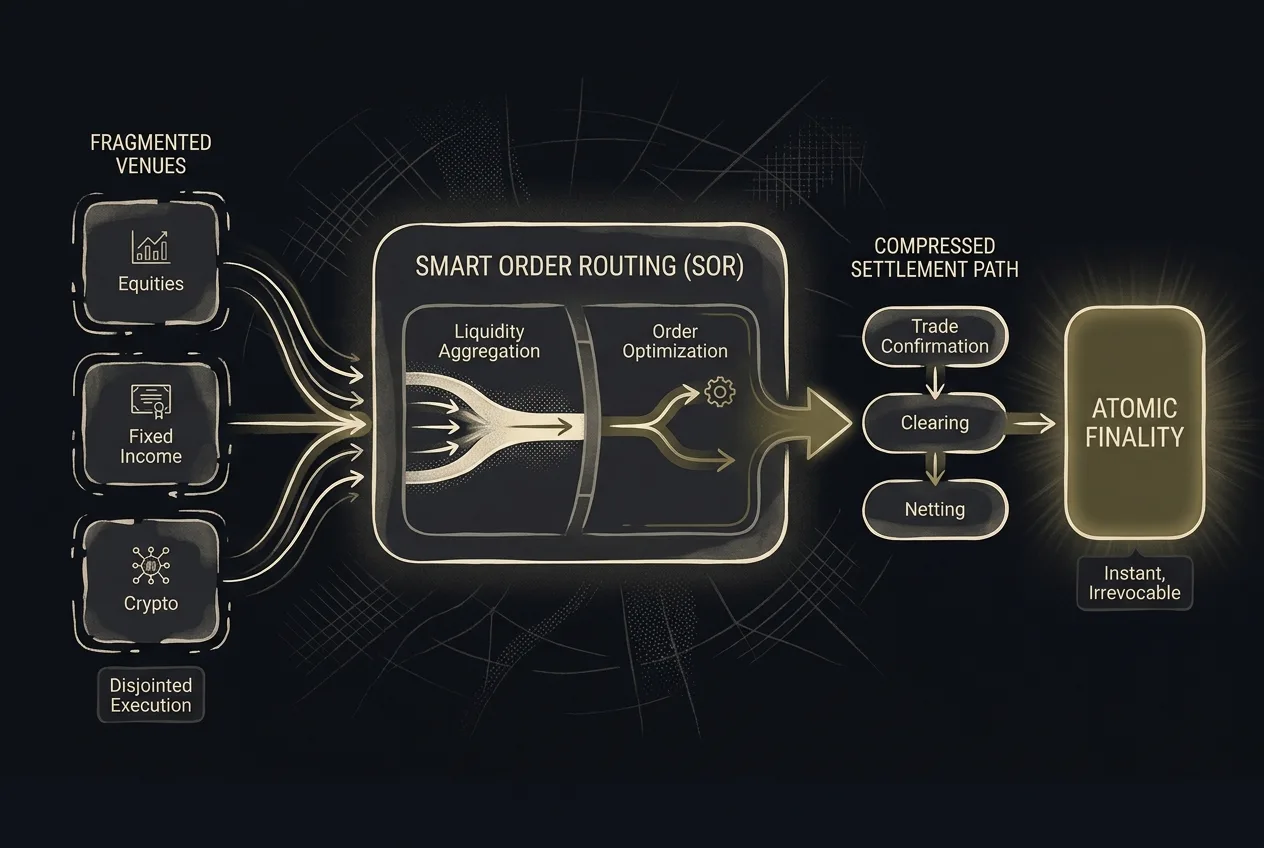
Smart order routing (SOR) technology has been a cornerstone of institutional equity trading for over a decade. These systems evaluate available liquidity across multiple venues in real time, routing orders to achieve optimal execution quality based on factors including price, size, speed, and the probability of adverse selection. In traditional markets, SOR algorithms operate within well-defined parameters: standardized order types, regulated venue hierarchies, and established protocols for accessing displayed and non-displayed liquidity.
Extending smart order routing across the traditional-digital boundary introduces challenges that go well beyond connectivity. The fundamental market microstructure differs in ways that require rethinking core routing logic.
Traditional equity markets operate on a continuous limit order book model with discrete price increments (tick sizes), time-price priority, and maker-taker fee schedules that create predictable incentive structures. Digital asset markets, particularly decentralized exchanges, use automated market maker (AMM) models where pricing is determined by mathematical formulas governing liquidity pool ratios. There is no order book, no time priority, and fee structures are embedded directly in the protocol rather than negotiated between venue and participant.
A cross-market SOR must reconcile these fundamentally different models into a unified optimization framework. This means developing pricing models that can compare the expected execution cost of routing through a central limit order book against the predictable slippage curve of an AMM pool. It means accounting for gas costs on blockchain networks alongside exchange fees in traditional markets. And it means managing the radically different latency profiles of these systems, where traditional exchange responses are measured in microseconds while blockchain transaction confirmation times can range from seconds to minutes.
Solving this requires an execution management system that treats traditional and digital venues as interchangeable sources of liquidity within a single optimization framework — the routing layer is the first place the one-operating-system thesis becomes concrete. The router does not branch on asset class; it branches on cost, expressed in a common currency. A CLOB's quoted spread, an AMM's slippage curve, exchange fees, and on-chain gas all resolve to the same unit: expected total cost to fill, net of expected adverse selection. Once execution cost is normalized, the venue type stops being a category the system reasons about and becomes a parameter it prices. That normalization is the engineering core of the problem, and it is what separates a genuinely unified router from a traditional router with a crypto adapter stapled on.

Unified Settlement: T+0 Dreams and Current Reality
Settlement is where the architectural differences between traditional and digital markets become most stark, and where convergence has the greatest potential to transform institutional operations.
Traditional securities settlement in the United States moved from T+2 to T+1 in May 2024, a milestone that required years of industry coordination and billions in technology investment. Despite this acceleration, T+1 settlement still means that for approximately 24 hours after a trade executes, both buyer and seller carry counterparty risk, capital is tied up in margin requirements, and reconciliation processes must track pending obligations across thousands of transactions.
Digital asset markets, by contrast, can achieve atomic settlement, where the exchange of assets between counterparties occurs in a single, indivisible transaction on a blockchain. There is no settlement lag, no counterparty risk during a pending period, and no need for a central counterparty (CCP) to guarantee performance. The trade is the settlement.
The implications for institutional operations are profound. A 2025 analysis by the Depository Trust and Clearing Corporation (DTCC) estimated that the industry allocates approximately $11 billion annually to managing the risks and operational overhead associated with multi-day settlement cycles. Atomic settlement eliminates the need for much of this infrastructure, potentially freeing billions in capital currently immobilized as margin and collateral.
However, the path from T+1 to T+0 is not simply a matter of moving everything onto a blockchain. Institutional trading involves complex workflows including allocation, confirmation, affirmation, and netting that serve legitimate purposes beyond mere settlement. The challenge is redesigning these workflows for an atomic settlement paradigm without sacrificing the risk management functions they currently provide.
The emerging approach is hybrid: tokenize traditional securities, settle them on blockchain infrastructure, and preserve the regulatory protections and institutional workflows that traditional markets require. JPMorgan's Onyx platform and BlackRock's BUIDL fund are early demonstrations that this hybrid model functions at institutional scale. The question is no longer whether institutional securities will settle on blockchain rails, but how quickly the transition occurs and which intermediaries survive the compression of the settlement value chain.
This is where the case for a single record becomes operationally exact rather than rhetorical. Settlement is fundamentally a question of what the firm believes it owns. When some positions settle T+1 through a central counterparty and others settle atomically on-chain, a single book of record has to represent both lifecycles without privileging either — a pending obligation and a final, irreversible transfer must coexist in the same data model, each carrying its true settlement state. A firm running two books of record for two settlement paradigms is, by construction, exposed to the gap between them: the moments where one ledger has updated and the other has not. Closing that gap is not a reconciliation feature added after the fact. It is a property of having modeled the position once.

Cross-Venue Liquidity Aggregation

Liquidity aggregation across traditional and digital markets represents one of the most technically demanding and commercially valuable problems in modern market structure. The core challenge is presenting a unified view of available liquidity to institutional traders, enabling them to access the best prices regardless of which venue, or which type of venue, offers them.
In traditional markets, consolidated tape facilities and securities information processors provide standardized market data feeds that aggregate quotes from multiple exchanges. While imperfect, these mechanisms provide a baseline level of price transparency that enables meaningful cross-venue comparison.
Digital asset markets lack equivalent infrastructure. Price data from centralized exchanges arrives through proprietary APIs with varying latency, reliability, and depth of book information. Decentralized exchange pricing is embedded in smart contract state that must be queried on-chain, introducing additional latency and complexity. And the absence of a consolidated tape means there is no authoritative source for best bid and offer across all venues.
Building institutional-grade liquidity aggregation across both market types requires solving several interconnected problems simultaneously. Data normalization must reconcile the different data models, timestamps, and precision standards used by traditional and digital venues. Latency management must account for the orders-of-magnitude difference in response times between traditional exchange matching engines and blockchain transaction processing. And risk management must continuously evaluate the creditworthiness and operational reliability of each venue, a particularly acute concern in digital asset markets where exchange failures and security breaches remain more common than in regulated traditional venues.
Institutions that aggregate liquidity well across both market types access deeper effective pools, which lets them execute larger orders with less market impact and capture the pricing dislocations that arise between traditional and digital venues. The advantage is real but it is not free or permanent: it accrues only to firms that can maintain accurate, real-time venue health and pricing across stacks with very different reliability characteristics, and it erodes as more participants build the same capability. The durable edge is less the aggregation itself than the system discipline required to keep it trustworthy under stress — when a digital venue degrades or a feed goes stale, the aggregator must know, and must reprice, before it routes.
Regulatory Harmonization: A Multi-Jurisdictional Challenge
Perhaps the most significant barrier to market structure convergence is regulatory fragmentation. Traditional financial markets operate within mature, well-established regulatory frameworks. Digital asset markets operate within frameworks that are still being written, vary dramatically across jurisdictions, and in some cases conflict directly with traditional market regulations.
The United States illustrates this tension acutely. The SEC asserts jurisdiction over digital assets that qualify as securities, applying regulations designed for traditional markets. The CFTC claims authority over digital asset derivatives. State regulators impose their own requirements through money transmitter licensing and state-specific digital asset frameworks. And the Federal Reserve, OCC, and FDIC have each issued guidance that affects how banks can interact with digital assets. The result is a regulatory environment where the same asset might be subject to overlapping, and sometimes contradictory, requirements depending on how it is classified and who is using it.
Other jurisdictions have taken more unified approaches. The Dubai Financial Services Authority (DFSA) has developed an integrated regulatory framework for digital assets within the Dubai International Financial Centre, treating them as a new asset class within an existing, comprehensive regulatory structure. The Monetary Authority of Singapore (MAS) has similarly extended its existing regulatory framework to encompass digital asset activities through its Payment Services Act and forthcoming Stablecoin Regulatory Framework. The UK Financial Conduct Authority (FCA) is pursuing a phased approach, building digital asset regulation onto its existing framework through targeted amendments rather than standalone legislation.
For institutions operating across multiple jurisdictions, regulatory harmonization is not merely a compliance matter. It affects market access, product design, and competitive positioning. A fund domiciled in the Cayman Islands, managed from Singapore, and executing across US, European, and Middle Eastern venues must navigate a matrix of requirements that can make certain strategies operationally infeasible regardless of their investment merit.
The architectural implication is the one most firms underweight. If a venue's permissibility for a given account depends on classification, jurisdiction, and asset type — and those rules differ by mandate and change as regimes evolve — then those constraints cannot live as institutional knowledge in a trading desk's heads or as after-the-fact surveillance. They have to be expressed as policy-as-code: machine-checkable rules, evaluated before an order is placed, that govern identically whether the target venue is a regulated exchange or a decentralized pool. Pre-authorization rather than post-hoc detection. This is the practical form of the principle that humans govern and machines operate: a compliance officer or portfolio mandate sets the policy once, in one place, and the system enforces it on every order across every venue type without a human in the execution loop. The same audit spine that records why a CLOB order was permitted records why an on-chain swap was blocked — one trail, one vocabulary, spanning both rails.
The trend toward regulatory convergence is real but slow. The Financial Stability Board, the International Organization of Securities Commissions, and the Basel Committee on Banking Supervision have each published frameworks meant to promote consistent treatment of digital assets. Translation of those principles into national legislation remains uneven, and regulatory development continues to lag market innovation. A firm cannot wait for harmonization; it has to encode whatever rules currently apply and re-encode them as they change. A system in which policy is data, not hardcoded logic, is what makes that pace survivable.
The Role of Market Makers in Hybrid Ecosystems
Market makers have always served as the connective tissue of financial markets, providing continuous liquidity and absorbing temporary imbalances between supply and demand. In the converging market structure, the role of market makers is evolving in ways that create both new opportunities and new risks.
In traditional markets, market making is a well-understood activity governed by clear obligations and incentive structures. Designated market makers on exchanges receive certain privileges in exchange for commitments to provide continuous two-sided quotes within specified spread parameters. Electronic market makers on multi-venue platforms use sophisticated algorithms to manage inventory risk while providing liquidity across multiple venues simultaneously.
Digital asset markets introduced a fundamentally different market-making paradigm through automated market makers. In AMM-based systems, liquidity is provided not by professional intermediaries making continuous decisions about pricing, but by passive liquidity providers who deposit capital into pools governed by deterministic algorithms. This passive approach democratized market making but introduced new risks, including impermanent loss, smart contract vulnerability, and the inability to adjust pricing in response to information events.
The hybrid market structure emerging from convergence requires market makers who can operate effectively across both paradigms. This means managing inventory positions that span traditional exchange-traded securities, over-the-counter derivatives, centralized digital asset exchange listings, and decentralized protocol liquidity pools. It means developing pricing models that account for the fundamentally different microstructure dynamics of each venue type. And it means building risk management systems that can aggregate and monitor exposures across a diverse set of infrastructure platforms with different failure modes and settlement characteristics.
The market makers who succeed here will treat the distinction between traditional and digital markets as an artifact of legacy infrastructure rather than a fundamental boundary — the same view that defines the systems serving them. Their function in providing liquidity, price discovery, and continuity does not diminish in a converged market; if anything, the proliferation of venues creates more of the temporary dislocations that skilled intermediaries exist to bridge. What changes is the infrastructure premium: an intermediary that can hold and rebalance inventory across exchange-traded securities, OTC derivatives, centralized listings, and protocol pools within one risk view will price and absorb imbalances that an intermediary running parallel stacks simply cannot see at the same time.

Institutional-Grade Execution Quality Across Market Types
For institutional investors, execution quality is not an abstract concept. It directly affects fund performance, fiduciary compliance, and competitive positioning. In a converging market structure, defining and measuring execution quality becomes significantly more complex.
Traditional metrics such as implementation shortfall, VWAP slippage, and reversion analysis were developed for equity markets with centralized price discovery and well-understood microstructure dynamics. Applying these metrics to digital asset execution requires adaptation. Transaction costs in digital markets include not just spread and market impact, but also gas fees, MEV (maximal extractable value) exposure, and bridge costs for cross-chain transactions. Timing benchmarks must account for the fundamental uncertainty in blockchain transaction confirmation, which introduces a source of execution risk that has no analogue in traditional markets.
Best execution obligations, which are legally mandated in many jurisdictions for traditional securities, are only beginning to be defined for digital assets. The European Union's MiCA regulation and the UK's forthcoming digital asset regime both contemplate best execution requirements for crypto-asset service providers, but the specific standards and enforcement mechanisms are still evolving.
For institutions operating across both market types, the practical challenge is a transaction cost analysis (TCA) framework that compares execution quality across fundamentally different market structures on a common basis. This is the same normalization the router requires, applied after the fact: a unified cost model, benchmarks appropriate to each venue type, and monitoring that detects execution-quality deterioration regardless of where a trade printed. The payoff is not only better measurement but defensible measurement. When best-execution obligations are demonstrated to a regulator, the firm that can show one consistent methodology across CLOBs and chains — drawn from the same audit spine that governed the orders in the first place — is in a materially stronger position than one stitching together two incompatible TCA reports and asking the regulator to trust the seam.
The Path Forward
Convergence is not a future event to anticipate. It is a present reality to navigate. Institutions that treat traditional and digital markets as separate allocation buckets, managed by separate teams through separate infrastructure, are building in structural inefficiencies that compound — and, more dangerously, building in the reconciliation seams where exposure goes unmeasured and policy goes unenforced.
The pattern running through every section above is the same. Routing, settlement, liquidity, compliance, market making, and execution measurement each break down into two stacks under the conventional approach, and each is strongest when collapsed into one. That is not an argument for a single vendor; it is an argument for a single model — one representation of an order, a position, and a fill; one book of record across settlement paradigms; one policy-and-audit spine evaluated before execution and identical across venue types. The institutions best positioned for this landscape are the ones building toward that model rather than accumulating adapters around the boundary.
This is the system Adaptic builds toward. The design represents every order, position, and fill once, regardless of whether it touches a regulated exchange or a chain; checks every order against the account's trading policy before it is placed; and records each decision on a single audit trail spanning both rails. The design premise is that a venue being a central limit order book or a chain is an implementation detail the system prices, not a boundary the institution has to organize itself around. Convergence is underway. The question is not whether to participate, but whether the system underneath is built for one market or forever reconciling two.