Next-Generation Investor Reporting: From Quarterly PDFs to Real-Time Transparency
Why investor reporting should be a query against the system of record rather than a quarterly assembly process — and what changes when the audit spine becomes legible to allocators.


A quarterly investor report is a reconstruction. Weeks after period-end, an operations team pulls figures from systems that have already moved on, reformats them into a template, layers on commentary, and ships a PDF describing a portfolio that no longer exists. The document is an artifact assembled to look like the truth — not the truth itself, queried. That distinction sits at the center of how investor reporting is changing, and most of the industry has yet to absorb it.
The cadence was once defensible. It no longer is. The same allocators who receive a 45-day-old PDF can monitor their public equity exposures intraday, receive corporate-action alerts within seconds, and move capital in milliseconds. They have learned to distrust the gap between when a number became true and when they were allowed to see it.
The shift underway is usually described as one of speed — from quarterly to real-time. That framing is too small. The deeper change is architectural: reporting stops being a separate assembly process layered on top of the books and becomes a read against the same record the manager itself operates from. Speed is the visible symptom. A single source of truth, queried at whatever resolution the recipient needs, is the cause. This essay is about that cause, and about the governance discipline real-time transparency demands in return.
Why the legacy pipeline cannot be fixed by speeding it up
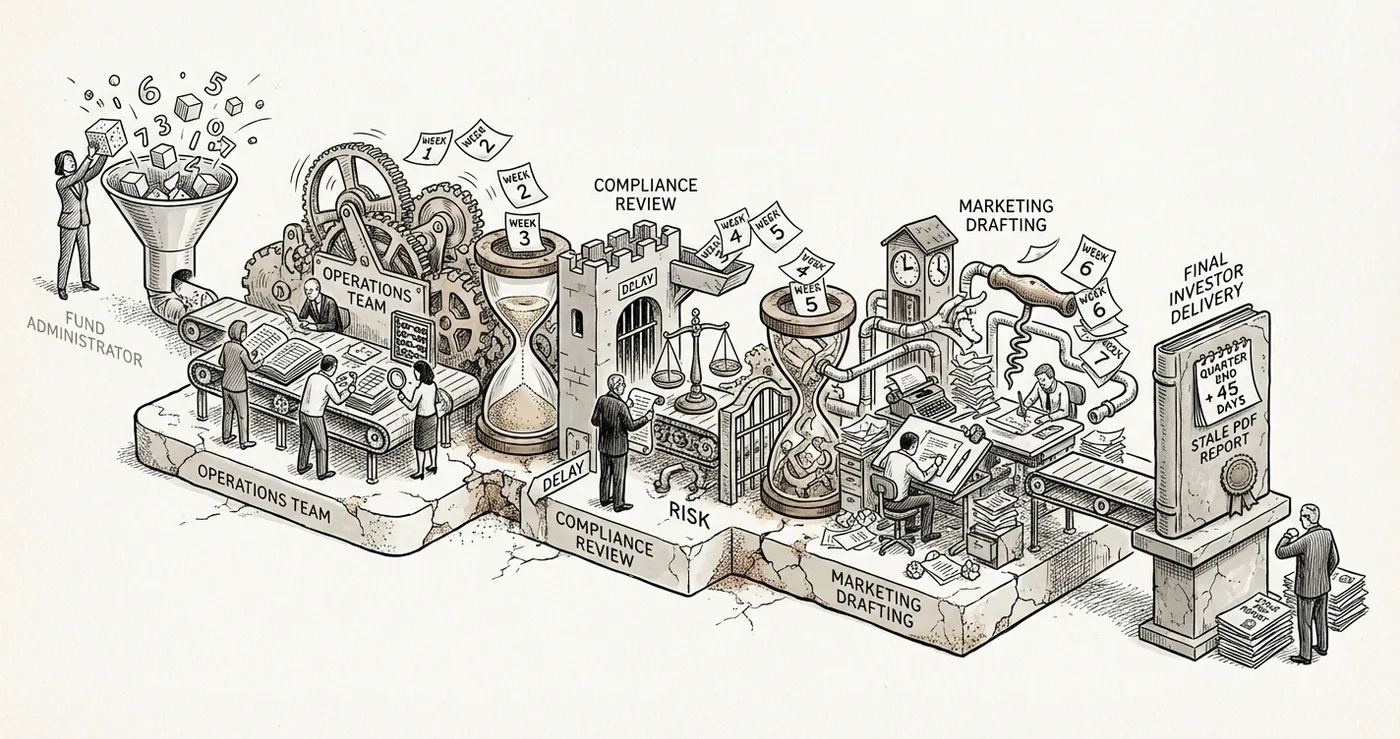
The structural flaw in traditional reporting is that the report is downstream of the system of record rather than a view onto it. A fund administrator produces month-end or quarter-end NAV. The manager's operations team extracts that data, reformats it into proprietary templates, drafts commentary, routes the document through compliance, and distributes the result by email or a document portal. Every figure an investor eventually reads has been copied, transformed, and re-keyed several times before reaching them.
Each hand-off adds latency and a new opportunity for the report to disagree with reality. By the time the PDF lands, the data is stale, the market has moved, and the portfolio may bear little resemblance to what the document describes. For allocators running multi-manager books with dozens or hundreds of underlying positions, the failure compounds: reconciling stale extracts across managers with mismatched timelines and formats into one portfolio-level view is slow, manual, and perpetually a step behind.
Compressing this pipeline does not fix it. A report produced overnight instead of over six weeks is still a copy that can drift from its source, still a fixed set of metrics frozen in a predetermined layout. An investor who wants attribution at the sector level rather than the asset-class level, risk decomposed under a different factor model, or a single position's contribution to drawdown has no recourse but to ask the manager and wait for a bespoke analysis. The constraint is not the clock. It is that the report and the record are two different things, and only one of them is true.

What sophisticated allocators now expect
Allocators have moved past wanting the same report sooner. Their portfolios and their regulators have grown more demanding, and they now treat a manager's reporting surface as something to interrogate rather than receive. The common thread across the requirements below is granularity on demand: the same underlying record, sliced along whatever dimension the question requires, without a second assembly cycle.
NAV and performance, computed not transcribed
Daily or T+1 NAV is becoming table stakes, but availability is the easy part. What allocators want is provenance: the pricing methodology, valuation adjustments, and accrual treatments that produce the number, exposed alongside it rather than asserted. Attribution must resolve from strategy down to individual position, across asset class, sector, and geography. Time-weighted and money-weighted returns should be computable over arbitrary periods, and benchmarks should be configurable as custom composites rather than a single fixed index. None of this is feasible if performance is transcribed into a template; it is feasible only if it is computed live against the position-level record.
Risk decomposition and factor exposure
Allocators manage risk at the total-portfolio level, which means they need the factors driving a manager's returns, not just the returns. Reporting must expose factor exposures under standard models — Barra, Axioma, or proprietary frameworks — alongside value-at-risk, stress results, concentration, and liquidity profiles, available on demand rather than buried in a quarterly appendix. For multi-strategy allocators, the decisive capability is aggregating exposures across managers to surface portfolio-level concentrations no single manager can see — a question that can only be answered when each manager exposes a queryable record rather than a static summary.
Drawdown and tail-risk analysis
Peak-to-trough drawdown, maximum drawdown duration, conditional value-at-risk, and tail-risk contribution by position are no longer specialist requests. Due-diligence teams treat them as baseline inputs to ongoing monitoring. The expectation is not merely that these metrics exist but that they can be decomposed across any dimension of the portfolio and recomputed as the book moves, because a tail-risk number that is three months old describes a risk the allocator no longer holds.
Regulatory reporting as a query, not a project
Regulatory disclosure is the clearest case for the same architecture, because regulators have effectively legislated the requirement for an auditable record. The burden has expanded steadily, and managers operating across jurisdictions face overlapping regimes, each with its own format, frequency, and deadline.
Form PF, required by the SEC of large private-fund advisers, demands detailed reporting on assets under management, leverage, counterparty exposures, trading practices, and portfolio liquidity; the 2024 amendments expanded both the data scope and, for certain events, the reporting frequency, pushing manual preparation past the point of practicality. AIFMD Annex IV, required of managers marketing into the European Union, imposes its own disclosures across investment strategy, risk profile, leverage, and liquidity management. CPO-PQR filings for commodity pool operators add another layer again. Each regime, in effect, asks the same question — what did you hold, with what risk, financed how — in a different dialect.
The institutional answer is to treat a filing as a query against the system of record rather than a project staffed each quarter. When extraction, transformation, and filing run directly off the portfolio and accounting systems that are the source of truth, the manual gathering and reformatting that once consumed weeks of staff time disappears, the error rate inherent in re-keying falls, and — critically — every reported figure carries an auditable trail back to the underlying event that produced it. That trail is the point. A filing is no longer an assertion the manager hopes survives examination; it is a view onto a record the manager can replay on demand. For a firm operating at scale, this is not a convenience but the only posture that does not scale compliance headcount linearly with regulatory surface area — the discipline of scaling from better architecture rather than more people.
One record, many views
Different investors need different resolutions of the same truth. A pension fund with a dedicated alternatives team may want position-level transparency with daily updates and custom factor analytics. A fund-of-funds allocator may prioritize strategy-level attribution and risk aggregated across its managers. A high-net-worth investor accessing the strategy through a feeder may prefer a plain-language summary with clear visualizations. These are not three reports. They are three queries against one record, presented at three depths.
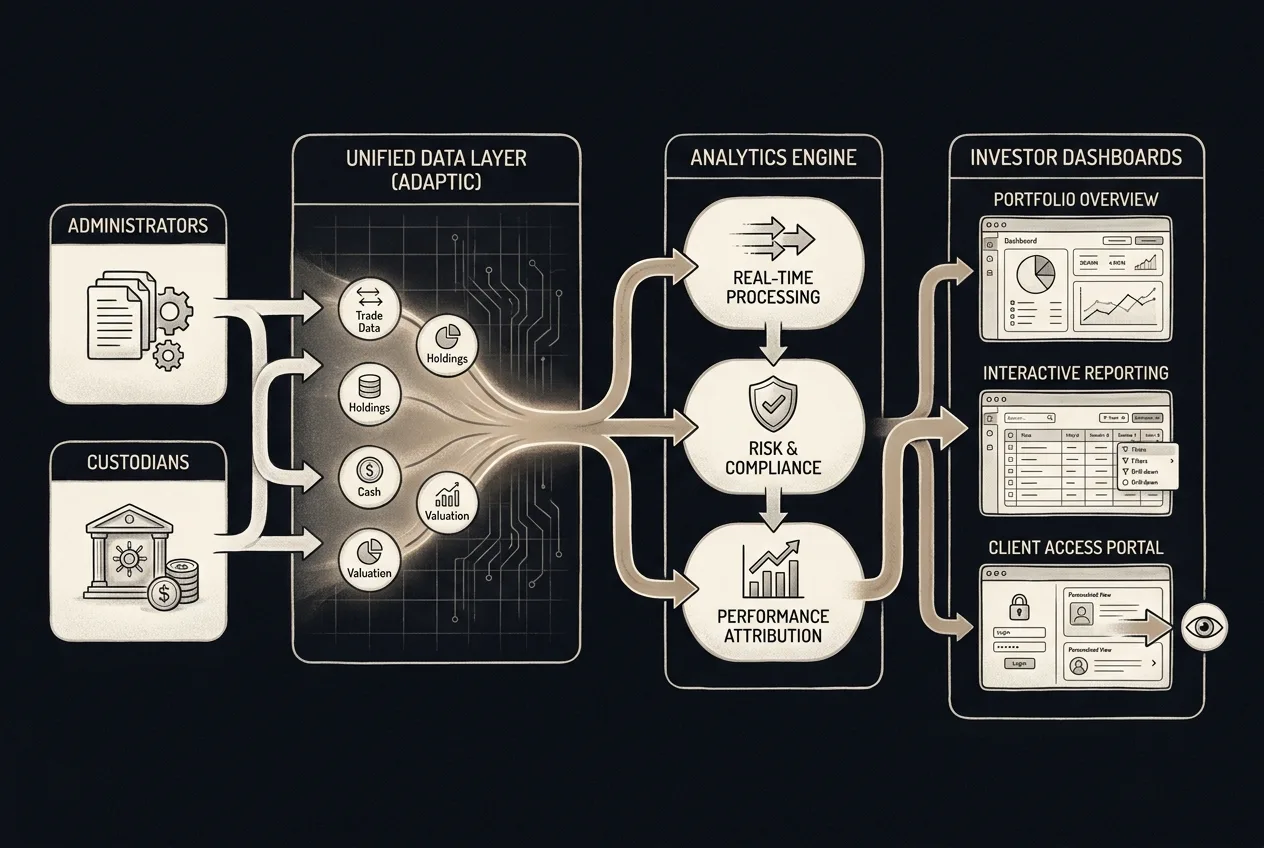
That separation — one source of truth, many presentation layers — is what makes tiering tractable. The data infrastructure stays unified, so every tier reconciles to the same numbers by construction; the presentation layer adapts to the sophistication of each recipient. The alternative, maintaining a distinct report pipeline per audience, guarantees that the tiers will eventually disagree, and that the disagreement will surface in front of an allocator at the worst possible moment.
The economics follow directly. When each audience requires its own assembly process, responding to a new investor or a new custom view is a fresh unit of work, and operational cost scales linearly with the investor base. When every view is a configuration over a shared record, the marginal cost of an additional investor or a new cut of the data approaches zero. Reporting capacity then scales with the quality of the data model, not the size of the investor-relations team.

Visualization in service of precision
Moving from documents to portals changes what good presentation means. A dense table of numbers was acceptable on a printed page where the reader had no alternative; in an interactive environment, where investors expect to extract insight quickly, the same table is a failure of design.
The principles here are well established in data analytics and still unevenly implemented across asset management. Time series should be interactive — selectable date ranges, toggled comparisons, precise values on hover. Attribution reads most clearly as waterfall or contribution charts that make each component's relative impact immediate. Risk decomposition benefits from heat maps and treemaps that reveal concentration at a glance. Drawdown is best rendered as an underwater chart that conveys magnitude and duration at once.
The non-negotiable constraint is that none of this may trade precision for polish. Institutional investors are expert readers of financial data, and they withdraw confidence the moment a platform appears to favor appearance over rigor. Every chart must be backed by the downloadable data behind it, every calculation transparent in its methodology, every visualization a faithful rendering of the underlying numbers. The visual layer is allowed to make the record easier to read; it is never allowed to become a second, prettier version of it.
The record is only as good as its inputs
A queryable record is worthless if what flows into it is stale or wrong, and the most consequential inputs originate outside the manager's walls — at fund administrators and custodians. A platform that cannot ingest directly from these counterparties through automated interfaces inherits the latency and error rate of manual transfer no matter how elegant its dashboards are. The integrity of every downstream view is set at the boundary where external data arrives.
The discipline, then, is direct ingestion: API connections or secure file transfer with the relevant administrators and custodian banks, pulling NAV, position files, transaction records, cash balances, and corporate-action notifications without human re-keying. This does more than remove a bottleneck. It establishes a reconciliation framework in which discrepancies between the manager's internal records and the administrator's official books are detected and resolved as a matter of routine, rather than discovered weeks later when a report fails to tie out. Reconciliation stops being a periodic event and becomes a continuous property of the system.
For a manager working across multiple administrators, fund structures, and jurisdictions, this ingestion-and-reconciliation layer is the foundation the entire reporting chain rests on. Without it, real-time reporting is aspiration dressed as capability. With it, the path from source event to investor-facing view runs end to end with minimal manual intervention — which is precisely what allows the same record to be trusted whether it is read by a regulator, an allocator, or the manager.
What real-time transparency is not
Continuous transparency is a discipline, not a default setting, and treating it as an unqualified good is how firms get it wrong. Three constraints govern any honest implementation.
The first is material non-public information. A position-level feed exposed in real time can constitute MNPI, and an allocator who sees live holdings before they are public may be constrained from trading on that knowledge — or worse, may not be. Real-time disclosure therefore has to be designed alongside information barriers, deliberate disclosure lags on sensitive positions, and a clear policy on who may see what and when. More transparency is not strictly better; the right transparency, governed explicitly, is.
The second is the difference between intraday figures and books of record. A live NAV estimate is an operational signal, not an audited, administrator-confirmed number, and presenting the two as interchangeable invites disputes that erode exactly the trust the system is meant to build. Real-time views must be labeled for what they are — provisional, pre-reconciliation — with the authoritative figure clearly distinguished once the administrator confirms it. Latency between the two is not a defect to hide; it is a fact to disclose.
The third is the governance boundary itself. Automating the path from source event to investor view removes humans from data movement, and that is the goal — humans should govern the system, not hand-key its outputs. But governance does not disappear; it moves upstream, to who defines the reconciliation rules, who approves a disclosure policy, who signs off on the methodology behind a published number. Automation earns trust only when a person remains accountable for the rules the machine executes. A reporting system that obscures who is responsible for what has not achieved transparency; it has merely relocated the opacity.
The transparency premium
With those constraints respected, the case for this architecture extends well beyond operational efficiency. Reporting quality increasingly influences capital allocation directly, creating what amounts to a transparency premium for managers who build the underlying record properly.
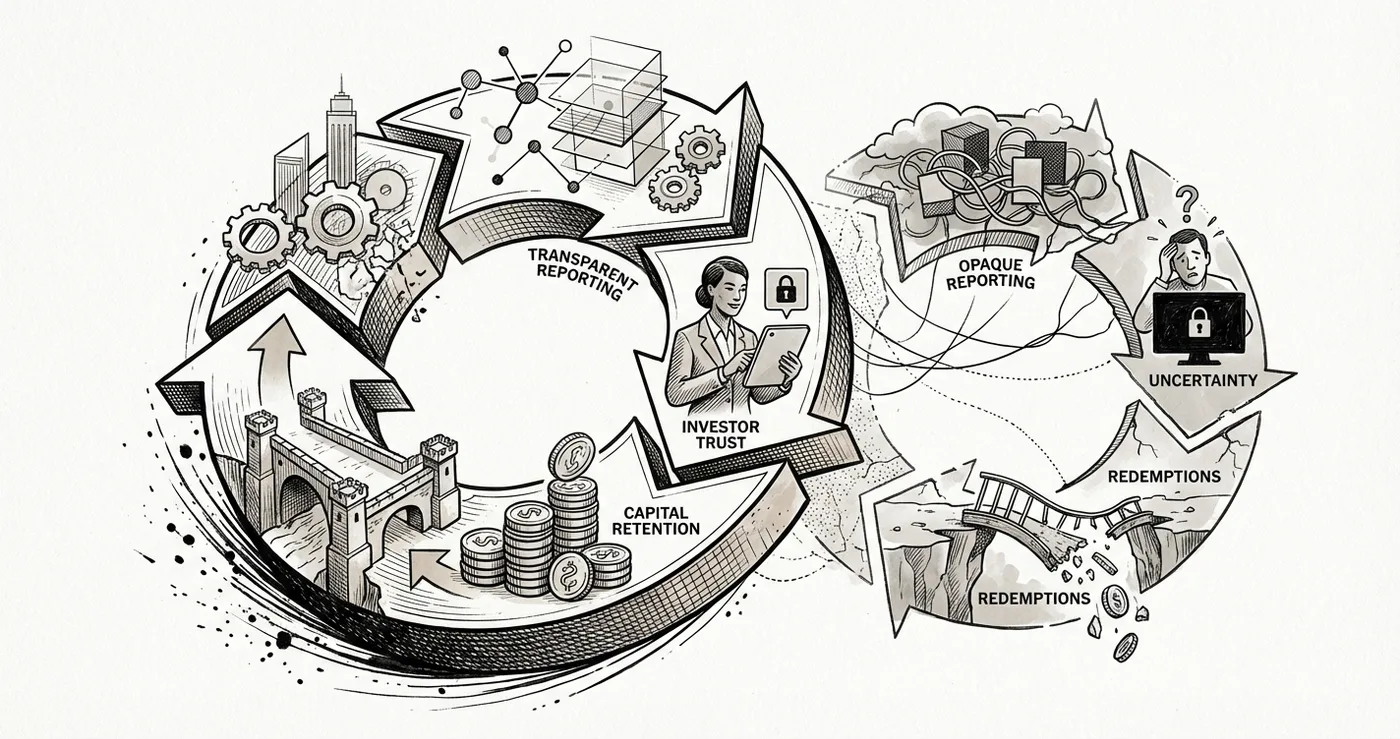
Allocators conducting manager due diligence now evaluate reporting capabilities alongside performance, risk management, and operational controls. Inadequate reporting and transparency are reasons an allocator declines a mandate or trims an existing one. Managers offering superior reporting, by contrast, can expect shorter due-diligence timelines, higher conversion from pipeline to allocation, and stronger retention through periods of underperformance.
The retention point deserves emphasis, because it is where the architecture pays for itself. Every manager will have periods of disappointing returns. When they arrive, a manager whose investors have had continuous, verifiable visibility into the portfolio is in a fundamentally different position from one whose first substantive contact in months is a letter explaining the loss. Trust assembled in advance cannot be manufactured under pressure. A continuously legible record contextualizes a drawdown within the portfolio and market that produced it, which reduces the reactive redemptions that come from investors filling an information vacuum with their worst assumptions. This is proof in place of reassurance — the record itself, not the commentary wrapped around it, is what holds the relationship.
The direction of travel is clear. Investor reporting is moving from a back-office compliance exercise to a front-office discipline, and the underlying shift is not from slow to fast but from a report that is assembled to a record that is queried. Managers who build the record once — governed at the top, ingested cleanly at the edges, exposed at whatever resolution the recipient is entitled to see — earn a reporting surface that serves allocators, regulators, and their own operators from the same source of truth. Those who keep reconstructing the quarterly PDF will find that surface, and the universe of allocators willing to trust it, narrowing with each passing year.