The Rise of Multi-Strategy Funds: Architecting Diversified Alpha Engines
How institutional multi-strategy funds combine equity, macro, quantitative, and event-driven approaches into a single book governed by one risk model, one record, and one compliance surface.


A multi-strategy platform running two hundred portfolio managers across equities, macro, credit, and systematic strategies holds, at any moment, a single net exposure to the technology sector, a single firm-wide Value at Risk, and a single answer to a regulator asking what the firm owns. None of those numbers exists inside any one pod. Each is a property of the whole book, and producing it correctly, continuously, and fast enough to act on is the problem the multi-strategy model is built to solve. That is why the single-strategy hedge fund, once the dominant structure in alternative asset management, has steadily lost ground to it. Firms like Citadel, Millennium Management, Balyasny, and Point72 have shown that combining many independent investment teams under one organizational umbrella produces risk-adjusted returns that are difficult to replicate through fund-of-fund allocations or single-strategy mandates.
The multi-strategy model is not merely a diversification play. It treats investment management as a platform business rather than a collection of independent craftspeople, and the platform's defining requirement is structural: many books that trade independently must resolve into one book that is risked, financed, and reported as a single entity. Understanding why the model has ascended means examining the organizational architecture, technology infrastructure, and risk frameworks that make that resolution possible. The multi-strategy fund is as much an engineering achievement as a financial one.
The Pod Structure: Decentralized Alpha, Centralized Risk
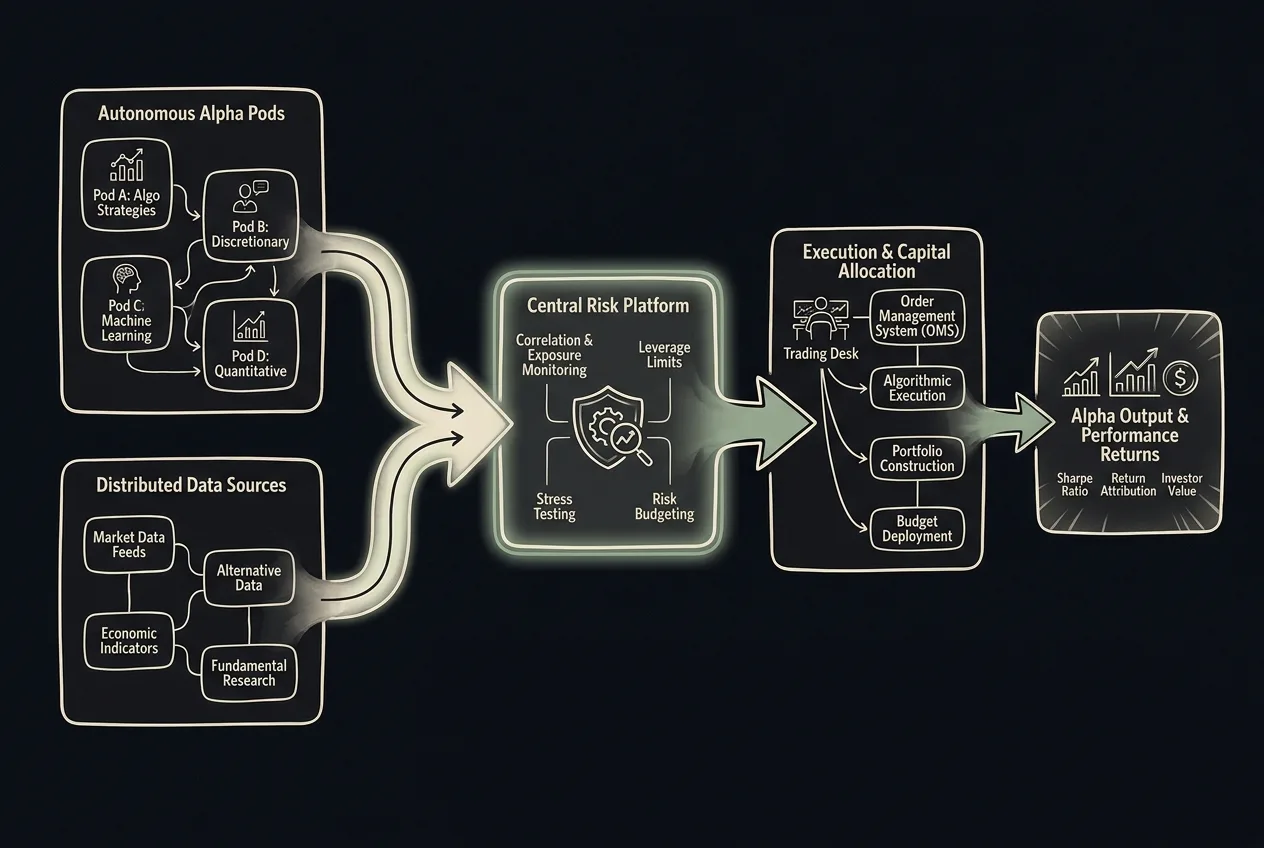
The defining organizational feature of the modern multi-strategy fund is the pod structure. Each pod is an autonomous investment team, typically comprising a portfolio manager and a small group of analysts, that operates a specific strategy within defined risk parameters. A large multi-strategy platform might operate fifty to two hundred pods simultaneously, spanning fundamental long/short equity, systematic equity, global macro, fixed income relative value, event-driven, quantitative, and commodity strategies.
Each pod functions as something close to an independent business. The portfolio manager has discretion over security selection, position sizing, and timing within their allocated capital and risk budget. They are compensated primarily on the alpha they generate, creating strong alignment between individual incentives and firm performance. This decentralization of investment decision-making is deliberate. It preserves the entrepreneurial intensity and specialization that drive alpha generation while embedding each pod within a framework that manages the aggregate risk of the enterprise.
The critical insight of the pod model is that alpha generation and risk management are separable concerns that benefit from opposite organizational structures. Alpha generation benefits from decentralization, specialization, and autonomy. Risk management benefits from centralization, standardization, and comprehensive oversight. The pod structure holds both at once, and the boundary between them is precisely where multi-strategy platforms succeed or fail. Decentralized decisions are only safe if they land in a centralized record. The moment a pod's positions live in a spreadsheet, a separate execution system, or a reconciliation that runs overnight, the firm has lost its single view of risk during exactly the hours when that view matters most. The doctrine that makes the structure work is narrow and unforgiving: humans govern, machines operate. Portfolio managers exercise discretion within their mandate; the system enforces the limits, captures every fill, and computes the aggregate, without a manager in the loop to slow it down or a reconciliation gap to hide an exposure.


Capital Allocation: The Internal Marketplace
Capital allocation within a multi-strategy fund operates as an internal marketplace, and the sophistication of this allocation process is a primary differentiator between platforms. At the simplest level, capital flows toward pods that are generating alpha and away from pods that are not. But the allocation decision is far more nuanced than a simple ranking of recent returns.
Effective capital allocation considers the capacity of each strategy, the marginal contribution of each pod to portfolio-level risk-adjusted returns, the correlation structure between pods, the current opportunity set in each pod's domain, and the liquidity profile of each pod's positions. A pod generating strong returns in a capacity-constrained niche may receive less incremental capital than a pod generating moderate returns in a deep, liquid market where the strategy can scale.
The reallocation cadence varies across firms. Some platforms conduct formal capital reviews quarterly, adjusting pod allocations based on a combination of quantitative performance metrics and qualitative assessments of strategy outlook. Others operate more dynamically, with risk officers authorized to reduce or increase pod allocations on shorter timeframes in response to changing market conditions or shifts in the opportunity set.
The speed and precision of capital reallocation is a structural advantage of the multi-strategy model over fund-of-fund alternatives. When an institutional investor allocates to a fund of funds, reallocating capital between underlying managers requires redemption notices, lock-up periods, and administrative processing that can take months. Within a multi-strategy platform, capital can move between pods in days or even hours, allowing the firm to respond to changing conditions with an agility that external allocation cannot match.
That agility is not free, and the cost structure is the model's most honest objection. Multi-strategy platforms pass through trading, technology, financing, and operating expenses to investors, then layer a performance fee on top, so the all-in cost to an allocator routinely exceeds the headline of a traditional two-and-twenty fund. The model earns that premium only if the platform converts capital into net-of-fee alpha that the allocator could not assemble more cheaply elsewhere. The reallocation machinery is one of the few mechanisms that justifies the drag: capital that moves quickly toward the best risk-adjusted opportunity and away from a decaying one recovers, in compounding terms, much of what the fee structure consumes. A platform that reallocates slowly is paying platform-level costs for fund-of-fund responsiveness.
Risk Budgeting Across Strategies
The risk management architecture of a multi-strategy fund must solve a problem that does not exist in single-strategy firms: aggregating and managing risk across fundamentally different types of investment activity. A long/short equity pod's risk is primarily driven by factor exposures and idiosyncratic stock selection. A global macro pod's risk is driven by interest rate sensitivity, currency exposure, and sovereign credit risk. A quantitative pod's risk may be driven by model parameters and data dependencies that have no analog in fundamental strategies.
Risk budgeting begins with defining the total risk capacity of the firm, typically expressed as a target volatility for the aggregate portfolio, a maximum drawdown tolerance, or a Value at Risk limit. This aggregate budget is then decomposed into individual pod allocations. Each pod receives a risk budget expressed in terms relevant to its strategy: gross and net exposure limits, sector concentration limits, position-level VaR limits, drawdown stop-losses, and factor exposure constraints.
These limits are only as good as their point of enforcement. A budget that exists in a risk report read the morning after is a description of a breach, not a defense against one. The enforcement that holds a two-hundred-pod book together lives at the pre-trade boundary, where every order is checked against the firm's limit set before it reaches the market — gross and net caps, single-name concentration, factor exposure, restricted lists, and regulatory thresholds, evaluated as policy-as-code across the entire book rather than as guidance distributed to each desk. Expressed this way, a limit is one definition applied uniformly to every pod, versioned, testable, and auditable, instead of an instruction that each team interprets and that drifts pod by pod. When a portfolio manager's mandate changes, the firm edits the policy, not two hundred local configurations.
The critical challenge is that the sum of individual pod risk budgets must be consistent with the aggregate firm-level risk target, after accounting for the diversification benefit of running multiple imperfectly correlated strategies. This requires estimating the correlation structure between pods, which is itself a complex and dynamic problem. Correlations between strategies are not stable. They tend to increase during market stress, precisely when the diversification benefit is most needed and most likely to disappoint.
Sophisticated multi-strategy platforms address this through stress-testing frameworks that estimate portfolio behavior under various correlation regime assumptions. Rather than relying on a single correlation matrix derived from recent history, the risk system evaluates portfolio exposure under normal correlations, elevated correlations consistent with moderate stress, and crisis-level correlations observed during historical tail events. Risk budgets are calibrated to ensure that the portfolio remains within acceptable bounds even under adverse correlation scenarios.

Correlation Monitoring and Regime Detection
Diversification across pods is an assumption, and correlation monitoring is how a platform tests it continuously rather than discovering its failure in a drawdown. Rising correlations between ostensibly independent strategies signal that the portfolio's true diversification is lower than it appears, and that a single dislocation could produce losses across many pods at once. The measurement is only as trustworthy as the record it runs on: correlations computed from each desk's separately maintained returns inherit every gap and timing mismatch between those systems, which is why this analysis belongs on the same unified ledger that books the positions.
Correlation monitoring operates on multiple timescales. Long-horizon correlations, estimated over months or quarters, inform strategic risk budgeting and capital allocation decisions. Short-horizon correlations, estimated using rolling windows of days or weeks, provide early warning of regime shifts. Intraday correlations, computed from tick-level returns, can reveal crowded trades or common factor exposures that are not apparent at lower frequencies.
Regime detection models attempt to identify transitions between market states that have materially different correlation structures. A common approach uses hidden Markov models to classify market conditions into regimes, such as low-volatility trending, high-volatility mean-reverting, or crisis, and estimates a separate correlation matrix for each regime. When the model detects a regime transition, risk budgets and hedging overlays can be adjusted proactively rather than reactively.
The practical challenge is that regime detection models are inherently noisy and subject to false positives. A risk management system that aggressively de-risks on every signal will incur substantial opportunity costs. The most effective implementations use regime signals as one input among many in a Bayesian framework that also incorporates macroeconomic indicators, market microstructure signals, and qualitative judgment from experienced risk officers.
Shared Infrastructure: The Platform Advantage
The economic case for the multi-strategy model rests substantially on the shared infrastructure that a platform provides to its constituent pods. Building and maintaining institutional-grade trading infrastructure, including execution management systems, market data feeds, risk analytics, compliance surveillance, operations processing, and technology infrastructure, requires enormous investment. A standalone fund managing a few hundred million dollars cannot justify the cost of best-in-class infrastructure in each of these domains. A multi-strategy platform managing tens of billions can.
The infrastructure advantage manifests in several concrete ways. Execution infrastructure, including direct market access, smart order routing, and transaction cost analysis, improves fill quality and reduces implementation costs for every pod on the platform. A sophisticated execution management system that routes orders intelligently across venues, manages market impact, and monitors execution quality can save several basis points per trade, a material advantage when compounded across thousands of trades per day.
Market data infrastructure provides each pod with access to a comprehensive data universe that would be prohibitively expensive for any individual pod to acquire independently. Real-time data feeds from global exchanges, alternative data sources including satellite imagery, credit card transactions, and natural language processing of news and filings, and historical databases spanning decades of tick data are available to every pod on the platform.
Risk and compliance infrastructure provides centralized oversight without imposing centralized decision-making, and it is the part of the platform where the architecture matters most. Every pod's positions flow through a unified risk system that computes firm-wide exposures, monitors regulatory limits, and enforces pre-trade compliance checks. The requirement underneath that sentence is exacting: one book, one risk model, one compliance surface. Firm-wide exposure is only correct if every pod writes to the same record of positions and fills — not a nightly export from each desk's own system, stitched together by a reconciliation job, but a single source of truth that every order updates as it executes. The alternative, a lattice of point tools bridged by overnight files, is how a platform discovers a concentrated factor exposure a day late, after the loss. A unified record means no individual pod can inadvertently create an outsized exposure the firm cannot see in real time, while each pod still operates with substantial autonomy within its allocated risk budget. The same record carries the attribution spine: because every position and fill is tagged to its pod on one ledger, the firm can decompose a day's profit and loss to the desk, the strategy, and the factor without a separate attribution pipeline that may disagree with the books.
Technology infrastructure, including compute clusters, network connectivity, and development tools, benefits from economies of scale. A platform can justify investment in high-performance computing infrastructure, low-latency network connections to exchanges, and dedicated engineering teams that maintain and evolve the platform's technology stack. These resources are shared across all pods, reducing the per-pod cost while raising the quality of the infrastructure available to each.

The Citadel and Millennium Models
While the multi-strategy concept is broadly shared, the specific implementations at leading firms reveal important architectural differences. Citadel operates a relatively concentrated model with fewer, larger pods and substantial centralized risk-taking. The firm's centralized quantitative risk management and execution infrastructure is deeply integrated, and the CIO maintains meaningful influence over aggregate portfolio construction. This model emphasizes coordination and coherence across the portfolio.
Millennium Management operates a more decentralized model with a larger number of smaller pods, each operating with greater autonomy. The firm's risk management is enforced primarily through hard limits on individual pod drawdowns, with automatic capital reduction triggered when a pod exceeds its loss threshold. This model emphasizes entrepreneurial independence and rapid capital reallocation, with less emphasis on centralized portfolio optimization.
Both models have produced exceptional long-term track records, suggesting that the multi-strategy framework is robust to significant variation in implementation details. The common elements, decentralized alpha generation, centralized risk management, shared infrastructure, and dynamic capital allocation, appear to be more important than the specific choices made within each dimension.
Challenges and Limitations
The multi-strategy model is not without challenges. Talent acquisition and retention is perhaps the most significant. The model depends on attracting and retaining skilled portfolio managers who are willing to operate within a platform's risk constraints rather than running their own independent funds. Compensation structures must be sufficiently attractive to recruit top talent while maintaining the firm's economic model.
Complexity is the cost of the structure, and it scales faster than headcount. Managing a platform with dozens or hundreds of pods across different asset classes and geographies creates operational and technological complexity that compounds with every desk added. The instinctive response is to staff against it — more risk analysts, more operations headcount, more middle-office reconciliation. That response does not scale, because each new pod adds connections to every existing one, and a coordination cost that grows with the square of the team cannot be solved by growing the team. The platforms that survive their own growth scale from better policy, not headcount: capacity comes from encoding limits, attribution, and compliance once, in systems that absorb the next pod at near-zero marginal effort, rather than from adding people to watch a widening surface. A firm that needs a new hire for every new manager has not built a platform. It has built a holding company for funds.
Capacity is the limit the model cannot engineer away. Many strategies that produce strong returns on hundreds of millions degrade on tens of billions, because the alpha lives in inefficiencies too small to absorb the capital. As a platform grows, it must either find new uncorrelated strategies or accept that incremental capital earns less than the capital already deployed — a constraint that no infrastructure resolves, only manages. Crowding is the same problem seen from outside the firm. As the model has grown in popularity, many pods across many platforms have converged on similar strategies, positions, and signals, producing crowded trades that unwind violently when conditions change. The events of early 2021, when several multi-strategy platforms experienced simultaneous losses in quantitative equity strategies, illustrated how a diversification that looks robust across pods can prove illusory across the industry. Pod-level risk compounds the effect: a manager facing a hard drawdown stop is forced to cut positions precisely when a crowded trade is already moving against the firm, and the platform's own deleveraging can accelerate the dislocation it was built to withstand.
Despite these challenges, the structural advantages of the multi-strategy platform model continue to attract institutional capital. The combination of diversified alpha sources, centralized risk management, shared infrastructure, and dynamic capital allocation creates a value proposition that is difficult to replicate through alternative structures. For institutional allocators seeking consistent, risk-adjusted returns with limited drawdowns, the multi-strategy fund has become, for a substantial portion of alternative portfolios, less one option among many than the default.
The firms that will define the next decade of multi-strategy investing are those that treat the platform itself as their primary product, investing continuously in the infrastructure, risk systems, and organizational design that let talented investors generate alpha while the platform governs everything else. The standard that separates such a platform from a collection of funds is whether it can prove its own state rather than assert it. Every limit enforced before a trade reaches the market, every exposure reconciled to a single record, every pod's contribution attributed on the same ledger that books the trade — these are claims a platform can demonstrate to an allocator, a regulator, or its own risk committee, on demand, rather than promises it asks to be trusted on. In this model, the fund is not a collection of strategies but an engine, and its power comes not from any single component but from the discipline with which one record, one risk model, and one compliance surface hold every component to the same truth.