Multi-Layered Risk Frameworks: Defending Institutional Portfolios in Volatile Markets
Why depth alone does not defend an institutional portfolio: the layers of a risk framework only work when the most consequential controls are enforced before the trade, every layer reads from one shared exposure model, and an audit spine links each action back to policy.


The vocabulary of institutional risk management has expanded sharply over the past decade. Where chief risk officers once spoke primarily of Value-at-Risk, tracking error, and drawdown limits, today's conversations encompass model risk, liquidity cascades, correlation regime shifts, and the emergent behavior of interacting algorithmic systems. This expansion reflects hard-won lessons rather than academic fashion. Market events repeatedly exposed the inadequacy of single-layer risk controls, and the firms that emerged strongest from the volatility of 2020, the rate shock of 2022, and the regional banking crisis of 2023 shared a common characteristic: they had built risk frameworks with genuine depth, where the failure of any single control was contained by the controls beneath it.
But depth alone is not the point, and this is where most frameworks quietly fail. A framework can have many layers and still lose money in the same predictable way, because the layers are advisory rather than enforced, and because each layer reasons from its own copy of the portfolio. The frameworks that hold under stress share two structural properties: their most important controls are enforced before a trade reaches the market, not reviewed after the loss is booked, and every layer computes risk from one shared model of exposure rather than from reconciled approximations. For institutional allocators evaluating AI-driven and algorithmic strategies, the presence of these properties — not the count of layers — is the most reliable signal that a strategy's theoretical edge will survive contact with real markets. This analysis examines the architecture of modern multi-layered risk frameworks, from pre-trade controls through real-time monitoring to post-trade analysis, and argues that the layers are only as good as the enforcement and the data model that bind them together.
The Anatomy of a Modern Institutional Risk Framework
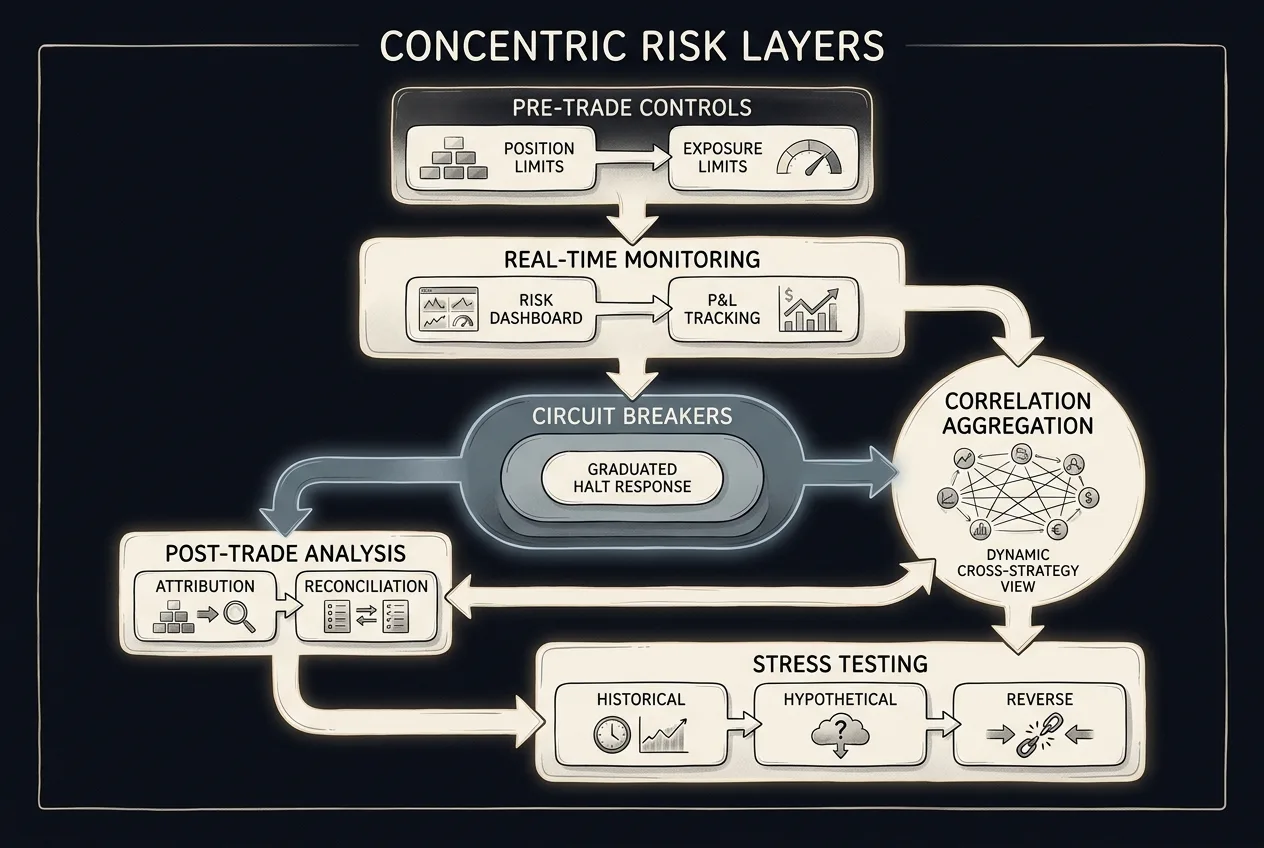
A robust institutional risk framework operates as a series of concentric defenses, each designed to catch threats that penetrate the layer above. This defense-in-depth architecture borrows from military doctrine and cybersecurity engineering, disciplines where single points of failure are unacceptable. In portfolio management, the principle translates to a system where no single control, however sophisticated, carries the entire burden of risk mitigation.
The layers of a modern framework typically include strategic asset allocation constraints, pre-trade risk validation, real-time execution monitoring, post-trade analysis and reconciliation, and portfolio-level risk aggregation with stress testing. Two design choices determine whether these layers add up to more than the sum of their parts. The first is independence of failure: a bug in the pre-trade engine must not also disable post-trade analysis, and a stalled real-time monitor must not stop the aggregation engine from flagging concentration. The second, in tension with the first, is a shared model of exposure: every layer must read from the same authoritative representation of what the portfolio holds and how much risk it is running, so that the pre-trade check, the live dashboard, and the regulatory report cannot disagree about the same position at the same moment. Independent code paths, one source of truth — the frameworks that fail under stress usually violate the second property, letting each layer maintain its own reconciled-but-divergent copy of reality until the copies drift apart precisely when accuracy matters most.
The organizational dimension is equally structural. Effective frameworks separate the teams that generate returns from those that govern risk, and the separation must be reflected in reporting lines and compensation incentives, not merely in procedure. The architectural counterpart to that human separation is the principle that humans set policy and machines enforce it: the risk function defines the limits, and the system applies them on every order without discretion at the point of execution. Accountability, in other words, is not a meeting cadence — it is encoded in who can change a limit and what the system does when one is breached.

Pre-Trade Risk Controls: The First Line of Defense
Pre-trade controls are the only layer that prevents losses rather than measuring them. Every other layer in the framework observes, attributes, or reports on risk that has already been taken; the pre-trade layer is where a dangerous order is stopped before it becomes a position. This is the practical meaning of enforcing policy before the trade instead of reviewing it after the loss, and it is the difference between a limit that is a control and a limit that is a post-mortem finding. Treated this way, the firm's risk appetite is not a document that the trading desk is trusted to honor — it is policy expressed as code, evaluated on every order, with no path to the market that bypasses it.
Because it sits on the order path, this layer is also the most time-sensitive. Validation must occur fast enough to avoid degrading execution quality: for strategies operating in liquid equity markets, that means sub-millisecond latency; for slower strategies the tolerance is greater. The principle is constant regardless of horizon — pre-trade controls must be fast enough to be invisible to the strategy and comprehensive enough to catch genuinely dangerous orders. Latency is not a reason to weaken the check; it is a constraint the check must be engineered to meet.
Position Limits and Concentration Controls
The most fundamental pre-trade control is the enforcement of position limits. These limits operate at multiple levels of granularity: per-security limits prevent excessive concentration in a single name, per-sector limits constrain industry exposure, per-asset-class limits maintain the portfolio's strategic allocation, and aggregate limits cap the portfolio's total market exposure.
Effective position limit frameworks define not only the threshold but the consequence of breaching it, and the consequence is what separates a real control from a logged warning. A useful way to structure this is to attach an action type to every limit. Some breaches should merely notify — the order proceeds and the risk team gains visibility into a position approaching its boundary. Some should be approval-gated — the order is held until a designated owner explicitly authorizes the exception, and the authorization is recorded against the limit it overrode. And some should be hard-gated — the order cannot reach the market under any circumstances, full stop, because the limit reflects a regulatory requirement or a board-approved risk appetite statement that no individual is permitted to relax in the moment. Mapping each limit to one of these responses turns "hard versus soft" from an informal distinction into an enforced policy, and it makes the system's behavior under breach predictable and auditable rather than dependent on who happens to be watching the dashboard.
For algorithmic portfolios, position limits must also account for the speed at which positions accumulate. A strategy that generates thousands of small orders per hour can respect the per-order limit every single time while collectively building a concentrated position over the course of a session — each order is individually compliant, the aggregate is not. Closing this gap requires the pre-trade check to evaluate the prospective order against the live, post-fill state of the book rather than against the order in isolation. Cumulative order flow monitoring, which tracks the net effect of all orders a strategy submits over rolling time windows, is the mechanism, and it only works when every layer reads position from the same exposure model in real time. A control that validates against a stale snapshot will wave through exactly the order that breaches the limit.
Exposure Checks and Margin Requirements
Beyond position counts, pre-trade controls validate that each order keeps the portfolio inside its target risk exposures — that it does not push beta, sector exposure, or factor loadings past defined boundaries. These are the same kind of enforced limits as position caps, simply expressed in factor space rather than notional, and they carry the same act-types: a marginal drift in factor loading might notify, while an order that would breach a hard beta ceiling is gated. For leveraged strategies, margin requirement checks ensure the portfolio holds sufficient collateral, with buffers sized for adverse moves.
Margin checks for algorithmic strategies require particular care. The rapid pace of trading can cause margin utilization to fluctuate significantly within a single trading session, and a strategy that is comfortably within margin limits in the morning may find itself in margin call territory by afternoon if market movements erode the value of its collateral. Pre-trade margin checks must incorporate not only the immediate impact of the proposed order but also a projection of how margin requirements might evolve under plausible market scenarios.
Order Validation and Anomaly Detection
The final layer of pre-trade controls validates individual orders against expected behavioral parameters. This includes checks for order size relative to average daily volume, price deviation from current market levels, and consistency with the strategy's historical ordering patterns. Orders that fail these checks are blocked or flagged for manual review.
Machine learning models are increasingly employed for pre-trade anomaly detection, trained on historical order flow to identify patterns that suggest a strategy malfunction, data feed error, or other operational issue. These models can detect subtle anomalies, such as a gradual drift in order characteristics that might indicate signal degradation, that rule-based systems would miss.

Real-Time Execution Risk Monitoring
Once orders pass pre-trade controls and enter the market, real-time monitoring systems track the execution process and its impact on the portfolio's risk profile. This layer operates on a continuous basis, processing market data, execution reports, and position updates as they occur.
Execution Quality Surveillance
Real-time execution monitoring compares the prices at which orders are filled against benchmarks such as the volume-weighted average price, the arrival price at order inception, and the theoretical price implied by the strategy's signal. Systematic deviations from expected execution quality may indicate changes in market microstructure, increased competition from other algorithmic strategies, or issues with the execution algorithm itself.
Transaction cost analysis at the real-time level enables the risk team to intervene during the trading session rather than discovering execution problems in post-trade reports. If a strategy's execution costs suddenly increase, the monitoring system can alert the risk team, who can investigate whether the cause is a temporary market condition, a broader structural change, or a problem with the strategy's execution logic.
Portfolio Risk Dashboard and Intraday P&L
The portfolio risk dashboard provides a consolidated, real-time view of the portfolio's risk profile: current exposures by asset class, sector, and geography; factor loadings relative to target ranges; realized and unrealized profit and loss; and risk utilization as a percentage of allocated limits. Its value is not the visualization but the data model behind it. When the dashboard, the pre-trade engine, and the regulatory report all read exposure from the same source, the number a risk manager sees on screen is the same number that gated the last order and will appear in the next filing. When they read from separate, periodically reconciled stores, the dashboard becomes a fourth opinion to reconcile rather than a window onto a single truth — and reconciliation lag is precisely the interval in which a breach hides.
Intraday profit and loss monitoring serves a dual purpose. It provides the risk team with visibility into the portfolio's performance trajectory, enabling early identification of strategies that are underperforming or behaving anomalously. It also enables the detection of P&L moves that are inconsistent with market movements, which may indicate data errors, position reporting issues, or unauthorized trading activity.
Automated Circuit Breakers
Automated circuit breakers are where the pre-trade act-types reappear at the portfolio level: instead of governing a single order, they govern the right of an entire strategy to keep trading. They operate at multiple levels — individual strategy drawdown limits suspend a single strategy, aggregate portfolio loss limits halt all trading, and market-wide breakers respond to extreme volatility or liquidity conditions. The same graduated logic applies. An initial breach should notify and raise monitoring intensity. An intermediate breach should reduce position, autonomously and without waiting for a human to acknowledge an alert. A severe breach should shut the strategy down and require explicit human authorization to restart. The machine operates the response in real time; the human governs whether and how trading resumes.
Calibration is the hard part, and it is a genuine tradeoff rather than a parameter to optimize away. Thresholds set too tight generate false alarms and interrupt legitimate trading, eroding both returns and the desk's trust in the control. Thresholds set too loose fail to prevent the losses they exist to prevent. There is no setting that escapes this tension; the discipline is to choose deliberately, document the reasoning, and revisit it as volatility regimes shift rather than letting a number chosen in a calm market quietly govern a violent one.

Post-Trade Risk Analysis and Reporting
Post-trade analysis is the reflective layer of the framework, examining what happened during the session and extracting lessons that inform future decisions. Its quality depends entirely on one prerequisite: a complete, append-only record of what the system did and why. If the framework cannot reconstruct, after the fact, which limit gated which order, which breach triggered which circuit breaker, and who authorized which exception, then post-trade analysis degrades into narrative reconstruction from partial logs. The layers described above only become accountable when they write to a common audit spine — a replayable, time-ordered record in which every risk action is linked back to the specific policy clause that produced it. That spine is what lets a firm answer, with evidence rather than recollection, the question every allocator and regulator eventually asks: when the control fired, why did it fire, and was it the correct response.
Performance Attribution and Factor Decomposition
Rigorous performance attribution decomposes portfolio returns into their constituent sources: alpha from the strategy's signals, returns from systematic factor exposures, the impact of execution costs, and the contribution of risk management actions such as position limits and circuit breakers. This decomposition reveals whether the strategy is generating returns from the sources its designers intended, or whether returns are being driven by unintended exposures.
Factor decomposition is particularly important for multi-strategy portfolios, where the interaction between strategies can create emergent factor exposures that are not present in any individual strategy. A portfolio that runs both a momentum strategy and a mean-reversion strategy, for example, may have lower aggregate factor exposure than either strategy individually, but the net exposure may shift unpredictably as relative signal strength varies.
Reconciliation and Data Integrity
Post-trade reconciliation verifies that the portfolio's internal records are consistent with the records maintained by custodians, prime brokers, and execution venues. Discrepancies may indicate operational errors, settlement failures, or more serious issues such as unauthorized trading. Automated reconciliation systems can process thousands of positions and transactions daily, flagging exceptions for manual investigation.
Data integrity checks extend beyond position reconciliation to encompass the market data and reference data that feed into risk calculations. A risk metric computed from corrupted market data is worse than useless, as it provides false confidence. Post-trade data integrity verification ensures that the inputs to risk calculations were accurate and complete.
Regulatory Risk Reporting
Institutional asset managers operate under regulatory frameworks that mandate specific risk reports at defined frequencies. These requirements vary by jurisdiction and fund structure but commonly include AIFMD Annex IV reporting for European alternative investment funds, Form PF for SEC-registered private fund advisers, MAS regulatory returns for Singapore-licensed fund managers, and DIFC risk reporting for Dubai-domiciled funds.
Each reporting regime has its own data requirements, calculation methodologies, and submission deadlines, but the architectural requirement is the same across all of them. A robust framework produces every regulatory report from the same exposure model and the same audit spine that drive internal risk management, so that the figure filed with a regulator is provably the figure the firm acted on. This is the single-data-model principle carried to its conclusion: internal and regulatory views of risk cannot diverge because they are computed from one source. Manual production of reports from separate data stores reintroduces precisely the drift the framework exists to eliminate, and the resulting inconsistencies between internal and filed numbers are a recurring source of regulatory scrutiny.
Tail Risk Management and Black Swan Preparation
The most challenging aspect of institutional risk management is preparing for events that, by definition, lie outside the range of normal experience. Tail risk management requires a fundamentally different mindset from day-to-day risk monitoring: rather than asking "what is the most likely outcome," it asks "what is the worst plausible outcome, and can the portfolio survive it."
Fat Tails and the Limits of Normal Distributions
Financial return distributions exhibit fat tails, meaning that extreme events occur far more frequently than a normal distribution would predict. For algorithmic strategies, fat tails are particularly dangerous because the strategies' risk models may underestimate the probability of extreme moves, the strategies' execution assumptions may break down during extreme volatility, and the liquidity environment during tail events may be radically different from normal conditions.
Tail risk management begins with acknowledging these realities and incorporating them into the risk framework. This means using return distributions that explicitly model fat tails, such as generalized hyperbolic distributions or empirical distributions derived from historical data, rather than relying on Gaussian assumptions.
Portfolio Hedging Strategies
Explicit tail risk hedging, through options strategies, volatility products, or crisis alpha allocations, provides a direct form of protection against extreme market events. The challenge lies in managing the cost of this protection, which represents a persistent drag on returns during normal market conditions.
Institutional approaches to tail risk hedging range from systematic put-buying programs that maintain a constant level of downside protection to dynamic hedging strategies that increase protection as market conditions deteriorate. The optimal approach depends on the portfolio's specific risk profile, the cost tolerance of its investors, and the nature of the algorithmic strategies being hedged.
Black Swan Playbooks
Beyond quantitative hedging, institutional risk frameworks increasingly include qualitative playbooks for responding to extreme events. These playbooks define decision-making authority during crises, specify communication protocols for investors and regulators, establish criteria for suspending normal trading operations, and outline procedures for orderly position liquidation under stressed conditions.
The value of these playbooks lies not in their ability to predict the specific nature of the next crisis, which is by definition unknowable, but in their ability to impose structure and discipline on decision-making during periods of extreme uncertainty. Teams that have rehearsed their crisis response through tabletop exercises and simulation drills consistently perform better during actual crises than teams that must improvise under pressure.
Correlation Risk and Portfolio-Level Aggregation
One of the most insidious risks in multi-strategy portfolios is the breakdown of correlation assumptions during market stress. Strategies that appear uncorrelated under normal conditions may exhibit sudden, dramatic increases in correlation during crises, as the common factor exposures that were negligible in calm markets become dominant under stress.
Dynamic Correlation Monitoring
Static correlation matrices, estimated from historical data, provide an inadequate basis for understanding the portfolio's true diversification characteristics. Modern risk frameworks employ dynamic correlation models that update continuously as market conditions change, capturing the time-varying nature of cross-strategy relationships.
Dynamic conditional correlation models, regime-switching models, and copula-based approaches each offer different perspectives on the portfolio's correlation structure. The most robust frameworks employ multiple models simultaneously, using the divergence between model estimates as an additional risk indicator. When models that normally agree begin to disagree about the portfolio's correlation structure, it may signal that a correlation regime shift is underway.
Aggregated Risk Metrics
Portfolio-level risk aggregation combines the risk profiles of individual strategies into a unified view of the portfolio's total risk. This aggregation must account not only for the risks within each strategy but also for the interactions between strategies, including correlation effects, shared factor exposures, and the potential for cascading failures.
The principal challenge in risk aggregation is achieving consistency across strategies that may use different risk models, different time horizons, and different risk measures. A portfolio that runs both a high-frequency market-making strategy and a medium-term statistical arbitrage strategy must find a common framework for comparing and combining their risk profiles. This typically involves mapping each strategy's positions to a common set of risk factors, computing factor exposures at the portfolio level, and applying portfolio-level stress tests that capture cross-strategy interactions.

Stress Testing Methodologies for Algorithmic Portfolios
Stress testing for algorithmic portfolios must go beyond the static scenario analysis used for traditional portfolios. Because algorithmic strategies will respond to market stress by executing trades, the stress test must simulate the full feedback loop between market conditions, strategy behavior, and portfolio outcomes.
Historical Scenario Replay
Historical scenario replay subjects the portfolio's current positions and strategies to market conditions drawn from past crisis periods. For algorithmic strategies, this involves not merely repricing current positions at historical stress levels but simulating how the strategies would have traded during the crisis, including their responses to changing signals, their execution under stressed liquidity conditions, and the impact of their circuit breakers and risk limits.
The selection of historical scenarios should include both well-known crisis events, such as the 2008 financial crisis, the 2020 pandemic shock, and the 2022 rate tightening cycle, and less prominent but instructive episodes, such as the 2015 Swiss franc de-pegging, the 2018 VIX spike, and various emerging market currency crises.
Hypothetical Scenario Construction
Hypothetical scenarios allow risk managers to explore threats that have no exact historical precedent. These scenarios are particularly valuable for algorithmic portfolios because they can be tailored to the specific vulnerabilities of the strategies being tested. A portfolio with significant exposure to equity momentum, for example, should be stress-tested against a momentum crash scenario with characteristics calibrated to produce maximum damage to the specific factor exposures in the portfolio.
Reverse stress testing, which starts from a defined loss level and works backward to identify the market scenarios that could produce that loss, is an especially powerful technique for algorithmic portfolios. By identifying the conditions under which the portfolio would experience its maximum defined loss, reverse stress testing reveals the portfolio's specific vulnerabilities and enables targeted risk mitigation.
The Role of Machine Learning in Predictive Risk Analytics
Machine learning is increasingly integrated into institutional risk frameworks, not to replace traditional risk models but to augment them with capabilities that conventional approaches cannot provide.
Predictive models trained on market microstructure data can provide early warning of deteriorating liquidity conditions, enabling proactive position reduction before a liquidity crisis materializes. Anomaly detection algorithms can identify unusual patterns in strategy behavior that may indicate model degradation, data quality issues, or changing market dynamics. Natural language processing applied to news feeds and social media can detect emerging risks before they are reflected in market prices.
The application of machine learning to risk management requires careful governance, and the governing principle is consistency: a model used to predict risk must meet the same validation, monitoring, and documentation standards as a model used to generate alpha, and its outputs must be recorded on the same audit spine so that a risk action driven by a model can be traced back to the model version and inputs that produced it. The honest limitation is structural. Overfitting is especially acute in risk applications because the events of greatest interest — extreme moves and strategy failures — are by definition rare in the historical data the models learn from. A machine-learning risk signal is therefore best treated as an additional input to an enforced control, not as the control itself; the enforcement still rests on explicit, human-governed policy, which is exactly why that policy must remain legible and auditable rather than delegated to a model no one can interrogate after the fact.
Conclusion
A multi-layered risk framework is not a one-time engineering project but a standing institutional commitment. Markets evolve, strategies adapt, regulations change, and the framework must evolve in parallel. The firms with the most effective risk management treat it not as a brake on trading but as the foundation that lets them deploy capital deliberately, because they understand in granular detail the risks they are taking and can prove how those risks are contained.
But the lesson worth carrying out of this analysis is narrower than "build more layers." Depth without enforcement is theater, and enforcement without a single source of truth is a collection of controls that will eventually contradict each other under stress. The frameworks that hold are the ones where the most consequential limits are enforced on the order path before a position exists, where every layer reasons from one shared exposure model, and where an audit spine links every risk action back to the policy that produced it. Those three properties are also what let a manager grow exposure through better policy rather than through a larger risk team: when limits are code and accountability is architecture, the framework scales with the portfolio instead of with headcount.
For allocators, this reframes due diligence. Any manager can describe an impressive strategy and produce a slide listing its risk layers. The questions that actually separate operational maturity are sharper: Which limits are enforced before the trade, and which are merely reviewed after it? Does every layer compute risk from the same data, or from reconciled approximations that can drift? Can the firm read back any past decision and show which policy clause governed it? Adaptic is built so that these questions have demonstrable answers rather than reassuring ones — every order checked against the account's trading policy before it reaches the broker, real-time exposure computed on a single model, and an append-only record of trade and governance decisions. Humans govern the policy; the machine operates it on every order. We regard institutional-grade risk management not as a feature but as a prerequisite, and we would rather it be inspected than described.