Market Microstructure Alpha: Extracting Signals from Order Book Dynamics
Order flow, book imbalance, and toxicity metrics carry real short-horizon information. We examine the mechanisms, where the alpha decays, and how to feed these signals into a governed execution system rather than a black box.


A single large-cap US equity can generate hundreds of thousands of order book events on an active trading day: bids and offers arriving, cancelling, and modifying at the millisecond scale. Each event is a small disclosure. A large limit buy resting deep in the book, a rapid burst of marketable sells, a flicker of placement and cancellation at the touch — every one reflects the intentions, beliefs, and constraints of a participant who would rather you did not see them clearly. The limit order book is the most information-dense data structure in financial markets, and for decades reading it was the exclusive domain of market makers and exchange specialists. That is no longer true. Institutional investors with the right infrastructure can extract meaningful short-horizon signal from order book dynamics, turning what was once operational plumbing into a systematic input.
The honest framing matters more than the promise. Market microstructure, the discipline concerned with how prices form and how trading mechanisms shape outcomes, has produced a deep theoretical foundation for these signals. But microstructure alpha is among the most fragile in the market: it decays in milliseconds to minutes, it is sharply capacity-constrained, and it competes against participants whose entire business is being faster than you. The practitioner's task is not to discover that order flow is informative, which is well established, but to translate that theory into something that survives transaction costs, latency, and competition, and to use it where an institution actually holds an edge.
The Information Content of Limit Order Flow
Every order submitted to an exchange carries information, but not all orders are created equal. A large limit buy order placed deep in the book may reflect a passive institutional accumulation strategy. A rapid succession of small marketable sell orders may indicate an algorithm liquidating a position under time pressure. A pattern of order placement and cancellation near the best bid or offer may signal a market maker adjusting inventory or a high-frequency trader probing for hidden liquidity.
The foundational insight, articulated by Glosten and Milgrom in 1985 and formalized in Kyle's lambda framework, is that order flow carries adverse selection risk. When an informed trader submits an aggressive order, the counterparty, typically a market maker, faces a systematic loss. The market maker responds by widening the spread, pricing in the probability that incoming flow is informed. The critical reframing for a practitioner is that the adverse selection component of the spread is not only a cost of trading; it is a measurable read on the information content of recent flow. The same quantity that prices your execution can, observed carefully, tell you something about where price is heading.
The practical work, then, is separation. Modern implementations decompose order flow into permanent and transient components: the permanent component reflects genuine information being incorporated into price, while the transient component reflects temporary liquidity imbalances, inventory adjustments, and noise. A strategy that cannot tell them apart trades on the transient component, which mean-reverts, and pays in both false signals and transaction costs. Most of the engineering in this domain is spent on that one distinction.
Book Imbalance as a Short-Term Directional Signal

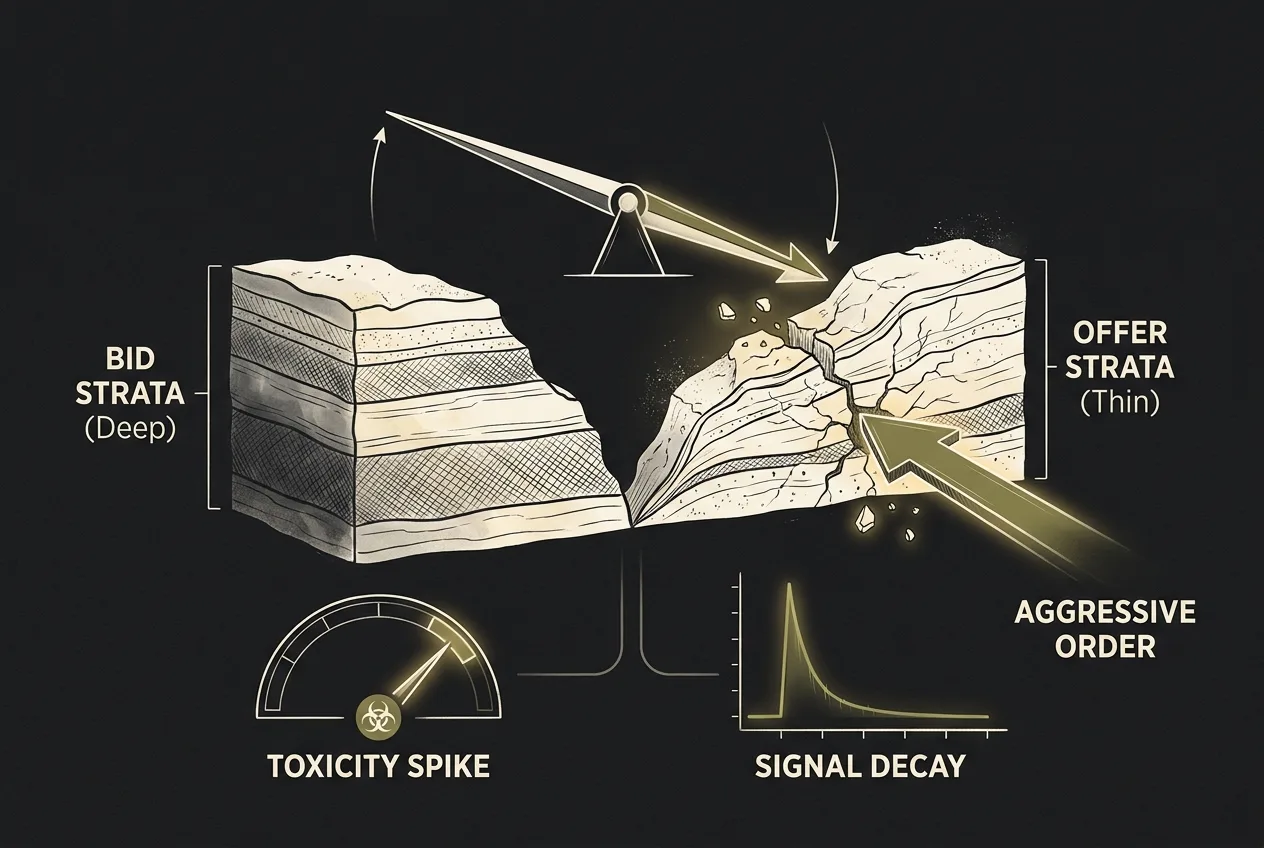
Among microstructure features, order book imbalance is perhaps the most extensively studied and most reliably predictive at short horizons. Book imbalance measures the relative weight of resting buy orders versus sell orders near the top of the book. A simple formulation compares the total volume at the best bid to the total volume at the best offer, but more sophisticated versions weight multiple levels of the book, apply decay functions to deeper levels, and normalize for time-of-day and security-specific patterns.
The predictive logic is straightforward. When buying interest, as reflected in resting limit orders, substantially exceeds selling interest at the top of the book, the next price movement is statistically more likely to be upward. This occurs because aggressive sellers arriving at the market will consume the relatively thin offer side more quickly, triggering price increments. The converse holds for sell-heavy imbalances.
The constraint is the half-life. Empirical research consistently finds that book imbalance predicts returns at horizons from milliseconds to several minutes, with signal strength decaying rapidly as new flow and cancellations equilibrate the book. At the holding periods most institutions actually trade, hours to days, raw book imbalance has little direct predictive power, and any pitch that it does should be treated with suspicion. Its value to an institutional desk lies elsewhere: in optimizing execution timing within a longer-horizon decision already made on other grounds, and as one component feature among many in models that combine microstructure data with fundamental and technical signals. The signal does not set the position; it sharpens how the position is acquired.
Trade Flow Toxicity and Order Flow Imbalance Metrics

Beyond the static snapshot of the order book, the sequence and characteristics of executed trades carry significant information. Trade flow toxicity metrics attempt to measure the degree to which recent order flow is dominated by informed participants, providing an early warning system for adverse price movements and liquidity deterioration.
The Volume-Synchronized Probability of Informed Trading (VPIN) metric, developed by Easley, Lopez de Prado, and O'Hara, estimates the probability that recent trading volume was initiated by informed participants. VPIN partitions trades into volume buckets rather than time intervals, accumulates buy-initiated and sell-initiated volume within each bucket, and computes the absolute imbalance as a fraction of total volume. Elevated VPIN readings indicate that informed traders are disproportionately active, which historically precedes periods of increased volatility and wider spreads.
Order flow imbalance (OFI), a related metric, aggregates the net change in the best bid and offer quantities across successive order book snapshots, weighted by whether the changes represent additions or cancellations on each side. OFI captures the dynamic evolution of supply and demand pressure more comprehensively than static book imbalance, incorporating information from both limit orders and cancellations.
For institutional investors, these toxicity metrics earn their place as risk inputs rather than directional bets. At the portfolio level, a sudden VPIN spike across a basket of holdings can signal an imminent volatility event, informing defensive actions such as reducing position sizes or tightening protective levels. At the execution level, a high-toxicity environment flags that execution costs are likely elevated and that patient limit order strategies may outperform aggressive market orders. It is worth stating the caveat directly: VPIN's predictive reliability is debated in the academic literature, and elevated readings precede volatility more often than they call its direction. The metric is most defensible used as a regime indicator that biases behaviour toward caution, not as a trigger fired blindly.
Market Fragmentation and the Complexity of Modern Microstructure
The proliferation of trading venues has fundamentally altered the microstructure landscape. In US equities alone, order flow is distributed across more than a dozen lit exchanges, numerous alternative trading systems and dark pools, and several wholesale market makers that internalize retail order flow. European markets present a similar fragmentation pattern under MiFID II. This dispersion creates both challenges and opportunities for microstructure-based strategies.
The primary challenge is data consolidation. No single venue's order book reveals the full state of supply and demand. A security can look thin on its primary listing exchange while substantial depth rests across dark pools and competing venues, and a strategy reading one book in isolation will draw confident conclusions from a partial picture. Consolidation is not a convenience here; it is a correctness requirement.
The opportunity lies in cross-venue information asymmetry. Price discovery does not occur uniformly across venues. Academic research has documented that certain exchanges consistently lead price discovery for specific securities, and that the sequence of quote updates across venues contains predictive information. A quote update on a leading venue that has not yet been reflected in prices on lagging venues creates a brief but exploitable discrepancy. While pure latency arbitrage across venues is dominated by the fastest participants, the broader pattern of cross-venue information flow can inform institutional execution strategies by identifying which venues are most likely to offer favorable prices for a given security at a given time.
Machine Learning for Microstructure Feature Extraction

The high dimensionality and non-linear structure of order book data make it a natural fit for machine learning approaches. Raw order book snapshots contain dozens of features per level across multiple levels, and the temporal evolution of these features introduces further complexity. Hand-crafted features like book imbalance and VPIN capture important aspects of this data, but they inevitably discard information that more flexible models can exploit.
Convolutional neural networks have been applied to order book data by treating successive snapshots as image-like arrays, where each row represents a price level and each column represents a feature such as volume, number of orders, or time since last update. The convolutional architecture can detect spatial patterns across price levels and temporal patterns across snapshots simultaneously, learning representations that generalize beyond any single hand-crafted feature.
Recurrent architectures, particularly long short-term memory networks and temporal convolutional networks, excel at modeling the sequential dynamics of order flow. The sequence of trade arrivals, cancellations, and modifications contains information about the strategies of other participants. A pattern of iceberg orders, which expose only a fraction of their true size, creates a distinctive signature in the order flow that recurrent models can learn to detect.
Attention-based transformer architectures represent the current frontier. By weighting different parts of the order book history with learned importance, transformers can focus dynamically on the most informative features and time periods, adapting to changing conditions without explicit regime detection. Reported results suggest transformer-based models outperform both hand-crafted features and simpler neural architectures for short-horizon return prediction, though the computational cost is significant and published gains in this field should be read with caution: backtests on microstructure data overstate live performance more often than they understate it.
That caution points to the discipline's real bottleneck, which is not model capacity but robustness. Raw price and volume features are non-stationary and security-specific. Effective microstructure pipelines normalize features against recent history, express quantities as fractions of average daily volume, and compute ratios and differences that hold up across time and across securities. Without that discipline, a model learns the idiosyncrasies of its training period and presents them back as edge. More capacity does not fix this; it accelerates the overfitting. The harder and more valuable work is the normalization, the out-of-sample validation, and the honest accounting of decay.
Latency and the Decay of Microstructure Alpha
Microstructure signals are among the fastest-decaying alpha sources in financial markets. A book imbalance signal that predicts the next one-second return with meaningful accuracy may have negligible predictive power at the five-minute horizon. This rapid decay creates a fundamental tension for institutional investors, who typically lack the ultra-low-latency infrastructure of dedicated high-frequency firms.
The decay curve is not uniform across all microstructure signals. Signals derived from order flow toxicity and cross-venue information flow tend to have slightly longer half-lives than raw book imbalance, reflecting the time required for the market to fully process the information embedded in these patterns. Signals that combine microstructure features with fundamental or cross-asset data can extend the relevant horizon further, as the interaction effects between fast microstructure signals and slower fundamental drivers may persist for minutes or hours.
This is why the right strategy for most institutions is to decline the speed race entirely. A firm operating at millisecond rather than microsecond latency will lose a direct contest with high-frequency market makers, and should not enter one. The value lies instead in using microstructure signals to improve execution quality within longer-horizon strategies, where the institution's edge already lives. A portfolio manager rebalancing a large-cap book can reduce implementation shortfall by timing submissions to favourable conditions: passive limit orders when the near side is thick, restraint when toxicity metrics flag elevated adverse selection. The same signal that a high-frequency firm trades on directly becomes, for an institution, a way to spend its existing alpha less wastefully.
Integrating Microstructure Signals into Institutional Execution
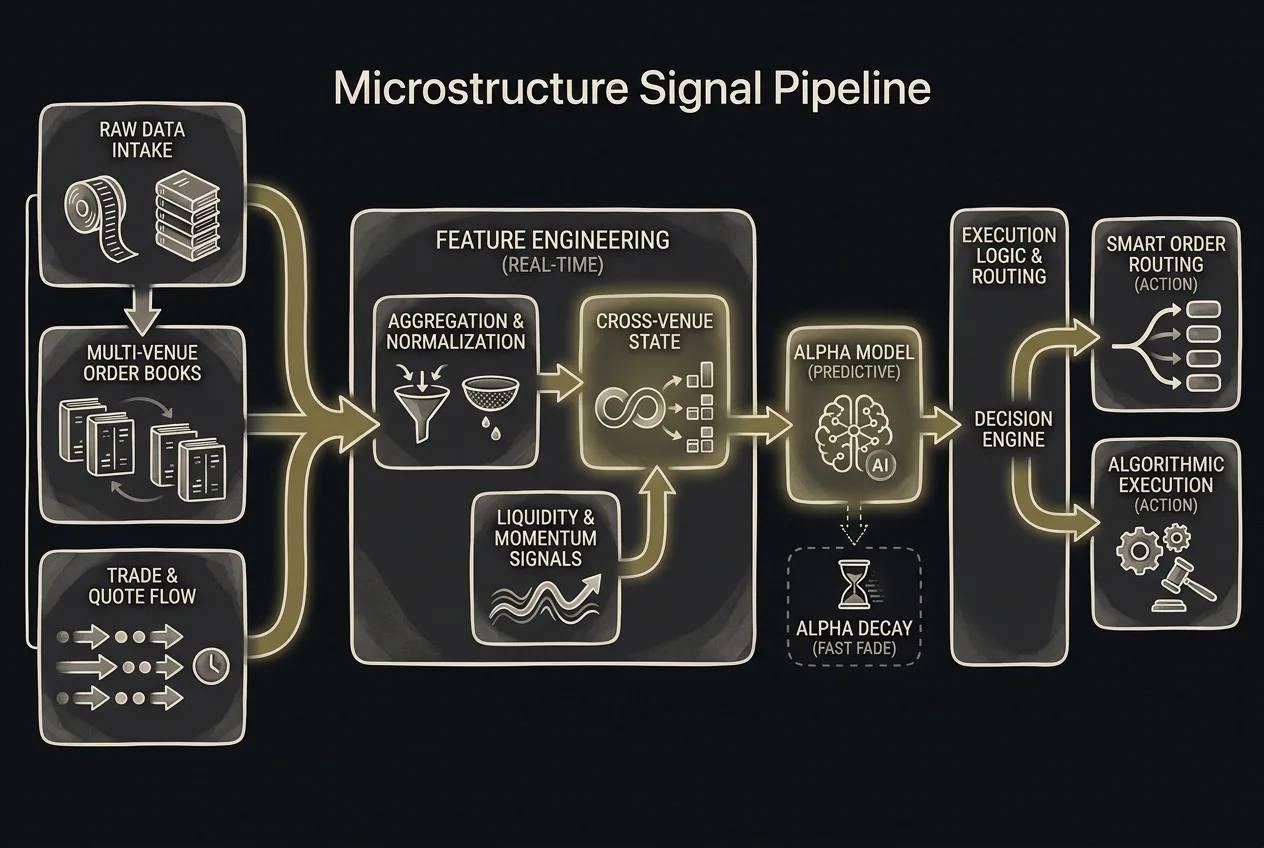
Integrating microstructure signals into an institutional workflow requires a layered architecture. At the lowest layer, high-frequency order book and trade data is captured, normalized, and processed with minimal latency. At the intermediate layer, feature extraction pipelines compute real-time metrics such as book imbalance, VPIN, OFI, and cross-venue spread differentials. At the highest layer, those features feed execution algorithms that decide on order placement, sizing, and venue selection. What makes the difference between a research curiosity and a production capability is what wraps that top layer: every signal that influences a live order should arrive with its provenance attached, so that a placement can later be traced to the book state and the feature values that justified it. A signal that cannot be reconstructed after the fact cannot be governed, and an institution that cannot explain why an order was sent is not running a system, it is running a black box.
That provenance is also where execution and risk bounds belong. A microstructure-aware implementation shortfall algorithm might adjust its urgency parameter on real-time toxicity readings: trading patiently when toxicity is low and the book is deep, capturing spread and minimizing impact, then accelerating when toxicity spikes and informed participants appear active. The discipline that keeps such adaptivity safe is to express the limits as policy enforced before the trade, not as conventions inside the model. Maximum participation rate, venue eligibility, and the bounds within which the algorithm may move its own urgency are checked at the boundary, so a mismeasured signal or a degraded feed cannot push the system past a limit a human authorized in advance. Humans set the policy; the machine operates inside it.
The most sophisticated implementations go further, binding microstructure signals to portfolio-level objectives. A multi-asset execution system might route equity orders to venues where recent conditions favour passive execution while adjusting futures hedges on cross-asset order flow correlations. The point of this integration is not sophistication for its own sake but coherence: microstructure stops being an isolated signal and becomes one input in a single governed process running from signal generation through portfolio construction, execution, and post-trade analysis. The same audit trail that records why an order was placed also feeds the analysis that decides whether the signal still works.
The firms that extract the most from microstructure data treat it as an institutional capability rather than a standalone strategy, and they accept what that demands. The order book is not merely a matching mechanism; it is a continuously updating representation of the market's collective intelligence, and reading it systematically is becoming a core competency. But the durable advantage is not the signal, which decays and is contested and is capacity-constrained by nature. It is the system around the signal: the provenance that makes every order explainable, the policy that bounds what any signal is permitted to do, and the governance that lets a desk add new signals by improving its rules rather than by adding headcount. The edge that lasts is not in seeing the book more clearly than everyone else, but in being able to act on what you see, at scale, under control, and prove afterward that you did.