The Hybrid Signal Factory: Combining ML, LLMs, and Classical Quant for Alpha
How ensemble signal generation combines classical quant, machine learning, and language models into a governed, auditable factory whose every signal carries lineage from source to trade.


Every alpha signal decays. It is one of the few reliable truths in quantitative finance. A momentum factor that delivered consistent Sharpe ratios for a decade gradually erodes as more capital chases the same pattern. A machine learning model trained on microstructure features loses its edge as exchanges update matching engines and competitors reverse-engineer similar approaches. A sentiment signal derived from social media becomes noise as retail participation shifts to new platforms. The half-life of alpha is shrinking, and the single-model paradigm is increasingly inadequate for institutional investors seeking durable, risk-adjusted returns.
The response to signal decay is not to abandon any one methodology but to combine them. The most sophisticated quantitative firms are converging on a hybrid architecture that fuses classical quantitative signals, modern machine learning, and large language model inference into a unified signal factory. This ensemble approach exploits the complementary strengths of each paradigm while mitigating their individual weaknesses, and the diversity itself buys time against decay: when one source erodes, the others carry the system.
But a factory that produces signals faster than anyone can explain them is a liability, not an asset. The harder problem is not generating signals; it is governing them. A signal that cannot be attributed, reproduced, or overridden has no place in an institutional portfolio, however predictive it appears in a backtest. The architecture that follows is therefore designed around two requirements held in tension: it must produce diverse, complementary alpha, and it must make every signal it produces accountable — traceable from its source data to the position it influenced, and subordinate to an explicit policy and a named human. The factory proposes; the policy and the human govern what trades.
The Signal Decay Problem: Why Single-Model Approaches Fail
Alpha decay is driven by a straightforward mechanism: as a profitable signal becomes known and capital flows toward it, the very act of trading compresses the opportunity. Academic publication accelerates the process. A factor documented in a top-tier journal may lose half its excess return within three to five years of publication, as dozens of funds implement systematic strategies around it. Machine learning models face an analogous problem. A gradient-boosted tree trained on order flow imbalance features may perform well in a low-volatility regime but collapse during a liquidity crisis when the statistical relationships it learned no longer hold.
Single-model approaches also suffer from blind spots intrinsic to their methodology. Classical quant models, built on linear factor exposures and covariance estimation, struggle to capture non-linear interactions between variables. Deep learning models excel at pattern recognition but are notoriously opaque, making it difficult to diagnose failure modes or satisfy regulatory explainability requirements. LLMs can parse unstructured text with remarkable nuance but lack the mathematical rigor to translate qualitative insight into precise position sizing.
No single paradigm covers the full spectrum of market information, and no single paradigm fails in the same way. The hybrid signal factory is a direct response to both facts: it widens coverage and decorrelates failure.


Classical Quant Signals: The Foundation
Classical quantitative signals remain the bedrock of systematic investing for good reason. Decades of academic research and live trading have established a robust understanding of factor premia, their economic rationale, and their behavior across market cycles. Momentum, value, carry, mean reversion, and statistical arbitrage strategies are well-understood, and their risk-return profiles have been extensively characterized.
The enduring value of classical signals lies in their interpretability and theoretical grounding. A momentum signal is not merely a statistical pattern; it reflects behavioral biases such as investor underreaction to new information and herding effects that amplify price trends. Mean reversion signals exploit the tendency of prices to overshoot fair value due to liquidity-driven dislocations. Statistical arbitrage strategies identify mispricings between related securities using cointegration analysis, exploiting deviations from long-run equilibrium relationships.
In a hybrid architecture, classical signals serve three critical functions. First, they provide a baseline of economically motivated alpha that is relatively robust to overfitting. Second, their well-characterized risk profiles enable precise portfolio construction and risk budgeting. Third, they serve as a reference frame against which more complex signals are judged: if an ML model generates a signal that is orthogonal to every known factor, that is not automatically alpha — it may be a data artifact, a look-ahead leak, or an overfit. Classical factors give the system a vocabulary for asking "what is this signal actually betting on?" before any capital is committed to it.
Modern implementations of classical signals benefit from improved data and faster computation, but the underlying economic logic is unchanged. The innovation lies in how these signals interact with machine learning and language model outputs in the ensemble.
Machine Learning Signals: Non-Linear Pattern Recognition
Machine learning has transformed alpha research by enabling the discovery of complex, non-linear relationships in high-dimensional datasets. Where classical quant relies on handcrafted features and linear models, ML approaches such as gradient-boosted decision trees, random forests, convolutional neural networks, and recurrent architectures can learn feature interactions directly from data.
Gradient Boosting and Tree-Based Methods
Gradient-boosted trees, including implementations like XGBoost, LightGBM, and CatBoost, have become workhorses of quantitative signal generation. Their advantages are well-suited to financial data: they handle missing values gracefully, are robust to outliers, perform implicit feature selection, and provide interpretable feature importance scores. For cross-sectional return prediction, tree-based models consistently rank among the top performers in academic benchmarks and live trading environments.
A typical application might use hundreds of features spanning price-based technical indicators, fundamental ratios, options-derived metrics, and microstructure variables to predict next-period relative returns across a universe of equities. The model's ability to capture interaction effects, such as the conditional relationship between momentum and volatility, yields alpha that is genuinely incremental to linear factor models.
Deep Learning and Neural Networks
Deep learning architectures extend the ML toolkit further. Long short-term memory (LSTM) networks and temporal convolutional networks excel at modeling sequential dependencies in time-series data, capturing patterns in order flow, intraday price dynamics, and volatility clustering that simpler models miss. Transformer architectures, originally developed for natural language processing, have shown promise for multi-asset return prediction by modeling cross-sectional and temporal relationships simultaneously.
Graph neural networks represent a frontier application, modeling the network structure of financial markets. By representing equities as nodes connected by supply-chain relationships, sector membership, or co-movement patterns, graph neural networks can propagate information across the network to improve predictions for individual securities.
Reinforcement Learning for Dynamic Strategies
Reinforcement learning (RL) introduces a fundamentally different approach to alpha generation. Rather than predicting returns and then constructing portfolios, RL agents learn policies that map market states directly to trading actions, optimizing a reward function that can incorporate transaction costs, market impact, and risk constraints. This end-to-end optimization can discover strategies that static predict-then-optimize pipelines miss, particularly in contexts where execution and timing are critical components of alpha.
The challenge with ML signals is their tendency to overfit and their sensitivity to distributional shift. A model trained on data from a low-rate, low-volatility regime may fail catastrophically when conditions change, and because the model is opaque, that failure is often invisible until it shows up in the P&L. This is a governance problem as much as a modeling one: a signal whose behavior cannot be inspected cannot be safely trusted at scale. The mitigations are structural — combining ML signals with more robust classical and LLM-derived signals in an ensemble, capping the weight any single opaque model can carry, and monitoring live feature distributions against training distributions so that drift triggers a downgrade before it triggers a loss.

LLM Signals: Extracting Alpha from Language
Large language models have opened a new dimension of alpha generation by enabling systematic, scalable analysis of unstructured text. Financial markets have always been driven partly by narratives, sentiment, and qualitative information embedded in earnings calls, regulatory filings, news articles, analyst reports, and management commentary. Until recently, extracting tradeable signals from these sources required armies of human analysts. LLMs change the economics of that work.
They also introduce failure modes that classical and ML signals do not have, and an honest account has to lead with them. LLM-derived signals are noisy: small changes in prompt or model version can move a sentiment score more than the underlying news does. They are prone to look-ahead leakage, because a model's pretraining corpus may already contain the outcome of the event being scored, inflating backtests in ways that never replicate live. And they hallucinate — asserting facts, numbers, or causal links that are not in the source. Treated naively, an LLM is a confident narrator that is sometimes wrong without warning. Treated as one bounded, heavily-validated input among several, constrained to extract from a specific document rather than to opine from memory, and version-pinned so that its outputs are reproducible, it becomes a genuine source of differentiated, slower-decaying signal. The discipline below assumes the second posture throughout.
Earnings Call Analysis
Earnings calls contain rich information beyond the headline numbers. Management tone, hedging language, specificity of forward guidance, and subtle shifts in emphasis between quarters all carry predictive content. An LLM can be fine-tuned to evaluate these transcripts along multiple dimensions: confidence level, risk awareness, strategic clarity, and consistency with prior statements. The resulting scores, when combined with fundamental data, have been shown to predict post-earnings drift and analyst revision trajectories.
The advantage over traditional NLP approaches, such as bag-of-words sentiment scores, is substantial. LLMs handle context, negation, conditional statements, and domain-specific jargon. The difference between "we are not concerned about competitive pressure" and "we are concerned about competitive pressure" is trivial for an LLM but has historically confounded simpler models. The validation burden, however, is correspondingly higher. Because the model could in principle recall how the stock actually moved after a given quarter, scoring transcripts requires strict point-in-time discipline: the signal must be reconstructed using only information available at the call, and its predictive claim must survive on transcripts dated after the model's training cutoff. A score that looks excellent in-sample and evaporates on genuinely out-of-sample dates is leakage, not alpha.
News and Event Interpretation
Real-time news interpretation is another application, though it is more contested. An LLM can ingest a breaking news article about a regulatory action, geopolitical event, or corporate announcement and assess its likely impact on specific securities, sectors, or asset classes faster than a human desk. The realistic edge here is rarely raw speed against the fastest latency-arbitrage players; it is judgment — correctly classifying ambiguous, multi-entity, or second-order news that keyword systems misread. This makes it most valuable for event-driven strategies operating over minutes to days, and for managing tail risk in systematic portfolios, rather than for headline-reaction races measured in milliseconds.
Beyond individual article analysis, LLMs can synthesize information across many sources to surface emerging themes earlier than aggregate data reveals them. A gradual shift in supply-chain commentary across an industry's earnings calls, for example, might point to a pending margin squeeze before it appears in reported figures. Signals of this kind are inherently lower in precision and must be sized accordingly: useful as a tilt or an early-warning input, not as a high-conviction standalone bet.
Regulatory and Filing Analysis
SEC filings, patent applications, merger documents, and other regulatory texts contain material information that is often buried in dense legal language. LLMs can parse these documents at scale, flagging material changes in risk-factor language between filings, surfacing inconsistencies between management commentary and financial disclosures, and routing the highest-signal passages to human analysts for confirmation. The reliable contribution here is triage and diff — comparing this filing to the last and to peers, and directing scarce attention — rather than autonomous legal judgment; conclusions about, say, related-party exposure are leads to verify, not findings to trade on. Because these signals derive from filing cadence rather than market activity, they tend to be slower-burning and less correlated with price-based and ML signals, which makes them valuable diversifiers in the ensemble.
Ensemble Approaches: The Architecture of Combination
The central challenge of hybrid signal generation is not producing individual signals but combining them effectively. Naive averaging destroys information. Signals from different paradigms operate on different time horizons, have different noise characteristics, and exhibit different patterns of failure. A well-designed ensemble must account for these differences.
Signal Normalization and Alignment
Before combination, signals must be normalized to a common scale and aligned temporally. A classical momentum signal might be updated daily, an ML cross-sectional model weekly, and an LLM sentiment score in real time following earnings releases. The ensemble architecture must handle asynchronous signal updates, appropriately weighting stale signals and incorporating new information as it arrives.
Z-score normalization within each signal's own history is a common starting point, but more sophisticated approaches use quantile normalization or rank-based transformations to ensure that signals contribute proportionally regardless of their native distributional properties.
Meta-Model Combination
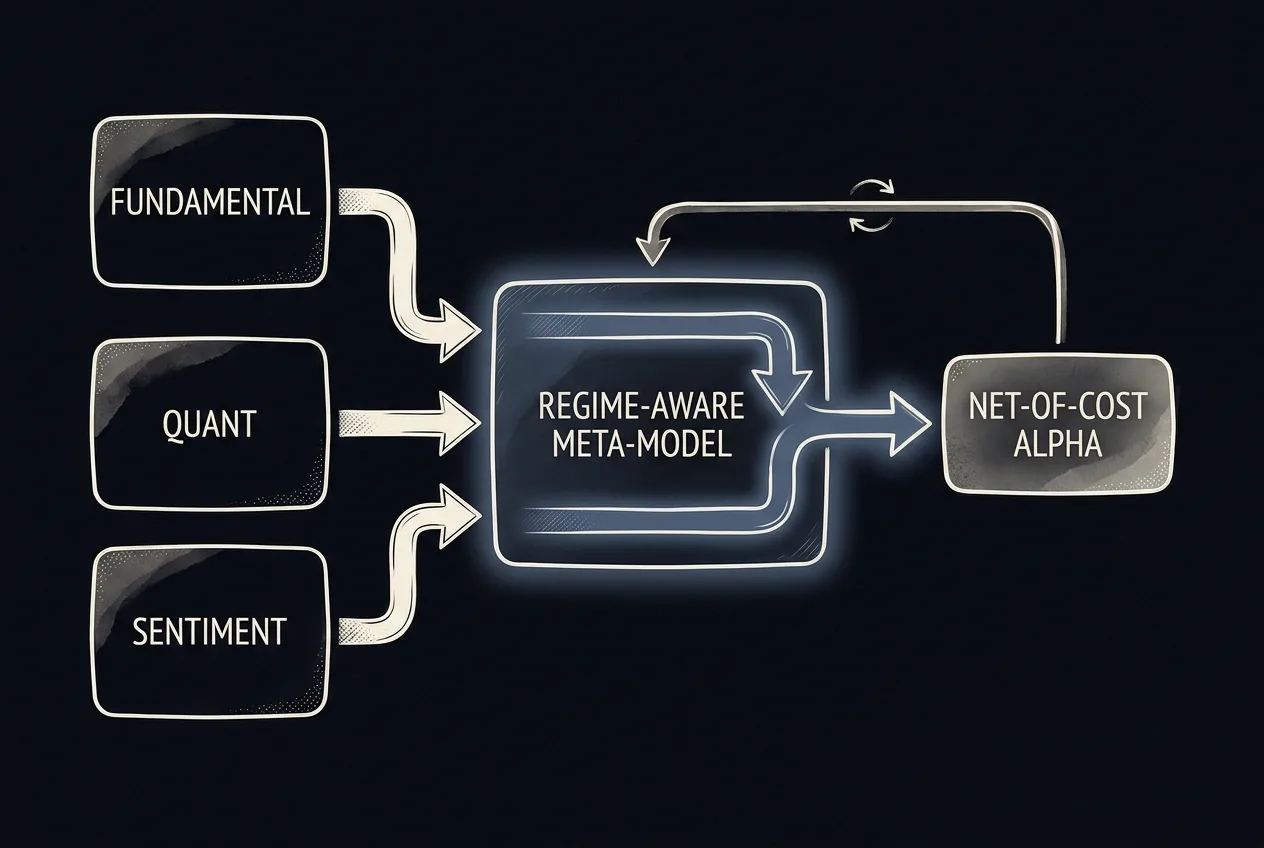
A meta-model, sometimes called a stacking layer, learns the optimal combination weights for component signals. This can be as simple as a regularized linear regression of realized returns on lagged signal values, or as complex as a gradient-boosted meta-learner that captures non-linear interactions between signals. The key constraint is to avoid overfitting the meta-model, which requires careful cross-validation with temporal separation between training and evaluation periods.
Crucially, the meta-model must be regime-aware. Optimal combination weights shift across market regimes: momentum signals may warrant higher weight in trending markets, while mean reversion signals dominate in range-bound conditions. Incorporating regime-detection variables, whether explicit (volatility level, yield curve slope, credit spreads) or learned (hidden Markov model state probabilities), into the meta-model improves out-of-sample stability.
Signal Correlation and Diversification
One of the primary benefits of combining heterogeneous signal sources is diversification at the alpha level. If an ML model's errors are uncorrelated with a classical quant model's errors, and both are uncorrelated with LLM-derived signal errors, the combined signal has a substantially higher information ratio than any individual component. This is the alpha-level analog of portfolio diversification, and it is equally powerful — and equally fragile in exactly the same way. Correlations are not constant. The diversification that holds in calm markets routinely collapses in a crisis, when classical, ML, and sentiment signals can all turn bearish at once and the ensemble that looked diversified reveals itself as a single regime bet.
Monitoring signal correlation in real time is therefore not optional. If two nominally independent signals become highly correlated within a specific regime, the ensemble must recognize that its effective number of independent bets has fallen and de-risk accordingly, rather than continue sizing as though the diversification still exists. Dynamic, regime-conditional correlation estimation — measured under stress, not just on average — is what keeps the combination honest about how concentrated it actually is.

Infrastructure Requirements for Real-Time Multi-Model Signal Generation
Running a hybrid signal factory in production imposes significant infrastructure demands. Classical quant signals are computationally lightweight, but ML model inference, particularly for deep learning architectures, requires GPU acceleration for real-time operation. LLM inference is the most resource-intensive, with large models requiring specialized hardware and careful optimization to meet latency requirements.
A production-grade architecture typically separates the signal generation pipeline into three tiers. The first tier handles data ingestion: market data feeds, alternative data streams, and text sources are normalized and stored in a time-series database with microsecond-precision timestamps. The second tier runs model inference, with separate compute clusters for classical signals (CPU-optimized), ML models (GPU clusters), and LLM inference (dedicated GPU nodes with quantized model serving). The third tier combines signals in the meta-model and feeds the result into the execution engine.
Event-driven architectures, built on message queues and stream processing frameworks, ensure that new information propagates through the pipeline with minimal latency. Feature stores provide a consistent interface for accessing both real-time and historical features, ensuring that models in production see the same data representation used during training.
Reproducibility is non-negotiable, and it is the property that turns a signal factory into a governable one. Every signal must carry its lineage: the source data and its point-in-time snapshot, the model and exact version that produced it, the feature vector it consumed, the combination weight it received, and the position it ultimately influenced. That chain is not a logging afterthought; it is the spine the rest of the system is built on. When a signal is recorded this way, "why did we hold this position?" has a deterministic answer that can be replayed bit-for-bit — which is precisely what performance attribution, model debugging, incident review, and regulatory examination all require, and precisely what an opaque black box cannot provide. A signal whose provenance is incomplete should be treated as inadmissible, not merely as poorly documented.
Backtesting and Validation Across Market Regimes
Validating a hybrid signal factory is harder than validating a single model, and the difficulty compounds the more sources are added. The interaction between component signals, the meta-model's learned weights, and the execution layer creates a system whose behavior cannot be inferred from its parts in isolation. Rigorous backtesting therefore requires exercising the full integrated pipeline — including the meta-model's weight selection — rather than each signal on its own. It is entirely possible for every component to validate cleanly while the combination overfits, because the meta-layer has degrees of freedom the individual models do not.
Walk-forward analysis with expanding or rolling windows is the standard approach, but it must be supplemented with regime-conditional evaluation. A hybrid system should demonstrate positive performance across distinct market regimes: bull markets, bear markets, high-volatility periods, low-volatility periods, rate-hiking cycles, and liquidity crises. Performance concentration in a single regime is a red flag suggesting overfitting to recent history.
Stress testing against historical crises, such as the 2008 financial crisis, the 2020 pandemic crash, and the 2022 rate shock, provides insight into tail behavior. Synthetic stress scenarios generated by perturbing historical data extend this analysis to events that have not occurred but are plausible.
Transaction cost modeling is critical. A signal that appears profitable in a frictionless backtest may be worthless after accounting for bid-ask spreads, market impact, borrowing costs, and execution slippage. The hybrid architecture must demonstrate net-of-cost alpha, and the execution strategy must be co-optimized with the signal generation pipeline.
The Adaptic Hybrid Signal Factory
At Adaptic, the signal factory is one part of a larger operating system for AI-managed capital — and that framing is the point. The factory's job is to propose; it is not authorized to act on its own. Classical factor models, a suite of ML algorithms, and LLM-based text analysis run on a single shared data model, with real-time combination and regime-aware adaptive weighting. But every signal they produce enters the same governed path before it can move a dollar.
That path should have three properties the preceding sections argued for. First, lineage by construction: each signal should be emitted with its source snapshot, model version, feature vector, and combination weight already attached, so attribution and deterministic replay are guaranteed rather than reconstructed after the fact. Second, explicit policy: position limits, exposure constraints, leverage ceilings, and eligibility rules should be encoded as explicit, versioned policy that the factory's output is checked against on every cycle. A signal that would breach those limits must be rejected by the policy regardless of how confident the meta-model is — the model does not get to overrule the rules it operates under. Third, a named human in the governing seat: the system should make the rationale, the lineage, and the proposed action legible enough that a portfolio manager can interrogate or override any decision, and the override is itself logged. Humans govern; machines operate.
This is also why we treat capability as something to be demonstrated rather than asserted. The combination of full audit logging, point-in-time reconstruction, and regime-conditional attribution lets a prospective client examine how alpha was generated on real history — including where it failed and how the guardrails responded — before any capital is committed. The architecture is built for extensibility, so new signal sources, model families, and data feeds can be added without disrupting the pipeline; but every addition enters under the same lineage, the same policy, and the same human authority as everything already in production.
Conclusion
The era of single-model alpha generation is ending. Signal decay, regime sensitivity, and the inherent limitations of any individual methodology make hybrid approaches not just advantageous but necessary for institutional investors seeking durable excess returns. Combining the economic grounding of classical quant, the pattern recognition of machine learning, and the linguistic judgment of LLMs produces a system that is more robust across regimes and harder to replicate than any of its parts.
But the harder half of the work is not generation; it is governance. The same diversity that makes the factory powerful also makes it more opaque and more prone to subtle failures — leakage, hallucination, correlations that vanish under stress. What separates an institutional system from a black box is not the cleverness of its signals but the discipline around them: every signal carries its lineage, every position can be reconstructed and explained, an explicit policy bounds what the machine may do, and a named human governs the decisions it proposes. Build the factory for that — auditable, policy-bound, human-governed — and the ensemble becomes something an institution can actually entrust with capital, rather than merely something that backtests well.