Democratizing Institutional Access: How Tokenization Lowers Barriers to Premium Strategies
How tokenization collapses the administrative cost of fund participation—through fractional interests, programmable eligibility, and secondary market infrastructure—to widen eligible-investor access to institutional-grade strategies without lowering operational standards.


A $50,000 allocation and a $5 million allocation to the same hedge fund consume nearly identical administrative effort: the same documentation review, the same anti-money-laundering checks, the same capital-account tracking, the same K-1. That fixed cost is the quiet reason most of the highest-performing strategies have been closed to all but the largest investors. The thresholds that fence them off—commonly $250,000 to $10 million or more across hedge funds, private equity, venture partnerships, and quantitative strategies—exist not because smaller allocations are economically irrational, but because the overhead of administering many small investors has historically exceeded the revenue they generate. Access ends up rationed by wealth rather than by suitability, sophistication, or alignment of interest.
Tokenization changes that arithmetic. When a fund interest is represented as a token on a ledger and the rules of participation are written as code, the marginal cost of administering an additional investor falls toward zero. Subscription processing, capital-account tracking, fee calculation, eligibility verification, and secondary transfer—each historically a manual step routed through transfer agents and legal counsel over weeks of settlement—become operations the contract executes and records as it runs. The argument of this piece is narrow and deliberate: tokenization does not make institutional strategies safer, smarter, or appropriate for everyone, and the word "democratization" should be read as widening eligible-investor access, not as opening private funds to the retail public. What it removes is the operational tax that made small allocations uneconomic. Removing that tax is enough to change who can be served.
The Access Problem: Structural Barriers to Premium Strategies
The institutional investment landscape has long operated on a tiered access model. At the top tier, sovereign wealth funds, large endowments, and pension systems with hundreds of billions in assets enjoy preferential access to the most sought-after managers, the lowest fee structures, and the most favorable liquidity terms. Below them, family offices and high-net-worth individuals can access many of the same strategies but at higher cost and with less negotiating leverage. Below that tier, the door is largely closed.
This stratification is not primarily a function of regulation, though regulation reinforces it. The root cause is operational economics. Consider the cost structure of a traditional hedge fund. Each new investor requires legal documentation review, anti-money laundering verification, tax identification, accreditation confirmation, and ongoing reporting. The fund administrator must track each investor's capital account, calculate management and performance fees at the individual level, process subscription and redemption requests, and issue K-1 tax documents. For a $10 million allocation, these costs are easily absorbed. For a $10,000 allocation, they render the economics nonviable.
The consequence is systematic exclusion. A qualified investor with $50,000 to allocate to alternative strategies faces a market that offers mutual funds, exchange-traded funds, and interval funds as the available universe. These products, while valuable, represent a fundamentally different return profile than the institutional strategies they attempt to replicate. The tracking error between a liquid alternative mutual fund and the underlying hedge fund strategy it mimics can exceed 500 basis points annually, driven by the constraints of daily liquidity, diversification requirements, and leverage limitations.
The access gap is not merely inconvenient; it has a measurable cost. A meaningful allocation to genuine alternative strategies has historically improved a portfolio's risk-adjusted return relative to one confined to traditional assets, which is precisely why large endowments and pensions hold them. When the floor on participation is set by administrative economics rather than by an investor's capacity to bear the risk, the constraint stops being a protection and becomes an artifact. That is the part tokenization can address: not the suitability of the strategy, which remains as demanding as ever, but the cost structure that made the suitability question moot below a certain account size.


Fractional Fund Participation Through Tokenization
Tokenization addresses the access problem by fundamentally restructuring the economics of fund administration. When a fund interest is represented as a digital token, the marginal cost of adding an investor approaches zero. Smart contracts automate subscription processing, capital account tracking, fee calculation, and distribution payments. The transfer agent function, traditionally a labor-intensive back-office operation, becomes a software service that scales without proportional headcount increases.
The mechanics are straightforward in concept, though demanding in execution. A fund issues tokens representing fractional interests in its limited partnership or equivalent structure. Each token encodes the investor's proportional ownership, fee obligations, and liquidity terms. When the fund calculates net asset value, the per-token NAV updates and each token holder's account reflects their current position without manual reconciliation.
A distinction worth holding onto here, because it governs which steps can be automated and which cannot: striking a NAV, moving cash, and authorizing a distribution are consequential acts, not mere bookkeeping. The contract can compute and record them deterministically, but the decision to publish a NAV or release a wire is the kind of act a credible structure keeps under human authority and pre-authorization. The right division of labor is the one institutional operators already understand—people set and approve the rules; the system carries them out. Tokenization makes that division explicit rather than implicit, which is most of its value.
Reducing Minimums Without Reducing Quality
Crucially, fractional participation requires no compromise in the underlying strategy. The portfolio manager runs the same book whether the fund holds 50 investors at $5 million each or 5,000 at $50,000 each. The investment process, the risk framework, and the return characteristics are identical. Only the administrative layer changes—and that is the point. Tokenization moves that layer off the per-investor cost curve that historically made the smaller of those two investor bases unservable, so adding the 5,000th holder costs a near-negligible increment over the 50th rather than fifty times more in handling.
This is not a theoretical construct. Several jurisdictions, notably the Dubai International Financial Centre, Singapore, and Switzerland, have established regulatory frameworks that explicitly accommodate tokenized fund structures. Funds operating under these frameworks have demonstrated that minimums can be reduced to $10,000 or less while maintaining institutional-grade operations, compliance, and reporting.
Programmable Capital Accounts
Beyond simple fractional ownership, tokenization enables programmable capital accounts that automate processes traditionally requiring manual intervention. Consider a fund with a 12-month lock-up period. In a traditional structure, enforcing this lock-up requires the fund administrator to track each investor's subscription date and reject redemption requests that violate the lock-up. In a tokenized structure, the lock-up is encoded in the smart contract. Tokens cannot be transferred or redeemed before the lock-up expires, and the constraint is enforced by code rather than by process.
This programmability extends to fee waterfalls, hurdle rates, catch-up provisions, and clawback mechanisms. Performance-fee calculations that require spreadsheets and discretionary review in traditional structures are executed deterministically against the encoded terms. The result is not merely operational efficiency but the removal of an entire category of operational risk: incorrect fee calculation, a material and recurring concern in complex fund structures. It also changes the character of the audit trail. Because the terms are policy expressed as code and every accrual is computed and written by the contract, the record of how a fee was reached is not a reconstruction assembled after the fact but a byproduct of execution—replayable, permanent, and identical for the manager, the administrator, and the investor inspecting it later.
Programmable Eligibility: Smart Contract-Based Investor Qualification
One of the most significant regulatory challenges in democratizing access to institutional strategies is investor qualification. Securities regulations in most jurisdictions restrict certain investment products to qualified, accredited, or professional investors. Verifying investor status is a manual process that creates friction and cost, and it must be repeated for each new investment.
Programmable eligibility moves that qualification logic into the rails. The criteria a regulator requires—accredited, qualified, professional, jurisdiction-permitted—are expressed as conditions the token enforces, checked by a combination of on-chain identity attestation and transfer restriction every time a holding changes hands. Compliance stops being a gate someone remembers to staff at subscription and becomes a property of the instrument itself.
On-Chain Identity and Accreditation
An investor who completes identity verification and accreditation review through an authorized provider receives an attestation that is recorded on-chain. This attestation, which contains no personal data but confirms that the investor has been verified to a specific standard, serves as a reusable credential. When the investor seeks to purchase tokens in a qualified fund, the smart contract checks for the presence of the required attestation before permitting the transaction.
Three consequences follow. An investor verified once can participate across multiple funds and issuers without repeating the qualification process. The issuer's compliance burden falls because the contract enforces the requirement on every transaction rather than relying on a person to apply it correctly at each subscription. And the timeline compresses from weeks of document submission and review to minutes of automated verification—not because the standard is lower, but because the check is performed once and reused, with the attestation carrying the proof rather than the personal data.
Transfer Restrictions and Compliance Logic
Programmable eligibility extends to secondary market transfers. In traditional private fund structures, transferring an interest requires the general partner's consent, legal review of the transfer agreement, and verification that the transferee meets qualification requirements. This process typically takes weeks and costs thousands of dollars in legal fees, effectively eliminating secondary market liquidity for most private fund interests.
In a tokenized structure, transfer restrictions are encoded in the smart contract. When a token holder attempts to transfer tokens, the contract verifies that the recipient holds the required attestations, that the transfer does not violate concentration limits or maximum investor counts, and that all regulatory requirements are satisfied. If all conditions are met, the transfer executes atomically. If any condition fails, the transfer is rejected with a specific reason code. The entire process completes in seconds rather than weeks.

Secondary Market Liquidity for Illiquid Investments
The illiquidity premium embedded in private investment strategies is well documented. Investors in private equity, venture capital, and hedge funds accept reduced liquidity in exchange for higher expected returns. But the illiquidity premium also acts as a barrier to access, because investors with shorter time horizons or smaller portfolios cannot afford to lock up capital for extended periods.
Tokenization does not eliminate the illiquidity of underlying assets, but it does create the infrastructure for secondary market trading of fund interests. This distinction is important. A private equity fund invested in illiquid portfolio companies cannot offer daily redemptions without creating an asset-liability mismatch. But the fund's tokenized interests can trade on a secondary market, allowing investors to exit their positions by selling to other qualified buyers rather than by redeeming from the fund.
Regulated Secondary Venues
Several regulated alternative trading systems now support secondary trading of tokenized securities. These venues provide order matching, price discovery, and settlement services for tokenized fund interests, subject to the same regulatory oversight that governs traditional securities exchanges. The availability of secondary market liquidity fundamentally changes the risk-return calculus for smaller investors considering allocations to illiquid strategies.
Consider an investor allocating $50,000 to a tokenized private equity fund with a 10-year term. In a traditional structure, that capital is locked for the fund's entire life, with distributions dependent on the general partner's exit schedule. In a tokenized structure, the investor can sell their position on a secondary market at any time, subject to finding a willing buyer at an acceptable price. The expected discount to NAV on secondary sales is the true cost of liquidity, and for many investors, that cost is far more palatable than total illiquidity.
Price Discovery and Transparency
Secondary markets for tokenized fund interests also improve price discovery. In traditional private markets, valuations are updated quarterly at best, and the true market-clearing price for a fund interest is unknown until a transaction occurs. Continuous secondary market trading generates real-time price signals that reflect the market's collective assessment of a fund's prospects. This transparency benefits all participants, including the fund manager, who gains insight into how the market values their strategy.
Regulatory Frameworks Enabling Democratic Access
The regulatory landscape for tokenized securities has matured significantly. Several jurisdictions have established comprehensive frameworks that accommodate digital securities while maintaining investor protection standards.
DIFC and the Digital Securities Regime
The Dubai International Financial Centre has established one of the most progressive regulatory frameworks for digital securities. The DFSA's regulatory framework explicitly recognizes security tokens and provides a clear pathway for tokenized fund formation, distribution, and secondary trading. Funds domiciled in the DIFC benefit from a common-law legal framework, international recognition, and access to a growing ecosystem of service providers specializing in digital asset infrastructure.
Regulation D and Regulation S
In the United States, tokenized fund interests are typically offered under Regulation D exemptions, which permit sales to accredited investors without SEC registration. Regulation S provides a parallel exemption for offshore sales to non-US persons. The combination of Reg D and Reg S enables global distribution of tokenized fund interests within established regulatory boundaries.
The SEC's evolving guidance on digital assets has introduced some complexity, but the fundamental principle remains clear: a tokenized security is still a security, subject to the same registration requirements and exemptions as a traditional security. This regulatory clarity, while sometimes restrictive, provides the legal certainty that institutional participants require.
MiCA and European Digital Finance
The European Union's Markets in Crypto-Assets Regulation provides a harmonized framework for digital asset issuance and trading across EU member states. While MiCA's primary focus is crypto-assets rather than tokenized securities, the regulation establishes infrastructure requirements for digital asset service providers that also benefit tokenized fund operations.
KYC/AML Automation for Onboarding at Scale
Reducing investment minimums without proportionally reducing compliance standards requires automated approaches to Know Your Customer and Anti-Money Laundering verification. Manual KYC processes that cost $50 to $100 per investor are acceptable when minimums are $250,000 but become economically prohibitive when minimums drop to $10,000.
Automated Identity Verification
Modern KYC platforms leverage optical character recognition, biometric verification, and database cross-referencing to complete identity verification in minutes rather than days. Document authentication algorithms can verify the genuineness of government-issued identification documents across hundreds of jurisdictions. Liveness detection ensures that the person presenting documentation is physically present, preventing identity fraud.
Continuous Monitoring
Traditional KYC is a point-in-time assessment, performed at onboarding and renewed periodically. Tokenized fund platforms can implement continuous monitoring, checking investor records against updated sanctions lists, politically exposed persons databases, and adverse media sources on an ongoing basis. This approach is not merely more thorough than periodic review; it is more cost-effective, because incremental checks against updated data are cheaper than full re-verification cycles.
Portable Identity
Perhaps the most transformative capability is portable identity. An investor who completes KYC verification with one platform can share their verified identity credentials with other platforms without repeating the process. Self-sovereign identity frameworks, where the investor controls their own verified credentials, enable this portability while preserving privacy. The investor shares proof of verification without sharing the underlying personal data, and each fund issuer can rely on the attestation without bearing the cost of independent verification.
The Investor Experience: From Application to Allocation
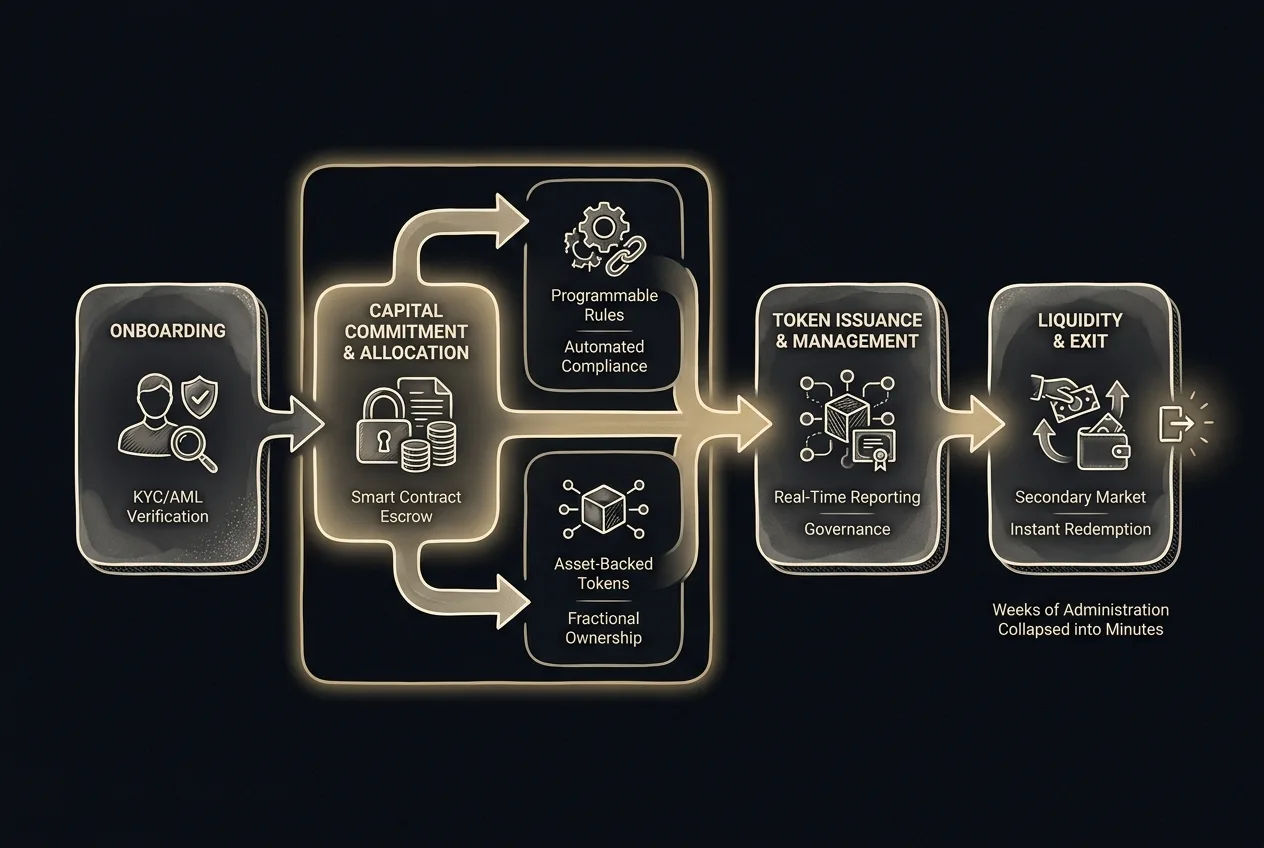
The end-to-end investor experience in a tokenized fund demonstrates the practical impact of these capabilities. Consider an investor seeking to allocate $25,000 to a tokenized quantitative trading fund.
Day one. The investor accesses the fund's digital offering platform. They complete identity verification using a smartphone, photographing their identification document and completing a biometric check. The platform cross-references their identity against sanctions lists and verifies accreditation status through a third-party provider. Total time: approximately fifteen minutes.
Same day. With verification complete, the investor reviews the fund's offering materials, including the private placement memorandum, subscription agreement, and risk disclosures, all presented in a digital format with electronic signature capability. They complete the subscription, funding their allocation via wire transfer or stablecoin payment. The smart contract records the subscription and issues tokens representing their fund interest.
Ongoing. The investor monitors their position through a digital dashboard that displays real-time NAV, cumulative returns, fee accruals, and distribution history. When the fund pays distributions, the smart contract calculates the investor's pro rata share and credits it automatically. Tax reporting documents are generated programmatically based on the investor's jurisdiction and tax status.
Exit. When the investor wishes to exit, they can either submit a redemption request during the fund's redemption window or list their tokens for sale on a regulated secondary market. If they choose secondary sale, the smart contract verifies that the buyer meets all eligibility requirements before permitting the transfer.
What stands out across these stages is not that any single step is novel—electronic signatures and automated KYC predate tokenization—but that the encoded terms make each step a recorded event rather than a manual handoff. The traditional alternative-investment process, with its paper documents, manual verification, multi-week onboarding, and quarterly glimpses of performance, asks the investor to trust that the back office is doing the arithmetic correctly. The tokenized process replaces that trust with a record the investor can inspect.

Risks of Democratization: Protecting Retail From Institutional Complexity
The democratization of institutional access creates genuine risks that must be addressed thoughtfully. Institutional strategies are complex, and complexity creates the potential for misunderstanding, misallocation, and harm.
Suitability and Investor Education
Reducing minimum investments does not eliminate the importance of suitability assessment. A quantitative trading strategy with monthly liquidity, leverage up to three times, and the potential for significant drawdowns is not appropriate for every investor, regardless of whether the minimum is $10 million or $10,000. Tokenized fund platforms must implement robust suitability frameworks that go beyond simple accreditation verification.
This includes investor education components that clearly communicate the strategy's risk characteristics, expected return profile, liquidity terms, and fee structure. Interactive risk questionnaires, scenario analysis tools, and plain-language strategy descriptions help investors make informed allocation decisions. The goal is not to restrict access paternalistically but to ensure that investors understand what they are purchasing.
Concentration Risk
Lower minimums create the risk that investors allocate a disproportionate share of their portfolio to a single strategy. An investor with $100,000 in total investable assets who allocates $25,000 to a single tokenized hedge fund has a 25% concentration in a single illiquid alternative investment. This concentration is far higher than any institutional portfolio would tolerate.
Tokenized fund platforms can mitigate this risk through portfolio-level checks that consider the investor's total allocation across the platform and flag concentration levels that exceed prudent thresholds. These checks are more effective when implemented at the platform level rather than at the individual fund level, because they can assess concentration across multiple fund investments.
Liquidity Illusion
Secondary market liquidity for tokenized fund interests, while beneficial, can create a false sense of liquidity. In normal market conditions, secondary markets may function smoothly with reasonable bid-ask spreads. In stressed conditions, liquidity may evaporate, leaving investors unable to exit at any price near fair value. Investors accustomed to the continuous liquidity of public markets may not appreciate the difference between genuine market liquidity and the conditional liquidity of a secondary market for alternative investments.
Clear disclosure of liquidity risks, historical secondary market trading volumes, and the distinction between redemption liquidity and secondary market liquidity is essential. Investors must understand that the ability to sell on a secondary market does not guarantee the ability to sell at a fair price.
Case Framework: A Tokenized Fund From Launch to First Distribution
To illustrate these concepts concretely, consider the lifecycle of a hypothetical tokenized quantitative equity fund from inception through its first distribution.
Fund Formation
The fund sponsor establishes a limited partnership in the DIFC, with the tokenized structure incorporated into the partnership agreement from inception. The fund's legal counsel works with a digital securities advisor to ensure that the token structure complies with DFSA regulations and the securities laws of each target distribution jurisdiction.
The smart contract suite is developed, audited by two independent security firms, and deployed to a permissioned blockchain. The contracts encode the fund's fee structure (1.5% management fee, 15% performance fee with a 6% hurdle rate), lock-up terms (6-month soft lock with a 3% early redemption fee), and investor eligibility requirements (accredited investors in permitted jurisdictions).
Capital Raise
The fund launches its offering on a regulated digital securities platform. Over 60 days, 340 investors subscribe, with allocations ranging from $15,000 to $2 million. Total assets raised: $42 million. The median allocation is $65,000, a level that would be economically nonviable in a traditional fund structure. Investor onboarding, including KYC/AML verification and accreditation confirmation, averages 22 minutes per investor.
Operations
The fund's quantitative strategy operates continuously, generating returns that are calculated and published daily. The smart contract tracks each investor's capital account, accruing management fees daily and calculating performance fees based on each investor's individual high-water mark. Investors access their positions through a digital dashboard that provides real-time portfolio analytics.
First Distribution
At the end of the fund's first fiscal quarter, the manager elects to distribute realized gains. The smart contract calculates each investor's pro rata distribution based on their capital account balance, deducts applicable fees, and executes the distribution in a single transaction. Three hundred forty investors receive their distributions simultaneously, within minutes of the manager's authorization. Tax documents reflecting each investor's specific circumstances are generated automatically and made available through the investor portal.
The contrast with traditional fund operations is stark. A traditional fund with 340 investors would require weeks of manual calculation, review, and reconciliation to process an equivalent distribution. The operational savings, estimated at 70 to 85 percent relative to traditional administration, directly benefit investors through lower fund expenses and faster processing.
The Path Forward
Tokenization does not promise frictionless access to institutional strategies overnight. Regulatory frameworks continue to evolve. Technology infrastructure requires further maturation. Investor education remains an ongoing challenge. And the fundamental risks of complex investment strategies do not disappear simply because the administrative wrapper changes.
What tokenization does provide is a structural answer to the one barrier that was never about suitability: the administrative cost that made small allocations uneconomic regardless of how qualified the investor was. Drive the marginal cost of administration toward zero, express compliance and eligibility as code the instrument enforces, and build secondary infrastructure for interests that the underlying assets cannot make liquid, and it becomes viable to serve an eligible investor at a fraction of the size that once defined the floor. The strategy is unchanged; the economics of who can hold it are not.
The firms that handle this well will be the ones that treat access and protection as the same problem rather than competing ones. Lowering a minimum without lowering the standard of disclosure, suitability, and operational rigor is the only version of this worth building; the alternative widens the door onto a worse experience. The discipline is the same one that separates a credible structure from a marketed one—accountability built into the architecture rather than asserted in the brochure.
This is the posture Adaptic builds from. Fund participation should be governed the way capital under management is: humans set and approve the policy—the eligibility rules, the fee terms, the conditions under which a NAV is struck or a distribution released—and the system carries that policy out and records every step as it does, so the audit trail is a property of the rails rather than something reconstructed later. Lower minimums follow from lower administrative cost, not from a lower standard. The aim is not to promote broader access but to make it operationally honest: served with the transparency, the complete record, and the rigor that institutional allocators have always required, and that a wider set of eligible investors now deserves as well.