Prime Brokerage Integration: Building Seamless Connectivity for Institutional Trading
How multi-prime connectivity, FIX normalization, and continuous reconciliation resolve into a single book of record — the architecture behind institutional-grade brokerage integration.


A single position held at three prime brokers is, on paper, one position. Inside most fund operations it is three records — three margin calculations, three settlement timelines, three corporate-action treatments — that someone, or some process, must continuously prove are the same position. That gap between the economic reality and the fragmented bookkeeping is the real subject of prime brokerage integration, and it is among the most operationally complex problems in institutional finance.
Prime brokers provide the foundational infrastructure that enables institutional trading: custody, clearing, financing, securities lending, and consolidated reporting. For decades, many funds operated with a single prime, accepting concentration risk in exchange for operational simplicity. That model gave way to multi-prime architecture after the 2008 financial crisis, when the collapse of several major broker-dealers turned counterparty concentration from a theoretical concern into a realized loss. Multi-prime is now the default for any fund operating at institutional scale — and the connectivity that makes it work is no longer a network problem but a data-model problem.
The technical demands extend well beyond establishing connections. A fund must maintain consistent order routing, real-time margin visibility, automated reconciliation, and robust failover across heterogeneous broker systems, each with its own API conventions, message formats, and operational idiosyncrasies. The firms that solve this cleanly earn concrete advantages: better financing through competitive tension between primes, reduced counterparty concentration, and access to specialized services from each prime without surrendering a unified view of the portfolio. The firms that solve it badly accumulate a different inheritance — a thicket of point integrations that each work in isolation and disagree in aggregate. The distinction is architectural, and it is the distinction this article is about.
Why Institutions Use Multiple Prime Brokers
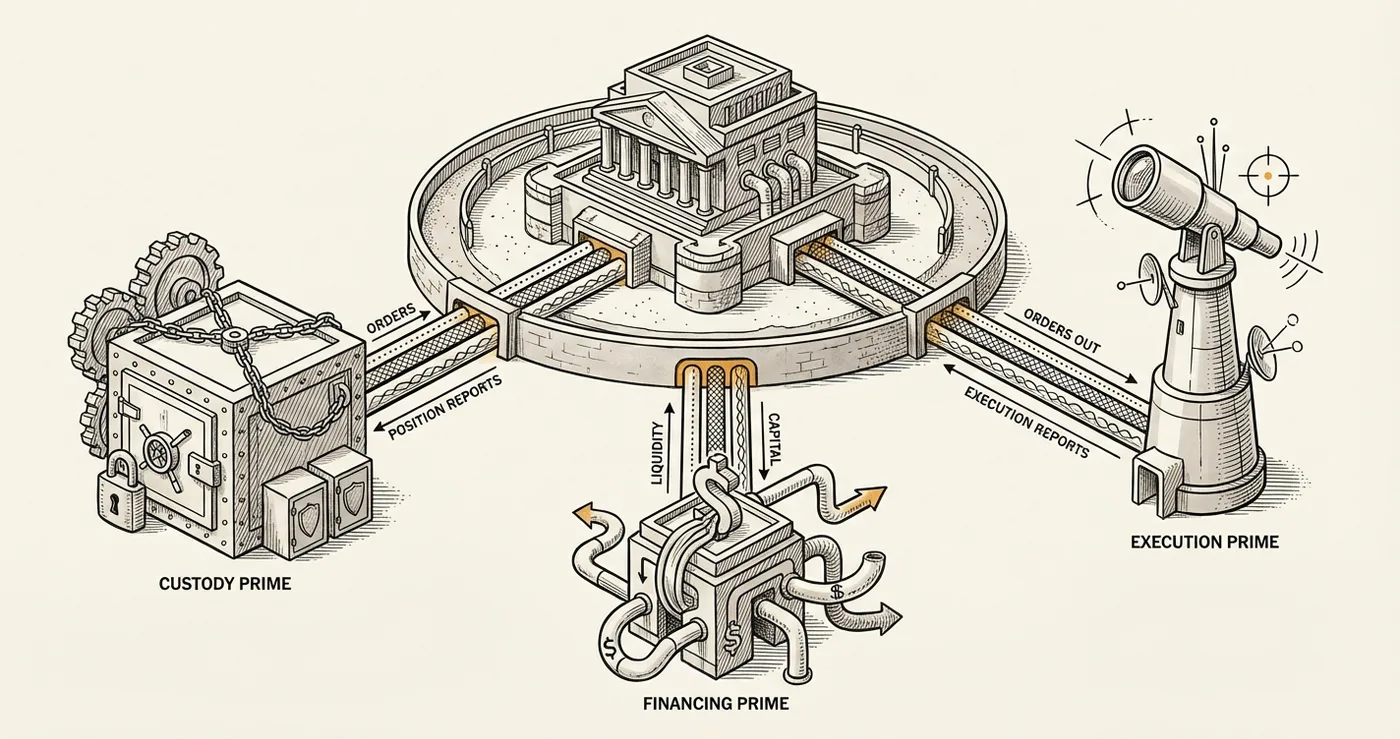
The shift toward multi-prime arrangements is rooted in both risk management and economic optimization. When Lehman Brothers filed for bankruptcy in September 2008, funds with single-prime relationships discovered that their assets could be trapped in lengthy insolvency proceedings, frozen in jurisdictions with unfavorable rehypothecation rules, or subject to unexpected claims from the prime's other creditors. The lesson was stark: counterparty concentration in prime brokerage is existential risk, not operational inconvenience.
Beyond risk mitigation, multi-prime architecture lets funds optimize across several dimensions at once. Financing rates vary by prime according to balance-sheet capacity and appetite for specific asset classes. A prime with a large equity lending desk may offer better short-locate availability and lower borrow costs on hard-to-borrow names; another may price fixed income or derivatives margin more competitively; a third may execute better in particular geographies. Distributing activity lets a fund negotiate each dimension on its merits and shift balances when a prime's terms deteriorate.
But every dimension a fund optimizes is a dimension it must then reconcile. Each prime runs its own technology stack — distinct connectivity protocols, message schemas, margin methodologies, and reporting formats — and each produces its own version of the truth about positions the fund holds across all of them. Without an integration layer that resolves those versions into one authoritative record, the operational burden of managing multiple primes can quietly exceed the economic benefit that motivated the arrangement. The economic case for multi-prime is well understood; the architectural case for treating it as a single-record problem is what most implementations get wrong.
FIX Protocol Integration Patterns and Optimization

The Financial Information eXchange (FIX) protocol is the lingua franca of institutional trading connectivity. Virtually every prime broker accepts FIX for order submission, execution reporting, and allocation messaging. However, the standardization that FIX provides at the protocol level masks significant variation at the implementation level. Each prime broker interprets the FIX specification differently, supports different optional fields, and imposes different session management requirements.
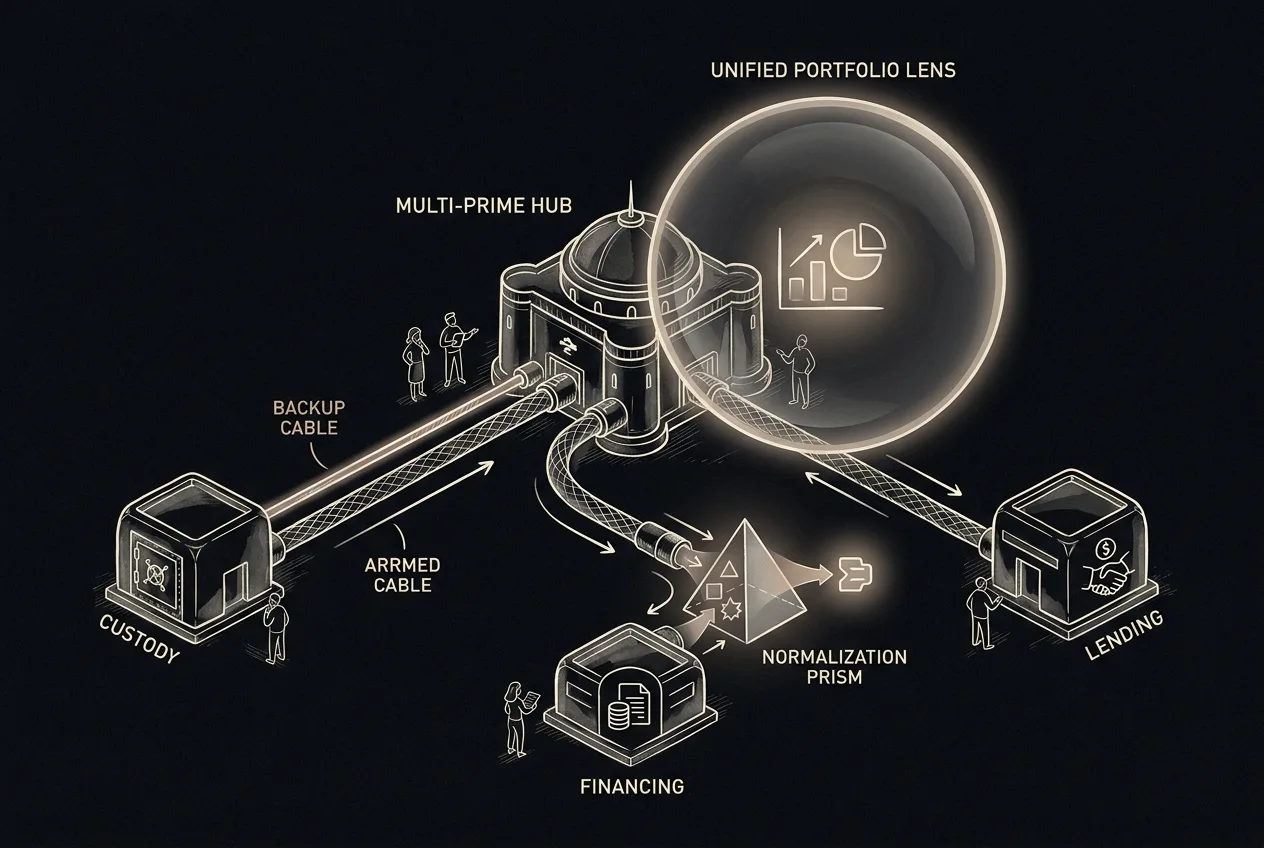
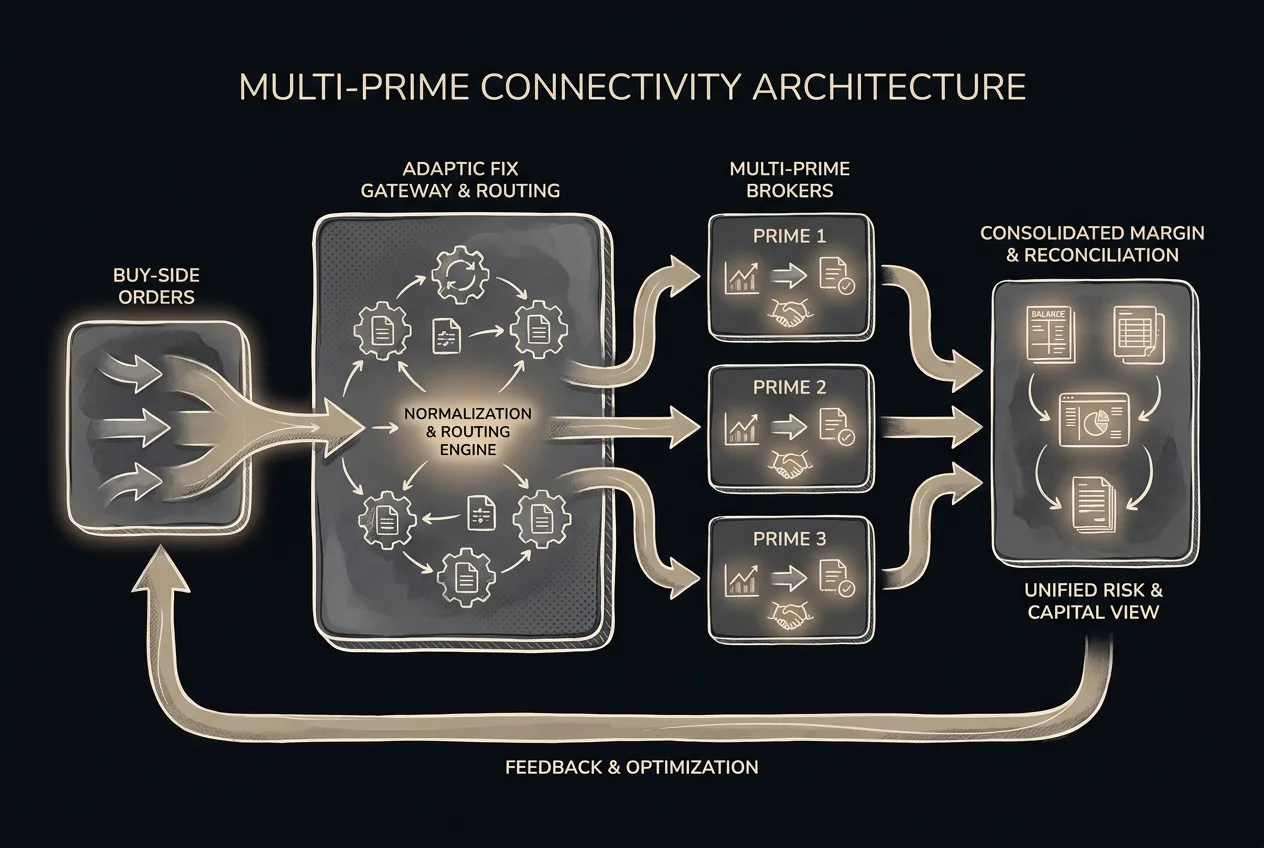
A well-designed FIX integration layer abstracts these broker-specific differences behind a unified internal interface, and the placement of that boundary is the whole design. Inbound messages from different primes are normalized into a canonical internal format at the gateway, before they touch any business logic. Outbound messages are translated from the canonical format into each prime's expected dialect at the last possible stage. The dialect lives only at the edges; everything inside speaks one language. This is the one-data-model principle applied at the wire: strategy logic, risk checks, and the order management system operate against a single representation of an order, regardless of which prime carries it. The alternative — letting each prime's conventions leak inward — forces every downstream component to know about every prime, which is precisely how a multi-prime estate degrades into a set of single-prime integrations that merely share a building.
Session management is a critical operational concern. FIX sessions are stateful TCP connections with sequence number tracking, and session failures require careful recovery procedures. Each prime broker connection must implement heartbeat monitoring, automatic reconnection with exponential backoff, and message gap-fill procedures to ensure that no execution reports are lost during network interruptions. The sequence number recovery process, where a reconnecting session requests retransmission of missed messages, must be handled correctly to avoid duplicate order submissions or missed fills.
Performance optimization of FIX connectivity focuses on reducing serialization overhead and minimizing network round trips. High-performance implementations use pre-allocated message buffers, avoid dynamic memory allocation on the critical path, and batch acknowledgments where the protocol permits. For latency-sensitive strategies, some firms maintain dedicated FIX sessions for different order types, ensuring that high-priority orders are not queued behind bulk allocation messages or administrative traffic on a shared session.
Order Routing and Smart Order Routing Across Prime Brokers
The order routing layer determines which prime broker handles each order, a decision that involves execution quality, financing implications, margin utilization, and operational considerations. This is distinct from smart order routing at the venue level, which determines where an order is executed within a broker's available venues. Prime broker selection operates at a higher level, determining the counterparty relationship through which the trade is conducted.
The routing decision engine evaluates several factors in real time. Current margin utilization at each prime determines available capacity: routing additional risk to a prime where the fund is approaching its limit invites a margin call or forced liquidation. Financing rates vary by prime and asset class, so a new long position routed to the cheapest financing source reduces carry cost. For short sales, the engine must check locate availability, because a name that is easy to borrow at one prime may be hard to borrow or unavailable at another.
The most consequential property of this layer is that these constraints are checked before an order leaves the building, not after a fill arrives. Margin headroom, locate availability, and per-prime concentration limits are eligibility rules, and the disciplined way to enforce eligibility rules is as policy-as-code in the pre-trade path — a single evaluation that every order crosses, expressed once and applied uniformly across every prime and venue, rather than as tribal knowledge distributed across a trading desk. Sophisticated routing systems extend this with a real-time model of each prime's margin methodology, predicting the margin impact of a proposed trade before submission. That prediction is what prevents the operationally disruptive case where an order is accepted and executed, only to trigger an unexpected margin call hours later when the prime's end-of-day calculation runs. The model must respect each prime's specific methodology: some use risk-based portfolio margining, others rules-based Regulation T calculations, and the benefit of cross-margining correlated positions varies significantly across primes. Encoded as policy, those differences become inputs to a routing decision; left implicit, they become the source of the next margin surprise.
Real-Time Margin Monitoring and Collateral Optimization
Margin management in a multi-prime environment requires maintaining a consolidated, real-time view of obligations and available collateral across all prime relationships. Each prime calculates margin independently, using its own risk models and haircut schedules. A security that receives a 15% haircut at one prime may receive a 20% haircut at another, creating optimization opportunities in how collateral is allocated.
The collateral optimization engine solves a constrained allocation problem: given a pool of eligible collateral and a set of margin obligations across primes, it determines the allocation that minimizes total financing cost while satisfying all margin requirements. This is computationally non-trivial because collateral eligibility, concentration limits, and haircut schedules differ across primes, and because the optimization must account for settlement timing when collateral needs to be transferred between custodians.
Real-time margin monitoring requires ingesting margin data from each prime as frequently as possible. Some primes provide intraday margin snapshots via API; others update only at end-of-day. The monitoring system must supplement prime-provided data with its own shadow margin calculations, using the same risk models each prime employs, to maintain a continuous estimate of margin utilization. Discrepancies between the shadow calculation and the prime's reported margin trigger alerts for investigation, often revealing data timing differences or position mismatches that need resolution before they become operational problems.
Position Reconciliation Across Prime Brokers

Reconciliation is where the one-data-model principle is continuously enforced rather than merely declared. It is the process of proving that the fund's internal book of record matches each prime's records, and that the consolidated view across all primes is accurate. In a multi-prime environment this complexity grows multiplicatively: each position may be split across primes, each trade may settle at a different custodian, and corporate actions may be processed on different timelines. The fund's internal record is the single source of truth; every prime statement is evidence to be matched against it, never a competing ledger to be averaged with it.
That distinction is what makes reconciliation a property of the audit spine rather than a nightly batch job. When every confirmation, break, and adjustment is appended to one replayable record, never rewritten — each entry linked to the trade and the prime that produced it — the state of any position at any past moment is reconstructible, and so is the reasoning that resolved every discrepancy. Automated reconciliation then operates as a continuous cycle against that spine. Trade-date reconciliation matches executed trades against prime confirmations, flagging breaks such as missing fills, incorrect prices, or mismatched quantities within minutes of execution. Settlement-date reconciliation verifies that trades settled correctly and that cash and security balances reflect expected movements. Position reconciliation compares the book of record against each prime's statement, surfacing discrepancies in quantities, prices, or corporate-action adjustments.
The most operationally demanding reconciliation challenges involve corporate actions and income events. A stock split processed at different times by different primes can create temporary position discrepancies that, if not identified quickly, may trigger erroneous risk calculations or trading decisions. Dividend payments with different ex-date interpretations across jurisdictions add further complexity for funds with international multi-prime arrangements. The reconciliation engine must maintain a corporate actions calendar and pre-compute expected position adjustments, flagging any prime whose reported positions deviate from the expected post-action state.
Break resolution workflows route identified discrepancies to the appropriate operations team with full context: the nature of the break, the affected positions, the relevant prime contacts, and a suggested resolution. This is the division of labor that lets a fund scale through policy rather than headcount — the machine detects, classifies, and routes every break the moment it appears; a human adjudicates the genuinely ambiguous ones and governs the rules by which the rest are resolved automatically. Persistent or systematic breaks usually point to an integration defect — a FIX mapping that consistently misreads a specific field, say — so the reconciliation system doubles as an early-warning mechanism for infrastructure problems that would otherwise surface as recurring manual cleanup.
Securities Lending and Financing Integration
Securities lending is a critical function of the prime brokerage relationship, enabling short selling and generating incremental revenue for funds with long portfolios. In a multi-prime environment, the securities lending integration must aggregate locate availability across primes, optimize borrow allocation for cost efficiency, and manage recall risk when lenders demand return of borrowed securities.
The locate aggregation system queries each prime's lending desk, either through automated APIs or FIX-based locate request messages, to build a consolidated view of borrow availability and cost. When a portfolio manager or algorithm needs to establish a short position, the system identifies the lowest-cost borrow source across all primes, considering not just the headline borrow rate but also the prime's historical reliability on locates, the probability of a recall, and any minimum borrow requirements.
Financing optimization extends beyond securities lending to include the fund's overall debit and credit balances across primes. A fund with a large cash credit at one prime and a debit balance at another is paying unnecessary financing costs. The treasury management layer monitors cross-prime balances and initiates transfers to minimize net financing expense, subject to operational constraints around transfer timing and minimum balance requirements at each prime.
Failover and Redundancy in Prime Connectivity
Connectivity failure to a prime broker during market hours is an operational emergency. Orders may be in flight, positions may need to be hedged, and margin obligations do not pause for technical difficulties. The failover architecture must provide continuity of operations when any single prime connection fails, without requiring manual intervention during the critical initial response period.
The primary failover mechanism is redundant connectivity to each prime, typically through geographically diverse network paths and independent FIX sessions. If the primary session to a prime fails, the backup session activates automatically, with the FIX sequence number recovery process ensuring that no messages are lost during the transition. The failover must be transparent to upstream systems: the order management system should not need to know or care which physical connection is carrying its messages to a given prime.
Beyond connection-level redundancy, the architecture must handle scenarios where an entire prime broker becomes unavailable. This requires the ability to reroute order flow to alternate primes, transfer margin collateral to cover increased obligations at the receiving primes, and adjust risk limits to reflect the changed counterparty landscape. These operations must be pre-planned and partially automated, because the time pressure during a prime broker outage, whether caused by a technical failure or a more serious credit event, does not permit deliberate architectural decision-making.
Disaster recovery testing is essential and must be conducted regularly with each prime broker's technology team. Simulated failover exercises verify that backup connections activate correctly, that sequence number recovery procedures work as documented, and that the time required to restore full operational capability meets the fund's recovery time objectives. Firms that treat disaster recovery as a compliance exercise rather than an operational necessity discover the gaps in their failover architecture at the worst possible time.
Across every layer examined here — FIX normalization at the gateway, pre-trade eligibility as policy, continuous reconciliation on the audit spine, failover that is rehearsed rather than assumed — the same principle recurs: the many faces a fund presents to its prime brokers must collapse into one record on the inside. Multi-prime is an economic strategy that only pays once the integration treats it as a single-record problem. Firms that build this way gain operational resilience, financing optimization, and the freedom to add, drop, or rebalance prime relationships without rewiring their own systems each time. Those that treat prime integration as a solved problem, or worse, as someone else's problem, inherit a fragmented estate whose disagreements surface at the least forgiving moments — a margin call, a settlement break, a counterparty in distress — and expose themselves to operational risk that no amount of investment alpha compensates for.