Building Institutional Compliance Automation: Beyond Checkbox Regulation
Checkbox compliance reviews losses after they happen. Encoding regulatory obligation as version-controlled policy, enforced before a trade executes, makes accountability a property of the architecture rather than a department.


The global financial services industry spends an estimated $270 billion a year on compliance, and at most institutional asset managers the line item still grows faster than assets under management. The reflex is to add people: hire more officers, buy another point solution, layer one more manual review onto the workflow. That reflex treats the symptom and misreads the disease.
The disease is architectural. The checkbox model of compliance, a review performed after the fact against a list, was built for a slower world of fewer jurisdictions, fewer asset classes, and trades measured in days. It cannot govern execution that happens in milliseconds across global venues, because by the time the box is checked the trade has already cleared and the loss, if there is one, has already been taken. A control that fires after the event is not a control. It is a record of what went wrong.
The argument of this piece is narrow and, I think, defensible: the firms that escape the compliance cost spiral will not do so by checking boxes faster. They will do it by changing where the check happens. Compliance becomes effective at the moment it stops being a department that reviews decisions and becomes a property of the system that makes them, regulatory obligation encoded as version-controlled policy and enforced before an order reaches the market rather than reviewed after it returns. Humans govern; machines operate within the constraints those humans have written down. Everything that follows is an argument for that one structural move.
The Compliance Cost Crisis
To understand why compliance automation has become urgent, it is necessary to appreciate the scale and complexity of modern regulatory obligations. A mid-sized institutional asset manager operating across the United States, European Union, United Kingdom, Singapore, and the Middle East may be subject to regulatory oversight from more than a dozen authorities, each with distinct reporting requirements, conduct standards, and examination procedures.
Consider the reporting burden alone. In the United States, SEC-registered investment advisers must file Form ADV (annually, with interim amendments), Form PF (quarterly for large advisers), Form 13F (quarterly), and various other filings depending on strategy type and investor composition. European managers face AIFMD Annex IV reporting, SFDR disclosures, PRIIPs documentation, and national regulator filings. Managers operating in Singapore must comply with MAS reporting requirements under the Securities and Futures Act. Those with structures in the DIFC must satisfy DFSA regulatory returns and anti-money laundering reports.
Each filing has its own data requirements, calculation methodologies, formatting standards, and submission deadlines. The data required often overlaps but never precisely aligns across jurisdictions, meaning that a single underlying portfolio generates multiple, slightly different representations depending on which regulator is asking. For a fund running multiple strategies across multiple vehicles in multiple jurisdictions, the permutations quickly become staggering.
Beyond periodic reporting, ongoing compliance monitoring adds another layer of complexity. Pre-trade compliance checks must verify that every proposed transaction is consistent with investment guidelines, regulatory restrictions, and client mandates before execution. Post-trade surveillance must detect potential market abuse, insider trading, and best execution failures after the fact. Client onboarding and ongoing due diligence must satisfy anti-money laundering (AML) and know-your-customer (KYC) requirements that vary by jurisdiction and client type. And all of this must be documented in a manner sufficient to withstand regulatory examination, litigation discovery, and investor due diligence.
The manual processes traditionally used to manage these obligations are not merely expensive. They are fragile, error-prone, and structurally unable to scale, because their throughput is bounded by analyst hours. Doubling the volume of trades or the number of jurisdictions roughly doubles the work, and the only available lever is headcount. A compliance framework built on spreadsheets, email chains, and periodic review is not a slower version of the right system. It is the wrong system, mismatched at the level of its foundations with a trading environment that operates in milliseconds across global venues and asset classes. The fix is not to run the wrong system faster.

Policy as Code: Compliance That Runs Before the Trade
The first generation of compliance technology automated the mechanics of the manual process without questioning the process itself. Workflow tools digitized paper approval chains. Reporting platforms formatted and filed regulatory returns. Screening systems matched transactions against sanctions and restricted-security lists. These tools cut labor cost and improved consistency, but they left the model intact. They automated the checking of boxes rather than removing the need to check them by hand.
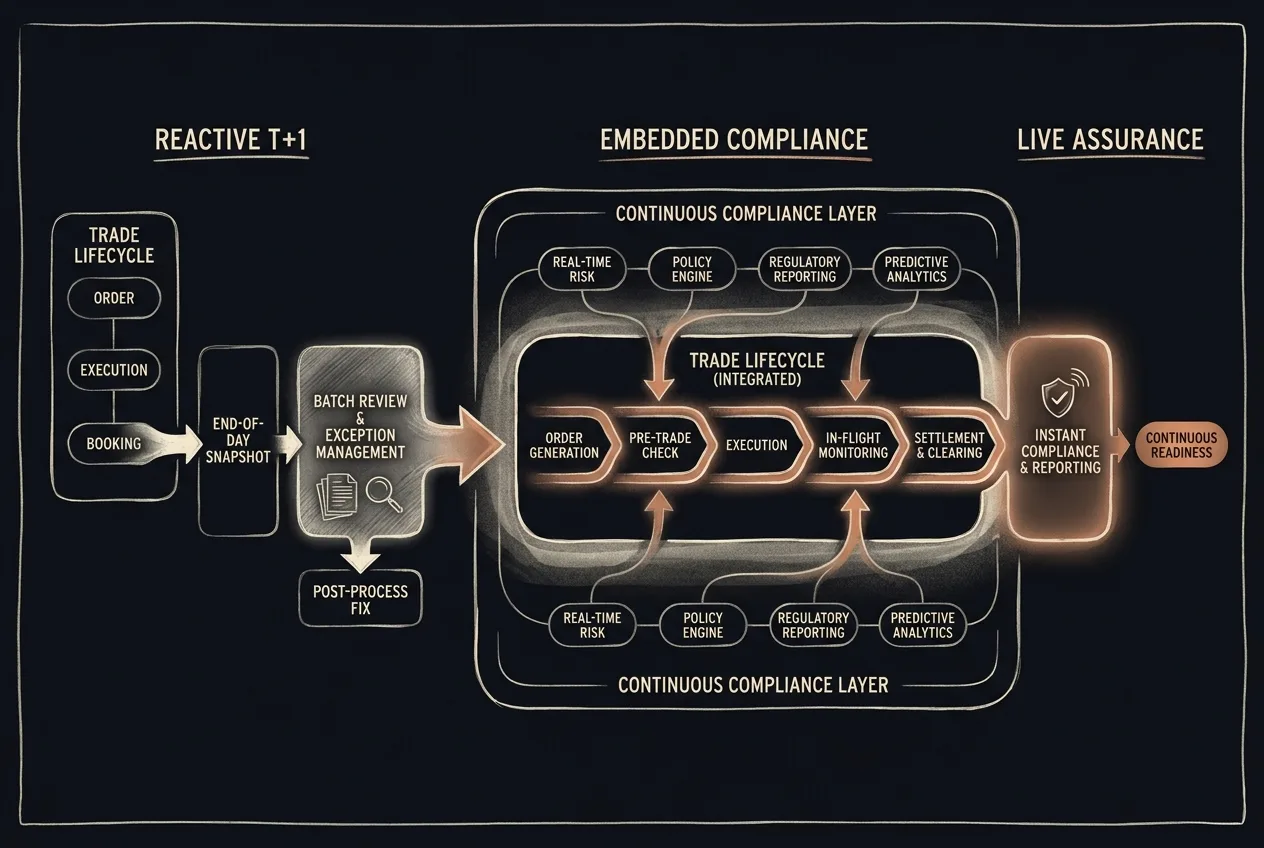
The structural alternative is to stop expressing policy as a list a human consults and start expressing it as code a machine enforces. An investment guideline, a concentration limit, a jurisdictional restriction, a mandate constraint: each of these is a rule, and a rule can be written down precisely, versioned in source control, tested against known cases, and evaluated automatically against every proposed order before that order is allowed to execute. This is what policy as code means. The policy is not a PDF in a binder and an analyst's memory of it. It is an executable artifact with an owner, a history, and a commit log, sitting in the path between a decision and the market.
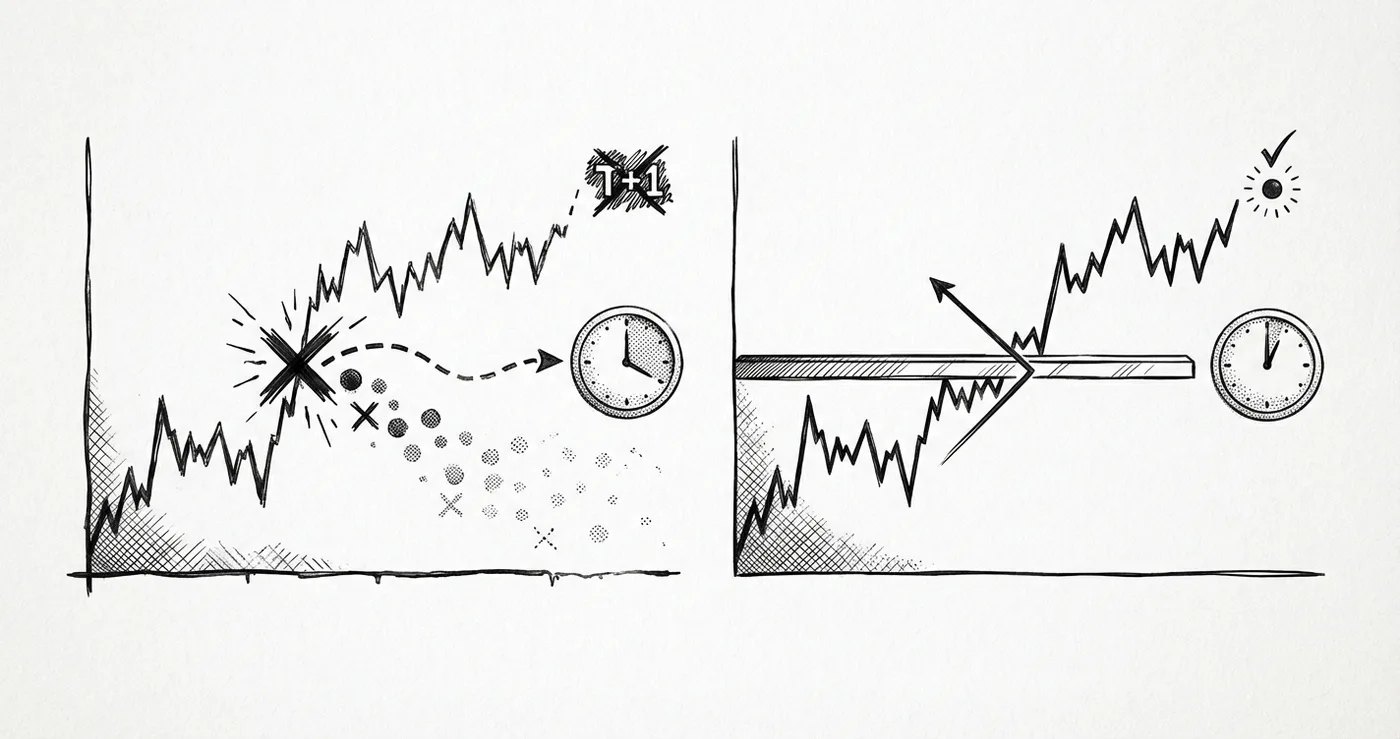
Three properties follow from that single change, and they are the properties checkbox compliance can never have. Enforcement moves from after the fact to before it: a check that would have flagged a concentration breach at T+1 instead blocks the order at T+0, so the breach never occurs and there is nothing to remediate. Change becomes governed: when a regulation is amended or a limit is tightened, someone edits the policy, the edit is reviewed and merged like any other change to a production system, and the diff shows exactly what the firm now enforces and who approved it. And scale decouples from headcount: a rule, once written, evaluates the ten-thousandth order as faithfully as the first, at no additional marginal cost in human attention. The firm scales on better policy, not more reviewers.
The closest analogue is manufacturing quality control. Early quality systems relied on end-of-line inspection, catching defects in finished goods after the cost of producing them was already sunk. Modern systems embed tolerances into the line itself, so a part that falls out of specification is rejected at the station that made it. Compliance is undergoing the same move, from end-of-period inspection to a constraint built into the act of production. The difference is not speed. It is where in the process the standard lives.
Surveillance and the Audit Spine
Pre-trade enforcement stops the violations a rule can anticipate. It does not, on its own, explain what happened, satisfy an examiner, or detect the patterns no single rule was written to catch. That is the work of surveillance, and the move from T+1 to real-time is the same move made one layer up.
Traditional surveillance runs on a T+1 basis, analyzing the previous day's activity for patterns that warrant investigation. The model has two structural defects. The first is timing: by the time a pattern surfaces, the damage is done. A manipulative sequence has already moved prices; a position that breached a concentration limit has already exposed the fund. Detection after the fact is a reporting function dressed as a control. The second is signal quality. Static-threshold surveillance fires whenever any line is crossed, and the overwhelming majority of what it produces is noise, alerts that demand investigation and reveal nothing. Every false positive consumes analyst time that genuine risk had a claim on.
Real-time surveillance addresses the timing defect directly. Monitoring activity as it occurs lets the system act before a violation is consummated, and where a rule is precise enough, the pre-trade layer blocks the order outright rather than flagging it for next-day review. Behavioral models address the signal defect. Rather than alerting on any threshold crossing, a model that has learned the normal trading pattern of a given strategy can distinguish a routine rebalance from a genuine anomaly and direct attention to the deviations most likely to matter. The honest framing is that this trades one failure mode for another: a model can be miscalibrated, and a surveillance system that surfaces too little is more dangerous than one that surfaces too much. Calibration is therefore not a tuning detail. It is the core of the design, and it is owned, reviewed, and adjusted by named humans rather than left to drift.
What makes surveillance defensible, though, is not the model. It is the record underneath it. Every order, every policy evaluation, every block, every alert, and every human disposition writes to an audit spine: an append-only log in which each entry is timestamped, attributed to the actor who caused it, linked to the specific policy clause it engaged, and replayable. Replayable is the load-bearing word. Months later, faced with an examiner, a litigant, or an allocator's operational-due-diligence team, the firm can reconstruct not merely that a decision was made but why, against which encoded rule, under whose authority, and what the system did in response. A surveillance alert that cannot be explained and replayed is an accusation without evidence. The audit spine is what turns "the system flagged it" into a defensible account.
AML/KYC Automation and Continuous Due Diligence
Anti-money laundering compliance and know-your-customer procedures represent some of the most labor-intensive and operationally complex obligations facing institutional asset managers. Traditional AML/KYC processes are fundamentally episodic. They are performed during client onboarding, repeated at periodic intervals (typically annually or biennially), and triggered by specific events such as significant transactions or changes in client circumstances. Between these checkpoints, monitoring is limited and often nominal.
This episodic model creates significant gaps in risk coverage. A client's beneficial ownership structure may change between annual reviews. A politically exposed person (PEP) designation may be added or removed. Sanctions lists are updated continuously, but screening against those lists often occurs only at defined intervals. The result is a compliance framework that provides point-in-time assurance rather than continuous risk management.
Intelligent automation transforms AML/KYC from an episodic exercise into a continuous process. Automated systems can monitor changes in client entity structures through corporate registry databases, screening services, and public records in near real time. PEP and sanctions screening can run continuously against updated lists rather than waiting for scheduled review cycles. Transaction monitoring systems can analyze patterns across the full history of a client relationship, identifying gradual shifts in behavior that might be invisible in any single review period.
Natural language processing enables automated analysis of adverse media, monitoring news sources and public filings in multiple languages for information relevant to client risk profiles. Entity resolution algorithms can identify connections between clients and high-risk entities that might not be apparent from manual review of individual records. And graph analysis techniques can map complex ownership structures and identify indirect relationships that create compliance exposure.
For managers operating across jurisdictions with different AML/KYC requirements, automation also addresses the harmonization challenge. A client onboarded in Singapore under MAS requirements may subsequently need to be cleared under EU AMLD6 standards and DFSA regulations. Intelligent systems can map the data collected during initial onboarding against the requirements of additional jurisdictions, identifying gaps that need to be filled and generating targeted requests rather than requiring the client to undergo a full onboarding process in each jurisdiction.
Automation here has a hard boundary, and stating it plainly is part of doing it correctly. Surveillance, screening, and monitoring can run unattended; certain acts cannot. Clearing a politically exposed person, overriding a sanctions hit, or admitting a client whose risk score sits above threshold are irreversible decisions with regulatory and reputational consequences, and they are gated to a named human who holds the authority and the accountability. The machine assembles the evidence, scores the risk, and prepares the recommendation; a person makes the call and signs it, and the audit spine records who. This is the same principle that governs the trading side of the platform: machines operate continuously within written constraints, and the consequential, irreversible act is reserved for a human who can be named. Automating the analysis is leverage. Automating the judgment would be an abdication.
The competitive implications are direct. Faster, smoother onboarding improves the investor experience and reduces time-to-capital. Continuous monitoring provides better risk coverage with lower operational overhead. And the audit trail that regulators expect is generated as a byproduct of the work rather than reconstructed afterward from analyst memory and email.

Cross-Jurisdictional Compliance
For institutional asset managers operating globally, cross-jurisdictional compliance is the defining challenge of the regulatory landscape. The complexity arises not merely from the number of regulatory regimes involved, but from the interactions and conflicts between them.
Consider a fund structured as a Cayman Islands exempted limited partnership, managed by a registered investment adviser in the United States, with a sub-adviser in Singapore and investors from the European Union, the Middle East, and Asia-Pacific. This single fund structure must comply with Cayman Islands Monetary Authority (CIMA) requirements, SEC regulations, MAS rules, EU investor protection standards, and the specific requirements of any DIFC or ADGM-based feeder vehicles. The compliance obligations are not merely additive. They interact in complex ways, where an action required by one jurisdiction may create complications under another.
Encoding policy as code is what makes this complexity tractable. When each requirement is a structured, machine-readable rule rather than a paragraph of prose, the relationships between requirements become analyzable: a regulatory knowledge graph can represent how a Cayman obligation interacts with an SEC one, and where the two pull in different directions. When a regulation is adopted or amended, the change is made once, to the relevant policy, and the system can assess its effect across every jurisdiction in which the manager operates, flagging the specific other rules it now conflicts with. The alternative, a human holding the full cross-border interaction map in their head, does not scale past a handful of regimes and leaves no record of the reasoning when an examiner asks for it.
This capability is particularly valuable during periods of rapid regulatory change. The ongoing evolution of digital asset regulation, ESG disclosure requirements, and data privacy standards creates a continuous stream of regulatory updates that must be analyzed for cross-jurisdictional impact. Automated monitoring and analysis ensures that no relevant change falls through the cracks, while structured impact assessment enables compliance teams to prioritize their response efforts based on materiality and urgency.
Regulatory Reporting Automation
Regulatory reporting is where the operational benefits of compliance automation are most immediately quantifiable. The traditional reporting process, involving manual data extraction, spreadsheet-based calculation, human review, formatting, and submission, is labor-intensive, error-prone, and difficult to scale.
Reporting automation begins not with the report but with the data beneath it. A single underlying portfolio has to appear in Form PF, Form 13F, AIFMD Annex IV, and a MAS return, each demanding a slightly different cut of the same facts. When those cuts are drawn by hand from separate extracts, they drift, and a fund can find itself having told two regulators two marginally different versions of its own position, which is precisely the kind of inconsistency an examination is built to surface. Generating every filing from one governed source of truth, the same record that feeds the audit spine, eliminates the drift at its origin. The figures reconcile because they were never separate.
For Form PF reporting, automation can continuously calculate systemic risk metrics, portfolio liquidity profiles, and counterparty exposures that would traditionally be compiled only at reporting deadlines. This provides compliance teams with real-time visibility into their regulatory reporting position, eliminating the end-of-quarter scramble that characterizes traditional processes.
AIFMD Annex IV reporting, with its detailed requirements for leverage calculation, risk profiling, and liquidity analysis across multiple methodologies, is particularly well-suited to automation. The calculations are complex but deterministic, meaning they can be precisely implemented in software and validated against known test cases. Once automated, these calculations run continuously rather than quarterly, providing fund management teams with ongoing visibility into their regulatory metrics.
MAS reporting for Singapore-regulated managers involves similar opportunities for automation, with the added complexity of requirements specific to Variable Capital Company (VCC) structures that many institutional managers are adopting as their preferred Asia-Pacific fund vehicle.
The firms that have fully automated their regulatory reporting consistently report benefits beyond simple cost reduction. Automated reporting provides earlier visibility into potential threshold breaches, enabling proactive management rather than after-the-fact disclosure. It reduces the risk of reporting errors that can trigger regulatory scrutiny. And it frees compliance professionals to focus on judgment-intensive activities, such as regulatory interpretation and policy development, rather than data manipulation and formatting.
Accountability as Architecture
Treating compliance as a cost center is not just a budgeting choice; it is a statement about where accountability lives. In the checkbox model, accountability resides in a department, a group of people whose job is to catch what the rest of the firm might do wrong. Departments have capacity limits, turnover, and bad days. Architecture does not. When the constraints are encoded in the system that executes, when every consequential decision is gated, logged, attributed, and replayable, accountability stops being a function someone performs and becomes a property of how the firm is built. That is the durable version of "compliance as competitive advantage," and it is worth more than the cost saving.
Sophisticated allocators have learned to read the difference. Operational due diligence exists precisely to test whether a manager's controls are real or aspirational, and a firm that can replay any decision against the policy in force at the time, show the commit history of that policy, and name the human who authorized each irreversible act is making a claim that is verifiable rather than asserted. The inference allocators draw is reasonable: a firm that engineers accountability into its regulatory stack is likely applying the same discipline to investment, operational, and counterparty risk. The compliance architecture is legible, so it serves as a proxy for the rest.
This dynamic creates a feedback loop that favors firms with advanced compliance capabilities. Better compliance infrastructure attracts more sophisticated allocators, who bring larger allocations and longer investment horizons. These allocations generate revenue that supports further investment in infrastructure, which in turn attracts additional allocators. The firms that view compliance as a strategic investment rather than a regulatory tax build compounding advantages that are difficult for less-automated competitors to replicate.
For emerging managers in particular, compliance automation can be transformative. Historically, the operational infrastructure required to satisfy institutional allocator due diligence requirements created a significant barrier to entry, effectively requiring emerging managers to build compliance capabilities appropriate for a firm many times their size before they could attract their first institutional allocation. Cloud-based compliance automation platforms lower this barrier by providing institutional-grade capabilities on a subscription basis, enabling smaller firms to present compliance infrastructure comparable to much larger competitors.
The Future: Predictive Compliance and Regulatory Sandboxes
The current generation of compliance automation is primarily reactive and contemporaneous, detecting issues as they occur and automating responses to known regulatory requirements. The next generation will be predictive, using pattern analysis and scenario modeling to anticipate compliance challenges before they materialize.
Predictive compliance systems analyze regulatory trends across jurisdictions to anticipate likely changes and their potential impact on fund operations. They model the implications of a proposed portfolio change before it executes, not only against existing rules but against rules a firm has reason to expect. And they use behavioral analysis to surface organizational patterns, rapid growth in a new asset class, expansion into an unfamiliar jurisdiction, that have historically preceded compliance failures. The discipline this demands is restraint about what "predict" means. A forecast of regulatory direction is an input to human judgment, not a substitute for it, and a model that quietly tightened or relaxed a live control on its own anticipation of a rule would itself be a governance failure. Prediction informs the policy a human writes; it does not write the policy.
Regulatory sandboxes, controlled environments in which firms can test innovative approaches under relaxed regulatory requirements, provide another frontier for compliance innovation. Jurisdictions including Singapore, the United Kingdom, Abu Dhabi, and the European Union have all established sandbox programs that enable financial institutions to experiment with new technologies and business models. For compliance automation providers, sandboxes offer the opportunity to test and validate advanced capabilities, including predictive analytics, automated regulatory interpretation, and adaptive control frameworks, in collaboration with regulators rather than in tension with them.
The convergence of these trends points toward a future in which the compliance function is fundamentally integrated into the investment process rather than operating as a parallel oversight mechanism. In this model, compliance considerations are embedded directly into portfolio construction, trade execution, and risk management systems, with intelligent automation ensuring that every decision is evaluated against the full spectrum of regulatory requirements in real time.

Conclusion
The compliance cost crisis is real, but it is a symptom. The cause is a model designed for a simpler era and asked to govern a faster one: a department checking boxes after the fact against a list. Scaling that model up, more people, more point solutions, more reviews, buys time and nothing else, because the marginal reviewer is the very cost the firm is trying to escape.
The structural answer is to move the check. Encode the obligation as version-controlled policy. Enforce it before the order executes rather than reviewing it after the loss. Reserve the irreversible acts for a named human and gate them. Log everything to an append-only, replayable spine. Do those four things and accountability stops being a department you fund and becomes a property of the system you run, and the firm scales on the quality of its policy rather than the size of its compliance floor.
This is the discipline Adaptic builds toward, and we hold ourselves to its terms before we ask anyone else to. We describe what the system does rather than what we hope it will. Compliance encoded into the path of every decision is not a feature of the platform layered on at the end. It is the shape of the platform. In a regulatory environment that grows more complex each year, the firms that endure will be the ones that decided, early, that the check belongs before the trade and not after the loss.