Systematic Macro Strategies: Encoding Macroeconomic Regimes in Algorithmic Portfolios
How systematic macro encodes economic regimes, central bank signals, and cross-asset premia into algorithmic portfolios, and why the discipline lives or dies on disciplined treatment of model uncertainty.


In 1992, George Soros sized a short position against sterling large enough to break the Bank of England, on a thesis he held in his head and a conviction no model produced. That archetype, the macro investor as intuitive synthesizer of global economic forces, defined a generation: Stan Druckenmiller navigating the dot-com bust, Ray Dalio constructing all-weather portfolios. The discretionary macro manager built a career on translating complex economic narratives into directional bets across currencies, rates, equities, and commodities. But the information environment that sustained that archetype has changed beyond recognition. The volume of economic data has exploded, central bank communication has become more frequent and more nuanced, and the interval in which markets price new information has compressed from days to milliseconds. No individual, however gifted, reads hundreds of indicators and parses every central bank speech as fast as the market now moves.
Systematic macro is the response. Rather than concentrating reasoning in one mind, it encodes macroeconomic logic into algorithmic frameworks that process large datasets, estimate regime shifts continuously, and allocate capital across asset classes within explicit risk limits. The point is not to retire economic judgment. It is to author that judgment once, as rules, and then have a system apply it consistently across thousands of decisions a discretionary process could never reach. That distinction, between the judgment a human authors and the execution a machine performs, is the organizing idea of this piece. It is also the line along which a third operating model sits: not the discretionary manager working from intuition, and not an opaque model whose calls no one can reconstruct, but an encoded framework a portfolio manager governs and can interrogate after the fact.
The Quantitative Approach to Macro Investing
Traditional macro investing is top-down: form a view on the global economic cycle, identify which asset classes benefit in that environment, and construct positions accordingly. Systematic macro preserves this logic but moves the judgment from the moment of the trade to the moment the framework is written. Economic conditions are measured through indicator composites rather than narrative assessment. Positioning follows a rule the manager specified in advance rather than conviction sized on the day. Risk management is embedded in portfolio construction rather than applied after the fact. The discretion has not disappeared; it has been relocated upstream, into a policy the portfolio manager authors and the system then executes.
The advantage is consistency. The framework applies the same logic to every data release, every central bank statement, and every shift in cross-asset correlations, and it does not anchor on the last move, overweight recent memory, or hold a loser out of pride. The disadvantage, and the central engineering challenge, is that macroeconomic relationships are non-stationary. The correlation between inflation surprises and equity returns flips sign depending on whether the economy is in a demand-driven expansion or a supply-constrained stagflation. A rule that was correct in one regime is not merely less useful in another; it can be actively wrong. The framework must therefore make its conditionality explicit, which means it must first solve the regime identification problem. That problem is hard, and the honest version of this discipline never forgets that the regime is estimated, not observed.
Regime Detection: Identifying Growth, Inflation, and Policy Regimes Algorithmically

The concept of economic regimes is straightforward: the economy cycles through distinct states, each characterized by different relationships between macroeconomic variables and asset returns. A standard taxonomy identifies four quadrants defined by growth and inflation: high growth with low inflation (the goldilocks environment favoring equities), high growth with high inflation (favoring commodities and TIPS), low growth with low inflation (favoring duration and defensive equities), and low growth with high inflation (the stagflationary regime where cash and real assets outperform). The taxonomy is a simplification, and it is worth naming as one. Real economies do not announce which quadrant they occupy, transitions are gradual and occasionally reverse, and the boundaries are drawn by the modeler, not by nature.
The hard problem is therefore not defining the regimes but inferring which one the economy currently occupies, ideally before markets have fully priced the transition. Hidden Markov models have been a workhorse for this since the regime-switching research of James Hamilton in the late 1980s. These models assume the economy transitions between unobservable states according to a Markov process, with observable indicators emitted as probabilistic functions of the hidden state. Given a time series of GDP growth, inflation, unemployment, and financial conditions, the model estimates the probability of being in each regime at every point in time. The estimate is only as good as the assumption that past state dynamics resemble future ones, an assumption that fails precisely at the structural breaks that matter most.
More recent approaches use dynamic factor models that extract common components from dozens or hundreds of indicators at once. The Chicago Fed National Activity Index and the Federal Reserve Bank of New York's Weekly Economic Index follow this philosophy, compressing high-dimensional data into a few latent factors that track the business cycle in near-real time. Systematic macro desks build proprietary versions, often adding higher-frequency inputs such as weekly jobless claims, daily credit spreads, and real-time consumer spending proxies to gain a timing edge over monthly official releases. The temptation here is to keep adding indicators until the model fits history beautifully and forecasts nothing; the discipline is to add a signal only when it survives out-of-sample, not because it improves the backtest.
Bayesian regime-switching models offer the most honest posture toward this uncertainty. Rather than forcing a binary call on the current regime, the model maintains a probability distribution over states and updates it continuously as new data arrives; the portfolio then sizes positions against that distribution. When regime uncertainty is high, exposure falls automatically, because no single state commands enough probability to justify conviction. This is the architecturally correct response to ambiguity: the framework expresses what it does not know, and de-risks rather than guesses. Treating an estimated regime as if it were a known fact is the first and most expensive mistake in systematic macro.


Central Bank Communication Analysis with NLP
Central bank policy is among the most important drivers of cross-asset returns over horizons of one to twelve months. The Federal Reserve, European Central Bank, Bank of Japan, and their peers set the price of money, shape the yield curve, and through forward guidance steer expectations about the future path of policy. For systematic macro, reading central bank communication is a first-order problem, and one with a long history of crude proxies that worked until they did not.
Natural language processing has changed what is extractable. Early efforts simply counted hawkish versus dovish keywords in FOMC statements, a coarse signal that nonetheless carried real information. Modern implementations use transformer-based language models fine-tuned on central bank corpora to assess the semantic content of statements, press conferences, speeches, and minutes, detecting shifts in emphasis, conditional language that signals policy optionality, and committee disagreements that foreshadow a pivot. The capability is genuine, and so is the failure mode: a model fine-tuned to the language of one tightening cycle can misread the next, because the same words carry different weight under a different reaction function. The signal is informative, not authoritative, and it belongs in a portfolio sized for the chance that it is wrong.
The Monetary Policy Uncertainty Index, built from the dispersion of language across Fed communications, has been associated with the magnitude of future rate moves and the volatility of rates markets. Systematic desks build real-time versions, updating allocations within minutes of a release. The speed edge is real but narrow: markets reprice the obvious within seconds of an FOMC statement, and the durable edge lies in the nuanced language changes whose implications take hours or days to settle into term premia and cross-asset correlations, where careful parsing still earns its keep.
Cross-Asset Momentum and Carry Strategies

While regime detection and central bank analysis provide the strategic layer, systematic macro portfolios generate a substantial portion of returns from two well-documented cross-asset premia: momentum and carry.
Cross-asset momentum, sometimes called time-series momentum or trend following, exploits the tendency of asset prices to trend over horizons of one to twelve months. The economic rationale is well-established: investor underreaction to macroeconomic news, gradual position adjustment by institutional investors facing mandate constraints, and herding behavior that amplifies initial price moves. In a macro context, trend following is applied across dozens of futures markets spanning equity indices, government bonds, currencies, and commodities. The diversification across asset classes and geographies is critical: while any individual trend signal is noisy, the portfolio-level signal benefits from the low correlation of trends across markets.
Carry strategies systematically harvest the yield differential across assets: going long high-yielding currencies against low-yielding currencies, owning positively sloped yield curves through duration extension, or holding commodities in backwardation against those in contango. The carry premium compensates investors for bearing regime-dependent risks. Currency carry performs well in low-volatility growth environments but suffers sharp drawdowns during risk-off episodes when funding currencies appreciate violently.
The interaction between momentum, carry, and regime signals is where systematic macro earns its keep. A naive carry strategy is short volatility in disguise: it collects small premia in calm markets and surrenders them violently in a crash. A carry strategy conditioned on the macro regime, cutting exposure when the regime model indicates deteriorating growth or rising financial stress, preserves much of the premium while sidestepping the worst drawdowns. Trend signals conditioned on regime can likewise separate trends driven by fundamental shifts, which tend to persist, from those driven by technical positioning, which tend to reverse. The conditioning rule is exactly the kind of judgment a portfolio manager authors once and encodes: when this regime probability crosses this threshold, reduce that exposure by that amount. Written down, the rule is testable, auditable, and consistent. The risk is equally explicit, because regime conditioning is only as good as the regime estimate, and a model that calls the regime late hedges the crash late.

Risk Parity and Macro Factor Allocation
Portfolio construction in systematic macro has been heavily influenced by the risk parity framework pioneered by Bridgewater Associates. The core insight is that traditional asset allocation, with its heavy concentration in equity risk, leaves portfolios dangerously exposed to a single macroeconomic scenario: continued economic growth. Risk parity equalizes the risk contribution of each asset class, resulting in portfolios with substantial allocations to fixed income and commodities that would be underweighted in a traditional mean-variance framework.
The evolution of risk parity toward macro factor allocation represents the next stage. Rather than equalizing risk across asset classes, which are heterogeneous bundles of factor exposures, modern systematic macro strategies decompose portfolios into exposures to macro factors: growth, inflation, real rates, credit, and liquidity. Each factor is expressed through the most capital-efficient instruments available, whether that is equity index futures for growth, breakeven inflation swaps for inflation, or commodity baskets for real asset exposure.
Factor-based allocation enables more precise risk management. When the regime model indicates rising inflation risk, the portfolio can reduce its inflation beta directly rather than selling equities, which carry both growth and inflation exposure, and hoping the net effect lands correctly. The decomposition also surfaces hidden concentration: a portfolio that looks diversified across asset classes can carry a single dominant macro-factor bet, a vulnerability that stays invisible until the regime shift that exploits it. Naming the exposure in factor terms is what makes it governable; you cannot manage a risk the portfolio reports only as a list of unrelated positions.
Macro Nowcasting with Alternative Data
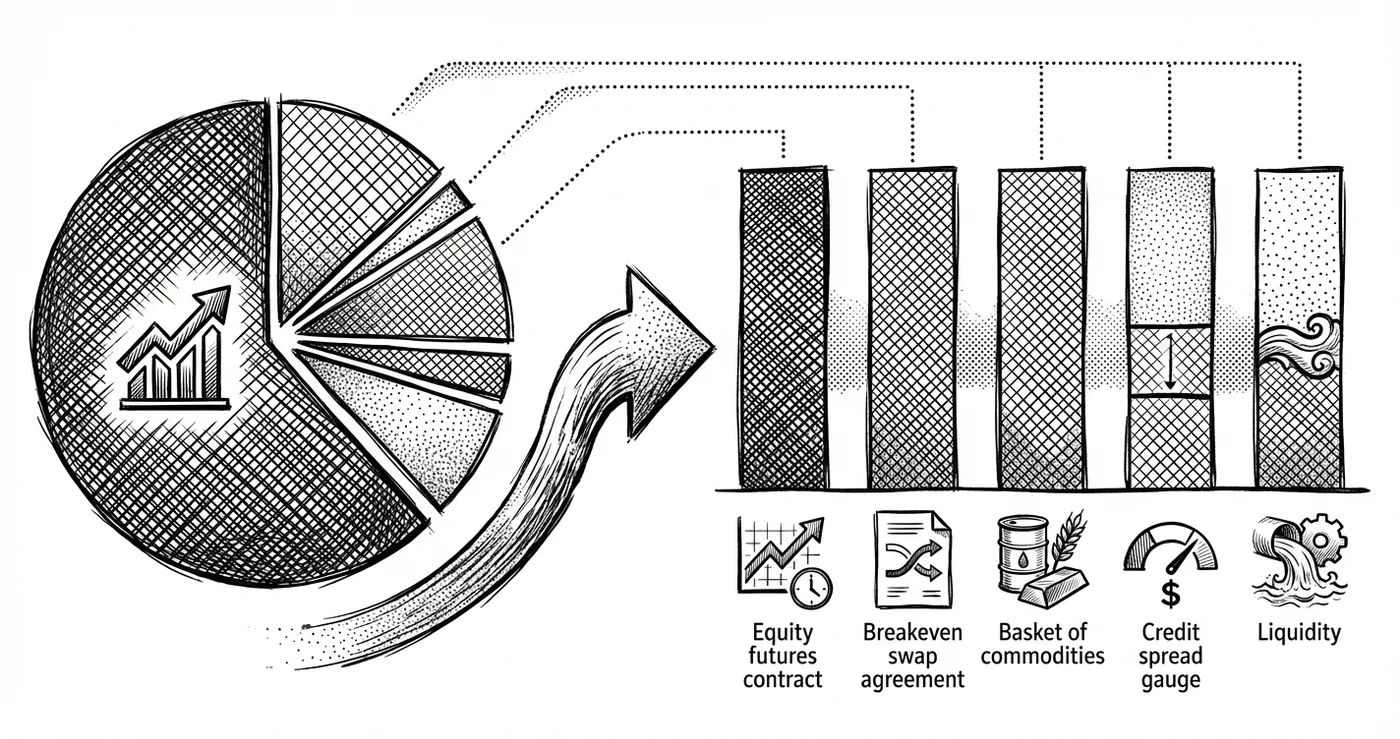
The information advantage in systematic macro increasingly depends on the ability to measure economic activity in real time rather than waiting for official statistics that arrive with publication lags of weeks or months. Macro nowcasting, the practice of estimating current economic conditions using timely data, has been transformed by the availability of alternative datasets.
Satellite imagery tracking parking lot occupancy at major retailers provides a real-time proxy for consumer spending. Shipping data from AIS vessel tracking systems measures global trade volumes as container ships move between ports. High-frequency employment data from payroll processors and job posting aggregators offers weekly reads on labor market conditions. Credit card transaction data reveals spending patterns by sector and geography days before official retail sales figures.
Systematic macro desks fold these streams into their regime frameworks to gain timing on turning points. The value concentrates at inflections: when the economy rolls from expansion to contraction, detecting the shift two weeks earlier rather than two weeks later can mean hundreds of basis points of avoided drawdown or captured upside. That is also where the data is least trustworthy, because a turning point is, by definition, a moment with little precedent to calibrate against.
The engineering challenges are substantial, and they are not incidental to the alpha; they are the reason it persists. Alternative data is noisy, irregularly sampled, seasonally unlike official statistics, and prone to structural breaks whenever a provider changes methodology, an event that mimics an economic signal while carrying none. A robust nowcasting model must absorb all of this and still emit a signal that survives transaction costs and the capacity limits of the strategies trading it. A backtest that ignores those frictions will show an edge that does not exist live, which is the most common way a promising nowcasting research program quietly fails.

Tail Risk Hedging in Systematic Macro Frameworks
Tail risk management is inseparable from systematic macro investing. Macro regimes do not transition smoothly; they rupture. The 2008 financial crisis, the 2020 pandemic shock, and the 2022 inflation surprise each demonstrated that the most damaging portfolio outcomes occur when multiple risk factors move simultaneously in directions that standard models assign low probability.
Systematic macro frameworks address tail risk through several mechanisms. Regime-conditional volatility targeting adjusts gross exposure dynamically, reducing leverage when regime uncertainty is elevated or when financial stress indicators cross predetermined thresholds. Options-based hedging programs maintain a persistent portfolio of out-of-the-money puts on equity indices and receivers on rates, sized to offset the estimated loss in the core portfolio under tail scenarios. The cost of this protection is treated as a line item in the risk budget rather than a discretionary expense.
Correlation regime modeling is particularly valuable for tail risk management. Asset correlations are themselves regime-dependent: equities and bonds are negatively correlated in disinflationary environments but become positively correlated during inflationary shocks, precisely when diversification is most needed. Systematic macro strategies model these conditional correlations explicitly, adjusting hedging ratios and portfolio construction to account for the correlation regime rather than relying on unconditional estimates that understate tail risk.
Stress testing completes the framework, and it must reach beyond the historical record. The observed sample of macro regimes is small, and the events that destroy portfolios are by construction underrepresented in it. Sophisticated desks therefore generate synthetic scenarios by sampling from the tails of their regime models, simulating environments that have not occurred but are plausible given the current state of the economy. These forward-looking tests expose vulnerabilities a backtest cannot, with the standing caveat that a synthetic scenario is only as credible as the model that produced it; sampling the tails of a misspecified model yields confident answers to the wrong question.

Assembling regime detection, central bank analysis, cross-asset signals, factor-based allocation, alternative-data nowcasting, and tail-risk management into one framework is the work of systematic macro. None of these components is certain. Each rests on an estimate that can be late, mis-specified, or overfit, and the discipline's quality is measured less by the sophistication of any single model than by how honestly the whole system treats what it does not know. A framework that de-risks under regime uncertainty, sizes signals for the chance they are wrong, and stress-tests beyond its own history is not weaker than one that projects confidence; it is the only kind that survives the regime it failed to anticipate.
This is where systematic macro points toward a more general operating model for managed capital. The discretionary manager keeps the thesis in one head, and the thesis dies with the manager's attention. A pure black box produces allocations no one can reconstruct, which is its own form of operational risk. The third model sits between them: the portfolio manager authors the regime framework, the conditioning rules, and the risk limits as explicit policy, and the system executes that policy consistently, at a scale and speed no person matches. Humans govern; machines operate. The judgment is human and stated in advance; the execution is mechanical and uniform.
What makes that model trustworthy rather than merely fast is the audit spine. Every regime call, every conditioning decision, and every position should be replayable and traceable to the encoded rule that produced it, so that a drawdown becomes a question the framework can answer rather than a mystery to litigate after the fact. A discretionary process cannot offer this, because its reasoning was never written down; a black box cannot, because its reasoning is not legible. An encoded framework can, and in capital management the ability to prove why a position was held is not a compliance afterthought but the foundation of the institutional trust the discipline is built to earn.