Model Risk Management: Governing AI Systems in Institutional Finance
How institutional firms govern AI-driven trading systems through model risk management: inventory, validation, monitoring, and the governance architecture that makes a model's behaviour accountable rather than opaque.


Every model is wrong. The only question that matters is whether it is wrong in ways that are understood, monitored, and bounded, or wrong in ways that stay invisible until a loss event forces their discovery. That distinction is the whole of model risk management, and it has never carried more weight than it does now, as institutional finance grows dependent on AI systems whose complexity and opacity exceed anything the industry has previously deployed.
A large institutional firm may run hundreds of models at once: classical linear regressions for factor exposure, deep neural networks for return prediction, large language models for earnings-call analysis. Each one embeds assumptions about market behaviour that may or may not hold. Each interacts with others in ways that can produce risks no single model exhibits in isolation. And each operates in a regulatory environment that demands transparency, documentation, and accountability that the models themselves are not built to provide. The proliferation is the easy part; governing it is the hard part.
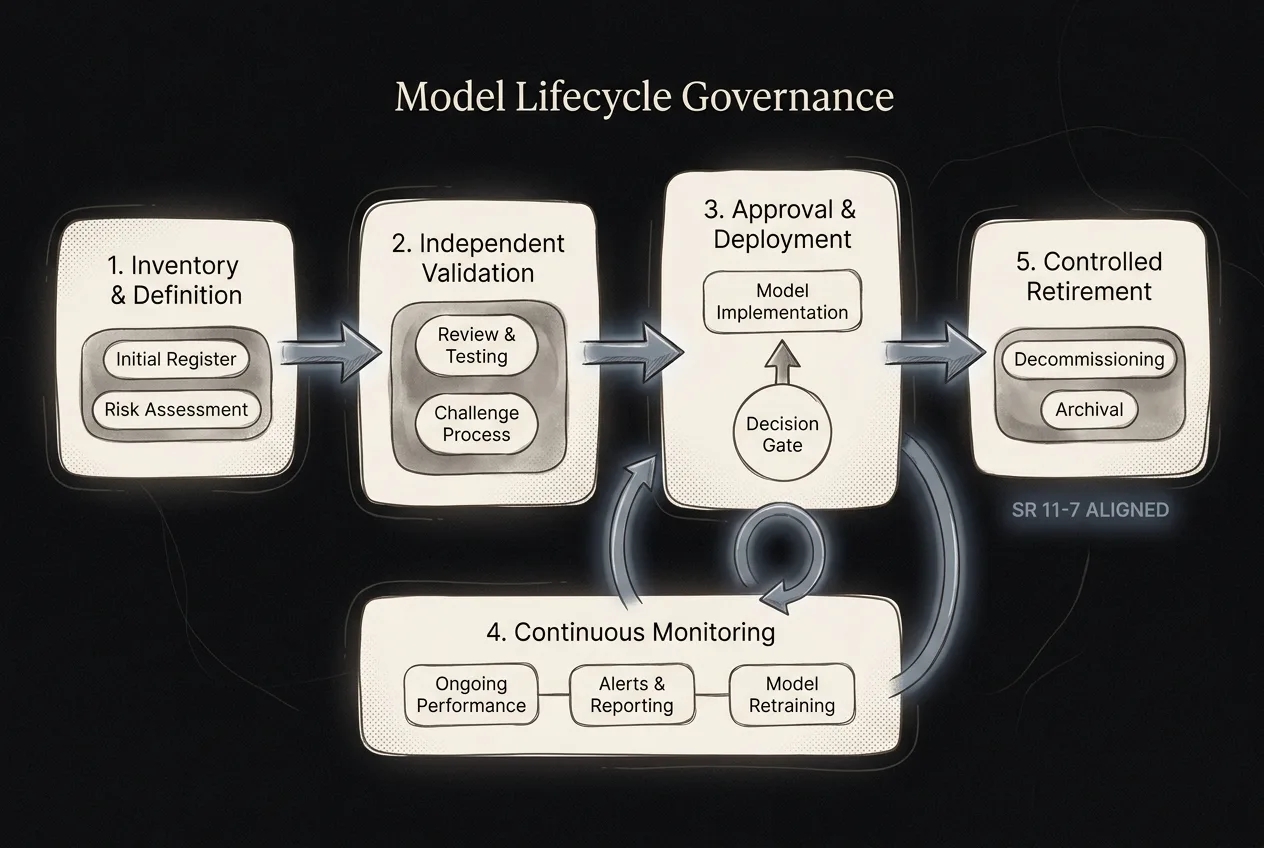
Model risk management is the discipline of ensuring these models serve their intended purpose without introducing unacceptable risk, across the full lifecycle from development through validation, deployment, monitoring, and retirement. Its deeper objective is to make accountability a property of the architecture rather than a department bolted on afterward. When a model can act on capital, the controls that constrain it must live in the same system as the model itself: a high-consequence output is approval-gated or named-human-gated, every decision is logged and explainable, and the limits a model operates within are enforced before an order reaches the market, not reconstructed after a loss. For firms deploying AI-driven strategies, a mature program is not merely a regulatory requirement. It is the precondition for operating an autonomous system at all.
SR 11-7 and the Regulatory Framework
The regulatory foundation for model risk management in the United States is SR 11-7, the supervisory guidance issued jointly by the Federal Reserve and the Office of the Comptroller of the Currency in 2011. While originally directed at banking organizations, SR 11-7 has become the de facto standard for model risk management across the financial industry, including asset managers, hedge funds, and proprietary trading firms that seek institutional credibility.
SR 11-7 defines a model as a quantitative method, system, or approach that applies statistical, economic, financial, or mathematical theories, techniques, and assumptions to process input data into quantitative estimates. Under this definition, virtually every algorithmic trading strategy, risk model, and portfolio optimization tool qualifies as a model subject to governance requirements.
The guidance establishes three pillars of model risk management. The first is model development, implementation, and use, which requires that models be developed with sound methodology, implemented correctly, and used appropriately. The second is model validation, which requires independent assessment of model quality and performance. The third is model governance, which requires board and senior management oversight, policies and procedures, and adequate resources for model risk management activities.
For AI-driven trading systems, these requirements strain at the edges. The guidance expects developers to demonstrate that a model's methodology is well-founded and appropriate for its intended use. For a linear regression, that demonstration is a paragraph. For a deep neural network with millions of parameters trained on terabytes of market data, "demonstrating methodology" cannot mean tracing the logic by hand; it has to mean something operational. The burden shifts from explaining how the model reasons to proving how it behaves: under what conditions it performs, where it fails, and what bounds the firm has placed around it. That reframing, from interpretability to demonstrated and constrained behaviour, runs through everything that follows.
The European regulatory landscape adds further requirements through the EU AI Act, which classifies AI systems by risk level and imposes graduated obligations. Trading systems that make autonomous decisions affecting financial outcomes will likely be classified as high-risk, triggering requirements for conformity assessments, technical documentation, human oversight, and post-market monitoring.
Model Inventory and Classification
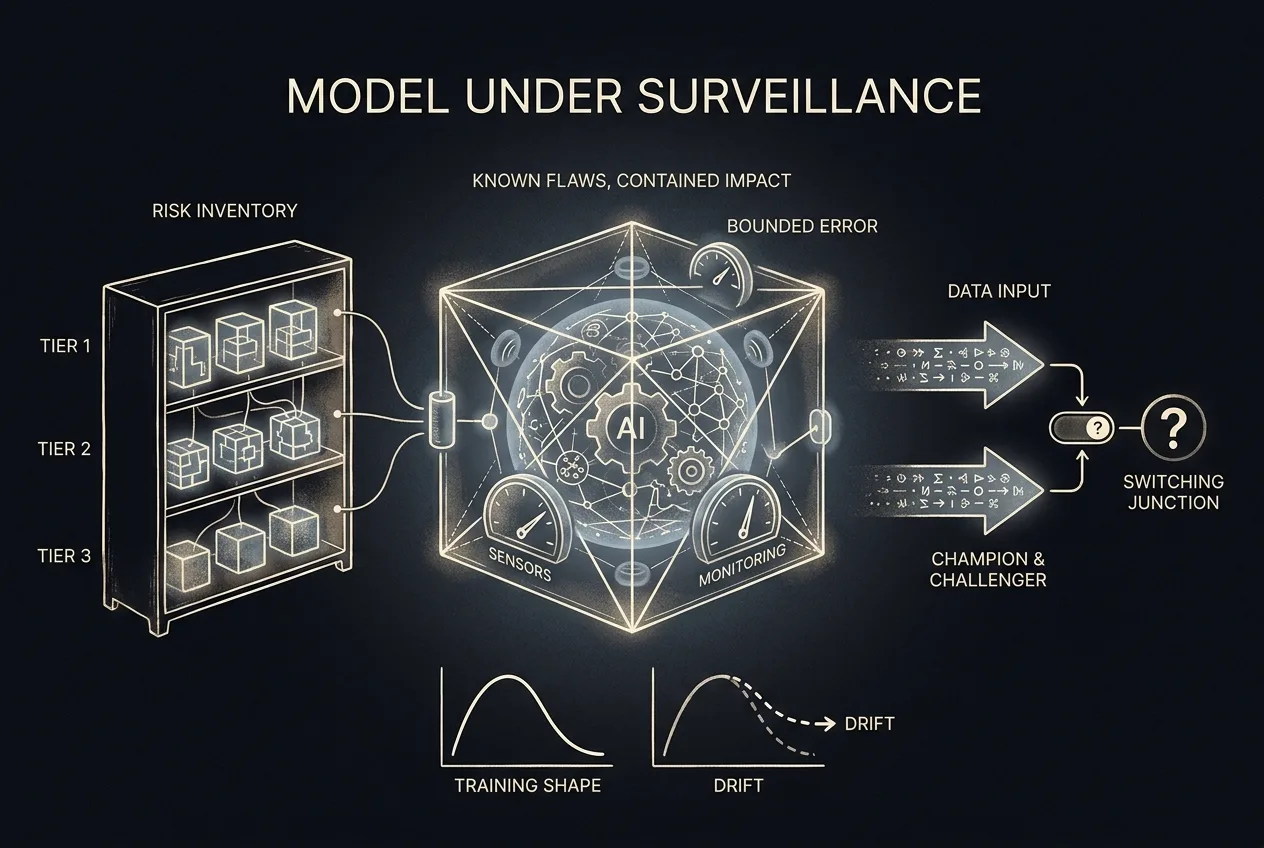
You cannot govern what you have not inventoried. The first step in any model risk management program is a comprehensive registry of every model in use, capturing not only the models themselves but their interconnections, dependencies, and downstream consumers. A firm that cannot list its models cannot claim to govern them, and the models a firm has forgotten it is running are precisely the ones that fail unobserved.
Building the Model Inventory
For each model, the registry should record its unique identifier and name, its purpose and intended use, the business unit and the named individuals accountable for it, the data inputs it consumes and the outputs it produces, the methodology and key assumptions, the dates of initial deployment and most recent validation, its risk tier, and any known limitations or conditions under which it must not be used. The naming of accountable individuals is not bureaucratic detail. A model with no human owner is a model no one will answer for when it fails, and accountability that cannot be traced to a person is not accountability.
For AI-driven trading firms, the inventory must capture several additional dimensions. The training data used for machine learning models should be documented, including the time period covered, any preprocessing or feature engineering applied, and any known biases or gaps in the data. The model's computational requirements, including hardware dependencies and inference latency, should be recorded. And the model's interaction with other models in the production pipeline should be mapped, because cascading failures between interconnected models represent a systemic risk that is invisible when models are assessed in isolation.
Risk-Based Classification
Not all models warrant the same level of governance, and treating them as if they did is its own failure mode: it spreads scrutiny evenly across systems that deserve none and systems that deserve all of it. A risk-based classification concentrates validation and monitoring where the consequences are largest. The criteria typically include the model's materiality, measured by the capital deployed on its outputs; its complexity, measured by parameter count, the opacity of its decision process, and the difficulty of interpreting its outputs; its novelty, reflecting whether the methodology is well-established or experimental; and its replaceability, measuring how quickly the model could be substituted if it failed.
The criterion that most often goes unstated is the one that should drive the tiering: the reversibility and consequence of the actions a model can take. A model that flags a position for human review and a model that can size and submit a trade unsupervised may share an architecture, but they sit at opposite ends of the risk spectrum because their outputs differ in consequence and in how easily a mistake can be undone. Classification should follow the act, not just the algorithm. The higher the consequence and the lower the reversibility of what a model can set in motion, the more the firm should gate that action behind approval, a named human, or a hard pre-trade limit, regardless of how elegant the model behind it is.
A common classification scheme uses three tiers. Tier one models are high-risk: they drive material trading decisions, manage significant capital, or operate in areas with high regulatory sensitivity. These models receive the most intensive validation and monitoring. Tier two models are medium-risk: they play supporting roles in the investment process or influence decisions that are ultimately reviewed by humans. Tier three models are low-risk: they perform routine analytical functions where errors have limited financial impact.
For an institutional trading firm, core alpha models, portfolio optimizers, and risk management systems would typically be classified as tier one. Execution algorithms, transaction cost models, and signal preprocessing pipelines might be tier two. Reporting tools, data visualization models, and internal analytics would typically fall into tier three.

Validation Methodologies
Model validation is the independent assessment of a model's quality, accuracy, and appropriateness for its intended use. It is the central mechanism through which model risk is identified and quantified.
Conceptual Soundness Review
The conceptual soundness review evaluates whether the model's theoretical foundation is appropriate for its intended application. For classical quantitative models, this review examines the economic rationale for the model's predictions, the appropriateness of its distributional assumptions, and the mathematical consistency of its formulation.
For machine learning models, conceptual soundness review takes a different form. The reviewer assesses whether the choice of algorithm is appropriate for the problem structure, whether the feature engineering process is economically motivated rather than purely data-driven, whether the training process includes appropriate regularization and cross-validation to mitigate overfitting, and whether the model's complexity is justified by its incremental performance over simpler alternatives.
The hardest part of conceptual soundness review for AI models is the assessment of causal reasoning. A model that predicts stock returns from the colour of a company's logo can post high in-sample accuracy through pure spurious correlation, with no causal mechanism connecting input to output. In-sample accuracy is the cheapest thing a model can produce and the easiest to mistake for skill. The reviewer's job is to ask whether the learned relationships are economically plausible and likely to persist out of sample, because a relationship the firm cannot explain is a relationship it cannot trust to survive the next regime.
Outcomes Analysis
Outcomes analysis compares the model's predictions against realized outcomes to assess its accuracy and identify systematic biases. For trading models, this means comparing predicted returns, risk estimates, or trading signals against actual market outcomes over a representative evaluation period.
Effective outcomes analysis goes beyond aggregate performance metrics to examine the distribution of errors, the model's performance across different market conditions, and the stability of its accuracy over time. A model that produces accurate predictions on average but wildly inaccurate predictions during market stress events may be more dangerous than one that is consistently modestly inaccurate, because the former creates a false sense of confidence that collapses precisely when accuracy matters most.
For machine learning models, outcomes analysis should also assess the model's sensitivity to distributional shift in its input data. If the statistical properties of the model's inputs change over time, as they inevitably do in financial markets, the model's predictions may degrade in ways that are not captured by static performance metrics. Monitoring the distribution of input features and the model's performance conditional on feature distribution changes provides early warning of this degradation.
Benchmarking
Benchmarking compares the model's performance against alternative approaches, including simpler models, industry-standard methodologies, and expert judgment. The purpose is to assess whether the model's complexity is justified by its incremental value and to provide a fallback option if the primary model fails.
For AI trading models, benchmarking against simple heuristic strategies is particularly important. If a neural network with fifty million parameters cannot consistently outperform a simple momentum strategy after transaction costs, the complexity is not justified and the risk of overfitting is high. Conversely, if the AI model demonstrates consistent, economically meaningful outperformance across multiple market regimes and evaluation periods, the case for its deployment is strengthened.
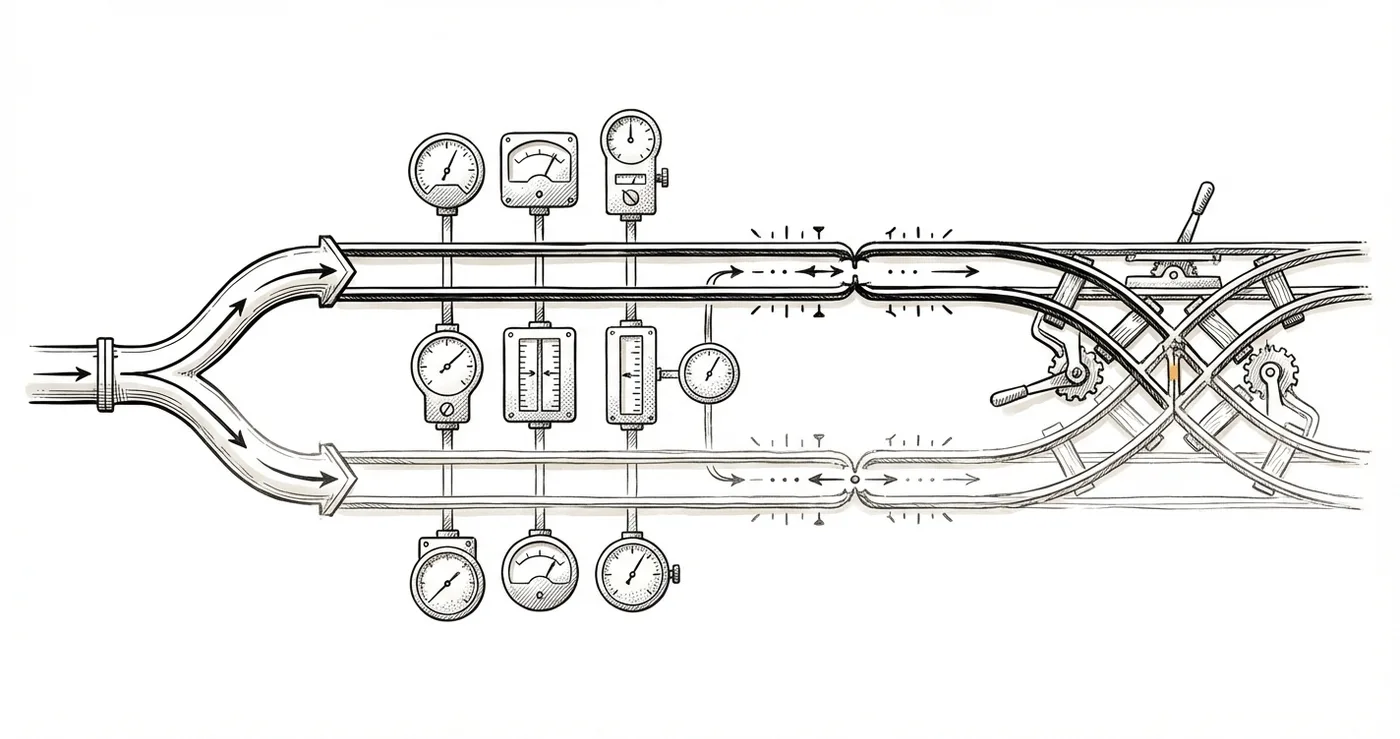
The champion-challenger framework formalises this comparison. One model is designated the production champion; one or more alternatives run as challengers in parallel on the same live data, producing signals that are recorded but not acted on. When a challenger consistently outperforms the champion over a predefined evaluation window, it becomes a candidate for promotion. The discipline this enforces is worth naming: a model earns its place in production by demonstrating performance on live data before it is allowed to move capital, not by promising it in a backtest. Promotion is a decision the evidence justifies, not a launch the team announces. Proof precedes deployment, never the reverse.
Model Monitoring: Detecting Degradation Before It Becomes Loss
Validation certifies a model at a moment in time; markets do not hold still for it. Monitoring is the continuous surveillance that keeps a validated model honest in production, catching degradation, drift, and failure while they are still cheap to fix. A model that passed validation a year ago and has run unmonitored since is, for governance purposes, an unvalidated model.
Performance Monitoring
Performance monitoring tracks the model's ongoing accuracy against the benchmarks established during validation. For trading models, this includes monitoring risk-adjusted returns, hit rates, information ratios, and other performance metrics on rolling windows of varying length. Sudden performance degradation may indicate a model failure, while gradual deterioration may signal structural changes in the market environment that are eroding the model's predictive power.
Performance monitoring should be automated, with alerts triggered when metrics breach predefined thresholds. These thresholds should include both absolute levels, such as a maximum acceptable drawdown, and relative measures, such as a minimum performance ratio relative to the benchmark challenger model. The alert framework should distinguish between transient deviations that are expected given the model's normal volatility and persistent degradation that warrants investigation.
Drift Detection
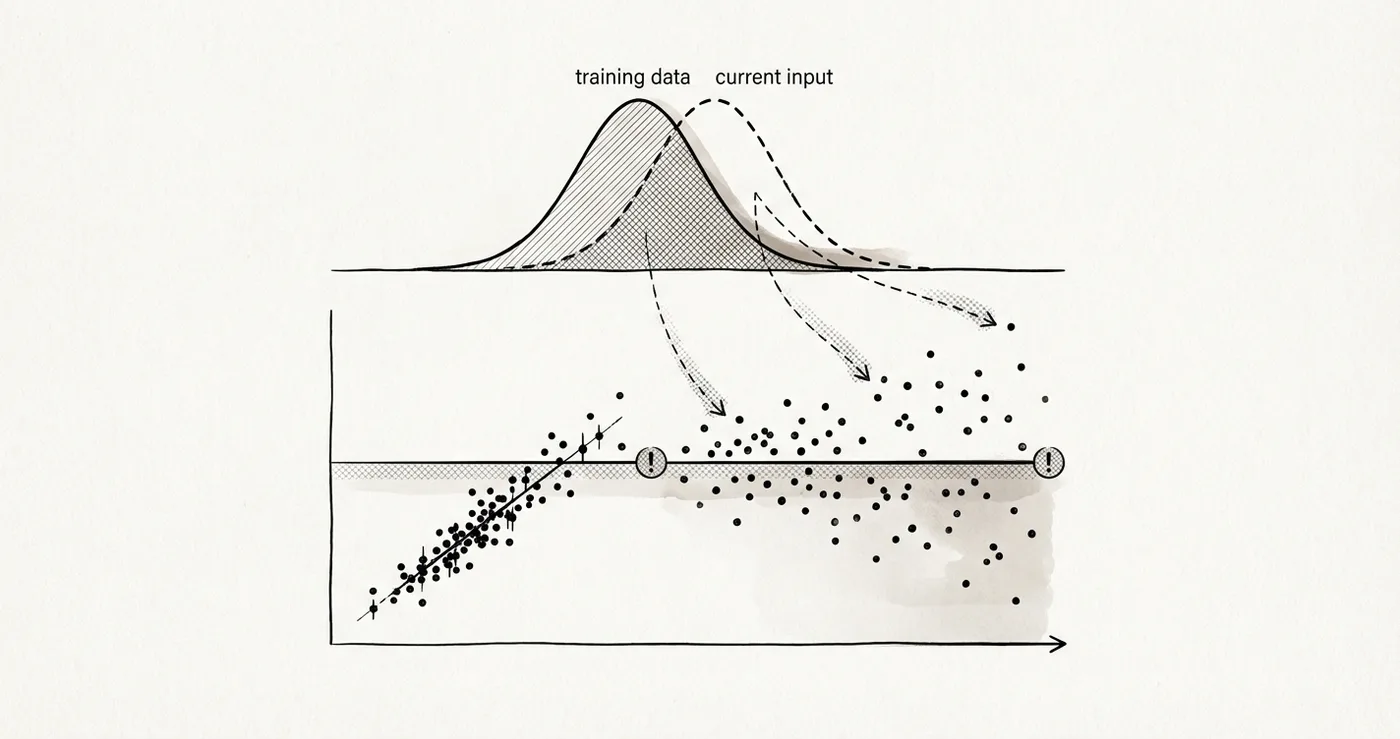
Drift refers to changes in the statistical properties of the model's inputs or the relationship between inputs and outputs over time. Input drift, also known as data drift or covariate shift, occurs when the distribution of the model's features changes relative to the training data. Concept drift occurs when the relationship between inputs and outputs changes, even if the input distributions remain stable.
Both forms of drift are endemic in financial markets. Market regimes shift, correlations evolve, liquidity conditions change, and the competitive landscape transforms as new participants enter and existing participants adapt their strategies. A model trained on data from a low-interest-rate, low-volatility regime will face both input drift and concept drift when rates rise and volatility increases.
Statistical tests for drift detection include the Kolmogorov-Smirnov test and the Population Stability Index for univariate input distributions, and multivariate distance metrics such as Maximum Mean Discrepancy for the joint input distribution. For concept drift, monitoring the residuals of the model's predictions over time provides a direct measure of whether the input-output relationship is stable.
Regime Change Detection
Beyond statistical drift, model monitoring should detect qualitative changes in the market environment that may invalidate the model's assumptions. Regime change detection algorithms, including hidden Markov models, change-point detection methods, and volatility regime classifiers, can identify transitions between distinct market states that may require different modeling approaches.
A detected regime change should trigger a reassessment of every model whose performance is regime-dependent. The response can range from switching to regime-specific models, to scaling position sizes down to reflect elevated uncertainty, to temporarily withdrawing exposure until the model's behaviour in the new regime is understood. The principle underneath these responses is that a model's autonomy should not be fixed. The latitude a system grants its models should contract as confidence falls, so that the moments of greatest uncertainty are also the moments of tightest constraint, exactly when a human is most likely to want a say.
Model Governance: The Institutional Framework
Model governance provides the organizational structure, policies, and processes that ensure model risk management is conducted consistently and effectively across the firm.
Development Standards
Model development standards define the minimum requirements for building and documenting models. These standards should specify the required methodology for data preprocessing, feature selection, and model training; the minimum documentation requirements for model specification, assumptions, and limitations; the required testing and validation steps before a model can be submitted for review; the code quality standards, including version control, testing, and reproducibility requirements; and the data governance requirements, including data lineage, quality checks, and access controls.
For machine learning models, development standards should also address the reproducibility challenge. Random seeds, hardware-dependent numerical precision, and non-deterministic training algorithms can produce different results from the same code and data. Standards should require that model outputs be reproducible to within a specified tolerance, and that the conditions necessary for reproduction are fully documented.
Documentation Requirements
Comprehensive documentation is a regulatory requirement, a governance necessity, and a practical tool for maintenance, but its most demanding form is the one regulators ask for least directly: the ability to reconstruct, after the fact, why a model produced a specific output on a specific day. The documentation package for each model should include a model development document covering purpose, methodology, data inputs, assumptions, and known limitations; a validation report covering the independent assessment of quality and performance; an implementation document covering how the model is deployed, including infrastructure dependencies, data pipelines, and failover procedures; and a monitoring plan specifying the metrics, thresholds, and escalation procedures for ongoing surveillance.
These static documents describe how a model is supposed to behave. The harder requirement is an audit spine that records how it actually behaved: every consequential decision logged with the inputs that produced it, the model version that ran, and the constraints in force at the time, in a form that can be replayed and explained rather than merely retrieved. When a position moves against the firm and the question becomes "why did the model do that," the answer should be a query, not an investigation. Documentation tells the examiner what the firm intended; the audit spine proves what the firm did.
For AI models, documentation should additionally include a description of the training process, including hyperparameter selection and the cross-validation methodology; an analysis of the model's sensitivity to training data variations; an explainability analysis that documents how the model's predictions relate to its inputs; and a fairness assessment, where applicable, that evaluates whether the model's outputs exhibit bias along protected dimensions.
Approval and Change Management
No model should reach production without formal approval from the model risk management function. The approval process verifies that the model was developed to the firm's standards, validated independently, documented comprehensively, and assigned an appropriate risk tier with corresponding monitoring requirements.
Approval, however, is a one-time gate, and a model's risk tier carries obligations that must hold on every order it generates, not just on the day it was signed off. The most durable governance translates those obligations into policy as code: the limits and constraints attached to a model's risk tier, such as maximum position size, permitted instruments, and the conditions under which an output requires human sign-off, are enforced by the production system before a trade executes rather than documented in a policy that a human is trusted to remember under pressure. A limit that lives in a PDF is a suggestion; a limit that lives in the order path is a control. Constraints checked pre-trade fail closed, which is the only safe way for them to fail.
Changes to production models, whether parameter updates, retraining on new data, or methodological modifications, should follow a change management process that includes impact assessment, testing, validation of the changes, and re-approval. The rigour of that process should be proportionate to the model's risk tier and the materiality of the change, and the encoded constraints must be re-derived from the new tier, never silently inherited from the old one.
Independent Model Review and Audit
Independence is a foundational principle of model risk management. The people who validate and monitor models must be organisationally independent from those who develop and use them, so that validation stays objective and concerns about model quality escalate without conflict of interest. This is the structural expression of a simple division of labour: humans govern, machines operate. The models run the strategy; a separate human authority decides whether they are allowed to, and on what terms. Collapsing that separation, letting the team that profits from a model also be the team that certifies it, is the single most common way model governance becomes theatre.
The Three Lines of Defense
Institutional model risk management typically follows the three lines of defense framework. The first line of defense consists of the model developers and users, who are responsible for building models that meet the firm's standards, testing them thoroughly, and using them appropriately. The second line of defense is the model risk management function, which provides independent validation, sets governance standards, and monitors model performance. The third line of defense is internal audit, which provides independent assurance that the model risk management framework itself is operating effectively.
Smaller firms that cannot staff a dedicated model risk management function can still satisfy the independence requirement through external validation services, peer-review arrangements across teams, or a rotating structure in which developers validate models built by others. The deeper lesson is that governance capacity should scale through better policy and better tooling, not through headcount. A firm does not need a validator for every model if its validation methodology, its inventory, and its monitoring are codified well enough that one independent reviewer can apply them consistently across many. The institutions that govern AI well are not the ones with the largest model risk teams; they are the ones whose governance is encoded thoroughly enough that a small team can enforce it everywhere.
External Audit and Regulatory Examination
External auditors and regulatory examiners provide an additional layer of oversight. Their assessments typically focus on the adequacy of the model risk management framework as a whole rather than the quality of individual models. They evaluate whether the firm has a comprehensive model inventory, whether validation is conducted with appropriate independence and rigor, whether monitoring is continuous and effective, and whether governance processes are followed consistently.
Preparation for external review requires maintaining documentation that is current, complete, and accessible. The model inventory should be up to date, validation reports should reflect the current state of each model, and monitoring dashboards should demonstrate continuous surveillance.
Sunset Procedures for Deprecated Models
Models have lifecycles. A model that was state-of-the-art when deployed may become obsolete as market conditions change, better methodologies emerge, or the business need it serves evolves. Sunset procedures provide a structured process for retiring models that are no longer fit for purpose.
Triggers for Model Retirement
Several conditions may trigger the model retirement process. Sustained underperformance relative to the champion-challenger benchmark indicates that the model is no longer competitive. Persistent drift that cannot be corrected through retraining suggests that the market dynamics the model was designed to capture have fundamentally changed. Regulatory or compliance changes may render the model's methodology non-compliant. Or a superior replacement model may have been validated and approved for deployment.
The Retirement Process
Model retirement should be a controlled, documented process rather than an abrupt shutdown. The process includes notification to all model users and downstream consumers, migration of any dependent processes to alternative models or data sources, archival of the model's code, documentation, and historical performance data, a post-mortem analysis that documents the reasons for retirement and any lessons learned, and removal of the model from the production environment and the active model inventory.
The post-mortem analysis is particularly valuable. Understanding why a model failed or became obsolete provides insights that improve the development and validation of future models. Common patterns, such as models that degrade during specific market regimes or models whose complexity was not justified by their incremental performance, should be documented and incorporated into the firm's model development standards.
Building an Institutional Model Risk Management Program
For firms at the beginning of their model risk management journey, the task of building a comprehensive program can seem overwhelming. A phased approach provides a practical path forward.
Phase One: Foundation
The foundational phase focuses on establishing the basic infrastructure of model risk management. This includes creating a model inventory that captures all models currently in use, developing a risk-based classification scheme, drafting model development and documentation standards, and establishing a governance committee with clear authority and accountability.
During this phase, the most critical action is to identify and classify the firm's highest-risk models and ensure that they have adequate documentation and monitoring. A complete program is not necessary to begin managing the most material risks.
Phase Two: Validation
The validation phase extends the program by conducting independent validation of all tier one models and establishing a rolling validation schedule for lower-tier models. This phase also involves developing standardized validation methodologies, training validators on AI-specific assessment techniques, and building the champion-challenger infrastructure for ongoing model comparison.
Phase Three: Continuous Monitoring
The monitoring phase implements automated, continuous surveillance of all production models. This includes deploying drift detection algorithms, establishing performance monitoring dashboards with automated alerting, and integrating monitoring outputs with the firm's broader risk management framework. At this stage, model risk becomes a continuously managed dimension of the firm's overall risk profile rather than a periodic assessment activity.
Phase Four: Maturity
At maturity, model risk management stops being a stage that follows development and becomes a property of how the firm builds. Developers design for governance from the outset, wiring in monitoring hooks, logging, and documentation rather than retrofitting them under audit pressure. Validation turns into a collaborative dialogue that improves the model rather than an adversarial gate that delays it. And the governance framework itself evolves continuously in response to new methodologies, regulatory change, and the lessons each model failure leaves behind.
Firms that reach this level stop treating model risk management as a compliance burden, because at maturity the framework is no longer separable from the systems it governs. The controls are not a layer wrapped around the models; they are part of the same architecture, which is what lets the firm deploy genuinely autonomous systems and still answer, at any moment, what those systems are permitted to do, what they actually did, and who is accountable for both. In a business where one unbounded model can erase years of returns, that is not a luxury the strongest firms add once they can afford it. It is the condition that lets them run AI at scale at all.