Counterparty Risk in the Digital Age: Monitoring and Mitigating Institutional Exposure
Why counterparty risk frameworks must move from periodic review to real-time, unified exposure measurement — with lessons from FTX, the limits of central clearing, and what disciplined collateral and CVA management require.


The collapse of FTX in November 2022 was not, in its fundamental mechanics, a novel event. It was a counterparty failure — the same category of risk that brought down Lehman Brothers in 2008, toppled Long-Term Capital Management in 1998, and has destroyed institutional capital in every decade since the invention of bilateral credit. What made FTX distinct was not the failure itself but its tempo: the speed with which it unfolded, the digital infrastructure that both enabled and obscured the underlying concentrations, and the breadth of sophisticated investors who discovered, too late, that their counterparty due diligence had not kept pace with the markets they were trading in.
For institutional allocators managing portfolios across traditional and digital asset classes, counterparty risk has become the defining measurement challenge of the era. Liquidity now fragments across centralized and decentralized venues; derivative structures have grown more layered; and a single exposure can route through an exchange that is simultaneously broker, custodian, and clearing house. The result is an environment in which counterparty exposures are larger, more interconnected, and harder to measure than at any prior point in financial history. The distinction between firms that survive the next failure and those that fund it will not be the quality of their periodic credit memos. It will be whether their exposure to any given counterparty is known continuously, aggregated across every venue, and bounded by limits that are enforced before a trade executes rather than reconstructed after a default.
From 2008 to FTX: The Evolving Landscape of Counterparty Risk
The global financial crisis of 2008 reshaped institutional understanding of counterparty risk in ways that reverberate to this day. Before Lehman's bankruptcy, many market participants treated the creditworthiness of major dealers as a near-certainty — an assumption baked into pricing models, collateral agreements, and operational workflows. The cascade that followed exposed the fragility of that assumption and the systemic consequences of concentrated counterparty dependencies.
The regulatory response was substantial. The Dodd-Frank Act and its international equivalents mandated central clearing for standardized derivatives, imposed margin requirements on uncleared swaps, and established reporting obligations designed to give regulators visibility into bilateral exposures. Basel III introduced the credit valuation adjustment (CVA) capital charge, forcing banks to hold capital against the risk that their counterparties might default. These reforms unquestionably reduced systemic risk in traditional financial markets.
Yet the subsequent decade demonstrated that counterparty risk is adaptive. As traditional markets became more tightly regulated, risk migrated to where the controls were thinnest. The digital asset ecosystem grew rapidly with minimal counterparty infrastructure, recreating conditions that had already proven dangerous in traditional finance. Exchanges served simultaneously as trading venues, custodians, and clearing houses, concentrating multiple failure modes in single entities. Lending platforms extended credit against inadequate collateral. Interlocking borrowing and lending relationships opened contagion channels that no participant could see in full.
The failures of Three Arrows Capital, Celsius, Voyager, and ultimately FTX in 2022 were not aberrations. They were the predictable result of nineteenth-century counterparty hygiene applied to a twenty-first-century asset class. The institutional lesson was unambiguous: a counterparty framework must evolve at least as fast as the markets it covers, and its underlying assumptions must be tested continuously against changing conditions rather than re-examined on a quarterly review cycle.

Real-Time Counterparty Credit Monitoring Frameworks
Traditional counterparty credit assessment relies on periodic reviews of financial statements, credit ratings, and qualitative factors such as management quality and business-model durability. These assessments remain necessary, but their update frequency is mismatched with the speed at which credit quality can deteriorate in modern markets. The point is not academic: Lehman Brothers held an investment-grade rating until days before its collapse, and FTX was raising capital from sophisticated institutional investors within months of its insolvency. A control that refreshes quarterly cannot govern a failure that completes in seventy-two hours.
The remedy is to supplement periodic assessment with continuous, market-implied signals. Credit default swap spreads, where available, provide a real-time consensus on default probability. Equity prices and implied volatility add signal for publicly traded counterparties. For private entities, where no liquid market price exists, the monitoring frame turns to operational telemetry — withdrawal processing times, spread widths, settlement reliability — as observable proxies for financial health. FTX's failure was visible in its withdrawal queue before it was visible anywhere on a balance sheet.
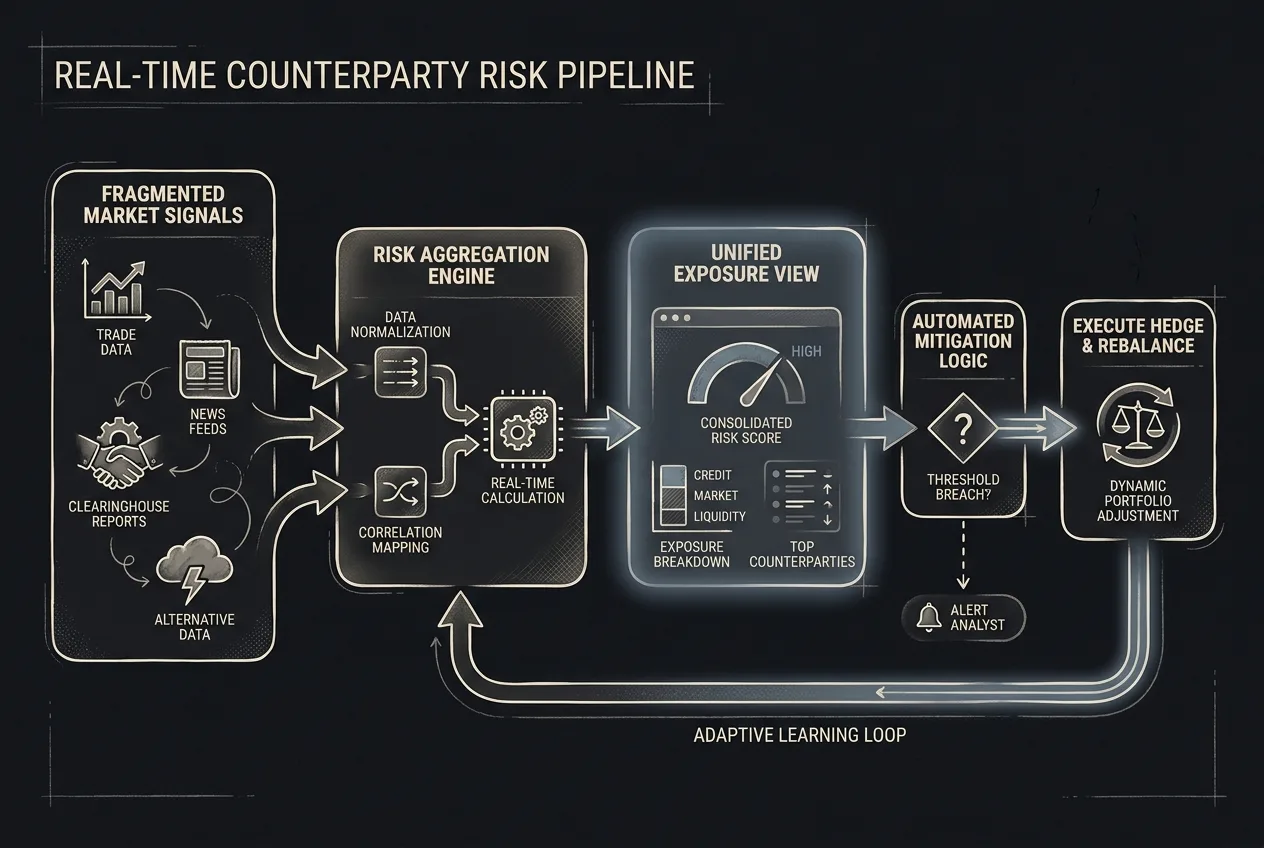
An effective real-time monitoring system rests on a small number of components that must hold together. A data aggregation layer collects and normalizes inputs from market feeds, regulatory filings, news services, and proprietary operational metrics. An analytics engine processes those inputs into counterparty credit scores that update continuously. An alerting framework converts deterioration into a defined response when a score crosses a threshold. And a reporting layer gives the risk committee both historical trends and forward-looking assessment. The architecture matters more than any single signal, because it determines whether a warning produces an action or merely a record.
What separates a dashboard from a control is what happens at the threshold. Notification alone delegates the decision back to whoever happens to be watching. A stronger design encodes the response as policy: deterioration past a defined level triggers a graduated act — notify the desk, gate the next incremental trade behind explicit approval, or require human sign-off before any further exposure is added to the named counterparty. Encoding the limit as enforceable policy rather than guidance is what makes the framework hold under stress, when discretionary judgment is least reliable and the temptation to wait for confirmation is greatest.
The most advanced implementations train models on historical default events to recognize the patterns that precede failure, combining quantitative signals with unstructured data such as sentiment in news coverage. These models extend reach, but they do not change the governing principle: a signal is only as useful as the action it is wired to, and the action is only as trustworthy as the limit that constrains it.

Collateral Management and Margin Optimization
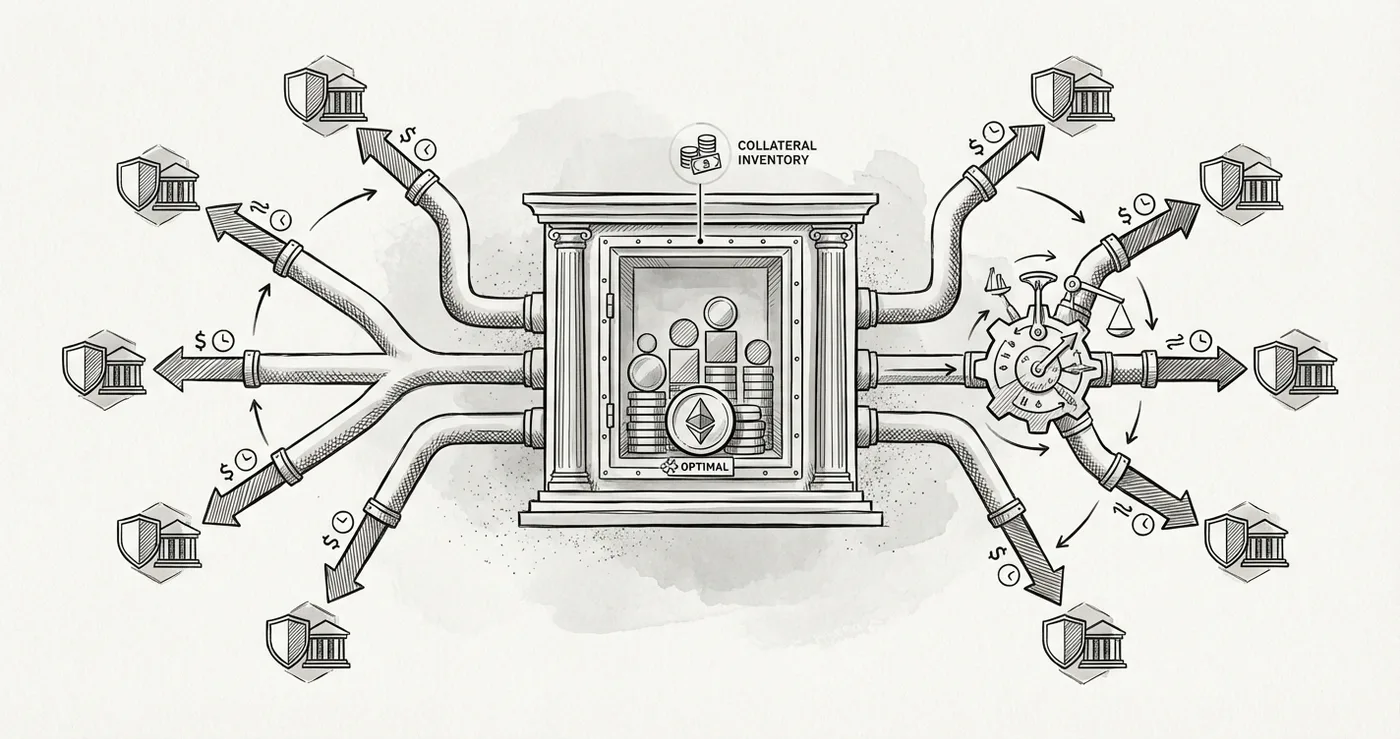
Collateral is the primary mechanism through which counterparty credit exposure is mitigated, and managing it well has become a discipline in its own right. The post-2008 framework raised collateral requirements across the system, which reduced unsecured counterparty risk and, in the same motion, created a new set of operational and optimization problems. Collateral does not eliminate exposure; it converts credit risk into liquidity and operational risk, which must then be managed in turn.
Modern collateral management coordinates several interlocking functions. Margin calculation engines determine the collateral required for each bilateral relationship and cleared position, incorporating initial margin, variation margin, and any add-ons imposed by clearing houses or bilateral agreements. Inventory management tracks available collateral assets, their eligibility under each agreement, and their opportunity cost. Optimization algorithms then identify the cheapest-to-deliver collateral for every obligation, minimizing the drag on portfolio returns while satisfying every requirement — a constrained allocation problem that only has a clean answer when positions, eligibility, and prices live on one coherent data model rather than in reconciled spreadsheets.
The move to daily and, increasingly, intraday margin calls has placed real demands on operational infrastructure. Firms that once managed collateral through end-of-day batch processes now need systems that calculate, call, and settle margin on a near-continuous basis. A failed margin movement is not a clerical inconvenience: under some clearing house rules it can trigger a default cascade, which makes the reliability of the settlement path itself a first-order risk.
For institutions operating across both traditional and digital asset markets, the conventions diverge sharply by domain. Traditional markets benefit from established triparty collateral services and standardized margining; the collateral can be optimized and mobilized without surrendering custody. Digital asset markets often require collateral to be posted directly on the exchange — which folds the venue's own solvency back into the position it was meant to secure, concentrating risk in precisely the entity the collateral was protecting against. The lesson of 2022 is that posted collateral is only as safe as the custodian holding it.
Central Clearing vs. Bilateral Risk Management
The post-crisis migration toward central clearing represented one of the most significant structural changes in counterparty risk management. Central counterparties (CCPs) interpose themselves between the two sides of a trade, guaranteeing performance and mutualizing default risk across their membership. For standardized, liquid products, central clearing has substantially reduced bilateral counterparty risk and improved transparency.
Central clearing reduces bilateral risk, but it does not abolish counterparty risk so much as relocate and reshape it. Concentrating exposure in a small number of systemically important CCPs creates single points of failure whose consequences would dwarf any individual institutional default. The default waterfall — the structure that distributes a defaulter's losses across surviving members — creates contingent exposures that are genuinely difficult to quantify and harder to hedge: a member's true exposure depends on the simultaneous behavior of every other member. And margin procyclicality, in which a CCP raises requirements during stress, amplifies liquidity pressure at exactly the moment participants can least absorb it. These are not arguments against clearing; they are the reasons clearing must be understood as a transformation of risk rather than its removal.
For products that remain bilaterally traded — by reason of complexity, illiquidity, or regulatory status — counterparty risk management rests on ISDA master agreements, credit support annexes, and netting arrangements. The protection these afford is real but conditional: it depends on the quality of the documentation, the enforceability of close-out netting across the relevant jurisdictions, and the operational capacity to actually exercise contractual rights under stressed conditions, when courts are slow and counterparties uncooperative. A netting set that holds on paper but cannot be enforced in time is not a hedge.
Institutional risk managers must therefore maintain fluency in both paradigms — knowing where central clearing reduces risk and where it merely transforms it, and ensuring that every bilateral relationship is governed by enforceable documentation and supported by adequate collateral.
Credit Valuation Adjustment and Wrong-Way Risk
Credit valuation adjustment represents the market price of counterparty credit risk embedded in a derivatives portfolio. Introduced as a formal accounting and capital requirement after 2008, CVA quantifies the expected loss due to counterparty default, weighted by the probability of default and the expected exposure at the time of default.
Computing CVA accurately requires simulating future exposure profiles for each counterparty relationship, incorporating both the potential evolution of market risk factors and the correlation between those factors and the counterparty's creditworthiness. That correlation — wrong-way risk — is among the most treacherous aspects of counterparty measurement, because it defeats the intuition that exposure and default probability are independent. Wrong-way risk arises when exposure to a counterparty rises precisely as that counterparty's credit quality falls. The textbook case is a credit default swap bought from a bank whose own creditworthiness is correlated with the reference entity, so the protection evaporates exactly when it is needed; but the same dynamic recurs in subtler forms across asset classes, and the 2022 failures were saturated with it.
The computation is demanding. Monte Carlo simulation of exposure across thousands of counterparties and tens of thousands of trades requires serious infrastructure, and many institutions have invested in GPU acceleration and adjoint algorithmic differentiation to keep these calculations tractable within risk-management time horizons.
The payoff is that CVA reframes counterparty risk as a price rather than an afterthought. The counterparty-adjusted cost of a trade can diverge materially from its quoted market price, and routing trades toward counterparties where the marginal CVA is lowest converts diffuse credit risk into an explicit input to execution. That only works, however, when the exposure is measured against a current and unified view of every position with that counterparty — a per-trade CVA computed against a stale or partial book optimizes against the wrong number.
Technology Solutions for Multi-Counterparty Exposure Aggregation
Everything above presupposes a capability most institutions discover they lack at the worst possible moment: a single, current view of total exposure to a given counterparty. Trading fragmented across venues, clearing houses, and bilateral desks leaves exposure data scattered across siloed systems that were never designed to reconcile with one another. Firms learn this during stress events, when the question "what is our total exposure to this name, right now" returns four different answers from four different systems and none of them is timely. Counterparty risk that cannot be summed cannot be limited.
The architecture that answers the question rests on a few principles. A unified data model normalizes position, collateral, and counterparty data from heterogeneous sources into one consistent representation, so that exposure is computed against a single source of truth rather than stitched together on demand. Real-time ingestion pipelines process trade confirmations, market data, and collateral movements as they occur, keeping that representation current rather than end-of-day. Entity resolution maps the corporate hierarchies of financial counterparties so that exposures to a dozen subsidiaries roll up correctly to the parent — the failure mode in which each subsidiary looks individually modest while the consolidated position is concentrated and unhedged.
Building on one current data model is also what makes a pre-trade limit enforceable. A limit on aggregate exposure to a counterparty is only meaningful if the system can evaluate it against live, consolidated positions in the moment a new trade is proposed — and either clear it, gate it behind approval, or block it. Checked after settlement, the same limit is a post-mortem; checked before execution against a unified book, it is a control. The unified data model and the pre-trade limit are two halves of one mechanism.
For institutions active in digital assets, integrating on-chain and off-chain data extends that picture into territory traditional disclosure does not reach. Blockchain analytics can reveal collateral movements, lending positions, and token holdings that a counterparty never reports, and combining that intelligence with conventional financial data yields a more complete read on counterparty health. Visualization then turns aggregated exposure into something a committee can act on — concentration heat maps, network diagrams of counterparty interconnection, scenario dashboards — but the visualization is downstream of the data model. A clear chart drawn over fragmented data is a confident picture of an incomplete reality.

Lessons from Recent Failures and Regulatory Responses
The failures of 2022 and 2023 reaffirmed several enduring principles while adding lessons specific to the digital age. The most important is that operational and counterparty risk are not separable. FTX did not fail because of an adverse market move; it failed because of governance deficiencies, commingled assets, and the absence of basic operational controls. Institutions that watched only market-implied credit signals missed the operational red flags that presaged the collapse — which is why the monitoring discipline described above must treat operational telemetry as a first-class signal, not a supplement.
The regulatory response has been measured but directional. The SEC and CFTC have moved to bring digital asset intermediaries within existing frameworks. Standard-setters including the Basel Committee and IOSCO have published guidance on the prudential treatment of crypto-asset exposures, including specific counterparty requirements. The European Union's Markets in Crypto-Assets regulation establishes a framework for digital asset service providers covering capital, custody segregation, and disclosure. The direction of travel is consistent: the controls that traditional finance learned after 2008 are being extended, unevenly but deliberately, to the venues where the next failure is most likely to originate.
The path forward synthesizes traditional counterparty discipline with the infrastructure to apply it continuously. Credit assessment becomes continuous rather than periodic. Collateral management becomes automated and optimized. Exposure aggregation spans every venue and asset class in real time, on one data model. Limits move from policy documents to enforced pre-trade controls. And operational due diligence becomes as rigorous and systematic as financial analysis. Running through all of it is a requirement that is easy to overlook until a dispute or a regulator demands it: every exposure calculation, limit check, and risk action should be recorded on an audit trail that can be reconstructed and explained after the fact. The same architecture that measures and bounds risk in real time should also be able to prove, later, exactly what was known and what was done about it.
None of this eliminates counterparty risk. That is neither achievable nor — given the role of credit in economic activity — desirable; the objective is not a portfolio without exposure but exposure that is measured, bounded, priced, and accountable. The discipline that follows is unglamorous and continuous, and it confers no advantage in the years when no counterparty fails. Its entire value is realized in the moment one does. The institutions that have done the work will measure, manage, and price the failure as it unfolds. The institutions that have not will be cataloguing their exposure for the first time after it has already become a loss.